
MELC-206 · Lesson 10 of 12 · 20 min
Occupational health and safety law for electrical contractors
▶ Video coming soon A video version of this lesson is on the way.
One of the four qualification domains is site safety management, and it has its own exam. The exam guide's reference set for that exam is three documents: the Act respecting occupational health and safety, the Act respecting industrial accidents and occupational diseases, and the Safety Code for the construction industry. Together with the CNESST that administers them, they form Quebec's health and safety regime. This lesson explains how the regime is organized, what it requires of an electrical contractor and the principal contractor on a site, and which parts are most likely to appear on the exam.
Quebec modernized its health and safety regime with a statute adopted in 2021, often referred to by its French initials, LMRSST. Its provisions came into force in stages, and the construction-site mechanisms described below apply to sites for which the CNESST receives a notice of opening on or after 1 January 2023. Other parts of the reform became permanent in 2025. Check the current text of each Act before you rely on a detail.
The three documents
The Act respecting occupational health and safety, known by its French initials as the LSST, is the prevention statute. Its object is the elimination of dangers to workers' health, safety and physical well-being at their source. It sets the general duties of employers and workers, the right to refuse dangerous work, the prevention and participation mechanisms, the powers of inspectors and the penalties. The Act respecting industrial accidents and occupational diseases, the LATMP, is the compensation statute. It provides compensation, rehabilitation and return-to-work rights for workers injured at work, financed by employer premiums, in exchange for workers giving up the right to sue their employer. The Safety Code for the construction industry is a regulation under the LSST that sets detailed rules for construction sites.
| Document | Purpose | Typical exam topics |
|---|---|---|
| Act respecting occupational health and safety (LSST) | Prevention: duties, rights, mechanisms, inspection | Employer and worker duties, right to refuse, principal contractor, prevention program |
| Act respecting industrial accidents and occupational diseases (LATMP) | Compensation and rehabilitation | Employment injury, reporting, employer obligations after an injury |
| Safety Code for the construction industry | Detailed site rules | Site opening notice, work near power lines, fall protection, lockout, excavations |
The CNESST
The Commission des normes, de l'équité, de la santé et de la sécurité du travail administers these statutes. Its inspectors visit sites, investigate accidents, issue correction notices and can order work stopped where they find danger. It collects employer premiums, classifies employers by industry for premium rates, and pays compensation to injured workers. An electrical contractor must register with the CNESST as an employer, declare its payroll and pay its premiums. The CMEQ fact sheet lists inspections and correction notices for health and safety among the CNESST's roles, alongside compensating and rehabilitating injured workers.
General duties of employers and workers
The LSST places the main duty on the employer: to take the necessary measures to protect workers' health and ensure their safety and physical well-being. That general duty is backed by specific obligations, including making sure work methods and equipment are safe, informing and training workers, supervising them, providing protective equipment free of charge, and controlling dangers at their source rather than relying only on personal protective equipment. Workers in turn must take the necessary measures to protect themselves and others, follow safety rules and take part in identifying and eliminating risks.
On a construction site, the principal contractor, the maître d'oeuvre, has additional duties. It is the owner or the contractor who has overall responsibility for carrying out the work on the site. When Électrique Rivière-du-Nord is the only contractor on a small renovation, it is usually the principal contractor. When it is a subcontractor on a larger project, the general contractor normally takes that role, and Électrique Rivière-du-Nord remains responsible as the employer of its own workers.
The right to refuse
A worker has the right to refuse to perform work if they have reasonable grounds to believe that doing it would expose them, or another person, to danger to their health, safety or physical well-being. The LSST sets the procedure: the worker informs the supervisor or employer, the employer examines the situation with the worker's representative where there is one, and if the disagreement continues, an inspector can be called to decide. A worker may not be penalized for exercising the right in good faith. The right does not apply where refusal would put another person in immediate danger, or where the conditions of the job are normal for that kind of work.
Worked problem
A refusal on a ladder
Kevin refuses to climb an extension ladder to reach a junction box above a stairwell, saying the ladder cannot be footed safely on the stairs. What should Émilie do?
Show solution
- Treat the refusal seriously and stop the task; Kevin has stated reasonable grounds.
- Examine the situation with Kevin. A ladder on stairs without a proper level base is a recognized hazard.
- Choose a safer method, such as a stair platform or a scaffold designed for stairs, or a mobile elevating platform if space allows.
- Do not reassign the task to another worker until the hazard is corrected, and do not penalize Kevin.
- Record the refusal and the correction.
Answer: Stop the task, correct the hazard with a proper platform, record the event, and do not penalize the worker.
Construction-site mechanisms since 2023
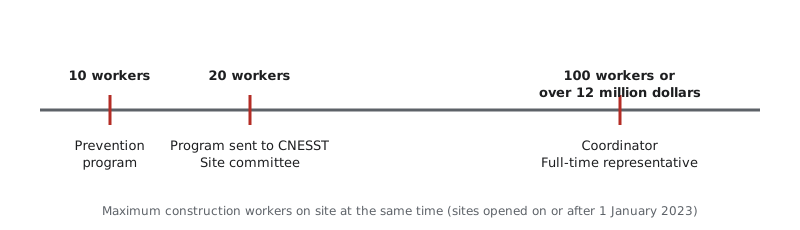
The modernization statute introduced prevention and participation mechanisms on construction sites, with thresholds based on the maximum number of construction workers on the site at the same time or the total cost of the work. The government's summary of the mechanisms, published when they came into force, lists the thresholds shown in the table. They apply to sites for which the CNESST receives a notice of opening on or after 1 January 2023.
| Mechanism | Threshold | Responsible party |
|---|---|---|
| Prevention program | 10 or more workers at the same time; sent to the CNESST before work starts if 20 or more | Principal contractor (maître d'oeuvre) |
| Site health and safety committee | 20 or more workers at the same time from the start of work | Principal contractor forms it |
| Health and safety coordinator | 100 or more workers at once, or work costing more than 12 million dollars | Principal contractor designates one or more |
| Part-time health and safety representative | More than 10 and up to 99 workers at once | Chosen by workers or the representative association |
| Full-time health and safety representative | 100 or more workers at once, or more than 12 million dollars | Designated by representative associations |
def site_mechanisms(max_workers, cost_dollars):
    big = max_workers >= 100 or cost_dollars > 12_000_000
    out = []
    if max_workers >= 10:
        out.append("prevention program" + (" (send to CNESST before work)" if max_workers >= 20 else ""))
    if max_workers >= 20:
        out.append("site committee")
    if big:
        out.append("health and safety coordinator")
        out.append("full-time representative")
    elif max_workers > 10:
        out.append("part-time representative")
    return out or ["no threshold reached"]

for name, workers, cost in [("Dental clinic fit-up", 6, 180_000),
                            ("Fourplex", 14, 1_900_000),
                            ("Seniors' residence wing", 45, 9_000_000),
                            ("Hospital addition", 130, 60_000_000)]:
print(f"{name}: " + ", ".join(site_mechanisms(workers, cost)))Dental clinic fit-up: no threshold reached Fourplex: prevention program, part-time representative Seniors' residence wing: prevention program (send to CNESST before work), site committee, part-time representative Hospital addition: prevention program (send to CNESST before work), site committee, health and safety coordinator, full-time representative
The function applies the thresholds from the table. A real site is assessed on its planned and actual maximum number of workers at once, so the principal contractor plans the mechanisms at the start and adjusts if the site grows.
The notice of opening a site
The Safety Code for the construction industry requires the principal contractor to send the CNESST a notice of the opening of a construction site, an avis d'ouverture de chantier, in the situations and within the time it sets, generally depending on the size and duration of the work. The notice tells the CNESST that a site is starting, who the principal contractor is and how many workers are expected. As seen above, the date the CNESST receives the notice also determines whether the newer mechanisms apply. Check the Safety Code for the triggers and timing.
Electrical hazards in the Safety Code
The Safety Code contains rules that matter directly to electrical work. It sets minimum approach distances for work near overhead power lines, which depend on the voltage, and requires measures such as having the distributor de-energize or protect the lines when work must come closer. It sets rules for temporary installations on sites, for protection of circuits and ground fault protection for portable tools, and for lockout of energy sources before work on machines and equipment. Quebec revised its lockout requirements in the general workplace regulation and in the construction code over the past decade, and both require a written procedure for each machine or installation that needs one.
Arc flash and shock risk assessment for energized work is addressed in practice through the CSA Z462 standard on workplace electrical safety, which many Quebec employers and principal contractors require. The exam is built on the documents provided, so focus on what the Safety Code says, but in practice a contractor should have an electrical safety program that covers energized work, approach boundaries and personal protective equipment.
Accidents and compensation
When a worker is injured, the employer must give first aid, ensure the worker receives care, and keep records. Serious accidents, including deaths and serious injuries, must be reported to the CNESST immediately by the fastest means, and the site of a serious accident must not be disturbed except to help victims or prevent further harm until an inspector authorizes it. Check the LSST for the exact list of accidents that must be reported and the time limits.
Under the LATMP, a worker who suffers an employment injury is entitled to compensation for lost income, medical assistance and rehabilitation. The employer has obligations in the first days, including paying the worker for the day of the injury and, for a period set by the Act, the wages the worker would have earned, which the CNESST then reimburses. A good return-to-work program, with temporary assignments the worker can safely do, reduces both the human and the financial cost of injuries.
A small contractor's safety program
Even below the thresholds for formal site mechanisms, an employer must manage risks. Électrique Rivière-du-Nord's program fits on a few pages: a policy signed by the owner, a list of the main hazards in its work with the controls for each, written lockout procedures for the equipment it works on regularly, rules for energized work and approach to power lines, a ladder and fall protection rule, an orientation checklist for new workers, a first aid and emergency plan, and an incident report form. Each crew carries a copy in the truck.
Toolbox meetings keep the program alive. Every Monday, the lead hand spends ten minutes with the crew on one topic, often drawn from a recent near miss. Kevin's ladder refusal became the topic one week, and the company bought two stair platforms the following month.
Working with the principal contractor
When Électrique Rivière-du-Nord works as a subcontractor, it follows the principal contractor's site rules and prevention program while remaining responsible for its own workers. In practice, that means attending the site orientation, sharing its own hazard information and procedures, reporting incidents to the principal contractor as well as handling its own obligations, and stopping work when a site condition creates danger for its crew, even if the condition was created by another trade.
Common mistakes
MistakeThinking the general contractor is responsible for your workers' safety on its site.
InsteadThe principal contractor has site-wide duties, but every employer remains responsible for its own workers.
MistakeCounting all the workers who will ever come to the site to apply the thresholds.
InsteadThe thresholds use the maximum number of construction workers on the site at the same time, or the total cost.
MistakeTreating a worker's refusal as insubordination.
InsteadThe right to refuse is protected; examine the danger and follow the LSST procedure.
MistakeCleaning up after a serious accident before the inspector arrives.
InsteadLeave the site undisturbed except to help victims or prevent further harm, and report immediately.
Summary and key terms
- The site safety exam uses the LSST, the LATMP and the Safety Code for the construction industry; the CNESST administers them.
- Employers must protect workers and control dangers at the source; workers must protect themselves and others.
- The principal contractor has site-wide duties; since 2023, prevention programs, committees, coordinators and representatives apply by site size.
- Workers may refuse dangerous work under the LSST procedure without penalty.
- The Safety Code covers work near power lines, temporary installations and lockout; serious accidents must be reported immediately.
- LSST
- The Act respecting occupational health and safety, Quebec's prevention statute.
- LATMP
- The Act respecting industrial accidents and occupational diseases, Quebec's compensation statute.
- Maître d'oeuvre
- The principal contractor with overall responsibility for carrying out the work on a site.
- Avis d'ouverture de chantier
- The notice of the opening of a construction site sent to the CNESST.
- Prevention program
- A site-specific written program identifying risks and measures, required from 10 workers at once.
Practice problems
Work each problem on paper first, then reveal the answer to check.
From how many workers on site at the same time is a prevention program required?
Show answer
10.
From how many workers at once must a site health and safety committee be formed?
Show answer
20.
What triggers a health and safety coordinator?
Show answer
100 or more workers at once, or work costing more than 12 million dollars.
Which statute governs compensation for injured workers?
Show answer
The Act respecting industrial accidents and occupational diseases.
Who designates the health and safety coordinator?
Show answer
The principal contractor.
Lesson quiz · 5 questions
Score 60% or more to complete this lesson.
Create a free account to save your progress, take quizzes and earn a certificate.