
MELC-206 · Lesson 5 of 12 · 20 min
The Quebec Construction Code, Chapter V, Electricity
▶ Video coming soon A video version of this lesson is on the way.
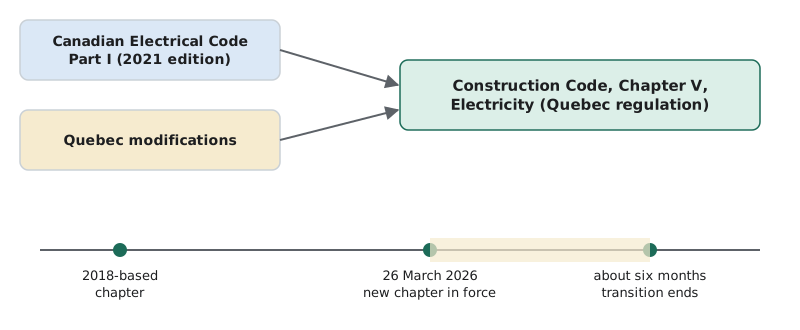
In most provinces, the Canadian Electrical Code is adopted by a short regulation that names an edition and lists a few variations. Quebec does something more elaborate. Its Construction Code is a single regulation divided into chapters for different trades and systems, and Chapter V, Electricity, contains the whole of the Canadian Electrical Code, Part I, with Quebec's modifications worked into the text. The result is a document that looks like the national code but is legally a Quebec regulation, published by Quebec and amended on Quebec's schedule. This lesson explains what that means for the exam and for practice.
A reminder on copyright before we start. The Canadian Electrical Code is a CSA Group standard, and Chapter V incorporates it. This course cites sections and rules by number and explains them in its own words. It does not reproduce code text, tables or figures. Use your own copy of the current Chapter V for every rule you rely on.
Where Chapter V comes from
The Building Act authorizes the RBQ to adopt a construction code and a safety code by regulation, subject to government approval. The Construction Code covers new work: construction, alteration and additions. Its chapters include building, plumbing, electricity, gas, elevating devices and others. The Safety Code covers the maintenance, use and safety of existing buildings and installations. For an electrical contractor, Chapter V of the Construction Code governs the installations it builds, and the Safety Code's electricity provisions govern what owners must keep up afterwards.
Chapter V is built on the Canadian Electrical Code, Part I. The RBQ, with the advice of a provincial electricity advisory committee, reviews each national edition, decides which Quebec modifications to keep, add or drop, and publishes a draft regulation for comment. After the government approves the regulation and it is published in the Gazette officielle du Québec, it comes into force on the date it sets, usually with a transition period.
The current edition
On 12 March 2026 the RBQ announced an update of Chapter V and of the Safety Code's electricity provisions. The updated Chapter V adopts the 2021 edition of the Canadian Electrical Code, with modifications for Quebec's needs and priorities. The government adopted the regulations on 25 February 2026, they were published in the Gazette officielle on 11 March 2026, and they came into force on 26 March 2026. A six-month transition period applies to the Construction Code.
Before that, Chapter V was based on the 2018 Canadian Electrical Code; the CMEQ's exam guide, revised in 2020, refers to the 2018 edition of Chapter V. Note the lag. Other provinces moved to the 2024 national edition in 2025, while Quebec moved from the 2018 to the 2021 base in 2026. A candidate who learned the code in another province, or who studied the core courses in this program, which use the 2024 national edition, must be careful: rule numbers and requirements that changed in the 2024 national edition may not yet apply in Quebec, and Quebec's own modifications may differ from both.
| Date | Event |
|---|---|
| 25 February 2026 | Government adopts the updated regulations |
| 11 March 2026 | Regulations published in the Gazette officielle du Québec |
| 12 March 2026 | RBQ announces the update |
| 26 March 2026 | Updated Chapter V, based on the 2021 Canadian Electrical Code, comes into force |
| 26 March 2026 plus six months | End of the transition period for the Construction Code |
from datetime import date

in_force = date(2026, 3, 26)
# Six months later, same day of the month
transition_ends = date(in_force.year, in_force.month + 6, in_force.day)
print("New Chapter V in force:", in_force)
print("Transition period ends about:", transition_ends)
for job_start in [date(2026, 2, 10), date(2026, 5, 4), date(2026, 11, 2)]:
    if job_start < in_force:
        note = "before the new chapter took effect"
    elif job_start < transition_ends:
        note = "inside the transition period: check the transition rules"
    else:
        note = "after the transition: the new chapter applies"
print(job_start, "-", note)New Chapter V in force: 2026-03-26 Transition period ends about: 2026-09-26 2026-02-10 - before the new chapter took effect 2026-05-04 - inside the transition period: check the transition rules 2026-11-02 - after the transition: the new chapter applies
The code shows the arithmetic only. The transition rules themselves are set in the regulation: read them to know which edition may be used for a job that started, was designed or was contracted near the change date. Do not assume a rule from another province's transition applies in Quebec.
What changed in 2026
The RBQ's announcement lists the main themes of the update. It integrates several recommendations of the provincial advisory committee on electricity. It renews the rules on the basic infrastructure for supplying electric vehicle charging equipment in individual dwellings that have a parking space or carport, in buildings of four units or fewer. It requires level 2 charging infrastructure for every parking space in residential buildings of five or more units. It requires electric vehicle charging to be included in the load calculation used to size service connections and feeders. And it updates the field evaluation standards for electrical equipment, known as SPE-1000 and SPE-3000, and the list of reference standards for equipment certification.
For the Safety Code, the update introduces requirements that depend on the year in which an electrical installation was built. That matters for owners and for contractors who are asked to assess or upgrade existing installations, because what an older building must meet can differ from what a new one must meet.
Worked problem
Charging infrastructure on two jobs
Électrique Rivière-du-Nord is wiring two new residential buildings after the transition period: a fourplex with four parking spaces and a twelve-unit building with twelve spaces. What does the update require for charging?
Show solution
- The fourplex is a building of four units or fewer, so the renewed rules on basic charging infrastructure for individual dwellings with parking apply.
- The twelve-unit building has five or more units, so level 2 charging infrastructure is required for every parking space, which is twelve spaces.
- In both buildings, electric vehicle charging must be included in the load calculation used to size the service and feeders.
- Read the exact requirements in Chapter V for what the infrastructure must include; this example uses the RBQ's summary only.
Answer: The fourplex gets the basic infrastructure rules for small buildings; the twelve-unit building needs level 2 infrastructure for all twelve spaces; both include charging in the load calculation.
How Quebec modifications appear
Because Chapter V is a Quebec regulation that incorporates the national code, the Quebec modifications are part of the published text. A rule may be replaced, added, deleted or altered. When you study for the Chapter V exam, learn to recognize the places where Quebec differs, because those are natural exam questions. Common areas of difference in past Quebec editions have included service and metering arrangements that tie in with the distributor's requirements, the scope and application of the code, administrative provisions on declarations and inspections, and particular requirements for some occupancies. Do not memorize a list from an older edition; build your own from the current one.
A practical method: as you work through each section of your study copy of Chapter V, mark every Quebec modification with a coloured tab and keep a one-line note of what it changes. When you meet a question that seems to have two right answers, one national and one Quebec, the Quebec text is the one that applies in Quebec.
Chapter V and the distributor's standard
Chapter V governs the installation on the customer's side. Hydro-Québec's service connection requirements govern how that installation connects to the distribution system. The two must agree, and in practice a contractor must satisfy both. The CMEQ execution-of-work exam provides both documents for that reason. A service arrangement that complies with Chapter V but not with the distributor's standard will not be connected, and an arrangement that suits the distributor but breaks a Chapter V rule will draw an RBQ correction notice.
The distributor's standard is updated on its own schedule. Check the edition before you rely on a dimension or an arrangement, and check whether the distributor has published notices that change it between editions.
Using the core courses with Chapter V
The core courses in this program teach the structure of the Canadian Electrical Code: the general sections, the supplementary sections, the tables and appendices, and the rule-numbering scheme. That structure carries over to Chapter V, because Chapter V is built on the national code. What does not carry over automatically is the edition. The core courses use the 2024 national edition; Chapter V now uses the 2021 base. Where the core courses mention a change introduced in 2024, check whether Quebec has it. Where they describe a 2021 rule that 2024 changed, the 2021 version may be the one that applies in Quebec, subject to Quebec's own modifications.
# A study log for Quebec modifications found in your own copy of Chapter V.
# The entries below are placeholders showing the format, not real rule text.
log = [
    ("Section 0", "scope and definitions", "Quebec wording on application"),
    ("Section 6", "services and service equipment", "ties in with the distributor's requirements"),
    ("Section 8", "load calculation", "electric vehicle charging included from 2026"),
    ("Section 86", "electric vehicle charging", "infrastructure rules for residential buildings"),
]
by_section = {}
for section, topic, note in log:
    by_section.setdefault(section, []).append(f"{topic}: {note}")
for section in sorted(by_section, key=lambda s: int(s.split()[1])):
    for line in by_section[section]:
        print(f"{section:<11} {line}")
print(len(log), "entries; add one for every Quebec modification you mark.")Section 0 scope and definitions: Quebec wording on application Section 6 services and service equipment: ties in with the distributor's requirements Section 8 load calculation: electric vehicle charging included from 2026 Section 86 electric vehicle charging: infrastructure rules for residential buildings 4 entries; add one for every Quebec modification you mark.
The Safety Code and existing installations
The Construction Code applies when work is done. The Safety Code applies to buildings and installations as they are used and maintained. For electricity, the Safety Code sets requirements that owners of certain buildings must meet for their existing installations, such as maintenance and verification obligations, and the 2026 update made some requirements depend on the year the installation was built. An electrical contractor meets the Safety Code most often when an owner asks for an assessment, a correction of hazards found during a verification, or upgrades required after an inspection.
When Électrique Rivière-du-Nord quotes on Mylène's residence, which was built in stages over thirty years, the year of each part of the installation now matters for what the owner must maintain. Émilie notes the construction dates of each wing in the client file, so that any Safety Code question can be answered quickly.
Reading Chapter V efficiently
The core courses taught a reading method for the Canadian Electrical Code: start from the section's scope, check the definitions, read the general rule, then the subrules and exceptions, then the appendix notes that explain intent. The same method works for Chapter V. Two additions help in Quebec. First, keep a list of the sections where Quebec modifies the national text, because those are where a question may expect a different answer from the one you learned elsewhere. Second, when a rule refers to the distributor, have the distributor's standard open beside it, because the two documents are designed to be read together.
Practise on real situations from your own work. Take the last three installations you did, list the Chapter V rules each one depended on, and check that you can find each rule in under two minutes. Do the same for the distributor's requirements on the service entrance. This exercise is the best single preparation for the execution exam.
When a client wants the newer national rule
Sometimes a designer or client asks for a requirement from the 2024 national edition that Quebec has not adopted. Going beyond the code is usually allowed, but a contractor cannot use a newer national rule to justify doing less than Chapter V requires. When in doubt, Chapter V governs, and the designer's specification may add to it.
Common mistakes
MistakeStudying from the 2024 national code and assuming Quebec matches it.
InsteadChapter V adopts the 2021 Canadian Electrical Code with Quebec modifications, in force from 26 March 2026.
MistakeIgnoring the transition rules for jobs that straddle the change date.
InsteadA six-month transition applies; read the regulation to see which edition a given job may use.
MistakeDesigning a service to Chapter V alone.
InsteadThe installation must also meet Hydro-Québec's service connection requirements.
MistakeQuoting the national code's text in a report.
InsteadCite Chapter V by section and rule number; the code text is copyrighted and Quebec's version may differ.
Summary and key terms
- Chapter V of the Construction Code incorporates the Canadian Electrical Code, Part I, with Quebec modifications, and is a Quebec regulation.
- The updated Chapter V adopts the 2021 national edition and came into force on 26 March 2026 with a six-month transition.
- The update changes charging infrastructure rules, includes charging in load calculations and updates field evaluation standards.
- The Safety Code covers existing installations; its updated electricity provisions vary with the year an installation was built.
- Installations must meet both Chapter V and the distributor's service connection requirements.
- Construction Code
- Quebec's regulation governing new construction work, divided into chapters by trade or system.
- Chapter V
- The electricity chapter of the Construction Code, based on the Canadian Electrical Code, Part I.
- Safety Code
- Quebec's regulation governing the maintenance and safety of existing buildings and installations.
- Transition period
- A limited time after a new edition takes effect during which the regulation sets rules for jobs near the change.
- ARVÉ
- Quebec abbreviation for electric vehicle charging equipment.
Practice problems
Work each problem on paper first, then reveal the answer to check.
Which edition of the Canadian Electrical Code does the updated Chapter V adopt?
Show answer
The 2021 edition.
When did the updated Chapter V come into force?
Show answer
26 March 2026.
How long is the transition period for the Construction Code?
Show answer
Six months.
What does the update require for residential buildings of five or more units?
Show answer
Level 2 charging infrastructure for every parking space.
Which regulation governs the maintenance of existing installations?
Show answer
The Safety Code.
Lesson quiz · 5 questions
Score 60% or more to complete this lesson.
Create a free account to save your progress, take quizzes and earn a certificate.