
MELC-206 · Lesson 3 of 12 · 20 min
Applying, approval and booking the exam
▶ Video coming soon A video version of this lesson is on the way.
Applying for an electrical contractor licence in Quebec is a sequence of linked steps rather than a single form. The company applies, the répondants prove competence, the CMEQ reviews the file, and only then is the licence issued. When a répondant needs to write exams, the exam bookings fit inside that sequence. This lesson walks through the steps in the order Électrique Rivière-du-Nord follows them, and it explains the CMEQ's retake rules, which shape every realistic study plan.
Fees and processing times are deliberately left out of the worked examples. The CMEQ publishes a fee schedule, and both the CMEQ and the RBQ publish processing information that changes from month to month. When you plan, look up the current figures and add a margin.
Two kinds of application
There are two situations. In the first, a new company applies for its first licence and designates its répondants at the same time. In the second, an existing licence holder changes or adds répondants, which is Électrique Rivière-du-Nord's situation. The second is simpler in one way, because the company has already been reviewed, but it carries its own risk: if a répondant leaves before a replacement is qualified, the company can find itself without a répondant in a required domain.
For a new company, the application package includes the licence application for the right type of entity, the officer and shareholder information, the integrity declarations, the original licence bond, the répondant information for each domain with the evidence of competence or a request to sit exams, and payment. The CMEQ application form for a legal person asks for original signatures from the company, its officers and its lenders in the relevant sections, and payment of the exact amount to the Corporation des maîtres électriciens du Québec.
For an existing company adding a répondant, the CMEQ needs to know who the new répondant is, which domains they will cover, and how they will prove competence. If the route is an exam, the candidate is registered for the exam sessions. If the route is recognized training or a professional record review, the evidence goes to the CMEQ for assessment.
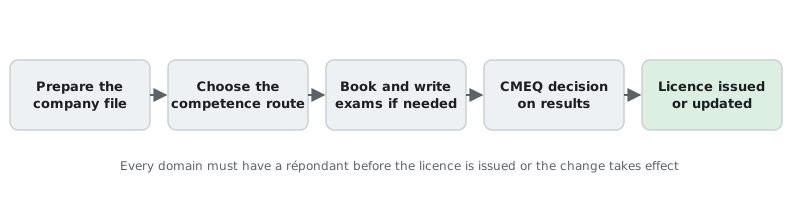
Preparing the file
Most delays in licence files come from missing or inconsistent information. The CMEQ forms ask for the company's legal name exactly as registered, its enterprise number, its head office address and its officers. If a name on the application does not match the enterprise register, or an officer listed on the register is missing from the application, the file stops while the CMEQ asks for clarification. Nadia's first task is to pull the company's current entry from the Quebec enterprise register and compare it line by line with the information the CMEQ has on file.
Émilie's personal file is next. She gathers photo identification, her CCQ journeyperson certificate, a record of her hours and her work history, and any training certificates that might support an exemption or a professional record review. She also reads the integrity questions carefully. She has nothing to declare, but if she had, she would gather the documents the form asks for before submitting rather than after.
| Item | For the company | For the répondant candidate |
|---|---|---|
| Identity | Legal name, enterprise number, head office address | Government photo identification |
| Control | Officers, shareholders, lenders | Role in the company |
| Integrity | Declarations about convictions, bankruptcy, past companies | Declarations about convictions |
| Competence | One répondant per domain | Exam registration, training proof or professional record |
| Financial | Original licence bond, payment | Exam fees as set in the fee schedule |
The exam sessions
The CMEQ's guide to its qualification exams describes written exams for the electrical contractor licence given over three consecutive days. Each exam has a fixed start time and duration, and the documents for each exam are provided at the sitting. Lesson 4 covers each exam in detail. For booking purposes, what matters is that a candidate who needs all the exams is committing to three full days, and that the documents provided are the official editions the CMEQ chooses, not the candidate's own annotated copies.
The guide lists the materials a candidate must bring to every exam: a pencil, an eraser, a pencil sharpener, a ruler and a calculator. Electronic agendas are not allowed in the project management exam, and candidates should assume that phones and other connected devices are not allowed at any exam. Check the current guide and the convocation letter for the rules that apply to your session.
Sessions are not offered every week. Candidates should look at the CMEQ calendar early, choose a session that leaves time for a possible retake, and register as soon as their file allows. If the company's licence depends on the result, as Électrique Rivière-du-Nord's will once Réjean retires, the timing matters more than the convenience of any one date.
Results and the retake rules
The CMEQ guide sets the pass mark at 60 out of 100. A candidate who fails an exam may register for one retake, and must do so within 30 days of the CMEQ decision confirming the failure. A candidate who fails the retake cannot sit that exam again until six months after the CMEQ decision on the second failure. These rules turn a single bad day into a delay of several months, which is why every plan in this course leaves room for a retake.
A passing result is valid for five years. Within that time it can be used to support the candidate's designation as a répondant. After five years, the knowledge must be assessed again. A candidate who passes but whose company plans change should keep the five-year limit in mind.
| Event | Rule from the CMEQ guide |
|---|---|
| Pass mark | 60 out of 100 |
| First failure | One retake allowed; register within 30 days of the CMEQ decision |
| Second failure | Wait six months from the CMEQ decision before sitting again |
| Validity of a pass | Five years |
Worked problem
Planning around a possible failure
Émilie writes the execution-of-work exam on 10 March. The CMEQ decision confirming a failure is dated 31 March. If she fails, what is the last day to register for the retake? If she also fails the retake and that decision is dated 30 June, when can she next sit the exam?
Show solution
- Retake registration: within 30 days of the decision dated 31 March, so by 30 April.
- After a second failure decided on 30 June, she must wait six months from that decision.
- Six months after 30 June is 30 December.
Answer: She must register for the retake by 30 April, and after a second failure she could not sit again until 30 December.
from datetime import date, timedelta

import calendar

def add_months(d, months):
    y, m = divmod(d.month - 1 + months, 12)
    y += d.year
    m += 1
    last_day = calendar.monthrange(y, m)[1]   # clamp to the end of the month
    return date(y, m, min(d.day, last_day))

first_decision = date(2027, 3, 31)
retake_deadline = first_decision + timedelta(days=30)
second_decision = date(2027, 6, 30)
next_sitting = add_months(second_decision, 6)
print("Register for retake by:", retake_deadline)
print("Earliest sitting after a second failure:", next_sitting)Register for retake by: 2027-04-30 Earliest sitting after a second failure: 2027-12-30
The calculator confirms the worked example. When you plan your own dates, use the dates on the CMEQ decisions you actually receive, not the exam dates, because the 30-day and six-month periods run from the decisions.
Approval and issuing
When every required domain has a répondant whose competence is established, and the company meets the other conditions, the CMEQ issues or updates the licence. For a new company, the 30-day post-licence conditions from lesson 2 start running then. For an existing company, the licence record shows the new répondant and the domains they cover.
The licence has a number that must appear in the places the regulations require, which typically include contracts, quotes, invoices and advertising. Clients and other contractors can check a licence through the public register. A good habit is to look up your own company's register entry after every change to confirm it shows what you expect.
Processing takes time. The RBQ publishes the dates of the files it is currently processing, and when this course was written its electrical licence page showed priority requests being processed several weeks after receipt and regular requests a few weeks later still. The CMEQ's own times may differ. Neither should be the critical path in a succession plan; submit early.
Rivière-du-Nord's timeline
Réjean and Émilie sit down with Nadia and build a timeline backwards from Réjean's planned retirement date. They include the file preparation, the next two exam sessions, a possible retake in each domain, the waiting period after a second failure as a worst case, and the CMEQ's processing time. The worst case uses most of the two years, which convinces Réjean to have Émilie register for the first available session rather than waiting until she feels fully ready.
# Worst-case succession timeline, in weeks
steps = [
    ("Prepare and submit the répondant file", 6),
    ("Study period before first session", 16),
    ("First sitting and decision", 4),
    ("Retake registration and second sitting", 8),
    ("Decision on retake", 4),
    ("Six-month wait after a second failure", 26),
    ("Third sitting and decision", 6),
    ("CMEQ updates the licence", 6),
]
total = 0
for name, weeks in steps:
    total += weeks
    print(f"{name:<42}{weeks:>4}  cumulative {total:>4}")
print("Worst case in months: about", round(total / 4.33))Prepare and submit the répondant file 6 cumulative 6 Study period before first session 16 cumulative 22 First sitting and decision 4 cumulative 26 Retake registration and second sitting 8 cumulative 34 Decision on retake 4 cumulative 38 Six-month wait after a second failure 26 cumulative 64 Third sitting and decision 6 cumulative 70 CMEQ updates the licence 6 cumulative 76 Worst case in months: about 18
Common reasons files are delayed
The CMEQ and the RBQ both publish lists of reasons applications are refused or held up, and the patterns are consistent. Missing original signatures, a cheque for the wrong amount, an officer missing from the application but listed on the enterprise register, an expired identification document, an unanswered integrity question, or a bond that names the company slightly differently from the application can each stop a file. None of these has anything to do with competence, and all are avoidable. Nadia builds a final checklist from the form's own instructions and has Réjean review it before anything is mailed.
A second group of delays comes from the competence evidence. A professional record review needs documents that show the candidate actually acted for a contractor in the domain: letters from former employers, lists of projects with dates and roles, and copies of documents the candidate signed. A recognized training route needs the official transcript or certificate, not a photocopy of a course outline. If you plan to use either route, start gathering the evidence months ahead.
Study plan for a working electrician
Émilie cannot stop working to study, so she builds a plan around her week. On three weeknights she studies for ninety minutes: one night on the administration documents, one on the safety documents, one on Chapter V and the distributor's standard. On Saturday mornings she does a timed practice set and reviews her mistakes. Every fourth week she takes a lighter week to avoid burning out. Over sixteen weeks that adds up to about a hundred hours, which matches what experienced répondants told her the exams require for someone with her field background.
She also asks Réjean to walk her through real company files: a bond renewal, a change of address report, a declaration log, a correction notice and its follow-up. Seeing the documents the exams describe makes the legal texts much easier to read.
Common mistakes
MistakeCounting the 30-day retake window from the exam date.
InsteadThe window runs from the CMEQ decision confirming the failure.
MistakeBringing your own annotated Code to the exam.
InsteadThe guide says the documents for each exam are provided; plan to work from clean official copies.
MistakeBooking the last session before a deadline with no room for a retake.
InsteadLeave time for one retake and, in a succession plan, for the six-month wait after a second failure.
MistakeLetting the company's register entry and the CMEQ file drift apart.
InsteadCompare the enterprise register with the licence file before every application and after every change.
Summary and key terms
- New companies apply for a licence with répondants; existing companies add or change répondants.
- The file needs identity, control, integrity, competence and financial information, with original signatures and the bond.
- The CMEQ exams run over three consecutive days with documents provided; candidates bring a pencil, eraser, sharpener, ruler and calculator.
- The pass mark is 60 out of 100. One retake is allowed within 30 days of the failure decision; a second failure means a six-month wait.
- A passing result is valid for five years; the licence is issued or updated when every domain is covered.
- Convocation
- The notice that confirms a candidate's exam session, time and place.
- Retake
- A second attempt at a failed exam, registered within 30 days of the failure decision.
- Public register
- The searchable list of licensed contractors and their subcategories.
- Critical path
- The chain of steps that sets the earliest date a plan can finish.
- Decision
- The CMEQ's written confirmation of an exam result, from which retake periods run.
Practice problems
Work each problem on paper first, then reveal the answer to check.
Within how many days of the failure decision must a candidate register for a retake?
Show answer
30 days.
How long must a candidate wait after failing the retake?
Show answer
Six months from the CMEQ decision on the second failure.
Name the five items the CMEQ guide says to bring to every exam.
Show answer
Pencil, eraser, pencil sharpener, ruler and calculator.
What is the pass mark on CMEQ exams?
Show answer
60 out of 100.
From which date do the retake periods run: the exam date or the decision date?
Show answer
The decision date.
Lesson quiz · 5 questions
Score 60% or more to complete this lesson.
Create a free account to save your progress, take quizzes and earn a certificate.