
MELC-206 · Lesson 12 of 12 · 27 min
Practice exam review and test-day strategy
▶ Video coming soon A video version of this lesson is on the way.
The CMEQ exams test whether you can find and apply the right rule, under time pressure, in documents you did not annotate yourself. That is a skill you can practise. This lesson pulls the course together: a summary of the figures and rules that come up most often, a method for each exam, a three-day plan, and a mixed practice set with answers. It ends with Émilie's results and what the company did next.
As with every lesson, confirm the current editions, the order of the exam days and any rule changes before your session. The method in this lesson works whatever the details turn out to be.
The figures worth knowing cold
You will have the documents, but you should not need them for the figures that come up again and again. The table collects the ones this course has covered. Some are in the documents provided at the exam, and some come from the CMEQ's guides and forms, which are not provided, so learning them saves time and avoids traps.
| Topic | Figure or rule | Lesson |
|---|---|---|
| Licence subcategory for electrical work | 16, Entrepreneur en électricité | 1 |
| Qualification domains | Administration, site safety, project and site management, execution of work | 1, 2 |
| Validity of an exam pass | Five years | 2, 3 |
| Pass mark | 60 out of 100 | 3, 4 |
| Retake | One retake, register within 30 days of the failure decision; six-month wait after a second failure | 3 |
| Exam days and total time | Three consecutive days; 12.75 hours across five exams in the guide | 4 |
| Chapter V base edition | 2021 Canadian Electrical Code, in force 26 March 2026, six-month transition | 5 |
| Licence bond, specialized contractor | 20,000 dollars (RBQ published amount) | 8 |
| Construction legal hypothec | Publish within 30 days after completion; act within six months | 9 |
| Site committee | 20 or more workers on site at the same time | 10 |
| Continuing education | 16 hours per two-year period, at least 8 on construction work; carry up to 4 | 11 |
| CCQ monthly report | By the 15th of each month | 7 |
A method for every exam
Use the same two-pass method on every exam. On the first pass, read each question, answer it immediately if you know the answer or can find it in under a minute, and mark it if not. Do not let any single question take more than two minutes on the first pass. On the second pass, return to the marked questions in order of how close you think you are. In the last minutes, make sure every question has an answer: there is one correct option, every question has the same value, and the guide does not describe any penalty for a wrong answer, so a blank is always worse than a guess.
Before you start answering, take two minutes to count the questions and set your checkpoints. If an exam has 75 questions and 180 minutes, with 15 minutes held in reserve, you need to be past question 25 at about the 55-minute mark and past question 50 at about the 110-minute mark. Write the checkpoints at the top of your scrap paper.
def checkpoints(questions, minutes, reserve):
    working = minutes - reserve
    per_q = working / questions
    marks = [round(questions * f) for f in (1/3, 2/3, 1)]
    return per_q, [(q, round(q * per_q)) for q in marks]

for exam, q, mins, res in [("Administration", 75, 180, 15),
                           ("Site safety", 40, 90, 10),
                           ("Execution of work", 60, 135, 12)]:
    per_q, marks = checkpoints(q, mins, res)
    plan = ", ".join(f"Q{n} by {t} min" for n, t in marks)
print(f"{exam}: {per_q:.1f} min per question; {plan}")Administration: 2.2 min per question; Q25 by 55 min, Q50 by 110 min, Q75 by 165 min Site safety: 2.0 min per question; Q13 by 26 min, Q27 by 54 min, Q40 by 80 min Execution of work: 2.0 min per question; Q20 by 41 min, Q40 by 82 min, Q60 by 123 min
The question counts are examples, because the guide does not publish them. Replace them with the counts you find on the day.
Exam-specific tactics
- Administration: know the structure of the Building Act and the qualification regulation so you can go straight to licences, répondants, changes, suspension and the bond. Many questions turn on who must do what and by when.
- Site safety management: with 90 minutes for three documents, answer the duty and threshold questions quickly and save the Safety Code searches for the second pass.
- Chapter V: use the index and the section structure from the core courses, and watch for Quebec modifications that change the national answer.
- Execution of work: expect questions that need two documents at once, such as a service arrangement that must satisfy both Chapter V and the distributor's standard.
- Project and site management: think like the person responsible for the project: schedule, estimate, coordination, quality and the building code requirements that affect electrical work.
The days before and between
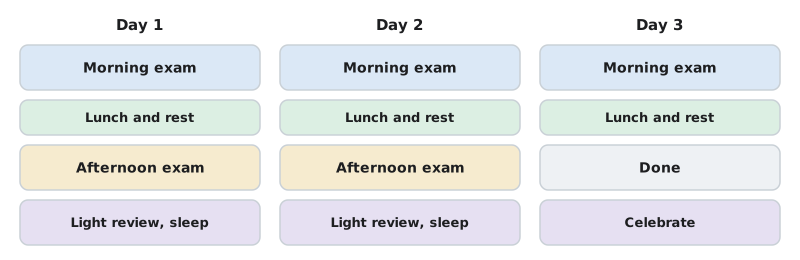
Three consecutive exam days reward a plan for rest as much as for study. In the final week, stop learning new material and switch to navigation drills: pick a topic, time yourself finding it in the provided documents, and repeat until each search is fast. The night before each day, review only the figures table and the structure of that day's documents, then stop. Eat properly at lunch; an afternoon exam after a skipped meal is a common way to lose points. After each day, resist the urge to replay every question with other candidates. You cannot change yesterday's answers, and tomorrow's exam needs your attention.
Bring the items the guide lists to every sitting: pencil, eraser, pencil sharpener, ruler and calculator. Bring a spare calculator battery. Bring identification and your convocation. Leave connected devices at home or in the car, and check the convocation for anything else that is required or forbidden.
Mixed practice set
Work through these questions with the documents and lessons, timing yourself at two minutes per question. The answers follow the set.
Practice problems
Work each problem on paper first, then reveal the answer to check.
A company's only répondant for execution of work fails to correct a continuing education default within 90 days. What is the consequence?
Show answer
The répondant is deemed to have stopped acting as répondant as of the end of the period, and the licence can lapse unless another qualified répondant covers the domain.
A candidate's first-attempt failure decision is dated 2 May. By when must they register for the retake?
Show answer
By 1 June, within 30 days of the decision.
An electrical subcontractor finished its part of a project on 1 June, but the general contractor completed the whole building on 20 July. From which date do the 30 days to publish the hypothec run?
Show answer
From completion of the work on the whole project, which courts generally treat as one date for all contractors: 20 July in this example.
A site will have 22 construction workers at the same time at its peak. Which mechanisms apply?
Show answer
A prevention program, sent to the CNESST before work starts, a site committee, and a part-time health and safety representative.
A client paid a 4,000 dollar deposit to a contractor who never started. Within what framework can the client claim?
Show answer
Against the contractor's licence bond, which covers deposits paid, through the RBQ's claims service.
A residential building with eight units and eight parking spaces is being wired after the 2026 Chapter V transition. What charging infrastructure is required?
Show answer
Level 2 charging infrastructure for all eight parking spaces, and charging included in the load calculation.
Who receives a request to remove a meter seal?
Show answer
Hydro-Québec.
Which three documents were provided at the site safety exam in the guide's edition?
Show answer
The LSST, the LATMP and the Safety Code for the construction industry.
How long is an exam pass valid if the candidate does not become a répondant?
Show answer
Five years.
Can the répondant for project and site management be someone other than an electrician?
Show answer
Yes, if that person proves competence in that domain.
Reviewing your mistakes
After every practice session, sort your wrong answers into three groups: you did not know the rule, you knew it but could not find it quickly, or you misread the question. Each needs a different fix. Unknown rules go on a study list. Slow searches mean more navigation drills on that document. Misreadings mean slowing down on the words that change the answer: except, not, maximum, minimum, within, after. Keep a running tally across sessions; the group that grows tells you where to spend your remaining study time.
from collections import Counter

# Tally of wrong answers from three practice sessions
mistakes = ["did not know", "slow search", "misread", "slow search", "did not know",
            "slow search", "misread", "slow search", "did not know", "slow search"]
tally = Counter(mistakes)
for cause, n in tally.most_common():
    print(f"{cause:<14}{n}")
focus = tally.most_common(1)[0][0]
print("Spend the next study block on:", focus)slow search 5 did not know 3 misread 2 Spend the next study block on: slow search
How it turned out
Émilie wrote all five exams over three days in the spring. She passed administration, site safety, Chapter V and project management on the first attempt, and failed execution of work by a narrow margin, mostly on distributor-standard questions she had not practised enough. She registered for the retake within the 30 days, spent six weeks working through the distributor's standard with Réjean, and passed. Nadia, who had decided to write administration as well, passed it on her first attempt.
Électrique Rivière-du-Nord reported the new répondants to the CMEQ: Émilie for execution of work, site safety and project management, Nadia for administration. Réjean stayed on as a répondant in all domains for one more year, which gave the company a full overlap before his retirement. The share sale to Émilie closed, the change was reported, and the company's next bonding review went smoothly because the surety could see a clear succession. Émilie's first continuing education period as répondant begins on the first 1 April after the period in which she qualified.
If you do not pass
A failed exam is a delay, not the end. Read the CMEQ decision carefully, note the date, and register for the retake within 30 days of the decision. Then analyse what went wrong using the mistake categories from this lesson. Candidates who fail narrowly usually have one weak area, often the distributor's standard in the execution exam or the qualification regulation in the administration exam. A focused six weeks on that area is usually enough.
If the failure puts the company's licence at risk, as it could have for Électrique Rivière-du-Nord, talk to the CMEQ early about the options. The company may be able to keep its existing répondant longer, designate another qualified person, or adjust its timeline. Waiting until a répondant has already left removes most of those options.
After you qualify
Qualifying as a répondant is the beginning of a new role. In the first months, a new répondant should review every open job file, meet the company's surety, broker and accountant, read the company's contracts with its main clients, and set up the monthly routine from lesson 7. It is also a good time to plan the first continuing education period and to tell clients about the change, which many appreciate.
Common mistakes
MistakeLeaving questions blank at the end of an exam.
InsteadEvery question has one correct option and the same value; answer every question before time runs out.
MistakeLearning new material the night before.
InsteadSwitch to navigation drills and the figures table in the final week, and rest between exam days.
MistakePractising only on the code for the execution exam.
InsteadPractise questions that combine Chapter V, the CMEQ technical guide and the distributor's standard.
MistakeTreating every wrong practice answer the same way.
InsteadSort mistakes into unknown rules, slow searches and misreadings, and fix each differently.
Summary and key terms
- Memorize the recurring figures, including those from CMEQ guides and forms that are not provided at the exam.
- Use a two-pass method with checkpoints set from the question count you find on the day.
- Tailor tactics to each exam: structure for administration, speed for site safety, Quebec modifications for Chapter V, two documents for execution.
- Plan rest and meals across three consecutive days; bring the items the guide lists.
- Review mistakes by cause and fix unknown rules, slow searches and misreadings differently.
- Two-pass method
- Answer quick questions first, mark the rest, then return to the marked questions.
- Checkpoint
- A question number you should have reached by a given time in the exam.
- Navigation drill
- Timed practice finding a topic in a reference document.
- Reserve
- Time kept at the end of an exam for marked questions and final checks.
- Convocation
- The notice confirming your exam session, time and place.
Practice problems
Work each problem on paper first, then reveal the answer to check.
What is the maximum time to spend on a single question in the first pass, using this lesson's method?
Show answer
About two minutes.
Should you leave a question blank if unsure?
Show answer
No. Every question has the same value and one correct answer; always answer.
Name the three causes of wrong answers this lesson asks you to track.
Show answer
Did not know the rule, slow search, and misreading.
What should the final week of study focus on?
Show answer
Navigation drills and the figures table, not new material.
Which exam most often combines Chapter V with the distributor's standard?
Show answer
Execution of construction work.
Lesson quiz · 5 questions
Score 60% or more to complete this lesson.
Create a free account to save your progress, take quizzes and earn a certificate.