
MELC-206 · Lesson 8 of 12 · 22 min
Contractor licensing, insurance and bonding
▶ Video coming soon A video version of this lesson is on the way.
A licence tells the market that a contractor has met minimum standards. Insurance and bonds tell clients what happens when something goes wrong anyway. In Quebec, one bond is a licensing condition, the licence bond. Others, such as bid, performance and payment bonds, are contractual and appear mainly on larger and public projects. Insurance is not listed as an attachment on the CMEQ application form reviewed for this course, but no serious contractor works without it, and clients will ask for proof. This lesson covers all three, and the licensing rules around them.
Amounts and rules change. The RBQ published draft regulations on contractor qualification for comment in February 2026, and any changes they bring may affect bonds and other conditions. Check the current rules before you rely on a figure.
The licence bond
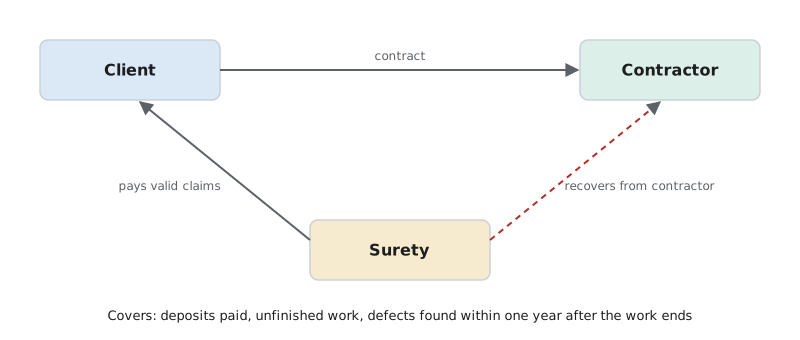
The licence bond, cautionnement de licence, is a guarantee given by a surety company that the contractor will meet its contractual obligations to clients. The RBQ's published information describes its purpose: it is meant to compensate clients for harm related to deposits paid, work left unfinished, and defects or faults discovered within one year after the work ends. The bond is not insurance for the contractor. If the surety pays a claim, it will generally seek to recover the amount from the contractor under the indemnity agreement the contractor signed when the bond was issued.
The RBQ's published amounts are 20,000 dollars for specialized contractors and 40,000 dollars for general contractors. Holders of only the new-home subcategories do not need the bond, because the mandatory warranty plan for new residential buildings protects their clients instead; a contractor that holds any other subcategory as well must still provide one. An electrical contractor is a specialized contractor. The CMEQ application asks for the original bond, so the bond must be arranged with a surety before the file is submitted. Confirm the amount that applies to electrical contractors licensed through the CMEQ when you apply.
| Feature | Licence bond, as described by the RBQ |
|---|---|
| Who provides it | A surety company, on the contractor's behalf |
| Amount, specialized contractor | 20,000 dollars |
| Amount, general contractor | 40,000 dollars |
| What it is meant to cover | Deposits paid, unfinished work, defects or faults found within one year after the work ends |
| Who it protects | Clients who suffered harm |
| Exemption | New-home subcategories only, covered by the warranty plan |
Claims against the bond
A client who suffers harm covered by the bond can claim. The RBQ offers an online service for claims against the licence bond, and the surety reviews the claim. Because the bond amount is limited, it may not cover the client's whole loss, and claims from several clients share the same amount. A contractor whose bond has paid out may find it harder and more expensive to get a new bond, which can threaten the licence itself.
The most common triggers are simple: a deposit taken for a job that never started, a job abandoned partway through, or defects the contractor refuses to correct. Each is also a conduct issue the CMEQ can look at. The best protection is to take only reasonable deposits, finish what you start and answer defect complaints promptly.
Worked problem
A deposit gone wrong
A small competitor of Électrique Rivière-du-Nord took a 6,000 dollar deposit from a homeowner for a panel upgrade, then closed its doors without doing the work. The homeowner asks Mylène, who knows the industry, what she can do. What is the likely route?
Show solution
- The loss is a deposit paid for work that was not done, which is the kind of harm the licence bond is meant to cover.
- The homeowner can claim against the competitor's licence bond through the RBQ's claims service.
- The surety reviews the claim; if it is valid and within the bond amount, it pays and then seeks to recover from the contractor.
- If other clients also claim, they share the bond amount, so recovery may be partial.
Answer: Claim against the licence bond through the RBQ's service; recovery depends on the claim's validity and other claims against the same bond.
from datetime import date

# Defects covered by the licence bond must be found within one year after the work ends.
def within_bond_window(work_ended, defect_found):
    one_year_later = date(work_ended.year + 1, work_ended.month, work_ended.day)
    return defect_found <= one_year_later

cases = [
    ("Loose neutral, basement subpanel", date(2026, 4, 30), date(2027, 2, 14)),
    ("Missing GFCI, garage", date(2025, 6, 15), date(2026, 8, 1)),
]
for what, ended, found in cases:
    print(f"{what}: work ended {ended}, found {found} ->",
"inside the one-year bond window" if within_bond_window(ended, found) else "outside the bond window")Loose neutral, basement subpanel: work ended 2026-04-30, found 2027-02-14 -> inside the one-year bond window Missing GFCI, garage: work ended 2025-06-15, found 2026-08-01 -> outside the bond window
Outside the bond window, a client may still have rights against the contractor under the Civil Code and the contract, but not against the licence bond. The window in the code follows the RBQ's description; the exact rules are in the regulation.
Insurance
Commercial general liability insurance protects the contractor against claims for bodily injury and property damage caused by its operations, including completed work. An electrical fire traced to a faulty connection months after a job is a classic completed-operations claim. Most general contractors, property managers and public bodies require proof of liability insurance with a minimum limit, often several million dollars, and ask to be named as additional insureds. Mylène's residence requires both from every contractor.
Other policies a small electrical contractor commonly carries include insurance on tools and equipment, commercial vehicle insurance, and, for companies that design installations, professional liability. Workers' injuries are covered by the public CNESST compensation system rather than private insurance, so the company must be registered with the CNESST and pay its premiums; lesson 10 covers that. An insurance broker who knows construction is worth the fee.
| Coverage | What it protects against | Who typically asks for proof |
|---|---|---|
| Commercial general liability | Injury or damage caused by operations and completed work | General contractors, property managers, public bodies |
| Tools and equipment | Loss or theft of tools and equipment | The contractor's own lender or landlord |
| Commercial vehicle | Vehicle accidents and damage | Required by law for vehicles |
| Professional liability | Errors in design or advice | Clients on design-build work |
| CNESST registration | Compensation for injured workers (public system) | Required by law for employers |
Contract bonds
On larger and public projects, owners often require contract bonds, separate from the licence bond. A bid bond guarantees that a bidder who wins will sign the contract and provide the other required bonds. A performance bond guarantees that the contractor will complete the work as contracted, often for half the contract price. A labour and material payment bond guarantees that the contractor will pay its subcontractors and suppliers. These are issued by surety companies after a review of the contractor's finances, experience and workload, and they are priced as a small fraction of the bonded amount.
For a small contractor, getting a first performance bond can be the hardest step in growing into public work. Sureties look at financial statements, working capital, the owner's personal guarantee and the contractor's track record. Électrique Rivière-du-Nord has a bonding line from a surety that allows it to bid public jobs up to a set size; Réjean has signed personal guarantees, and the surety has asked how the succession will affect the company's management.
Worked problem
Comparing two bid scenarios
Émilie is pricing an electrical subcontract on a public school renovation with a contract value of 380,000 dollars. The owner requires a performance bond and a payment bond, each for half the contract value. The surety's rate in this example is 1.2 for every 100 dollars of contract value for the pair. What does the bond cost add to the bid?
Show solution
- The rate applies to the contract value: 380,000 dollars.
- Cost: 380,000 divided by 100, times 1.2, equals 4,560 dollars.
- Add the bond cost to the bid before markup, because it is a real project cost.
Answer: The bonds add 4,560 dollars to the cost of the bid in this example. Rates vary by surety and contractor.
Public contracts
Public bodies in Quebec buy construction work under public procurement rules. Contractors bidding on public contracts generally must hold the right licence and subcategory, be in good standing with Revenu Québec for contracts above set thresholds, and, for contracts above higher thresholds, hold an authorization from the public procurement authority. Many tenders, public and private, go through the Bureau des soumissions déposées du Québec, which the CMEQ fact sheet describes as receiving and forwarding tenders to reduce competition problems. Since September 2025, a regulation on prompt payment and rapid dispute resolution applies to public construction contracts; lesson 9 covers it.
These rules change, and the thresholds are set in regulations. Before bidding on public work, check the current requirements in the tender documents and with the procurement authority.
Licence renewal and fees
A licence must be kept in force. The CMEQ's fee schedule sets the fees for applications, exams, membership and renewal, and the RBQ's pages list a separate tariff and the annual payroll declaration. Nadia diarizes every renewal and payment date. A lapsed licence means the company cannot legally do electrical work, cannot bid, and may face CCQ suspension of its sites, so renewal is not an administrative detail.
Working with a surety
A surety decides whether to issue a bond, and on what terms, based on the contractor's character, capacity and capital. Character is the owner's and the company's reputation for meeting obligations. Capacity is the experience, staff and systems to do the work. Capital is the financial strength to absorb a bad job. For a small electrical contractor, the surety will usually ask for annual financial statements, a list of work in progress, a résumé of key people and personal guarantees from the owners.
Sureties also watch for changes that affect risk. A succession like Réjean's is one of them. The surety wants to know who will run the company, whether the new owner has the experience and the répondant qualifications, and whether the personal guarantees will change. Réjean and Émilie meet the surety together a year before his planned retirement, which turns what could be a concern into evidence of good planning.
Certificates of insurance
Clients and general contractors ask for certificates of insurance before a contractor starts work. A certificate summarizes the policies, limits and dates, and may name the client as an additional insured. Nadia keeps a current certificate on file and asks the broker for job-specific certificates when a contract requires particular wording. She also checks the contract's insurance clause before signing, because some clients require limits, endorsements or deductibles the standard policy does not have, and changing a policy takes time and money.
When a claim happens, notify the insurer promptly, even if the contractor believes it is not at fault. Late notice can jeopardize coverage. Keep the job file intact, because the insurer will need it.
Deposits and consumer contracts
Residential clients are often consumers, and consumer protection rules apply to the contract. For electrical work, the practical points are simple: put the contract in writing, describe the work and the price clearly, take only a reasonable deposit, and give the client the information the rules require. A contractor that takes a large deposit and then cannot perform exposes its licence bond, its reputation and, in serious cases, its licence.
Common mistakes
MistakeTreating the licence bond as insurance for the contractor.
InsteadThe bond protects clients; the surety can recover what it pays from the contractor.
MistakeAssuming the bond covers defects found two years after the work.
InsteadThe RBQ describes the bond as covering defects found within one year after the work ends.
MistakeLeaving bond costs out of a public bid.
InsteadPerformance and payment bond premiums are real costs and belong in the estimate.
MistakeThinking private insurance covers injured workers.
InsteadWorkers' compensation in Quebec is the public CNESST system; employers must register and pay premiums.
Summary and key terms
- The licence bond protects clients for deposits, unfinished work and defects found within one year after the work ends.
- The RBQ's published amounts are 20,000 dollars for specialized and 40,000 dollars for general contractors; new-home-only licences are exempt.
- Liability insurance is not on the CMEQ form reviewed but is demanded by clients; vehicles, tools and design risks need their own cover.
- Bid, performance and payment bonds are contractual and common on public and larger projects.
- Public contracts add tax, authorization and procurement requirements; keep the licence renewed.
- Cautionnement de licence
- The licence bond, a surety guarantee of the contractor's contractual obligations to clients.
- Surety
- The company that issues a bond and pays valid claims, then seeks recovery from the contractor.
- Performance bond
- A bond guaranteeing that a contractor will complete the contracted work.
- Payment bond
- A bond guaranteeing that a contractor will pay its subcontractors and suppliers.
- Completed operations
- Liability insurance coverage for claims arising after the work is finished.
Practice problems
Work each problem on paper first, then reveal the answer to check.
What is the RBQ's published licence bond amount for a specialized contractor?
Show answer
20,000 dollars.
Name the three kinds of harm the RBQ says the licence bond is meant to cover.
Show answer
Deposits paid, unfinished work, and defects or faults found within one year after the work ends.
Which licence holders do not need a licence bond?
Show answer
Holders of only the new-home subcategories, covered by the warranty plan.
What does a payment bond guarantee?
Show answer
That the contractor will pay its subcontractors and suppliers.
Who compensates injured workers in Quebec?
Show answer
The CNESST, through the public compensation system.
Lesson quiz · 5 questions
Score 60% or more to complete this lesson.
Create a free account to save your progress, take quizzes and earn a certificate.