
MELC-206 · Lesson 1 of 12 · 22 min
How electrical licensing works in Quebec
▶ Video coming soon A video version of this lesson is on the way.
Quebec organizes electrical contracting differently from every other province. In most of Canada, a provincial safety authority certifies a master electrician or a field safety representative and licenses the business that employs that person. In Quebec, the business licence itself is the central credential, and it is issued through a professional corporation rather than a government department. The Corporation des maîtres électriciens du Québec, usually called the CMEQ, qualifies electrical contractors on behalf of the Quebec government and issues the electrical contractor licence. Every licensed electrical contractor in the province is a member of the CMEQ, and its members are the master electricians of Quebec.
This course prepares you for the qualification path that leads to that licence. If you have completed the five core courses, you already know how to navigate the Canadian Electrical Code. Quebec adds its own layer: the Code de construction, Chapter V, Electricity, which adopts the Canadian Electrical Code with Quebec amendments; the Building Act and its regulations; the construction-industry labour rules administered by the Commission de la construction du Québec; and the occupational health and safety regime run by the CNESST. The CMEQ exams test all of these, which is why most of the work in this course is about law, administration and management rather than wiring.
Rules, fees and exam arrangements change. Every fact in this course was checked against official sources when it was written, and where a detail could not be confirmed it is described in general terms. Before you apply, read the current CMEQ qualification documents and the current Régie du bâtiment du Québec pages, and treat them as the final word. Where this course and the official documents disagree, the official documents win.
Meet the team at Électrique Rivière-du-Nord
This course follows one company through the licence process and the work that comes after it. Électrique Rivière-du-Nord inc. is a small electrical contractor in Saint-Jérôme, in the Laurentides region north of Montreal. It employs nine electricians and apprentices and does residential renovation, small commercial fit-ups and some institutional work. The founder, Réjean Bouchard, has been the company's répondant, the qualified person who answers for the company's competence, in every required domain for twenty-two years. He wants to retire within two years, and the licence cannot survive his departure unless someone else in the company qualifies.
That person is Émilie Gagnon. Émilie holds a certificat de compétence-compagnon, the journeyman certificate issued by the Commission de la construction du Québec, and has worked as a construction electrician for nine years, the last four as Réjean's lead hand. She knows the technical side well. What she has never done is estimate a full project, manage a site safety program, deal with an RBQ correction notice, or answer for the company's finances. She will start by qualifying in the domains Réjean can no longer cover alone, and over two years the company will move its répondant roles to her.
Three others appear throughout the course. Nadia Haddad manages the office: payroll, the monthly reports to the Commission de la construction du Québec, declarations of work, invoicing and insurance. Kevin Paquette is a second-period apprentice who works on Émilie's crew and will be the subject of several supervision questions. Mylène Roy is the property manager of the Résidence des Érables, a private seniors' residence that is one of the company's largest clients. Their jobs give every lesson a concrete example.
| Person | Role | Credential |
|---|---|---|
| Réjean Bouchard | Founder; current répondant in all domains | Master electrician, CMEQ member |
| Émilie Gagnon | Lead hand; répondant candidate | Certificat de compétence-compagnon, electrician |
| Nadia Haddad | Office manager: payroll, CCQ reports, declarations | None required |
| Kevin Paquette | Second-period apprentice | Certificat de compétence-apprenti |
| Mylène Roy | Property manager, Résidence des Érables | Client |
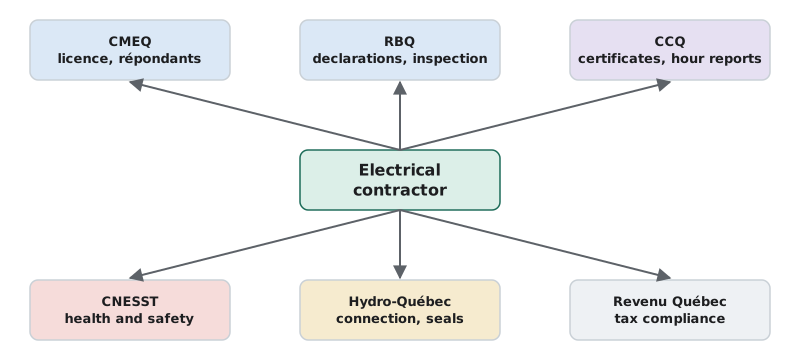
The legal framework
The foundation is the Building Act, the Quebec statute that governs construction work, construction contractors and owner-builders. It creates the Régie du bâtiment du Québec, the RBQ, which issues construction contractor licences, adopts the building codes, receives declarations of work, inspects work and enforces the Act. The Act requires anyone who carries on business as a construction contractor to hold a licence with the subcategories that match the work. For electrical installation work, the relevant subcategory is number 16, Entrepreneur en électricité, or electrical contractor.
The Act also provides for the qualification of certain contractors through professional corporations. For electrical contractors, that body is the CMEQ, and for plumbing and heating contractors it is a sister corporation. The RBQ's own page on electrical contractor licences describes the CMEQ as acting as a mandatary of the Quebec government and taking responsibility for qualifying its members. In practice this means that an electrical contractor applies to the CMEQ, proves its répondants' competence through the CMEQ, and receives an electrical contractor licence from the CMEQ, rather than going to an RBQ counter. A contractor that also does general construction work holds an RBQ licence for those other subcategories.
A second statute, the Master Electricians Act, creates the CMEQ itself and makes membership compulsory for anyone who carries on business as an electrical contractor. The corporation has its own regulations, including rules on member conduct, discipline and mandatory continuing education. Its members carry the title master electrician, maître électricien. Unlike Alberta or Ontario, the title in Quebec does not belong to an individual who passed an exam; it belongs to the licensed contractor and the qualified people behind it.
Under the Building Act sit the codes. The Code de construction, the Construction Code, is divided into chapters, and Chapter V, Electricity, governs electrical installations. It adopts the Canadian Electrical Code, Part I, with modifications for Quebec. A separate Code de sécurité, the Safety Code, governs the maintenance and safety of existing buildings and installations. Lesson 5 covers Chapter V and its current edition in detail.
The labour side: the Commission de la construction du Québec
Quebec's construction industry is also governed by a labour statute, commonly called Act R-20, which covers labour relations, vocational training and workforce management in construction. The Commission de la construction du Québec, the CCQ, administers it. The CCQ issues competency certificates to workers, including the certificat de compétence-apprenti for apprentices and the certificat de compétence-compagnon for journeypersons. It also collects monthly reports of hours worked from employers, enforces the collective agreements and can suspend work done without the proper licences or certificates.
For a construction electrician, the CCQ path is a 1,800-hour vocational diploma in electricity, four apprenticeship periods of 2,000 hours each, for 8,000 hours in total, and the provincial qualification exam. Passing the exam leads to the journeyperson certificate. That certificate is about the worker's trade competence. The contractor licence is a separate thing: it is about the business and the people who answer for it. Émilie's journeyperson certificate is a strength in her qualification file, but it does not give her a licence.
The occupational health and safety side: the CNESST
The Commission des normes, de l'équité, de la santé et de la sécurité du travail, the CNESST, administers the Act respecting occupational health and safety, the Act respecting industrial accidents and occupational diseases, and the Safety Code for the construction industry. It inspects sites, issues correction notices and stop-work orders for health and safety matters, collects employer premiums and compensates injured workers. One of the CMEQ's qualification domains is site safety management, and the exam in that domain is built around these statutes. Lesson 10 covers them.
Hydro-Québec and the other players
Hydro-Québec is the province's electricity distributor for most customers. A contractor deals with it for service connection requests, meter work and requests to remove a seal, and must meet its service requirements, published in a standard for electrical service connections that the CMEQ exams treat as a reference. Revenu Québec audits businesses and is involved in the licence process through tax compliance questions. The Bureau des soumissions déposées du Québec receives tenders for many public and private projects, and a separate security bureau issues permits for security-system work. A CMEQ fact sheet on who does what lists these bodies and their roles; lesson 6 returns to it when it covers declarations of work.
| Organization | Main role for an electrical contractor |
|---|---|
| CMEQ | Qualifies répondants, issues the electrical contractor licence, member discipline, continuing education |
| RBQ | Adopts Chapter V, receives declarations of work, inspects, issues correction notices, prosecutes |
| CCQ | Worker competency certificates, monthly hour reports, collective agreements, site checks |
| CNESST | Health and safety law, site inspections, premiums, compensation for injured workers |
| Hydro-Québec | Service connection requests, seal removal requests, service standards |
| Revenu Québec | Tax audits and investigations of individuals and businesses |
The répondant system
The central idea of Quebec contractor qualification is the répondant. A company does not hold competence in the abstract; it designates natural persons, called répondants, who have proven their competence in each required domain. The CMEQ's company licence application asks for at least one répondant in each of four domains: administration, site safety management, project and site management, and execution of construction work. For execution of construction work, the application also lists the subcategories for which the répondant is qualified, which for an electrical contractor means subcategory 16.
One person can be répondant in several domains, as Réjean is in all four. A larger company may spread the roles across several people. Each répondant must be active in the company, and a person cannot act as répondant for more than one company at once. If a répondant leaves and no one else is qualified in that domain, the company's licence is at risk, which is exactly the problem Réjean's retirement creates. Lesson 2 covers how a répondant proves competence, and lesson 7 covers what the role requires day to day.
Worked problem
Mapping Réjean's retirement
Électrique Rivière-du-Nord has one répondant, Réjean, in all four domains. He plans to stop working in 24 months. What does the company need before he leaves?
Show solution
- List the four domains: administration, site safety management, project and site management, execution of construction work in subcategory 16.
- For each domain, the company needs at least one other active person who has proven competence before Réjean's departure takes effect.
- Émilie can qualify in all four, or the company can split them, for example Émilie for execution of work and site safety, and Nadia for administration if she qualifies.
- Plan the exams early enough that a failed attempt and the waiting period for a retake still fit inside the 24 months.
Answer: The company needs a qualified répondant in each of the four domains before Réjean leaves, with time to spare for a retake.
# Months of slack in Rivière-du-Nord's succession plan
months_until_retirement = 24
plan = [
    ("Application and file review", 2),
    ("Study and first exam sitting", 4),
    ("Possible retake, after the waiting period", 7),
    ("CMEQ processing of the répondant change", 2),
]
used = sum(m for _, m in plan)
for step, m in plan:
    print(f"{step:<45}{m:>3} months")
print(f"{'Total planned':<45}{used:>3} months")
print(f"{'Slack before retirement':<45}{months_until_retirement - used:>3} months")Application and file review 2 months Study and first exam sitting 4 months Possible retake, after the waiting period 7 months CMEQ processing of the répondant change 2 months Total planned 15 months Slack before retirement 9 months
How this course fits the program
The Quebec program in this site's Electrical Licensing stream combines the five core courses on the Canadian Electrical Code with this jurisdiction course. The core courses give you the code skills that the Chapter V exam and the execution-of-work exam test. This course adds the Quebec-specific material: the institutions, the qualification process, the exams and their reference documents, Chapter V's place in the legal framework, declarations of work, the répondant's duties, the licence bond, legal hypothecs, health and safety law, continuing education and exam strategy. The lessons follow Émilie through the same sequence.
A final point on language. The CMEQ guide to its exams says questions are available in French and English. Quebec's legal texts and many of its forms exist in both languages, but in daily practice much of the industry works in French. This course is written in English and gives the French terms in parentheses the first time each appears, because you will meet those terms on forms, on sites and in the reference documents.
Common mistakes
MistakeThinking the master electrician title belongs to a person who passed an exam, as in Alberta or Ontario.
InsteadIn Quebec the title belongs to members of the CMEQ, which are licensed electrical contractors; individuals qualify as répondants for a company.
MistakeAssuming the journeyperson certificate from the CCQ is enough to run an electrical contracting business.
InsteadThe CCQ certificate proves trade competence. The contractor licence is a separate credential that requires qualified répondants in four domains.
MistakeGoing to the RBQ for an electrical contractor licence.
InsteadElectrical contractors are qualified and licensed through the CMEQ, which acts as a mandatary of the government; the RBQ licenses other contractor subcategories.
MistakeTreating the CNESST and the RBQ as the same inspector.
InsteadThe RBQ inspects for compliance with the Construction Code; the CNESST inspects for health and safety. Each issues its own correction notices.
Summary and key terms
- The Building Act requires a construction contractor licence with the right subcategory; electrical installation work needs subcategory 16.
- The CMEQ qualifies electrical contractors as a mandatary of the government and issues the electrical contractor licence; membership is compulsory.
- A company proves competence through répondants in four domains: administration, site safety management, project and site management, and execution of work.
- Chapter V of the Construction Code adopts the Canadian Electrical Code with Quebec amendments.
- The CCQ certifies workers and administers construction labour rules; the CNESST administers health and safety law.
- CMEQ
- Corporation des maîtres électriciens du Québec, the professional corporation that qualifies and licenses electrical contractors.
- RBQ
- Régie du bâtiment du Québec, the body that administers the Building Act, adopts the codes and inspects construction work.
- Répondant
- A natural person who has proven competence in a qualification domain and answers for a contractor in that domain.
- Subcategory 16
- The licence subcategory Entrepreneur en électricité, required for electrical installation work.
- Certificat de compétence-compagnon
- The journeyperson certificate issued by the Commission de la construction du Québec.
Practice problems
Work each problem on paper first, then reveal the answer to check.
Which organization qualifies electrical contractors and issues their licence in Quebec?
Show answer
The CMEQ, acting as a mandatary of the Quebec government.
Name the four qualification domains on a CMEQ company licence application.
Show answer
Administration, site safety management, project and site management, and execution of construction work.
Which licence subcategory covers electrical installation work?
Show answer
Subcategory 16, Entrepreneur en électricité.
How many apprenticeship hours does the CCQ path to the electrician journeyperson certificate require?
Show answer
Four periods of 2,000 hours, or 8,000 hours.
Can one person be the répondant for two different companies at the same time?
Show answer
No. A person may act as répondant for only one company.
Lesson quiz · 5 questions
Score 60% or more to complete this lesson.
Create a free account to save your progress, take quizzes and earn a certificate.