
MELC-206 · Lesson 7 of 12 · 21 min
Duties and responsibilities of the Electrical Contractor Licence (CMEQ) holder
▶ Video coming soon A video version of this lesson is on the way.
A licence is not a certificate to frame and forget. It comes with continuing duties for the company that holds it and for the répondants who stand behind it. Some duties come from the Building Act and the qualification regulation, some from the CMEQ's own regulations, some from the construction labour rules, and some from the codes the company works under. This lesson gathers them into a single picture, organized around the question every répondant should ask: what am I answering for?
The duties described here are the ones the CMEQ and RBQ documents reviewed for this course make clear. The regulations contain more detail, including exact reporting deadlines for changes, and those deadlines are revised from time to time. Treat this lesson as a map of the territory and the regulations as the ground itself.
The company's duties
The licence belongs to the company, and many duties attach to the company directly. It must carry on its electrical business only within the subcategories its licence covers. It must keep its information with the CMEQ accurate: its name, address, officers, shareholders and répondants. It must keep its licence bond in force. It must display its licence number where the rules require, and it must not hold itself out as an electrical contractor in a way that misleads the public. It must file declarations of work when Chapter V requires them, act on correction notices from the RBQ, and comply with the codes in every installation it does.
The company is also an employer in the construction industry, with duties to the CCQ and the CNESST. The CMEQ fact sheet notes that the CCQ receives the monthly report of employee hours and the payment of amounts owed by the 15th of each month. The company must hire workers who hold the right competency certificates, respect the collective agreements and keep the records that the CCQ can audit. Lesson 10 covers the CNESST side.
| Duty | Source | Who in the company handles it |
|---|---|---|
| Keep CMEQ file current: name, address, officers, shareholders, répondants | Qualification regulation and CMEQ rules | Owner and office manager |
| Keep the licence bond in force | Building Act and qualification regulation | Office manager with the surety |
| Declarations of work where required | Chapter V | Office manager, checked by the répondant |
| Act on RBQ correction notices | Building Act | Répondant for execution of work |
| Monthly CCQ report and payment by the 15th | Construction labour rules | Office manager |
| Comply with the codes in every installation | Building Act and Chapter V | Every worker, supervised by the répondant |
What a répondant answers for
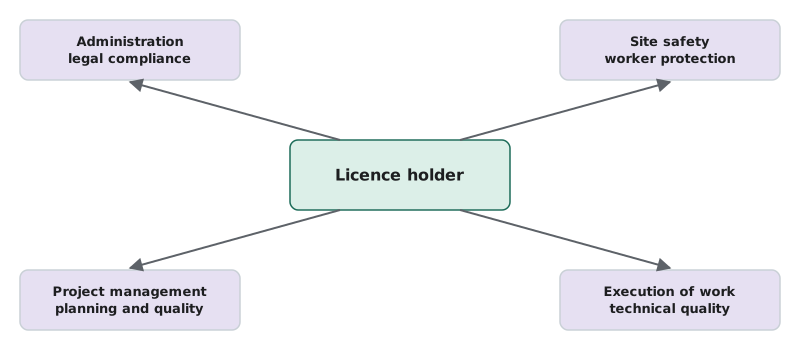
Each répondant answers for the company's competence in their domain. That is a legal role, not a courtesy title. The répondant for administration answers for the company's compliance with the laws on running a construction business. The répondant for site safety management answers for its management of health and safety on its sites. The répondant for project and site management answers for how its projects are planned and run. The répondant for execution of construction work answers for the technical quality of the installations in subcategory 16.
A répondant must be genuinely active in the company. A person cannot lend their qualifications to a company they do not work for, and a person cannot act as répondant for more than one company at once. The CMEQ admission form also requires that the technical répondant consent in writing to the designation of any other representative, and that the representative take part in management or be a senior manager. Those rules aim to make sure that the people whose competence the licence depends on are actually involved in running the business.
Supervision of work and workers
Most of an electrical contractor's legal exposure comes from what its workers do when no répondant is watching. The répondant for execution of work cannot inspect every connection, but must have a system that makes good work the normal result: qualified workers, clear assignments, supervision of apprentices, quality checks and corrections. The construction labour rules require that workers hold competency certificates appropriate to their trade and that apprentices work under the supervision of journeypersons according to the ratios and rules set in the regulations. Check the current rules before assigning crews, because the ratios and their exceptions are revised from time to time.
Kevin is a second-period apprentice. Émilie assigns him to her crew and never leaves him alone on live work or on a job where no journeyperson is present. She signs off his logbook entries honestly, because the CCQ relies on them to track his progress, and because the company could be held responsible if an apprentice's hours were misrepresented.
Worked problem
Staffing a Saturday call-out
A client calls on a Saturday with a tripped main breaker at a small restaurant. The only workers available are Kevin, a second-period apprentice, and Marc, a journeyperson who is also available but two hours away. Kevin is ten minutes from the site. What should Émilie do?
Show solution
- The work involves diagnosing a fault on an energized service, which an apprentice must not do without journeyperson supervision.
- Send Marc, and tell the client the realistic arrival time.
- If the client needs the site made safe immediately, Kevin may go to keep people away from the panel and wait, without opening or working on the equipment.
- Record the call-out, who attended and what was done.
Answer: Send the journeyperson. The apprentice may only secure the area and wait, not work on the equipment.
Quality control
The RBQ has published a quality control guide for electrical installations, together with a verification sheet, to help contractors build their own checking routine. The guide is organized by part of the installation and by circuit, and the verification sheet records the client, the people who did and checked the work, the date and remarks. It refers to the 2018 edition of Chapter V, so its rule references will be updated as the guides catch up with the 2026 edition, but its structure is a useful model.
Émilie adopts a simple routine for Électrique Rivière-du-Nord. Every job of more than a day has a checklist built from the RBQ verification sheet and the company's own lessons from past correction notices. The lead hand completes it before the job is closed, and Émilie reviews a sample each month. When the RBQ issues a correction notice, the item goes on the checklist so the same mistake is caught next time.
# Monthly quality sample: what share of closed jobs had a complete checklist?
closed_jobs = {
    "J-2601": True, "J-2602": True, "J-2603": False, "J-2604": True,
    "J-2605": True, "J-2606": True, "J-2607": False, "J-2608": True,
    "J-2609": True, "J-2610": True,
}
complete = sum(closed_jobs.values())
total = len(closed_jobs)
print(f"Checklists complete: {complete} of {total}")
print("Follow up on:", ", ".join(j for j, ok in closed_jobs.items() if not ok))
target = 9   # Émilie's target: at least 9 of every 10 jobs
print("Target met" if complete >= target * total / 10 else "Below target")Checklists complete: 8 of 10 Follow up on: J-2603, J-2607 Below target
Reporting changes
Changes to the company's structure or people must be reported. The qualification regulation and the CMEQ's rules set the deadlines, which are generally short. Typical reportable changes include a change of name or address, a change of officers or shareholders, the departure of a répondant, the designation of a new répondant and a change in the company's legal form. If a répondant leaves and no other qualified person covers the domain, the company must act quickly to designate a replacement or risk the licence lapsing.
Réjean's planned retirement is a reportable change. So is the sale of a third of the shares to Émilie. Nadia diarizes both, with reminders well before the deadlines, and the company's lawyer prepares the share sale documents with the CMEQ requirements in mind.
Professional conduct and discipline
The CMEQ regulates its members' conduct. The CMEQ fact sheet lists discipline under the member rules, investigations and penal prosecutions among its roles. Clients, other contractors and inspectors can complain about a member, and the CMEQ can investigate. Conduct that can lead to discipline typically includes misleading clients, failing to honour obligations, practising outside the licence, and conduct that harms the reputation of the profession. The RBQ, separately, can investigate and prosecute offences under the Building Act, and the CCQ can investigate labour-rule violations.
Most complaints against small contractors start with communication failures: a quote that did not say what it excluded, a change that was not written down, a call that was not returned. Those are administration and project management problems as much as technical ones, which is why the CMEQ qualifies répondants in those domains.
| Body | Can investigate | Typical subject |
|---|---|---|
| CMEQ | Members' conduct; penal matters under its statutes | Misleading a client, unprofessional conduct |
| RBQ | Offences under the Building Act | Work without a licence, failure to correct |
| CCQ | Construction labour rules | Workers without certificates, unreported hours |
| CNESST | Health and safety law | Unsafe work, failure to report an accident |
Continuing education
The CMEQ's continuing education regulation applies to répondants for execution of construction work in subcategory 16. Compliance is a condition of continuing to act as répondant. Lesson 11 covers the requirements in detail. For this lesson, the key point is that the duty is personal to the répondant and directly affects the licence: a répondant who does not meet the requirement and does not fix the default within the allowed time is deemed to have stopped acting as répondant, which can cause the licence to lapse unless another qualified répondant covers the domain.
A répondant's monthly routine
Many experienced répondants describe the role as a set of routines rather than a set of rules. Réjean's monthly routine, which he is handing to Émilie, has five parts. First, review the list of jobs started and finished, and check that each has a declaration number or a written reason why none was needed. Second, sample the quality checklists of closed jobs and follow up on any gaps. Third, review open correction notices and their deadlines. Fourth, check the crew assignments for apprentice supervision and certificate status. Fifth, check the company calendar for reports, renewals and continuing education.
The routine takes about two hours a month for a company of Électrique Rivière-du-Nord's size. It catches problems while they are small and gives the répondant evidence that the company has a system, which matters if the RBQ, the CMEQ or a client ever questions the company's work.
Handling client complaints
Every contractor receives complaints. The way they are handled often decides whether a complaint becomes a disciplinary file, a bond claim or a lawsuit. A good process acknowledges the complaint quickly, sends a qualified person to look at the problem, separates what the contractor is responsible for from what it is not, corrects what needs correcting, and confirms in writing. When the complaint is about something outside the contract, explaining that politely and in writing, with the contract's scope attached, prevents most escalation.
Mylène once complained that a new corridor lighting circuit at the residence tripped every evening. Émilie found that another contractor had added a heater to the circuit after Électrique Rivière-du-Nord finished. She documented the added load, moved the heater to a dedicated circuit under a change order, and sent Mylène a short report. The complaint closed in a week and the client relationship improved.
Ethics in small decisions
Most ethical problems in contracting look small at the time: a quote that leaves out an exclusion to win the job, an apprentice's hours rounded up, a declaration not filed because the job was short. Each one creates a risk for the répondant and the company. A simple test helps: would you be comfortable explaining the decision to the CMEQ, the RBQ and the client, in writing? If not, choose differently.
Common mistakes
MistakeTreating the répondant role as a name on a form.
InsteadA répondant answers for the company's competence in the domain and must be active in the company.
MistakeLeaving an apprentice alone on a job to save travel time.
InsteadApprentices work under journeyperson supervision according to the construction labour rules.
MistakeReporting a répondant's departure after the replacement is found.
InsteadReport changes within the regulatory deadlines; plan replacements before the departure.
MistakeClosing a correction notice without updating the company's checklist.
InsteadFeed every notice back into quality control so the same error is not repeated.
Summary and key terms
- The company must keep its CMEQ file current, maintain its bond, file declarations, act on correction notices and comply with the codes.
- As a construction employer it also reports hours to the CCQ by the 15th of each month and follows health and safety law.
- Each répondant answers for the company's competence in their domain and must be active in only one company.
- Apprentices work under journeyperson supervision; quality control should be systematic and learn from correction notices.
- The CMEQ handles member discipline; the RBQ, CCQ and CNESST investigate within their own laws.
- Active répondant
- A répondant who genuinely works in and takes part in the company they answer for.
- Reportable change
- A change in the company's name, address, officers, shareholders, legal form or répondants that must be reported.
- Verification sheet
- The RBQ's quality control form for recording checks of an electrical installation.
- Discipline
- The CMEQ's process for dealing with members' conduct under its rules.
- Competency certificate
- A CCQ certificate showing a worker's trade status, such as apprentice or journeyperson.
Practice problems
Work each problem on paper first, then reveal the answer to check.
By what day of each month must the CCQ monthly report and payment be made?
Show answer
The 15th.
Can a répondant act for two companies at the same time?
Show answer
No.
Name two reportable changes.
Show answer
Any two of: name, address, officers, shareholders, répondants, legal form.
Which body handles discipline of CMEQ members?
Show answer
The CMEQ.
What happens if a répondant does not fix a continuing education default in time?
Show answer
They are deemed to have stopped acting as répondant, which can cause the licence to lapse.
Lesson quiz · 5 questions
Score 60% or more to complete this lesson.
Create a free account to save your progress, take quizzes and earn a certificate.