
MELC-206 · Lesson 11 of 12 · 19 min
Renewal and continuing education
▶ Video coming soon A video version of this lesson is on the way.
Qualifying is the start, not the end. A licence must be kept in force, the company's information must stay current, and the répondant for execution of work must keep up with mandatory continuing education. Quebec's continuing education requirement for electrical contractors is set in a CMEQ regulation that took effect in 2022, and it has teeth: a répondant who does not comply can be deemed to have stopped acting as répondant, which can make the licence lapse. This lesson explains the requirement, the reporting, the consequences of a default, and the renewal tasks a company must diarize.
The figures in this lesson come from the CMEQ regulation on mandatory continuing education as adopted in March 2020 and in force from 1 April 2022, and from the RBQ's electrical licence page when this course was written. Check the current regulation and the CMEQ's member pages for any changes.
Who must comply
The regulation applies to CMEQ members through their répondants for the execution of construction work, that is, the qualified individuals responsible for construction work under the electrical contractor subcategory, number 16. The répondants for administration, site safety management and project management are not covered by this particular requirement. Certain members domiciled outside Quebec who hold a licence under specific exemptions are excluded. The obligation is personal: it attaches to the répondant, but its consequences fall on the company.
How many hours
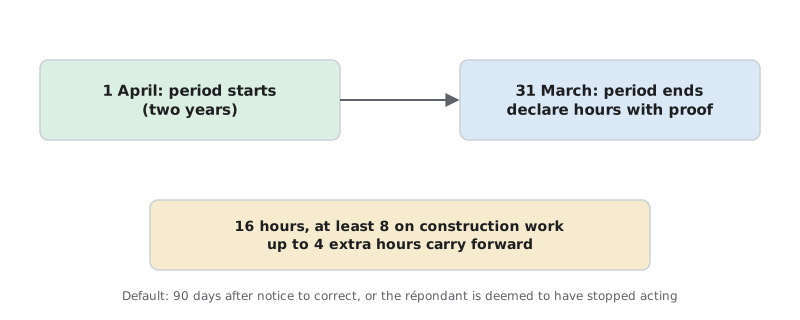
A répondant must complete at least 16 hours of continuing education in each reference period, of which at least 8 hours must relate to knowledge of construction work. Hours above the requirement can be carried forward to the next period, up to a maximum of 4 hours. A reference period lasts two years and runs from 1 April to 31 March. The first period began on 1 April 2022, so the periods run 2022 to 2024, 2024 to 2026, and 2026 to 2028. The RBQ's electrical licence page noted that the last reference period ended on 31 March 2026.
| Element | Requirement in the CMEQ regulation |
|---|---|
| Who | Répondants for execution of construction work, subcategory 16 |
| Hours per period | At least 16 |
| Of which on construction work knowledge | At least 8 |
| Carry-forward | Up to 4 hours into the next period |
| Reference period | Two years, 1 April to 31 March |
| First period began | 1 April 2022 |
What counts
The regulation accepts a range of formats: courses, workshops, seminars, conferences, colloquia, congresses, structured workplace training and other activities the CMEQ designates. The content must relate to running a construction business, the activities of a master electrician, or the répondant's licence subcategories. Eligible topics include the applicable codes and techniques, plan reading, cost estimation, project and site management, financial management, and the laws and ethics that apply to members. The CMEQ assesses activities for recognition, and requests for recognition of an activity must be submitted at least 30 days in advance. The CMEQ may also impose specific training on répondants, for example when a new code edition comes into force.
When Chapter V moved to the 2021 Canadian Electrical Code base in March 2026, training on the changes became an obvious choice for répondants starting the 2026 to 2028 period. Émilie plans to take a code update course early in that period, which will count toward the 8 hours on construction work knowledge, and a short course on estimating, which counts toward the remaining hours.
Worked problem
Émilie's first full period
Émilie becomes répondant for execution of work in July 2026, during the 2026 to 2028 period. Is she required to complete the hours for that period?
Show solution
- The regulation exempts a répondant for the period in which they first receive a licence or first qualify as répondant for a company.
- July 2026 falls in the period from 1 April 2026 to 31 March 2028, so that is her first period as répondant.
- She is exempt for 2026 to 2028, and her first required period is 1 April 2028 to 31 March 2030.
- Training she takes before April 2028 is still worthwhile, and the exam itself already tested her knowledge, but she should check how early hours are treated before counting on them.
Answer: She is exempt for the 2026 to 2028 period; her first required period starts on 1 April 2028.
Reporting and records
The regulation requires the répondant to file a declaration electronically by 31 March at the end of each period, with proof of attendance or evaluation results. Supporting documents must be kept for two years after the end of the period. The RBQ's electrical licence page, when this course was written, said licence holders had 90 days to declare their hours for the period that ended on 31 March 2026. Read the current CMEQ instructions for the deadline that applies to you, and do not leave the declaration to the last week.
# Continuing education tracker for a répondant (hours)
REQUIRED, MIN_CONSTRUCTION, MAX_CARRY = 16, 8, 4
activities = [
    ("Chapter V 2026 update course", 7.0, True),
    ("Estimating electrical projects", 6.0, False),
    ("Arc flash safety refresher", 3.5, True),
    ("Financial statements for contractors", 3.0, False),
]
carried_in = 2.0
total = carried_in + sum(h for _, h, _ in activities)
construction = sum(h for _, h, c in activities if c)
print(f"Total hours including carry-in: {total}")
print(f"Construction work knowledge hours: {construction}")
ok = total >= REQUIRED and construction >= MIN_CONSTRUCTION
print("Requirement met" if ok else "Requirement NOT met")
carry_out = min(MAX_CARRY, max(0.0, total - REQUIRED))
print(f"Hours that can be carried forward: {carry_out}")Total hours including carry-in: 21.5 Construction work knowledge hours: 10.5 Requirement met Hours that can be carried forward: 4
The tracker assumes carried-in hours count toward the total; check how the regulation treats carried hours against the 8-hour construction minimum before you rely on them for that part of the requirement.
When a répondant falls short
After a period ends, the CMEQ notifies the répondant, and the company's representative, of any default. The répondant then has 90 days to correct the default and provide proof. A répondant who does not do so is deemed to have stopped acting as répondant as of the end of the period. If that répondant was the only one in the execution-of-work domain, the company's licence can lapse unless it replaces the répondant or another qualified répondant takes over. A répondant who lapses in this way must prove compliance before receiving a new licence or qualifying again.
The rule makes continuing education a business risk, not just a personal obligation. Nadia puts the period end, the declaration deadline and a reminder three months before each on the company calendar, and she asks Émilie for her certificates as soon as she completes each activity.
| Date | What happens |
|---|---|
| 1 April | New two-year period begins |
| During the period | Complete activities; request recognition at least 30 days before any activity that needs it |
| 31 March at period end | Declaration due electronically with proof, under the regulation |
| After the period | CMEQ notifies any default to the répondant and the company |
| 90 days after the notice | Last day to correct the default and provide proof |
| If not corrected | Répondant deemed to have stopped acting as of the period end; licence at risk |
Keeping the licence in force
Continuing education is one of several recurring tasks. The company must pay its CMEQ membership dues and licence fees as the fee schedule requires, keep its licence bond in force, file its annual payroll declaration with the RBQ, keep its CNESST registration and premiums current, file its monthly reports with the CCQ, and report changes in its officers, shareholders, address and répondants within the regulatory deadlines. Missing any of these can lead to suspension, penalties or, in the worst case, the loss of the licence.
# A compliance calendar for the office (dates are examples; set them from the current rules)
calendar = [
    ("CCQ monthly report and payment", "15th of every month"),
    ("RBQ payroll declaration", "annually, per RBQ instructions"),
    ("CNESST payroll declaration", "annually, per CNESST instructions"),
    ("CMEQ dues and licence renewal", "per CMEQ fee schedule"),
    ("Licence bond renewal with the surety", "before the bond anniversary"),
    ("Continuing education declaration", "end of each two-year period"),
]
for task, when in calendar:
print(f"- {task:<40} {when}")- CCQ monthly report and payment 15th of every month - RBQ payroll declaration annually, per RBQ instructions - CNESST payroll declaration annually, per CNESST instructions - CMEQ dues and licence renewal per CMEQ fee schedule - Licence bond renewal with the surety before the bond anniversary - Continuing education declaration end of each two-year period
Good habits for répondants
Successful répondants treat continuing education as part of managing risk. They plan their hours at the start of each period around the changes they know are coming: a new code edition, changes in health and safety law, new contract rules for public work. They keep their certificates in one folder. They check that an activity is recognized before paying for it. And they share what they learn with the crew, because the point of the requirement is that the company's work reflects current rules.
Choosing activities that matter
With only 16 hours required over two years, a répondant can meet the minimum easily. The better question is which hours will make the most difference to the company's work. A practical approach is to look back over the last period: which correction notices did the company receive, which complaints, which bids were lost, which projects went over budget? Each points to a topic. If the RBQ flagged bonding errors twice, a course on grounding and bonding under the current Chapter V is a better investment than a general seminar. If several bids were lost on price, a course on estimating may pay for itself.
Code changes deserve priority. The 2026 move to the 2021 Canadian Electrical Code base, with Quebec's new requirements on charging infrastructure and load calculations, affects almost every residential job. A répondant who takes a structured course on the changes early in the period protects the company from a wave of correction notices.
Sharing what you learn
The requirement applies to the répondant, but the benefit comes from the crew. After each course, Émilie prepares a one-page summary for the toolbox meeting: what changed, what the crew must do differently, and where to find the rule. The summaries also become part of the company's quality checklist when they affect common installations.
Records that survive an audit
Keep a simple folder for each period with the certificate or proof of attendance for each activity, the date, the number of hours, the provider, and a note on which part of the requirement it counts toward. Keep the declaration confirmation. The regulation requires supporting documents to be kept for two years after the period ends, so a folder for the 2026 to 2028 period must be kept until at least 31 March 2030. A digital copy in the company's shared drive makes the records easy to find if the répondant changes companies or the CMEQ asks.
If an activity's recognition is uncertain, ask the CMEQ before paying for it, at least 30 days in advance as the regulation requires. An unrecognized course may still be worthwhile, but it will not help meet the requirement.
Common mistakes
MistakeAssuming every répondant must meet the 16-hour requirement.
InsteadThe CMEQ regulation applies to répondants for execution of construction work in subcategory 16.
MistakeTaking all 16 hours in business topics.
InsteadAt least 8 of the 16 hours must relate to knowledge of construction work.
MistakeCarrying 10 extra hours into the next period.
InsteadOnly up to 4 hours can be carried forward.
MistakeIgnoring a default notice because the licence still shows as active.
InsteadThe répondant has 90 days to correct the default, after which they are deemed to have stopped acting as répondant.
Summary and key terms
- Répondants for execution of construction work must complete at least 16 hours per two-year period, at least 8 on construction work knowledge.
- Periods run from 1 April to 31 March; the first began on 1 April 2022; up to 4 extra hours carry forward.
- Activities must relate to the business, master electrician activities or the subcategories; recognition requests need 30 days' notice.
- A default not corrected within 90 days of notice means the répondant is deemed to have stopped acting, putting the licence at risk.
- Renewal also means dues, fees, the bond, payroll declarations, CCQ reports and reporting changes on time.
- Reference period
- The two-year continuing education cycle running from 1 April to 31 March.
- Carry-forward
- Extra hours, up to 4, credited to the next period.
- Recognition
- The CMEQ's assessment that an activity counts toward continuing education.
- Default
- Failure to meet the continuing education requirement for a period.
- Deemed to have stopped acting
- The consequence of an uncorrected default: the répondant no longer counts as répondant for the company.
Practice problems
Work each problem on paper first, then reveal the answer to check.
How many continuing education hours must a répondant for execution of work complete per period?
Show answer
At least 16.
How many of those must relate to construction work knowledge?
Show answer
At least 8.
How long is a reference period, and when does it start?
Show answer
Two years, starting 1 April.
How many days does a répondant have to correct a default after notice?
Show answer
90 days.
How far in advance must a request for recognition of an activity be submitted?
Show answer
At least 30 days.
Lesson quiz · 5 questions
Score 60% or more to complete this lesson.
Create a free account to save your progress, take quizzes and earn a certificate.