
MELC-206 · Lesson 2 of 12 · 20 min
Eligibility for the Electrical Contractor Licence (CMEQ)
▶ Video coming soon A video version of this lesson is on the way.
Eligibility in Quebec has two layers, and candidates often confuse them. The first layer is the company: who owns and runs it, whether it is in good standing, and whether it can meet the licence conditions. The second layer is the people: the répondants who prove competence in each qualification domain. A company with spotless finances and no qualified répondant cannot get a licence, and a brilliant répondant cannot get a licence without a company that meets the conditions. This lesson works through both layers, using Électrique Rivière-du-Nord's succession as the example.
As always, check the current CMEQ documents before you rely on any detail. The CMEQ publishes application forms for natural persons, partnerships and legal persons, a guide to its qualification exams, and fee schedules, and it revises them from time to time. The forms quoted in this lesson are the versions the CMEQ had published when this course was written.
Who can hold the licence
The licence holder can be a natural person carrying on business in their own name, a partnership, or a legal person such as a business corporation. The CMEQ publishes a separate licence application for each. The application for a legal person asks for the company's name and any other names it uses, its Quebec enterprise number, known by its French initials as the NEQ, and the address of its head office, which must be a physical address rather than a post office box. If the company has no enterprise number yet, it attaches its certificate of incorporation, shareholder agreement or partnership contract instead.
The application also identifies every officer, with a copy of government-issued photo identification for each. A company that is itself an officer, a shareholder or a lender must complete an additional schedule. This is how the CMEQ, like the RBQ, sees who really controls the business, which matters for the integrity questions that follow.
Électrique Rivière-du-Nord inc. is a business corporation. Réjean owns all its shares, and he is its president and only officer. As part of the succession, he plans to sell a third of the shares to Émilie. When that happens, Émilie becomes an officer and shareholder, and the company must update the CMEQ about the change in its officers and shareholders within the time the regulations allow.
Integrity and good standing
Both the CMEQ and the RBQ ask applicants a series of questions about criminal and tax offences, bankruptcy and past involvement in companies that failed to meet their obligations. The CMEQ application asks these questions about the company, its officers, its shareholders and its lenders. A yes answer does not automatically mean refusal, but it triggers further review. If a relevant conviction has been pardoned or has led to an absolute discharge, the applicant attaches proof. For some answers, an explanatory letter is required.
The reason for these questions is consumer and public protection. A licence tells clients, owners and public bodies that a contractor has met minimum standards of competence and integrity. Quebec's construction industry has been the subject of a public commission of inquiry into corruption, and the licensing system includes rules aimed at keeping people with certain offences out of the industry for a period of time. A candidate who has any doubt about a past matter should raise it with the CMEQ before applying rather than discovering a problem during review.
The four qualification domains
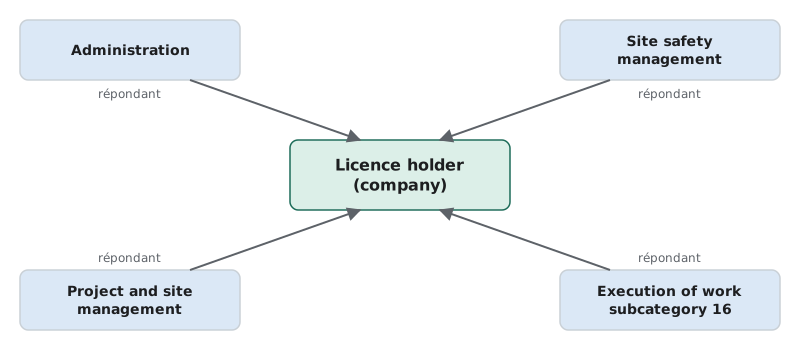
The CMEQ company application asks for at least one répondant in each of four domains:
- Administration, which covers the laws and rules that govern running a construction business: the Building Act and its regulations, contracts, labour relations, financial management and the obligations of a licence holder.
- Gestion de la sécurité sur les chantiers, or site safety management, which covers occupational health and safety law and the Safety Code for the construction industry.
- Gestion de projets et de chantiers, or project and site management, which covers planning, estimating, scheduling, site organization and quality.
- Exécution de travaux de construction, or execution of construction work, in the subcategories the company wants. For an electrical contractor, this is subcategory 16, and the competence assessed is technical: Chapter V, the practical requirements for installations, and the distributor's service requirements.
Each répondant must prove competence in the domain or domains they cover. A company cannot list a répondant who has not proven competence, and the domains are not interchangeable: passing the technical exams does not satisfy the administration domain.
How a répondant proves competence
The CMEQ application form describes four ways a répondant's competence can be assessed. The first is passing the CMEQ exam in the domain. The second is completing a training program the CMEQ recognizes for that domain. The third is a review of the person's professional record, which looks at past experience acting for a contractor in the domain. The fourth is competence already recognized, for example because the person has been a répondant before and the recognition is still valid.
The CMEQ's exam guide adds detail on exemptions. It describes two ways to be exempted from an exam: passing a CMEQ-recognized training program, or having acted as the responsible person for an electrical company within the past five years in the relevant field. It also says that a passing exam result remains valid for five years, after which the knowledge must be assessed again. The five-year rule matters for planning: a candidate who passes the administration exam now but does not become a répondant within five years will need to be assessed again.
| Route | What it involves | Typical candidate |
|---|---|---|
| Exam | Pass the CMEQ exam or exams for the domain | A first-time répondant such as Émilie |
| Recognized training | Complete a program the CMEQ recognizes for the domain | A candidate whose college or association program is recognized |
| Professional record | Review of documented experience acting for a contractor in the domain | Someone who already managed that domain for a contractor |
| Competence already recognized | Earlier recognition that remains valid | A former répondant returning within the validity period |
Does a répondant need to be an electrician?
Not in every domain. The administration, site safety and project management domains test management knowledge. A company can have an office manager, an estimator or a part-owner who is not an electrician serve as répondant in those domains if that person proves competence. The execution-of-work domain is different: the exams are technical, and in practice the candidates who pass them are electricians with substantial field experience, usually journeypersons.
The exam guide does not, in the version reviewed for this course, list a fixed number of years of trade experience as a precondition to sitting the execution-of-work exams. Candidates should check the current admission requirements with the CMEQ, because conditions for the technical domain have been revised in the past and may be set in the regulations rather than the guide. What the guide makes clear is that the exams assume real working knowledge: they are open-document exams on Chapter V, the CMEQ technical guide and the distributor's service standard, and they move quickly.
For Électrique Rivière-du-Nord, the plan is that Émilie will qualify in execution of work and site safety first, because those are closest to what she already does. Nadia, who has run the office for twelve years, is considering the administration exam. Project and site management will fall to Émilie in the second year. If Nadia does not qualify, Émilie will take administration as well.
Worked problem
Building the répondant plan
Réjean is répondant in all four domains. Émilie will qualify in execution of work and site safety in year one and project management in year two. Nadia may qualify in administration in year one. Which domains are covered by someone other than Réjean at the end of year one if both pass?
Show solution
- Execution of construction work, subcategory 16: Émilie.
- Site safety management: Émilie.
- Administration: Nadia.
- Project and site management: only Réjean until Émilie qualifies in year two.
Answer: Three of four domains. Réjean must remain répondant for project and site management until Émilie qualifies in it.
Conditions after the licence is issued
The CMEQ's admission form, which a company completes when it joins the corporation, lists conditions the company must meet within 30 days after its electrical contractor licence is issued. In the version reviewed for this course, these include an office of at least 15 square metres at the main place of business, a business telephone number listed in the local directory rather than a cellphone, a visible sign of at least 23 by 46 centimetres showing the company name and activity with the CMEQ logo of at least 15 by 15 centimetres, and the CMEQ logo and the full company name permanently displayed on the sides of commercial vehicles.
The form also says that until the licence is issued, the company may not present itself as an electrical contractor or CMEQ member. That rule catches new companies that print business cards, letter vehicles or advertise before the licence arrives. A company that does electrical work without the licence exposes itself to penal prosecution and to the CCQ's power to suspend work done without the required licences.
# Checking a new company's 30-day conditions (sizes in centimetres and square metres)
office_m2 = 14.2
sign_w, sign_h = 30, 45
logo_w, logo_h = 15, 15
listed_landline = True
vehicles_marked = 2
vehicles_total = 3

checks = {
    "Office at least 15 m2": office_m2 >= 15,
    "Sign at least 23 x 46 cm (either orientation)": max(sign_w, sign_h) >= 46 and min(sign_w, sign_h) >= 23,
    "Logo at least 15 x 15 cm": logo_w >= 15 and logo_h >= 15,
    "Listed business landline": listed_landline,
    "All commercial vehicles marked": vehicles_marked == vehicles_total,
}
for item, ok in checks.items():
print(("OK " if ok else "FIX ") + item)FIX Office at least 15 m2 FIX Sign at least 23 x 46 cm (either orientation) OK Logo at least 15 x 15 cm OK Listed business landline FIX All commercial vehicles marked
The output shows that this hypothetical new company needs a slightly larger office and must mark its third vehicle before the 30 days run out. The sizes come from the CMEQ form; check the current version for any changes.
The licence bond and other financial conditions
Most construction contractors in Quebec must provide a licence bond, a cautionnement de licence, which protects clients if the contractor fails to meet its contractual obligations. The CMEQ application asks for the original bond unless the applicant requests only the new-home subcategories, which are covered by the residential warranty plan instead. The RBQ's published amounts are 20,000 dollars for specialized contractors and 40,000 dollars for general contractors. Lesson 8 covers the bond, what it covers and how claims work.
Beyond the bond, the regulations governing contractor qualification can require proof of financial capacity, tax compliance and registration with the bodies an employer deals with. The application form reviewed for this course did not list insurance or financial statements as attachments, but a contractor will need liability insurance in practice, and public clients and general contractors will demand it. Lesson 8 covers insurance and contract bonds as well.
Out-of-province candidates
Quebec has labour mobility agreements with Ontario and other jurisdictions that address the recognition of trade qualifications and, in some cases, contractor qualifications. A contractor licensed elsewhere who wants to work in Quebec should not assume that its home licence is enough: it will usually need a Quebec licence with subcategory 16, qualified répondants, and compliance with Quebec labour rules on its sites. The CMEQ can explain which recognition routes are available. Candidates should also check the exemptions in the continuing education regulation, which treat certain members domiciled outside Quebec differently.
Common mistakes
MistakeAssuming a company's good finances can make up for a missing répondant.
InsteadEvery domain needs a qualified répondant; finances and integrity are separate conditions.
MistakeBelieving the execution-of-work exam result also covers administration.
InsteadEach domain is assessed separately. Technical competence does not prove administrative competence.
MistakeAdvertising or lettering vehicles as an electrical contractor before the licence is issued.
InsteadThe company may not present itself as an electrical contractor or CMEQ member until the licence is issued.
MistakePassing an exam and then waiting six years to act as répondant.
InsteadA passing result stays valid for five years, after which the knowledge must be assessed again.
Summary and key terms
- Eligibility has two layers: the company's identity, integrity and conditions, and the répondants' proven competence.
- The application identifies officers, shareholders and lenders and asks about criminal, tax and bankruptcy matters.
- Each of the four domains needs at least one répondant who proved competence by exam, recognized training, professional record or existing recognition.
- Exam results stay valid for five years; experience as a responsible person in the past five years can exempt a candidate.
- After the licence is issued, the company has 30 days to meet conditions on its office, telephone, sign and vehicles.
- NEQ
- Numéro d'entreprise du Québec, the Quebec enterprise number assigned to registered businesses.
- Exemption
- Relief from a CMEQ exam because of recognized training or recent experience as a responsible person.
- Professional record review
- Assessment of a répondant's competence based on documented experience acting for a contractor.
- Cautionnement de licence
- The licence bond that protects clients if a contractor fails to meet its contractual obligations.
- Officer
- A director or senior manager of a company, identified on the licence application.
Practice problems
Work each problem on paper first, then reveal the answer to check.
How long does a passing CMEQ exam result remain valid?
Show answer
Five years.
Name two ways, other than an exam, that a répondant can prove competence.
Show answer
Any two of: recognized training, professional record review, competence already recognized.
What minimum office size does the CMEQ admission form require?
Show answer
15 square metres at the main place of business.
Can a non-electrician be the répondant for administration?
Show answer
Yes, if that person proves competence in the administration domain.
What must a company with no Quebec enterprise number attach to its application?
Show answer
Its certificate of incorporation, shareholder agreement or partnership contract.
Lesson quiz · 5 questions
Score 60% or more to complete this lesson.
Create a free account to save your progress, take quizzes and earn a certificate.