
MELC-206 · Lesson 4 of 12 · 20 min
The exam format and the references allowed
▶ Video coming soon A video version of this lesson is on the way.
The CMEQ exams look different from most trade exams. They are open-document, but the documents are provided rather than brought, and each exam has its own set. They are multiple-choice, but they cover law and management as much as wiring. They run over three consecutive days, so stamina and planning matter as much as knowledge. This lesson describes the exams as the CMEQ's exam guide presents them, then turns that description into a preparation plan for each one.
The guide reviewed for this course was a revision published in 2020. It names specific editions of the reference documents, including the 2018 edition of Chapter V. Chapter V has since been updated to adopt the 2021 Canadian Electrical Code, in force on 26 March 2026 with a six-month transition. The CMEQ updates its exams and documents when the codes change, so confirm which editions your session uses before you study. The structure described here, five exams over three days with documents provided, is the part least likely to change.
The five exams
The guide describes five written exams for the electrical contractor licence. Each corresponds to a qualification domain or, for execution of work, to the two halves of the technical domain. The table summarizes the schedule and documents as the guide presents them.
| Exam | Duration in the guide | Documents provided at the sitting (guide edition) |
|---|---|---|
| Administration | 3 hours (8:30 to 11:30) | Building Act, the contractor qualification regulation, the construction labour relations Act |
| Site safety management | 1 hour 30 (13:00 to 14:30) | Industrial accidents and occupational diseases Act, occupational health and safety Act, Safety Code for the construction industry |
| Construction Code, Chapter V, Electricity | 3 hours (8:30 to 11:30) | Chapter V (2018 edition in the guide) |
| Execution of construction work | 2 hours 15 (13:00 to 15:15) | CMEQ technical guide (2019), Chapter V (2018), Hydro-Québec standard E.21-10 |
| Project and site management | 3 hours (8:30 to 11:30) | Construction Code, Chapter I, Building (2010 modified); no electronic agendas |
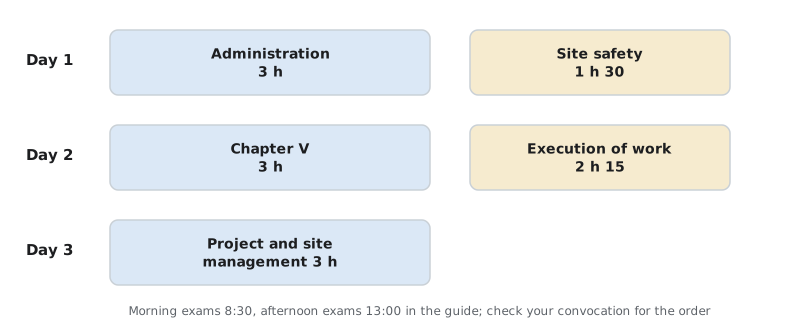
The guide gives each exam a fixed time slot. The exact order of the days can vary from session to session, so read your convocation. The pairing of a three-hour morning exam with a shorter afternoon exam is consistent across the guide's timetable, and it is worth planning for: by the afternoon of each day you will be tired, and the afternoon exams are short, so pacing errors cost more.
Question format
According to the guide, every exam is written, multiple-choice, with four options and only one correct answer, and every question in an exam carries the same value. Questions are available in French and English. The pass mark is 60 out of 100. The guide does not give the number of questions in each exam, so you cannot plan your pace from a published count. Instead, plan from the duration: at your first pass through the paper, note how many questions there are and divide the time.
Because the documents are provided and the questions all carry equal weight, the exams reward fast, accurate navigation of documents you have learned well in advance. A candidate who has to read the Building Act for the first time during the exam will not finish. A candidate who knows the Act's structure, the regulation's main sections and where the definitions are can find almost any answer in under two minutes.
The administration exam
The administration exam tests the laws and rules for running a construction business. The documents provided in the guide's edition were the Building Act, the regulation on the professional qualification of contractors and owner-builders, and the Act respecting labour relations, vocational training and workforce management in the construction industry. Expect questions on licence requirements and subcategories, the obligations of licence holders and répondants, changes the company must report, the licence bond, suspension and cancellation, the labour relations Act's rules on competency certificates and hiring, and the monthly reports to the CCQ.
Prepare by reading each document from beginning to end once, then building your own map of where each topic lives. The regulation on qualification is the document most candidates under-prepare. It contains the conditions for issuing a licence, the rules on répondants, the reasons for refusal, suspension and cancellation, and many of the time limits for reporting changes.
The site safety management exam
The site safety exam is short, and it covers three documents in the guide's edition: the Act respecting industrial accidents and occupational diseases, the Act respecting occupational health and safety, and the Safety Code for the construction industry. Expect questions on the duties of employers, workers and the principal contractor, prevention programs and site committees, the right to refuse dangerous work, accident reporting, and specific Safety Code requirements such as work near power lines, fall protection, and lockout. Lesson 10 covers this material. With only 90 minutes, pacing is critical; skip anything that needs a long search on the first pass.
The Chapter V exam
The Chapter V exam is the closest to a conventional code exam. The document provided is Chapter V of the Construction Code, which contains the Canadian Electrical Code as amended for Quebec. Expect the same kinds of questions as the core courses prepare you for: definitions, wiring methods, conductor sizing, overcurrent protection, grounding and bonding, demand loads and special installations, with Quebec amendments where they apply. The core courses' navigation and calculation skills transfer directly. Lesson 5 explains how Chapter V is organized and how the Quebec amendments appear.
The execution of construction work exam
The execution exam tests practical knowledge of how installations are carried out in Quebec. The documents in the guide's edition were the CMEQ's technical guide, Chapter V and Hydro-Québec's standard for electrical service connections, known as E.21-10. Expect questions that combine the three: for example, a service entrance arrangement that must satisfy both Chapter V and the distributor's requirements, or a typical installation detail described in the technical guide. Candidates who have only studied the code are often surprised by how much of this exam depends on the distributor's standard.
Get to know the distributor standard's structure before the exam. It covers the arrangements for service connections, metering, the responsibilities of the customer and the distributor, and many dimensional requirements. Lesson 6 explains how the distributor fits into the work process.
The project and site management exam
The project management exam covers planning and running construction work. The document provided in the guide's edition was Chapter I, Building, of the Construction Code, which is Quebec's adoption of the National Building Code with modifications. Electronic agendas are not allowed. Expect questions on estimating and bidding, scheduling, site organization, quality control, plans and specifications, and the building code requirements an electrical contractor meets on a project, such as fire separations and the integrity of assemblies that cables and raceways pass through.
Total exam time
Worked problem
Adding up the exam time
Using the durations in the guide, how many hours of writing does a candidate face if they sit all five exams?
Show solution
- Administration: 3 hours.
- Site safety management: 1.5 hours.
- Chapter V: 3 hours.
- Execution of construction work: 2.25 hours.
- Project and site management: 3 hours.
- Total: 3 + 1.5 + 3 + 2.25 + 3 = 12.75 hours.
Answer: 12.75 hours, or 12 hours 45 minutes, spread over three days.
# Time budget per question once you know the count at the sitting
exams = {
    "Administration": 180,
    "Site safety management": 90,
    "Chapter V": 180,
    "Execution of construction work": 135,
    "Project and site management": 180,
}
# The guide does not publish question counts; these are counts you might find on the day
seen = {"Administration": 75, "Site safety management": 40, "Chapter V": 80,
        "Execution of construction work": 60, "Project and site management": 70}
total = sum(exams.values())
print(f"Total writing time: {total} minutes = {total / 60:.2f} hours")
for name, minutes in exams.items():
    reserve = 15 if minutes >= 135 else 10
    per_q = (minutes - reserve) / seen[name]
print(f"{name:<34}{per_q:4.1f} min per question, {reserve} min reserve")Total writing time: 765 minutes = 12.75 hours Administration 2.2 min per question, 15 min reserve Site safety management 2.0 min per question, 10 min reserve Chapter V 2.1 min per question, 15 min reserve Execution of construction work 2.0 min per question, 15 min reserve Project and site management 2.4 min per question, 15 min reserve
The question counts in the code are invented for illustration; the guide does not publish them. The method is what matters: at the start of each exam, count the questions, set aside a reserve, and divide.
Language and terminology
Questions are available in French and English, and the documents exist in both languages. Many candidates who work in English on site still find it useful to know the French terms, because forms, site signs and conversations with inspectors often use them. A short glossary helps: répondant, déclaration de travaux, avis de correction, maître d'oeuvre, hypothèque légale, cautionnement. This course gives the French term the first time each concept appears.
Building your own map of each document
Because you will work from clean copies provided at the sitting, your preparation has to live in your head rather than in tabs and margin notes. The most effective way to build that is a one-page map of each document. For the Building Act, list the main divisions and the subjects each covers: application and definitions, the RBQ, licences, contractor obligations, guarantees, codes, inspection and enforcement, penal provisions. Do the same for the qualification regulation, the labour relations Act, the three safety documents and Chapter V. Rewrite each map from memory every week until you can draw it in five minutes.
Then practise with the real documents. Choose a topic at random, such as the reasons a licence can be suspended, the duties of the principal contractor, or the rule on box fill, and time how long it takes to find the answer. Aim for under a minute for common topics and under two for rare ones. Candidates who do this for a few weeks report that the exam feels like a familiar search rather than a reading test.
Reading the question before the options
Multiple-choice questions on legal documents often include distractors that are true statements about the wrong situation. A question about the duties of the principal contractor may offer an option that correctly describes the duties of every employer. Read the question stem first, decide what you are looking for, find it in the document, and only then look at the options. If two options both look right, reread the stem for the word that separates them: principal contractor or employer, within or after, minimum or maximum, licence holder or répondant.
Calculation questions in the Chapter V and execution exams deserve the same discipline. Write down the rule you are applying and its result before choosing an option. A wrong option is often the answer you would get by skipping a step, such as forgetting a correction factor or using the wrong voltage, so landing on an option is not proof that you are right.
Energy across three days
Five exams in three days is a long effort. Most candidates find that their accuracy drops in the last hour of each day. Plan your reserve time for that hour, and use short breaks if the session allows them. A candidate who arrives on day three rested will often outperform a candidate who knows more but studied late every night.
Common mistakes
MistakePlanning your pace from a question count found online.
InsteadThe guide does not publish counts; count the questions at the sitting and divide your time then.
MistakeStudying only the code for the execution exam.
InsteadThe execution exam also uses the CMEQ technical guide and the distributor's service standard.
MistakeAssuming the editions named in an old guide are still current.
InsteadChapter V adopted the 2021 Canadian Electrical Code from 26 March 2026; confirm the editions used at your session.
MistakeTreating the 90-minute safety exam as the easy one.
InsteadIt covers three documents in very little time, so pacing and navigation are critical.
Summary and key terms
- There are five written, multiple-choice exams over three consecutive days, with documents provided.
- Each question has four options, one correct answer and equal weight; the pass mark is 60 out of 100.
- Administration, site safety, Chapter V, execution of work and project management each have their own documents.
- The execution exam combines Chapter V, the CMEQ technical guide and Hydro-Québec's service standard.
- Total writing time in the guide's timetable is 12.75 hours; confirm current editions and order before your session.
- Open-document exam
- An exam where reference documents are available; at the CMEQ, they are provided at the sitting.
- E.21-10
- Hydro-Québec's standard for electrical service connections, used in the execution exam.
- Chapter I, Building
- The building chapter of the Quebec Construction Code, used in the project management exam.
- Technical guide
- The CMEQ's practical guide to installations, provided in the execution exam.
- Reserve time
- Minutes kept back at the end of an exam to return to skipped questions.
Practice problems
Work each problem on paper first, then reveal the answer to check.
How many CMEQ exams does the guide describe for the electrical contractor licence?
Show answer
Five.
Which exam is 90 minutes long in the guide's timetable?
Show answer
Site safety management.
Which three documents were provided for the execution exam in the guide's edition?
Show answer
The CMEQ technical guide, Chapter V and Hydro-Québec standard E.21-10.
What is the total writing time across all five exams?
Show answer
12.75 hours.
Which device does the guide specifically exclude from the project management exam?
Show answer
Electronic agendas.
Lesson quiz · 5 questions
Score 60% or more to complete this lesson.
Create a free account to save your progress, take quizzes and earn a certificate.