
MELC-206 · Lesson 6 of 12 · 21 min
Permits, inspections and the inspection authority
▶ Video coming soon A video version of this lesson is on the way.
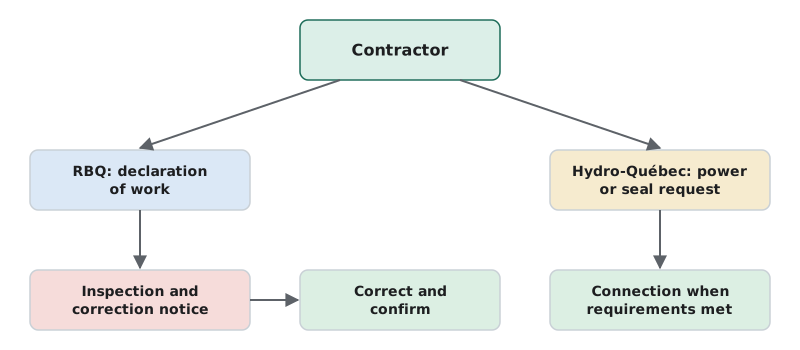
Candidates who come to Quebec from other provinces often look for the electrical permit and cannot find one. In Alberta or Ontario, a contractor takes out a permit or files a notification before work and an inspector reviews the work against it. Quebec's system works differently. For work covered by Chapter V, the licensed contractor files a declaration of work, a déclaration de travaux, with the RBQ in the cases and within the deadlines the Code sets. The RBQ uses those declarations, along with complaints and its own programs, to decide where to inspect. The distributor, Hydro-Québec, handles connection and seal requests separately. This lesson explains how those pieces fit together and who the inspection authority is.
The details of the declaration system, including exactly which work must be declared, the deadlines and the fees, are set in the Construction Code and the RBQ's fee schedule and are revised from time to time. This lesson describes the system's structure and points to the places to check. It does not quote deadlines or fees that could not be confirmed against the current official text when the course was written.
The declaration of work
A declaration of work tells the RBQ that regulated work is being done at a given place, by a given licensed contractor, for a given owner. The CMEQ's fact sheet on who does what lists the RBQ as the body that receives declarations of work, in the cases and within the deadlines set by the Code. For electricity, the relevant provisions are in Chapter V. The contractor that does the work, through its répondant and its office, is responsible for filing.
The declaration is not an approval. The RBQ does not review a design before work starts in the way a plan reviewer would. Instead, the declaration creates a record that the RBQ can use to choose installations for inspection and to follow up on complaints. A contractor that fails to file when required exposes itself to penal proceedings and loses the record that shows the work was declared.
For other systems, the RBQ publishes the rule in a form that shows how the system works. For gas installations, for example, its page says the contractor or owner-builder files after work starts, no later than the 20th day of the month following the start of the work. Do not assume the electrical rule is the same. Read the declaration provisions in the current Chapter V and the RBQ's guidance for electricity, and set up your office procedure from them.
What a declaration records
A declaration generally identifies the installation's address, the owner, the contractor and its licence number, the nature of the work, its scale or value, and the dates. Nadia keeps a declaration log for Électrique Rivière-du-Nord so that she can match every job in the accounting system to a declaration number, or to a written reason why no declaration was required. That habit pays off when the RBQ asks about a job months later, and it makes the répondant's oversight easier.
| Field in Nadia's log | Why it matters |
|---|---|
| Job number and address | Links the declaration to the accounting record and the site |
| Owner and contact | The RBQ may contact the owner; the client must know a declaration exists |
| Type and scale of work | Determines whether a declaration is required and what fee applies |
| Start date and filing date | Shows the declaration met the deadline in the Code |
| Declaration number | Proof of filing; goes on the job file and the quality checklist |
| Reason if not declared | Documents why the Code did not require a declaration |
from datetime import date

# Office log: flag jobs whose declaration is missing or late.
# DUE_DAYS is a placeholder for your office rule; set it from the current Chapter V provisions.
DUE_DAYS = 10
jobs = [
    ("J-2611", date(2026, 10, 5), date(2026, 10, 9), "D-55120"),
    ("J-2612", date(2026, 10, 7), None, None),
    ("J-2613", date(2026, 10, 12), date(2026, 10, 29), "D-55301"),
    ("J-2614", date(2026, 10, 14), None, "not required: maintenance only"),
]
today = date(2026, 10, 30)
for job, start, filed, number in jobs:
    if number and not filed:
        status = number
    elif not filed:
        late = (today - start).days > DUE_DAYS
        status = "MISSING, past office deadline" if late else "missing, still within office deadline"
    else:
        status = "late" if (filed - start).days > DUE_DAYS else "on time"
print(f"{job} started {start} {status}")J-2611 started 2026-10-05 on time J-2612 started 2026-10-07 MISSING, past office deadline J-2613 started 2026-10-12 late J-2614 started 2026-10-14 not required: maintenance only
The deadline in the code is a placeholder, labelled as such. Replace it with the rule in the current Code, and keep the log simple enough that it is actually used.
The RBQ as inspection authority
The RBQ is the inspection authority for Chapter V in Quebec. Its inspectors check installations for compliance with the Construction Code and the Safety Code. Inspections may be chosen from declarations, targeted at particular types of work or contractors, triggered by complaints or incidents, or part of the RBQ's broader programs. When an inspector finds a non-conformity, the RBQ issues a correction notice, an avis de correction, which the contractor must act on. The CMEQ fact sheet lists inspections and correction notices among the RBQ's roles and says the contractor must follow up.
A correction notice identifies the non-conforming items and sets the expectations for correcting them. The contractor corrects the work, confirms the correction in the way the notice requires, and keeps the documents. Ignoring a correction notice can lead to further enforcement, including penal proceedings, and repeated non-compliance can affect the contractor's standing and its licence. The RBQ also investigates and prosecutes offences under the Building Act.
Worked problem
A correction notice at the dental clinic
An RBQ inspector visits the dental clinic renovation Émilie's crew completed and issues a correction notice listing three items: a missing bonding connection to a metal water pipe, an unlabelled panel circuit directory and a receptacle without the required protection in an exam room. What should Émilie do?
Show solution
- Read the notice carefully and confirm the location and the rule cited for each item.
- Schedule the corrections promptly and assign a journeyperson to do them, with Kevin assisting for training.
- Check the rest of the job for the same errors, since one missed bond often means others.
- Confirm the corrections to the RBQ as the notice requires and file the notice, the corrections and photos in the job record.
- Review why the items were missed and add them to the company's quality checklist.
Answer: Correct all three items, confirm to the RBQ as required, check for similar errors and update the quality checklist.
The CNESST as the other inspector
The RBQ is not the only inspector on a Quebec site. The CNESST inspects for health and safety, and it also issues correction notices and can stop work that presents a danger. An electrical contractor can receive a notice from either body, for different reasons, on the same day. Lesson 10 covers the CNESST in detail. The point here is to keep the two straight: an RBQ notice is about the installation's compliance with the codes, and a CNESST notice is about the safety of the workers and the workplace.
Hydro-Québec requests
Work that connects to the distribution system involves Hydro-Québec. The CMEQ fact sheet lists two kinds of requests the distributor receives from contractors: requests to remove a seal, called descellement, and requests for power supply, called demandes d'alimentation. Both must be made within the deadlines in the distributor's service standard. A new service, a service upgrade or meter work usually requires a request, and the distributor will not connect or reconnect until the installation meets its requirements.
Hydro-Québec's standard for electrical service connections, E.21-10, is known in the industry as the blue book. It is a reference document in the CMEQ execution-of-work exam, and it is the document a contractor uses daily for service arrangements, metering locations and clearances. The distributor publishes updates and notices; check the current edition before relying on a requirement.
| Situation | Who to contact | Document to check |
|---|---|---|
| New service or service upgrade | Hydro-Québec (power supply request) | Distributor service standard E.21-10 |
| Meter base work that needs the seal removed | Hydro-Québec (seal removal request) | Distributor service standard E.21-10 |
| Regulated electrical work covered by Chapter V | RBQ (declaration of work, where required) | Chapter V declaration provisions |
| Inspection or correction notice about the installation | RBQ | The notice and Chapter V |
| Health and safety on the site | CNESST | Safety Code for the construction industry |
Municipal permits
Municipalities in Quebec issue building permits under their own planning and building bylaws. Electrical work is regulated provincially by the RBQ through Chapter V, but an electrical contractor working on a project that needs a municipal building permit must still respect the permit's conditions and the municipality's bylaws, for example on hours of work, signs or the location of equipment. On larger projects, the general contractor or owner usually obtains the municipal permit. On a small renovation where Électrique Rivière-du-Nord is the only trade, Nadia checks whether the owner needs a municipal permit before work starts and makes sure the client knows it is their responsibility.
The RBQ payroll declaration
The RBQ's electrical licence pages also list a payroll declaration, a déclaration de la masse salariale, among the obligations of contractors. It is separate from declarations of work and is filed annually on the RBQ's form. Its purpose and the way it is used are set out in the RBQ's guidance and fee rules; Nadia diarizes it each year alongside the CCQ monthly reports and the CNESST payroll declaration so that none is missed.
What happens during an RBQ inspection
An RBQ inspection of an electrical installation usually starts with the inspector identifying the installation, the owner and the contractor, often from a declaration. The inspector examines the parts of the installation that are accessible and visible, may ask for the panel to be opened or for covers to be removed, and checks the work against Chapter V. A contractor representative who knows the job should be available if possible, because questions about design choices, conductor sizes or protective devices are easier to answer on the spot than in writing afterwards.
The inspector records any non-conformities. If there are any, the RBQ issues a correction notice that lists them and sets out what must be done. A careful contractor reads each item, checks the rule cited, and asks for clarification promptly if an item seems mistaken; arguing after the deadline has passed is much harder than asking a question the same week.
Building good habits into the job file
Inspections go better when the job file is complete. Émilie's standard job file holds the contract or work order, the drawings and any changes, the load calculation, the panel schedule, the declaration number, the distributor request numbers, the completed quality checklist, test results such as insulation resistance and ground fault tests where they were done, and photos of work that will be concealed. When the RBQ or a client asks a question, the answer is in one place.
Photos are particularly valuable. A photo of a bonding connection or a box before the drywall goes up can settle a question about concealed work without opening a wall. The crew photographs concealed work as a habit, and Nadia files the photos by job number and date.
Complaints and incidents
Some RBQ inspections follow a complaint from a client, a neighbour or another trade, or an incident such as a fire or a shock. In those cases, the inspector may focus on a particular part of the installation. The contractor should cooperate, provide its documents and avoid altering the installation before the inspector has seen it, unless a hazard must be made safe. If a hazard must be addressed immediately, document the condition with photos first and tell the inspector what was done.
Common mistakes
MistakeWaiting for an electrical permit before starting work, as in another province.
InsteadQuebec uses declarations of work to the RBQ in the cases and deadlines set by Chapter V; there is no provincial electrical permit to wait for.
MistakeAssuming the electrical declaration deadline is the same as the gas one.
InsteadEach system has its own rules; read the Chapter V provisions and the RBQ guidance for electricity.
MistakeTreating a correction notice as optional because the job is finished.
InsteadThe contractor must correct the work and confirm as the notice requires, or face further enforcement.
MistakeForgetting the distributor until the day of connection.
InsteadMake seal removal and power supply requests within the deadlines in the distributor's standard.
Summary and key terms
- Quebec electrical contractors file declarations of work with the RBQ in the cases and within the deadlines set by Chapter V.
- A declaration is a record, not an approval; the RBQ uses it, complaints and its programs to choose inspections.
- The RBQ is the inspection authority for Chapter V and issues correction notices that the contractor must act on.
- The CNESST inspects separately for health and safety.
- Hydro-Québec receives seal removal and power supply requests under its service standard E.21-10, the blue book.
- Déclaration de travaux
- A declaration of work filed with the RBQ for regulated work, in the cases and deadlines set by the Code.
- Avis de correction
- A correction notice listing non-conformities that must be corrected.
- Descellement
- Removal of a distributor seal, requested from Hydro-Québec.
- Demande d'alimentation
- A request to Hydro-Québec for electrical power supply.
- Blue book
- Industry name for Hydro-Québec's service connection standard E.21-10.
Practice problems
Work each problem on paper first, then reveal the answer to check.
Which body receives declarations of work for electrical installations?
Show answer
The RBQ.
Is a declaration of work an approval of the design?
Show answer
No. It is a record the RBQ uses to choose inspections and follow up.
Name the two kinds of requests the CMEQ fact sheet says Hydro-Québec receives from contractors.
Show answer
Seal removal requests and power supply requests.
Who issues correction notices for health and safety matters?
Show answer
The CNESST.
What is the blue book?
Show answer
Hydro-Québec's standard for electrical service connections, E.21-10.
Lesson quiz · 5 questions
Score 60% or more to complete this lesson.
Create a free account to save your progress, take quizzes and earn a certificate.