
MELC-205 · Lesson 9 of 12 · 20 min
Contracts and construction liens in Ontario
▶ Video coming soon A video version of this lesson is on the way.
Electrical contractors build things for other people and then wait to be paid. Ontario's Construction Act exists largely to manage that wait: it sets up holdbacks so that money is set aside for everyone down the chain, gives contractors and suppliers lien rights against the property when they are not paid, sets prompt payment deadlines, and provides a fast adjudication process for disputes. The Act was overhauled in 2018 and 2019, when it was renamed from the Construction Lien Act and prompt payment and adjudication were added, and amended again with changes that came into force on 1 January 2026. Business Administration questions on the ME exam draw on these rules, and every DME who signs off on invoices and change orders needs to understand them. This lesson explains the main ideas using Grand River's café job; it is not legal advice, and the Act's exact deadlines should always be checked in its current text or with a lawyer.
Builders' liens or construction liens?
Several provinces, including Alberta and British Columbia, call these claims builders' liens and have statutes named for them. Ontario's statute calls them construction liens, and since the 2018 changes the statute itself is simply the Construction Act. The idea is the same, but the rules are not: deadlines, holdback rules, prompt payment and adjudication all differ from province to province. Tyler, who learned the Alberta terms, has to unlearn some of them. On the exam, use the Ontario terms and the Ontario rules, and do not assume that a deadline you learned elsewhere applies here.
Contract basics
A contract needs an offer, an acceptance, something of value exchanged in each direction and an intention to be bound. In construction, written contracts are the norm, and standard forms are widely used. In Canada, the Canadian Construction Documents Committee publishes standard forms for prime contracts between owners and contractors and for subcontracts, and many owners and general contractors use them with their own supplementary conditions. A standard form gives both sides a familiar structure: scope, price, schedule, how changes are handled, payment, warranties, insurance and dispute resolution.
Changes are where most disputes begin. A change order is an agreed change to scope, price or time, signed by both parties. A change directive, in contracts that allow it, is an instruction from the owner or consultant to proceed with a change before the price is agreed, with the value settled later. Maria's rule on the café job is simple: no extra work without a signed change order or written directive. When the general contractor's superintendent asks Grand River to add four receptacles for a coffee machine the client forgot, she writes up the change, gets it signed by the general contractor's project manager, and only then sends Liam to do it.
Holdbacks
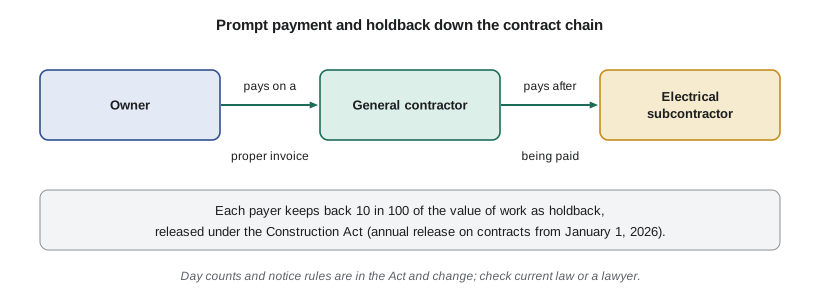
The holdback is the Act's oldest protection. Each payer in the construction pyramid, from the owner down, retains 10 in 100 of the value of the services and materials supplied under each contract or subcontract as they are invoiced. The money is held back so that, if someone further down the chain goes unpaid, there is a fund to answer their lien. The Act also allows a separate finishing holdback for the last part of the work in some situations.
Holdback used to be released only after substantial performance of the whole project, which on long projects could mean waiting years. The amendments in force from 1 January 2026 introduced a mandatory annual release regime: on each anniversary of the owner–contractor contract, the owner must publish notice within 14 days and pay the accrued holdback within a set window afterwards, unless liens have been preserved, and contractors must then pass holdback down to their subcontractors within 14 days of being paid. For contracts that were already in effect, the annual release begins on a later anniversary under transition rules. The details have exceptions, so read the current provisions before relying on them.
Worked problem
Holdback on a progress invoice
Grand River's subcontract for the Victoria Street café is 120,000 dollars plus HST. Its first progress invoice is for 30,000 dollars of work completed, plus HST. How much holdback does the general contractor keep, and how much does it pay on this invoice before HST?
Show solution
- Holdback is 10 in 100 of the value of the work invoiced: 0.10 × 30,000 = 3,000 dollars.
- The amount paid before HST is 30,000 − 3,000 = 27,000 dollars.
- HST is handled under the tax rules; holdback is calculated on the value of the work, so check how your contract and accountant treat HST on holdback.
- The 3,000 dollars is released later under the Act's holdback provisions.
Answer: The general contractor holds back 3,000 dollars and pays 27,000 dollars plus the applicable tax.
contract = 120_000
invoices = [30_000, 42_000, 36_000, 12_000]   # value of work billed each month, before tax
held = paid = 0
for month, value in enumerate(invoices, start=1):
    holdback = round(value * 0.10, 2)
    held += holdback
    paid += value - holdback
    print(f"Month {month}: billed {value:>7,}  paid {value - holdback:>9,.2f}  holdback {holdback:>8,.2f}")
print(f"Billed {sum(invoices):,} of {contract:,}; paid {paid:,.2f}; holdback retained {held:,.2f}")Month 1: billed 30,000 paid 27,000.00 holdback 3,000.00 Month 2: billed 42,000 paid 37,800.00 holdback 4,200.00 Month 3: billed 36,000 paid 32,400.00 holdback 3,600.00 Month 4: billed 12,000 paid 10,800.00 holdback 1,200.00 Billed 120,000 of 120,000; paid 108,000.00; holdback retained 12,000.00
By the end of the job, 12,000 dollars of Grand River's money sits in holdback. On a small job that is a manageable delay; across a dozen jobs it is a serious part of a contractor's cash flow, which is why the annual release regime matters to subcontractors.
Prompt payment
Before 2019, there was no general legal deadline for paying contractors in Ontario; payment depended on the contract and on negotiation. The prompt payment rules changed that. In broad terms, an owner must pay a contractor's proper invoice within a fixed number of days unless it gives a notice of non-payment within a shorter period, and a contractor must pay its subcontractors within a fixed number of days after receiving payment, with its own notice process if it was not paid. The commonly cited figures are 28 days for the owner and 7 days for the contractor to pay down the chain, but the notices, exceptions and transition rules are detailed, so confirm them in the Act.
The 2026 amendments tightened the definition of a proper invoice. An invoice is now deemed proper unless the owner gives written notice of a deficiency, identifying what is wrong and how to fix it, within seven days of receiving it. For a subcontractor like Grand River, the practical effect is to make the payment clock more predictable. Aisha makes sure every invoice includes the information the Act and the contract require: the contractor's name and address, the date, the period covered, the work done, the contract or purchase order reference, the amount and the payment terms, and the name and address of the person to receive payment.
Liens
A construction lien is a claim against the owner's interest in the land, given to anyone who supplies services or materials to an improvement and is not paid. It is a powerful remedy because it attaches to the property, not just to the person who owes the money. To use it, a lien claimant must preserve the lien within a strict time and then perfect it by starting a court action within a further time. The commonly cited periods since 2019 are 60 days to preserve, generally running from the publication of a certificate of substantial performance or from completion or abandonment of the claimant's work, and 90 days after the last day for preservation to perfect. Miss the deadline and the lien expires, though the debt itself may still be pursued in other ways.
Lien rights can also arise for people who never had a contract with the owner. A supplier who sold wire to Grand River for the café, and was not paid by Grand River, could preserve a lien against the café owner's interest even though the owner never ordered anything from that supplier. That is exactly the situation the holdback system is designed to cover, and it is why general contractors ask subcontractors for statutory declarations that their own suppliers and workers have been paid before releasing holdback.
Liens interact with holdback. In general, an owner who has properly retained and paid holdback according to the Act limits its exposure to liens to the holdback amount. That is why owners and general contractors take holdback seriously, and why a subcontractor who has not been paid should register a lien in time rather than wait for promises. Maria has never registered a lien, but she knows Grand River's lawyer's number and keeps a calendar of substantial performance dates for each job.
| Tool | Purpose | Key timing (check the Act) |
|---|---|---|
| Holdback | Fund to protect people down the chain | 10 in 100 retained; annual release on contracts from 2026 |
| Prompt payment | Fixed payment deadlines | Owner and contractor deadlines after a proper invoice |
| Lien | Claim against the property | Preserve within 60 days; perfect within 90 days after |
| Adjudication | Fast interim decisions on disputes | Up to 90 days after completion under the 2026 rules |
Adjudication
Adjudication is a fast, interim dispute process run through the Ontario Dispute Adjudication for Construction Contracts authority, known as ODACC. A party can refer a dispute about payment, valuation of work, change orders, set-offs and other matters to an adjudicator, who decides it on a short timetable. The decision is binding in the meantime and can be enforced, although the parties can later go to court or arbitration. The 2026 amendments extended the time to start an adjudication: notice can now be given within 90 days after the contract is completed, abandoned or terminated, where it previously had to be given before completion. They also allowed private adjudicators in some circumstances and provide for publication of determinations.
For a small contractor, adjudication is often the most practical way to resolve a disputed invoice, because it is faster and cheaper than court. On the café job, the general contractor refuses to pay for the coffee machine receptacles, claiming they were in the original scope. Because Maria had a signed change order, the dispute ends with a phone call; without it, Grand River would have had to decide whether a few hundred dollars justified an adjudication.
Substantial performance, completion and warranties
Many of the Act's deadlines run from substantial performance or completion, so it helps to know what those mean. Substantial performance is reached when the improvement, or a substantial part of it, is ready for use or is being used for its intended purpose and the remaining work can be finished for a relatively small cost, measured against a formula in the Act. A payment certifier or the owner and contractor can certify substantial performance, and the certificate is published, which starts important clocks. Completion is the point when the remaining work is truly finished, subject to the Act's rules for minor remaining items.
Warranties are separate from the lien and holdback rules. Most contracts include a warranty period, often one year from substantial performance, during which the contractor must fix defects in its work at its own cost. Deficiencies identified at the end of a job are usually listed and corrected before final payment of any remaining amounts. On the café job, the general contractor's deficiency list includes two missing cover plates and an unlabelled circuit in the panel schedule. Liam fixes them in an hour, and Maria photographs the corrected items for the close-out file, because a clean close-out keeps the holdback release on schedule.
What the DME needs to do
The Construction Act is business law, but it touches a DME's daily work. The DME often decides when work is complete, signs off on change orders, and knows which jobs are falling behind on payment. Maria's checklist for each job includes: a written contract with clear scope; signed change orders before extra work; invoices that meet the proper invoice rules; a record of holdback retained by the payer; the date of substantial performance or completion; and an alert when lien deadlines approach. None of this is electrical code, but all of it decides whether Grand River gets paid for code-compliant work.
Common mistakes
MistakeDoing extra work on a verbal request.
InsteadGet a signed change order or written change directive before doing extra work.
MistakeForgetting that holdback applies at every tier.
InsteadEach payer retains 10 in 100; track holdback owed to you on every job.
MistakeWaiting too long to preserve a lien.
InsteadLien deadlines are strict; preserve within the time in the Act.
MistakeRelying on pre-2026 holdback rules.
InsteadAnnual holdback release and proper invoice changes took effect on 1 January 2026.
Summary and key terms
- Ontario's Construction Act provides holdbacks, liens, prompt payment and adjudication.
- Each payer retains 10 in 100 as holdback; contracts from 2026 have mandatory annual holdback release.
- Prompt payment sets deadlines for owners and contractors after a proper invoice; from 2026 an invoice is deemed proper unless a deficiency notice is given within seven days.
- Liens must be preserved and perfected within strict time limits, commonly 60 and 90 days.
- Adjudication through ODACC gives fast interim decisions; notice can be given up to 90 days after completion.
- Holdback
- Money retained by a payer, 10 in 100 of the value of work, to protect lien claimants.
- Proper invoice
- An invoice that meets the Act's content requirements and starts the prompt payment clock.
- Construction lien
- A claim against the owner's interest in the land by an unpaid supplier of services or materials.
- Adjudication
- A fast interim dispute process under the Construction Act.
- Change order
- A signed agreement changing a contract's scope, price or time.
Practice problems
Work each problem on paper first, then reveal the answer to check.
What share of the value of work is retained as holdback?
Show answer
10 in 100.
What authority runs construction adjudication in Ontario?
Show answer
ODACC.
From 2026, when is an invoice deemed proper?
Show answer
Unless the owner gives written notice of a deficiency within seven days.
Holdback on a 50,000 dollar invoice?
Show answer
5,000 dollars.
What document should exist before extra work?
Show answer
A signed change order or written change directive.
Lesson quiz · 5 questions
Score 60% or more to complete this lesson.
Create a free account to save your progress, take quizzes and earn a certificate.