
MELC-205 · Lesson 8 of 12 · 20 min
Contractor licensing, insurance and bonding
▶ Video coming soon A video version of this lesson is on the way.
The Business Administration section of the exam assumes that a Master Electrician understands how an electrical contracting business is set up and kept legal. Maria has worked for Grand River for years, but the office side has always been Frank's and Aisha's world. As a future DME, and possibly one day an owner, she needs to know what the company must have in place to hold its Electrical Contractor licence: a designated ME, the required insurance, workplace insurance coverage, correct display of the licence, and the paperwork that keeps it all current. She also needs to understand bonds, which the licence does not require but many contracts do. This lesson covers those topics in general terms; exact amounts and requirements are in Ontario Regulation 570/05, the Workplace Safety and Insurance Act, the Construction Act and the contracts themselves, so check the current versions.
Getting an Electrical Contractor licence
A business applies for an Electrical Contractor licence through ESA's online licensing platform. The application identifies the business and its owners, names at least one licensed Master Electrician to be designated as DME, and provides evidence of the insurance and workplace insurance coverage the regulation requires. ESA charges an application fee and an annual licence fee, which are listed on its fees page. The licence is issued to the business entity, so a sole proprietor and a corporation owned by the same person are different licensees; if Maria later incorporated her own company, the corporation would need its own licence.
The Director of Licensing can refuse an application, or later propose to suspend or revoke a licence, for reasons set out in the regulation, including past conduct that suggests the business will not operate honestly and lawfully. As with the ME licence, the applicant receives a notice of proposal and may request a hearing. In practice, most applications go through without difficulty if the business has a qualified DME, the right insurance and no history of serious problems.
Choosing a business structure
Exam questions in Business Administration sometimes step back from electrical law to general business basics, and the structure of the business is one of them. A sole proprietorship is the simplest: one person owns the business, keeps the profits and is personally responsible for its debts. A partnership spreads ownership among two or more people, who share profits and, in a general partnership, share personal liability for the firm's debts. A corporation is a separate legal person, incorporated provincially or federally; its owners are shareholders whose personal liability is generally limited to their investment, although directors can be personally liable for some obligations, such as unpaid wages and certain taxes.
Grand River Electrical Contracting Ltd. is an Ontario corporation, with Frank as its main shareholder and director. The licence is held by the corporation, not by Frank personally. If Maria eventually buys the business, the simplest route may be to buy Frank's shares, so that the licensed corporation continues and its licence, contracts and WSIB account stay in place, with ESA notified of the change in ownership. Buying the business's assets into a new company would instead mean a new licensee and a new licence application. Those decisions involve lawyers and accountants, but a Master Electrician should understand why the choice matters.
Tax registrations follow from the structure. A business that makes taxable sales above the small supplier threshold must register for and collect the harmonized sales tax, and an employer must register a payroll account, deduct income tax, Canada Pension Plan contributions and Employment Insurance premiums from employees' pay and remit them on time. Unpaid source deductions are one of the obligations that can follow a corporation's directors personally, which is one reason Aisha treats remittance dates as fixed deadlines.
Insurance the licence requires
ESA's guideline on duties summarizes section 8 of the regulation: a licensed contractor must keep the liability insurance the regulation requires and maintain its registration with the Workplace Safety and Insurance Board. If it stops meeting either requirement, it must notify ESA immediately and stop operating until it complies again. The regulation sets the minimum liability coverage; read the current amount in your legislation book rather than relying on a figure you heard on a job site. Insurers usually provide a certificate of insurance that ESA can rely on, and the contractor must make sure the policy is renewed before it expires.
Most contractors carry more insurance than the licence requires, because clients and general contractors demand it. A typical small electrical contractor might hold commercial general liability insurance, automobile insurance for its vehicles, coverage for tools and equipment, and, if it does design work, professional liability insurance. General contractors often require higher liability limits than the minimum and ask to be named as additional insureds on the subcontractor's policy. Aisha keeps a schedule of all of Grand River's policies with their renewal dates and limits, and a folder of certificates sent to clients.
| Insurance | What it covers | Required by |
|---|---|---|
| Commercial general liability | Injury or damage to third parties caused by the business | The licensing regulation (minimum) and most contracts |
| Workplace insurance (WSIB) | Workers injured on the job | Workplace Safety and Insurance Act |
| Automobile | Company vehicles | Ontario law for vehicles |
| Tools and equipment | Loss or theft of the contractor's tools | Business choice |
| Professional liability | Errors in design or advice | Contracts involving design |
WSIB and clearance certificates
Ontario's workplace insurance system, administered by the Workplace Safety and Insurance Board, is mandatory for most construction businesses, and since 2013 the mandatory coverage rules in construction extend to many independent operators, sole proprietors and partners who were previously able to opt out. An electrical contractor registers with the WSIB, reports its payroll and pays premiums. Workers injured on the job receive benefits through the system, and in return employers are generally protected from being sued by their workers for workplace injuries.
Clearance certificates matter whenever a contractor hires another contractor. A clearance certificate shows that the subcontractor is registered and in good standing with the WSIB. If a principal hires a subcontractor without checking clearance, and the subcontractor fails to pay its premiums, the WSIB can hold the principal responsible for the unpaid amounts related to the work. On the Lakeview Condos job, before the civil subcontractor starts trenching, Aisha downloads its clearance certificate from the WSIB's online service and diarizes the expiry date, so that she can check it again before paying each invoice.
from datetime import date

# Aisha's clearance check before paying subcontractor invoices
clearances = {
    "Lakeview civil (trench and pads)": date(2026, 5, 31),
    "Coring and firestop contractor": date(2026, 3, 15),
}
pay_date = date(2026, 4, 2)
for sub, expiry in clearances.items():
    ok = expiry >= pay_date
print(f"{sub:<34} clearance to {expiry.isoformat()} {'OK to pay' if ok else 'GET NEW CERTIFICATE FIRST'}")Lakeview civil (trench and pads) clearance to 2026-05-31 OK to pay Coring and firestop contractor clearance to 2026-03-15 GET NEW CERTIFICATE FIRST
Displaying the licence
ESA's guideline, citing sections 17 to 24 of the regulation, says the contractor's licence number must be shown in correspondence, contracts and advertisements and on business vehicles, and the licence certificate must be posted at each place of business. ESA allows 90 days after a licence is issued to comply. The purpose is consumer protection: a homeowner looking at a truck, a website or a quote can see that the business is licensed and check the number on ESA's public registry.
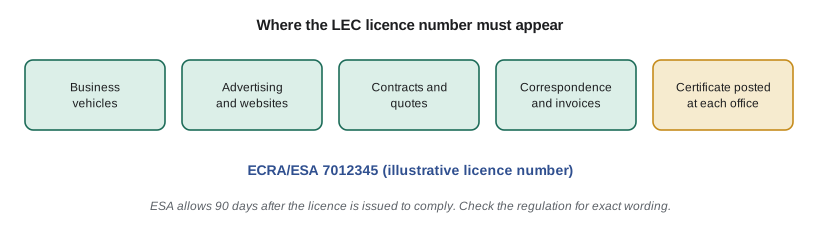
Advertising includes more than newspaper ads. Websites, social media pages, online directory listings, flyers, lawn signs and business cards are all ways of advertising, and ESA treats them that way. When Grand River redesigned its website last year, Aisha made sure the licence number appeared in the footer of every page, and she asked the sign shop to add it to the new truck lettering. Maria notes that an unlicensed business displaying a made-up licence number, or someone else's, is the kind of thing ESA's public registry exists to catch.
ESA's public registry works in the other direction too. Before Grand River subcontracts any electrical scope to another firm, Aisha looks the firm up on the registry to confirm its licence is current and its name matches the one on the quote. A minute's check protects Grand River from the rule against letting unlicensed businesses work under its notifications.
Bonds
A bond is a three-party guarantee: a surety company promises a project owner that the contractor will meet certain obligations, and if the contractor fails, the surety pays up to the bond amount and then recovers from the contractor. Ontario's electrical contractor licence does not require a bond, unlike some licences in other jurisdictions. Bonds come into electrical contracting through contracts, especially public sector work and larger private projects.
Three kinds are common. A bid bond guarantees that a contractor whose tender is accepted will enter into the contract and provide the required performance and payment bonds. A performance bond guarantees that the contractor will complete the work according to the contract. A labour and material payment bond guarantees that the contractor will pay its subcontractors and suppliers. Ontario's Construction Act requires performance and labour and material payment bonds on certain public sector contracts above a threshold value set in the Act, using prescribed forms; check the current threshold and the required bond amounts in the Act. Sureties look closely at a contractor's finances, experience and track record before issuing bonds, so a contractor that wants to bid public work needs to build that relationship in advance.
Worked problem
A bonded tender
A school board tenders the electrical work for a new elementary school. The tender requires a bid bond with the tender, and a performance bond and a labour and material payment bond from the successful bidder. Grand River has never bid bonded work.
Show solution
- Grand River must arrange bonding capacity with a surety before the tender closes, which means providing financial statements, work-in-progress schedules and references.
- The bid bond goes in with the tender; if Grand River wins and then refuses to sign, the surety pays the owner up to the bond amount.
- If Grand River wins, it provides the performance and payment bonds on the prescribed forms before work starts.
- Grand River should price the bond premiums into its tender.
Answer: Bonded public work is open to Grand River only if it arranges surety support well before the tender deadline.
Consumer contracts
Much of Grand River's residential work is done for homeowners, which brings in Ontario's consumer protection law. Consumer agreements for home renovation and repair work generally need to be in writing and to include specific information, such as a description of the work, the price and the contractor's details. Where a contractor gives an estimate, consumer law generally limits how far the final price can exceed it without the consumer's agreement; a commonly cited limit is 10 in 100 above the estimate. Agreements made in the consumer's home after the contractor's visit can carry a cooling-off period during which the consumer may cancel. Ontario has also passed a new consumer protection statute to modernize these rules, so check which provisions are in force when you write.
These rules show up on the exam because the contractor's duty to follow all applicable law includes consumer protection, and the DME's compliance duty does too. On the Elm Street job, Grand River gives the homeowner a written contract with a clear scope, a fixed price for the base work and unit prices for extras, and it gets written approval before doing any extra work. That protects both sides.
Renewing and changing the licence
The Electrical Contractor licence is renewed through the licensing platform, with the renewal confirming that the business still meets the requirements: a DME in place, insurance and WSIB current, information up to date. Changes in between renewals, such as a new address, new owners, a change of business name or a change of DME, must be reported to ESA within 5 business days, as lesson 7 explained. A change of legal entity, such as a sole proprietor incorporating, is treated as a new licensee and needs a new licence.
Common mistakes
MistakeAssuming the EC licence requires a surety bond.
InsteadThe licence requires liability insurance and WSIB; bonds come from contracts and, for some public work, the Construction Act.
MistakeHiring a subcontractor without checking WSIB clearance.
InsteadGet and track clearance certificates; the principal can be liable for unpaid premiums.
MistakeLeaving the licence number off the website.
InsteadAdvertising includes websites and social media; show the licence number.
MistakeExceeding a consumer estimate without approval.
InsteadConsumer law limits how far a final price can exceed an estimate; get written approval for changes.
Summary and key terms
- An Electrical Contractor licence needs a designated ME, the required liability insurance and WSIB registration.
- If insurance or WSIB lapses, the contractor must notify ESA immediately and stop operating until it complies.
- The licence number must appear on correspondence, contracts, advertising and vehicles; ESA allows 90 days to comply.
- Bonds (bid, performance, labour and material payment) come from contracts and the Construction Act, not from the licence.
- Consumer contracts must meet Ontario consumer protection law, including rules on written agreements and estimates.
- Certificate of insurance
- A document from an insurer confirming that a policy is in force.
- Clearance certificate
- A WSIB document showing that a business is registered and in good standing.
- Surety
- A company that guarantees a contractor's obligations under a bond.
- Performance bond
- A bond guaranteeing that the contractor will complete the work.
- Labour and material payment bond
- A bond guaranteeing payment of subcontractors and suppliers.
Practice problems
Work each problem on paper first, then reveal the answer to check.
What must an LEC do if its WSIB coverage lapses?
Show answer
Notify ESA immediately and stop operating until it complies.
Does the Ontario EC licence require a surety bond?
Show answer
No; bonds come from contracts and certain public projects.
Where must the licence number appear?
Show answer
Correspondence, contracts, advertising and business vehicles.
What does a clearance certificate show?
Show answer
That a business is registered and in good standing with the WSIB.
What does a labour and material payment bond guarantee?
Show answer
Payment of subcontractors and suppliers.
Lesson quiz · 5 questions
Score 60% or more to complete this lesson.
Create a free account to save your progress, take quizzes and earn a certificate.