
MELC-205 · Lesson 6 of 12 · 20 min
Permits, inspections and the inspection authority
▶ Video coming soon A video version of this lesson is on the way.
In most provinces, electrical work needs a permit from the provincial inspection authority. Ontario uses different words for the same idea: the person doing the work files a notification of work with ESA, ESA inspects the work, and ESA issues the documents that let a utility connect power and that confirm the installation complies. The words matter on the exam, because questions use ESA's terms. The process matters even more for a Master Electrician, because the designated ME is responsible for making sure the contractor's work is notified, inspected and corrected. This lesson walks through the process using Grand River's jobs, with details from ESA's public guidance on notifications and inspections.
Who is the inspection authority
ESA is the inspection authority for electrical installations in Ontario. Its inspectors review installations, accept or reject work, issue defect notices and authorize connection. Municipal building departments issue building permits under the Building Code Act, and a renovation may need both a building permit and an ESA notification, but the building official does not inspect the electrical work for compliance with the OESC; ESA does. Local distribution companies, the utilities that own the distribution system, connect services only when ESA has authorized the connection. Each organization has its own role, and an exam question may test whether you know which one to call.
Grand River's office manager, Aisha, keeps a short contact list for each job: the ESA notification number, the area inspector's name if known, the local distribution company's service connection desk and, where there is one, the municipal building permit number. On the Victoria Street café, the general contractor holds the building permit, while Grand River holds the electrical notification for its scope.
Notification of work
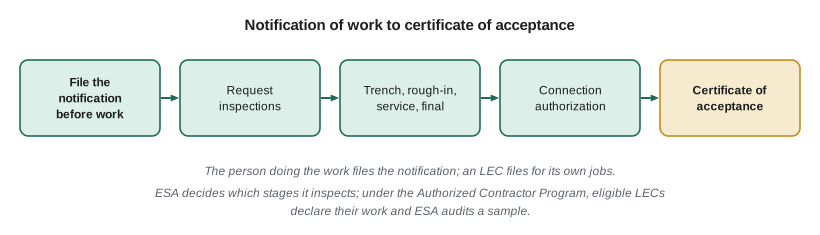
ESA's rule is simple to state. You must file a notification of work before starting electrical work. The person doing the work files it: when a homeowner hires a licensed electrical contractor, the contractor files. ESA's guidance tells everyone, in bold, never to take out a notification on behalf of someone else. Notifications can be filed through ESA's online services, which most contractors use, or by form or telephone. The fee depends on the type and size of the work, with a minimum residential notification fee that ESA lists as 92 dollars at the time of writing.
A notification is not open-ended. ESA's guidance says residential notifications expire after 12 months if no inspections have taken place, with inspection fees refunded less a processing fee. Filing a new notification for the same work later means paying full fees again. For a contractor, this means notifications should be filed when work is actually about to start, not months in advance, and jobs that stall should be tracked so that inspections happen before notifications lapse.
Worked problem
The Elm Street renovation
Grand River is hired to rewire the kitchen and basement of a semi-detached house on Elm Street and to replace the 100 A service with a 200 A service. The homeowner asks whether she needs to file anything.
Show solution
- Grand River is doing the work, so Grand River files the notification with ESA before starting.
- The homeowner does not file for the contractor, and the contractor must not file for anyone else.
- The job will need inspections at rough-in, for the service change, and at the end.
- Because the service is being replaced, the utility will need ESA's connection authorization before reconnecting power.
Answer: Grand River files the notification, books the inspections and gives the homeowner a copy of the certificate of acceptance when the work passes.
Inspections
After filing, the person who filed requests inspections as the work reaches each stage. ESA's guidance lists typical stages: trench, service or connection, rough-in and final. ESA inspectors work weekdays during business hours, and ESA decides which stages and which installations it inspects in person. It may issue connection authorizations without an on-site inspection in some cases. The inspector checks the work against the OESC and the notification; if something does not comply, the inspector issues a defect notice that must be corrected before the work is accepted.
From Maria's point of view as a future DME, inspections are not a test to be passed so much as a check on the contractor's own quality control. The guideline on duties gives examples of what direct supervision means, and permit management and Code compliance are both on the list. A good DME knows which jobs are at which stage, makes sure inspections are requested on time, and follows up defects quickly. A DME who learns about a rough-in defect only when the drywallers are waiting has a scheduling problem and possibly a compliance one.
| Stage | What is usually being checked |
|---|---|
| Trench | Underground conductors, depth and protection before backfill |
| Service or connection | Service equipment ready for the utility to connect |
| Rough-in | Boxes, cables and raceways before walls and ceilings are closed |
| Final | The completed installation, devices and equipment |
Getting ready for an inspection
Inspections go faster and pass more often when the site is ready. Maria's checklist for a rough-in inspection is short: the notification number and the job address match; the work for that stage is complete, not half done; boxes, cables and raceways are visible and not yet covered; bonding and grounding connections can be seen; circuits are identified at the panel where the stage calls for it; and someone who knows the job is on site to answer questions. For a service inspection she adds the meter base, the service entrance conductors and the grounding electrode connections, and confirms that the clearances in front of the equipment are kept clear of stored material.
On the Elm Street job, the homeowner's contractor for drywall wanted to start the day after the rough-in was finished. Maria booked the inspection before the last cable was pulled, told the drywaller the earliest date he could close the walls, and put a sign on the basement door saying not to cover anything until the inspection passed. Closing walls before a rough-in inspection is one of the most common causes of conflict on renovation jobs, and the cost of opening them again falls on whoever covered the work too early.
Industrial and maintenance work
The Conestoga Plastics motor control upgrade shows a different side of notifications. Large industrial plants often have their own maintenance electricians who carry out ongoing work, and ESA has programs for facilities that manage their electrical safety continuously under an agreement with ESA, rather than notifying each small job. When an outside contractor like Grand River is hired for a project, the contractor's work still needs to be covered properly, either by Grand River's own notification or under the plant's arrangement with ESA, depending on the facility's status. Maria asks the plant's maintenance manager at the start of the job which applies, and records the answer in the job file. The exam is unlikely to test the details of these programs, but it may test the principle that electrical work is notified and inspected unless a specific arrangement covers it.
Connection authorization
A utility will not connect a new or altered service until ESA authorizes it. The authorization tells the local distribution company that the installation is ready to be energized. ESA's guidance says a service connection authorization lasts up to six months from issue, so a connection that is delayed beyond that may need a new authorization. On the Elm Street job, Grand River books the service inspection, ESA issues the authorization, and the utility schedules the disconnect and reconnect. The homeowner's power is off for as short a time as the coordination allows.
There is an exam point in the sequence. Work must not be energized or connected to the supply before the required authorization. A contractor who reconnects a service itself, or asks a friendly utility crew to do it before authorization, is breaking the Code's Section 2 rules, whatever the quality of the work.
Certificate of acceptance
When an installation passes inspection, the person who filed receives a certificate of acceptance. ESA describes it as confirmation that the electrical work complies with the Ontario Electrical Safety Code. Homeowners need it for insurance, for sale of the house and for their own peace of mind, and ESA advises homeowners who used a contractor to ask the contractor for a copy. Grand River emails a copy to every residential client and keeps one in its job file. On commercial jobs, the general contractor and owner usually want copies for their close-out documents.
The Authorized Contractor Program
ESA runs an Authorized Contractor Program for licensed contractors who meet its criteria. Under the program, an authorized contractor declares its own work, and ESA audits a sample of installations rather than inspecting each one in the usual way. The program rewards contractors with good compliance records and lets ESA concentrate inspections where the risk is higher. Participation has its own requirements and can be withdrawn if a contractor's work falls short. The details are on ESA's website; for the exam, know that the program exists, that it applies to licensed contractors, and that the contractor still files notifications and remains responsible for compliance.
The program is also a useful reminder of what ESA values. Contractors with strong records earn more trust and fewer routine inspections; contractors with weak records see more inspectors, more defect notices and, eventually, licensing action. The same logic applies to individual Master Electricians: a DME whose jobs pass first time builds a reputation with the local inspectors that makes every later job smoother.
Frank has thought about applying for Grand River. He decides to wait until Maria is licensed and established as a second DME, because the program asks a lot of the contractor's own quality control, and he wants two people sharing that load.
Responsibility when work is subcontracted
ESA's guideline on duties makes a point that matters on larger jobs: the licensed contractor holding the notification is responsible and liable for all the electrical work at the site, including subcontracted work, unless the subcontractor took out its own notification. On the Lakeview Condos EV charging retrofit, Grand River subcontracts the trenching and the concrete pads to a civil contractor. The electrical work, including the conductors in the trench, is Grand River's, under Grand River's notification, and Grand River must make sure it is inspected before backfill. If Grand River had subcontracted part of the electrical work to another licensed contractor, that contractor could take out its own notification for its scope, and responsibility would follow the notifications.
The guideline also forbids a licensed contractor from taking out notifications for unlicensed persons or letting them operate under its licence. A subcontractor whose work requires a contractor licence must hold one. A DME who signs off work done by an unlicensed company under the DME's employer's notification exposes both the employer and themselves.
from datetime import date

# Residential notifications expire after 12 months with no inspection (ESA guidance).
jobs = {
    "Elm Street renovation": (date(2026, 2, 2), date(2026, 3, 18)),   # filed, first inspection
    "Garage subpanel, Oak Ave": (date(2025, 9, 15), None),            # filed, no inspection yet
    "Basement suite, King St": (date(2025, 4, 20), None),
}
today = date(2026, 4, 10)
for name, (filed, inspected) in jobs.items():
    if inspected:
        status = f"inspected {inspected.isoformat()}"
    else:
        days = (today - filed).days
        status = "EXPIRED - new notification needed" if days > 365 else f"no inspection yet, {365 - days} days left"
print(f"{name:<28} {status}")Elm Street renovation inspected 2026-03-18 Garage subpanel, Oak Ave no inspection yet, 158 days left Basement suite, King St no inspection yet, 10 days left
Aisha runs a report like this every month. A notification approaching expiry is usually a job that has stalled, and it is better to call the client than to pay for a second notification.
When things go wrong
ESA's inspectors can issue defect notices that require work to be corrected within a set time. Failing to correct defects, working without notifications, or repeated poor work can lead to further action against the contractor and the Master Electrician, including licensing action and, since 2023, administrative penalties for certain contraventions. The licensing regulation also expects contractors to keep records, and ESA may ask for them. A DME who keeps a clear record of notifications, inspection dates, defects and corrections can show that the company manages its work responsibly.
Common mistakes
MistakeStarting work and filing the notification at the end of the week.
InsteadFile the notification before starting electrical work.
MistakeLetting the homeowner file the notification for the contractor's work.
InsteadThe person doing the work files; never file for someone else.
MistakeReconnecting a service before ESA authorizes it.
InsteadThe utility connects only after ESA's connection authorization.
MistakeAssuming the building inspector checks the wiring.
InsteadESA inspects electrical work for OESC compliance; building permits are separate.
Summary and key terms
- In Ontario, the person doing electrical work files a notification of work with ESA before starting.
- Inspections are requested at stages such as trench, service, rough-in and final; ESA decides which it inspects.
- A utility connects a service only after ESA's connection authorization, which lasts up to six months.
- A certificate of acceptance confirms that the work complies with the OESC.
- The contractor holding the notification is responsible for all electrical work under it, including subcontracted work.
- Notification of work
- Ontario's equivalent of an electrical permit, filed with ESA before work starts.
- Connection authorization
- ESA's authorization for a utility to connect or reconnect a service.
- Certificate of acceptance
- The document confirming that inspected work complies with the OESC.
- Defect notice
- An inspector's written notice of work that must be corrected.
- Authorized Contractor Program
- An ESA program in which eligible LECs declare their work and ESA audits a sample.
Practice problems
Work each problem on paper first, then reveal the answer to check.
Who files the notification when a homeowner hires an LEC?
Show answer
The LEC, before starting work.
What is the minimum residential notification fee listed by ESA?
Show answer
92 dollars at the time of writing; check current fees.
How long does a service connection authorization last?
Show answer
Up to six months from issue.
What happens to a residential notification with no inspection for 12 months?
Show answer
It expires.
Who issues building permits?
Show answer
The municipality, separately from ESA notifications.
Lesson quiz · 5 questions
Score 60% or more to complete this lesson.
Create a free account to save your progress, take quizzes and earn a certificate.