
MELC-205 · Lesson 12 of 12 · 21 min
Practice exam review and test-day strategy
▶ Video coming soon A video version of this lesson is on the way.
Everything in this course comes together on one morning in an exam centre: 80 questions, three hours, three books on the desk and a pass mark that applies to each section as well as to the paper as a whole. Knowledge is necessary, but it is not enough. Candidates fail this exam with good knowledge because they run out of time, lose a section to one weak area, or second-guess correct answers. This lesson turns the format from lesson 4 into a plan for the day, reviews the topics most likely to cost marks in each section, works through a short mixed practice set, and follows Maria from the week before the exam to the moment she applies for her licence. The practice questions here are original and written from public sources; ESA's actual questions are confidential and protected.
A time plan for three hours
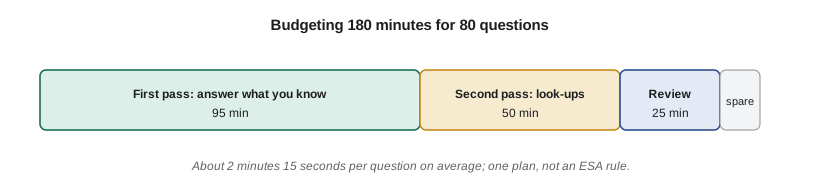
Three hours for 80 questions averages two minutes and fifteen seconds a question, but questions are not average. A workable plan uses two passes. In the first pass, go through all 80 questions in order. Answer every question you can answer confidently in under about a minute and a half, including quick look-ups you know exactly where to find, and mark every answer on the answer sheet as you go. For anything that needs a longer search, a calculation or careful reading of a regulation, make your best provisional choice, mark the question number on your booklet, and move on. In the second pass, return to the marked questions and give them the time they need. Leave the last part of the exam for a review of questions you flagged as uncertain.
Maria's version of the plan gives about 95 minutes to the first pass, about 50 minutes to look-ups and calculations, and about 25 minutes to review, with ten minutes spare for the unexpected. The exact split matters less than having one. Without a plan, it is easy to spend twelve minutes on a stubborn Code question in the first half hour and then rush the last fifteen questions, which are worth just as much.
Protecting each section
Because each section needs 60 in 100, a candidate cannot rely on a strong section to carry a weak one. During the exam, it helps to know roughly how you are doing in each section, so that the second pass can go where it is most needed. Maria marks each question in her booklet with a small letter for its section, C for Code, W for Worker Safety or B for Business Administration, and a tick or question mark for her confidence. At the start of her second pass, she counts the question marks in each section. If one section has noticeably more, she works on it first.
Her practice records showed where her risks were. Worker Safety was her weakest section at first, because she knew safe practice better than the regulation's wording. Business Administration had a different trap: several questions turned on precise numbers of days, and she sometimes mixed up business days and calendar days. The Code section was her strongest, but long look-ups in less familiar sections could eat time. Knowing this, she planned to answer Worker Safety and Business Administration questions carefully the first time through and to leave long Code look-ups for the second pass.
# Maria's practice results by section (correct / out of)
sessions = {
    "Week 1": {"Code": (22, 27), "Worker Safety": (15, 26), "Business": (19, 27)},
    "Week 2": {"Code": (23, 27), "Worker Safety": (19, 26), "Business": (21, 27)},
    "Week 3": {"Code": (24, 27), "Worker Safety": (21, 26), "Business": (23, 27)},
}
for week, secs in sessions.items():
    right = sum(c for c, n in secs.values()); total = sum(n for c, n in secs.values())
    parts = ", ".join(f"{s} {c/n:.0%}" for s, (c, n) in secs.items())
    weakest = min(secs, key=lambda s: secs[s][0] / secs[s][1])
    ok = right / total >= 0.70 and all(c / n >= 0.60 for c, n in secs.values())
print(f"{week}: overall {right/total:.0%} ({parts}) weakest: {weakest} -> {'pass' if ok else 'fail'}")Week 1: overall 70% (Code 81%, Worker Safety 58%, Business 70%) weakest: Worker Safety -> fail Week 2: overall 79% (Code 85%, Worker Safety 73%, Business 78%) weakest: Worker Safety -> pass Week 3: overall 85% (Code 89%, Worker Safety 81%, Business 85%) weakest: Worker Safety -> pass
The first week would have failed on Worker Safety alone, even with an overall score close to 70 in 100. By the third week, every section was comfortably above the minimum. Tracking sections separately is what made the problem visible early enough to fix.
High-value topics to review
In the last week, review rather than learn. For the Code section, revisit Section 2 and the Ontario amendments: notification, inspections, connection authorization, approval of equipment, defects and reporting serious electrical incidents. Then review the definitions you have tabbed and the technical sections where your practice showed slow look-ups. For Worker Safety, reread the duties of employers, supervisors, workers and constructors, the electrical hazards part of O. Reg. 213/91, especially section 190 and its exceptions and tag requirements, the overhead line distances, the right to refuse and the reporting rules for critical injuries. For Business Administration, reread ESA's 2025 guideline on duties from start to finish, the licensing regulation's rules on DMEs and changes, administrative penalties under O. Reg. 12/23, and the main features of the Construction Act and consumer protection law.
| Section | Topics that often cost marks |
|---|---|
| Ontario Electrical Safety Code | Section 2 rules; definitions; slow look-ups in less familiar sections |
| Worker Safety | Who has which duty; section 190 exceptions and tag contents; reporting critical injuries |
| Business Administration | DME rules and deadlines; business versus calendar days; insurance, WSIB and display; holdback and liens |
A short mixed practice set
Try these before reading the answers in the practice section at the end of this lesson. Time yourself: eight questions in about eighteen minutes is exam pace.
- 1. A licensed contractor's only DME resigns on a Friday. How many business days does the contractor have to notify ESA, and how long may it keep operating without a DME before it must apply for an extension?
- 2. A homeowner asks a licensed contractor to file the notification so that the homeowner's brother-in-law, who has no licence, can do the wiring. What should the contractor do?
- 3. Under section 190 of O. Reg. 213/91, what four pieces of information must a lockout tag show?
- 4. A candidate scores 76 in 100 overall but 58 in 100 in Business Administration. Do they pass?
- 5. A progress invoice is for 25,000 dollars of work. How much holdback does the payer keep?
- 6. When did the 2024 OESC come into effect?
- 7. A Master Electrician's licence expired 13 months ago. Can they simply pay a late fee?
- 8. Who issues the Certificate of Qualification for the construction and maintenance electrician trade?
Score yourself honestly and note which section each miss came from. If two or more misses came from one section, that is where your last week of review should go.
The week before and the night before
In the final week, Maria does one last full-length timed session early in the week and spends the rest of the time on targeted review and look-up drills. She stops adding tabs and notes four days before the exam, so that her books are settled and she knows exactly where everything is. She checks her materials against ESA's permitted list one more time and removes two loose sheets she had tucked into the back of her Code. She confirms the exam centre's address, the start time and parking, and reads the instructions in her confirmation email about identification and arrival time.
The night before, she packs her clear bag with the permitted items, sharpens two pencils, puts a fresh battery in her calculator and sets two alarms. She does not study late. Frank's advice, from experience, is that an extra hour of sleep is worth more than an extra hour of reading, because the exam rewards clear thinking and steady pace more than last-minute facts.
In the exam room
When the exam starts, Maria spends the first minute looking through the booklet to see how questions are arranged and whether sections are grouped. She writes her time checkpoints in the margin of the first page: question 30 by about the 55-minute mark, question 60 by about 75 minutes later, and the end of the first pass by about 95 minutes. She reads every question to the end before looking at the options, watching for words like not, except, minimum, maximum, before and after. For calculations, she works the answer out first and then finds it among the options.
When she meets a question she cannot answer, she eliminates what she can, picks the best remaining option, marks it on the answer sheet, and flags it in the booklet. There is no penalty for a wrong answer, so no question should be left blank. In the review period, she changes an answer only when she finds a clear reason, such as a misread word or a calculation error. Changing answers on a vague feeling is more likely to turn a right answer into a wrong one than the reverse.
Energy matters over three hours. Maria takes a few seconds at each checkpoint to sit back, breathe and check the clock, rather than working head-down until she notices she is tired. If a question makes her anxious, she treats that as a signal to flag it and move on, not to fight it. Candidates who freeze on one question often lose more marks to the panic that follows than to the question itself. By the time she reaches the second pass, the hard questions feel less threatening because most of the paper is already done.
She also keeps her desk tidy: Code on the left, legislation book in the centre, guideline on the right, calculator and pencils above. Every book goes back to the same place after each look-up. It sounds trivial, but in a three-hour open-book exam, the seconds spent finding a book under a pile add up to minutes.
After the exam
ESA emails results, generally within 15 business days, and does not give them by phone. Maria's email arrives eleven business days after the exam: she has passed, with every section above the minimum. She applies for her Master Electrician licence on the licensing platform the same week, well inside the 12-month window, attaching the documents she gathered in lesson 2. About four weeks later, her licence is issued. Grand River designates her as its second DME, records the designation date and scope in its DME list, and notifies ESA within 5 business days. She puts her renewal dates in her calendar, and Aisha adds the licence number to Maria's records and to the company's DME list.
If she had failed, the plan was just as clear: look at which section was weak, book the next suitable session straight away, and remember that a second failure would mean approved training before a third attempt. Dev, who is writing in the autumn, inherits her study plan, her practice questions and her look-up lists. Frank starts counting down to retirement.
Bringing it together
The Ontario Master Electrician exam tests three things at once: whether you can find and apply the Ontario Electrical Safety Code, whether you know the safety law that protects workers on electrical jobs, and whether you understand the business and licensing rules that make a contractor legal. The licence that follows carries real responsibility, because the DME's duties of planning and supervision are personal and enforceable. A candidate who prepares for all three sections, practises under exam conditions and walks in with a plan is well placed to pass, and well placed to do the job that comes after.
Common mistakes
MistakeSpending too long on one hard question early.
InsteadGive a provisional answer, flag it and move on; come back in the second pass.
MistakeLeaving questions blank.
InsteadAnswer every question; there is no penalty for guessing.
MistakeStudying new material the night before.
InsteadStop adding material days before and sleep well; review, do not cram.
MistakeWaiting months to apply for the licence after passing.
InsteadApply promptly; the pass must be within the previous 12 months.
Summary and key terms
- Use a two-pass plan: quick answers first, look-ups and calculations second, review last.
- Track each section separately; each needs 60 in 100 as well as 70 in 100 overall.
- In the last week, review Section 2, section 190 of O. Reg. 213/91 and ESA's guideline on duties.
- Pack only permitted materials; settle your tabs and notes days before the exam.
- After passing, apply for the licence promptly; the contractor then designates the new DME and notifies ESA.
- First pass
- Going through every question once, answering those that can be done quickly.
- Second pass
- Returning to flagged questions that need look-ups or calculations.
- Provisional answer
- A best-guess answer marked on the sheet so no question is left blank.
- Checkpoint
- A planned time by which a given question number should be reached.
- Section balancing
- Directing review time to the section at most risk of falling below 60 in 100.
Practice problems
Work each problem on paper first, then reveal the answer to check.
Practice set, question 1.
Show answer
Notify ESA within 5 business days; operate up to 60 calendar days, then apply in writing for up to 60 more.
Practice set, question 2.
Show answer
Refuse; never file a notification for someone else, and do not let an unlicensed person work under the licence.
Practice set, question 3.
Show answer
The reason for the disconnection, the name of the person who disconnected, the employer and the date.
Practice set, question 4.
Show answer
No; each section needs at least 60 in 100.
Practice set, question 5.
Show answer
2,500 dollars (10 in 100).
Practice set, question 6.
Show answer
1 May 2025.
Practice set, question 7.
Show answer
No; after one year a new application and a new exam pass are required.
Practice set, question 8.
Show answer
Skilled Trades Ontario.
Lesson quiz · 5 questions
Score 60% or more to complete this lesson.
Create a free account to save your progress, take quizzes and earn a certificate.