
MELC-205 · Lesson 11 of 12 · 20 min
Renewal and continuing education
▶ Video coming soon A video version of this lesson is on the way.
A Master Electrician licence is not a lifetime credential. In Ontario it must be renewed every year, and it stays valid only while its holder keeps meeting the requirements that earned it. The same is true of the contractor licence it supports. Lapses happen more often than people expect: a renewal email lands in a spam folder, a trade certificate renewal is forgotten, a credit card on file expires. For a DME, a lapsed licence is not a private inconvenience, because it can affect the contractor the DME serves. This lesson covers renewal as ESA describes it, what happens when a licence lapses, and how a Master Electrician keeps their knowledge current. ESA's renewal pages and the licensing regulation are the authorities; check them each year, because the process has changed several times as ESA moved to its online platform.
The yearly renewal
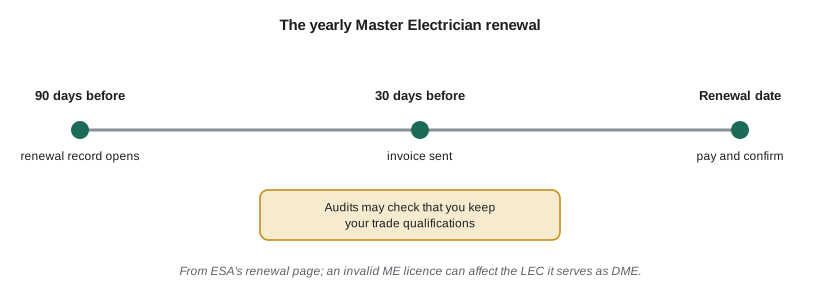
ESA's page on renewing a Master Electrician licence says that every year, each Master Electrician must log in to the online licensing platform, complete a renewal record, make the annual payment and confirm their eligibility. ESA sends the renewal forms 90 days before the licence is due for review and an invoice 30 days before renewal. The fee is listed on ESA's fees page. The renewal record asks the holder to confirm that the information on file is current and that they still meet the licence requirements, including holding valid trade qualifications where those apply.
ESA's page also states that all Master Electricians are subject to audit to confirm that they are maintaining their trade qualifications, and that failure to maintain the licence requirements may result in the licence becoming invalid. It adds a warning that matters for DMEs: an invalid ME licence may also affect the Electrical Contractor licence of the company the holder serves. If Maria were Grand River's only DME and her licence lapsed, Grand River would be in the same position as a contractor that had lost its DME.
from datetime import date, timedelta

renewal = date(2027, 5, 14)                 # Maria's licence anniversary (illustrative)
reminders = [
    (renewal - timedelta(days=90), "Renewal record opens: check details, start renewal"),
    (renewal - timedelta(days=30), "Invoice arrives: pay and confirm eligibility"),
    (renewal - timedelta(days=7),  "Final check: confirmation received?"),
    (renewal, "Renewal date"),
]
for when, what in reminders:
print(when.isoformat(), what)2027-02-13 Renewal record opens: check details, start renewal 2027-04-14 Invoice arrives: pay and confirm eligibility 2027-05-07 Final check: confirmation received? 2027-05-14 Renewal date
Maria puts these dates in her calendar the day her licence is issued, with the same reminders for her Certificate of Qualification. Aisha adds them to Grand River's licensing calendar, alongside the company's own licence renewal, its insurance renewals and its WSIB reporting dates.
Keeping the trade certificate valid
For an ME who qualified through the journeyperson route and who still does electrical work personally, the trade certificate matters twice: it supports the ME licence and it is legally required for the hands-on work. Certificates of Qualification in Ontario's trades are issued by Skilled Trades Ontario and must be renewed periodically, with a fee, through its own system. ESA's audit may check that the certificate is current. A Master Electrician who lets the certificate lapse could find their ME licence questioned and would be breaking trades law by doing the work.
This is a common trap for people moving into office-based roles. A DME who spends most of the week planning, quoting and supervising may stop thinking of themselves as a working electrician, and the certificate renewal slips. The guideline is clear that a DME needs a valid trade certificate for any electrical work they perform personally, so even a DME who only occasionally picks up the tools needs to keep it current.
The contractor licence renewal
The Electrical Contractor licence has its own renewal through the licensing platform. The renewal confirms that the business still has at least one DME, that its liability insurance and WSIB registration are current, and that its information is up to date. The guideline notes that the contractor must keep application and renewal documents for the life of the licence. Renewal is also a natural point to update the DME list, check that the licence number appears correctly on new advertising and vehicles, and confirm that the certificate is posted at each place of business.
When a licence lapses
ESA's guideline on duties, citing section 15 of the regulation, says that a licence must be renewed before it expires. A renewal within one year after expiry is possible but carries a late fee. After one year, a new application is required, and for a Master Electrician that includes passing the exam again. A licence that has expired, been suspended or been revoked must be returned to ESA within 5 business days, unless the holder is renewing it.
Consider what this means in practice. If Maria's licence expired in May and she noticed in August, she could renew late with a fee, but she would not have been a valid ME, and so not a valid DME, between May and August. If she were Grand River's only DME, the company would have been operating without one. If she noticed the following June, more than a year after expiry, she would have to apply again from scratch and pass the exam. A calendar reminder is much cheaper.
| Situation | What follows (check the current regulation) |
|---|---|
| Renewed before expiry | Licence continues without interruption |
| Renewed within one year after expiry | Possible, with a late fee; the licence was not valid during the gap |
| More than one year after expiry | New application required; an ME must pass the exam again |
| Licence expired, suspended or revoked | Return it to ESA within 5 business days unless renewing |
Worked problem
A lapse at the worst moment
Grand River has two DMEs: Frank and Maria. Frank's licence renewal fails because his card on file has expired, and he does not notice for six weeks. What is the effect?
Show solution
- Frank's ME licence was not valid for six weeks, so he was not a valid DME during that time.
- Grand River still had Maria as a valid DME, so the company was never without one.
- Frank can renew late, within one year, with a late fee.
- Grand River should review whether any work Frank supervised alone during the gap needs attention, and should check its records.
Answer: Having two DMEs protected Grand River; Frank renews late and both set reminders.
Keeping your information current
Renewal is the yearly check, but licence information also has to stay accurate in between. The licensing regulation requires licence holders to tell ESA about changes to the information they provided, and the guideline sets a five-business-day limit for contractors. A Master Electrician who moves house, changes their email address or changes their name should update their record on the licensing platform promptly. The email address matters most in practice, because it is where renewal notices, invoices and any correspondence from ESA arrive. A notice that goes to an old address does not stop the licence from expiring.
Designation changes are handled through the contractor. When Grand River designates Maria, the company notifies ESA and records the designation in its DME list; Maria confirms it on her own record if the platform asks her to. If the scope of her designation changes, for example if Grand River opens a second office and designates Dev for that office, the company reports the change.
Moving between employers
A Master Electrician licence belongs to the person, so it travels with them. If Maria left Grand River for another contractor, her ME licence would remain valid as long as she kept renewing it. Grand River would have to notify ESA within 5 business days that she was no longer its DME, and if she had been its only DME, the 60-day rule from lesson 7 would start. Her new employer could designate her as its DME once she joined, but only one contractor at a time can hold her designation, so the designations would have to be sequenced properly.
The same principle applies if she starts her own business. Her company would need its own Electrical Contractor licence, with her designated as its DME, and she would have to stop being Grand River's DME before her own company's designation took effect. Frank and Maria have no plans for that, but understanding the rule helps her answer exam questions about DMEs who change jobs, which are common because the timing rules are easy to test.
Owners who sell their business face related questions. If Frank sells his shares in Grand River to Maria, the licensed corporation continues and ESA is told about the change in ownership and directors. If the business is sold as assets to a new company, the new company needs its own licence. Either way, the DME arrangements must be in place on the day of the change, not sorted out afterwards.
Standards of conduct
ESA publishes standards of conduct and guidelines for licence holders, and its renewal page reminds Master Electricians to follow them along with the Electrical Safety Code. The standards set expectations about honesty, integrity and compliance with the law, and they describe the kinds of conduct that can lead to compliance action, suspension or revocation. They are not a list of electrical rules; they are about how licence holders deal with ESA, clients, workers and the public. Reading them once a year at renewal time is a sensible habit, and some of the principles appear in exam questions about the responsibilities of licence holders.
Continuing education and staying current
At the time of writing, ESA's renewal page does not list a mandatory number of continuing education hours for Master Electricians. ESA has consulted publicly on continuing education, so this could change, and a candidate should check ESA's current renewal requirements rather than assume. Mandatory or not, a Master Electrician who stops learning falls behind quickly: each new Code edition changes rules, ESA issues bulletins between editions, and new technologies such as energy storage, EV charging and building-integrated solar bring new requirements.
ESA offers code training on each new edition of the OESC, and its newsletter for contractors and its toolbox talk materials summarize changes and common defects. Industry associations, colleges and manufacturers offer courses on specific topics. Maria plans to take ESA's training on each new edition, to read the bulletins that affect Grand River's work, and to run a short toolbox talk for the crew every month on a recent change or a common defect. Frank points out that teaching others is one of the best ways for a DME to stay sharp, and that the monthly talk doubles as evidence of the training and supervision the regulation expects.
Staying current also means watching for changes to the law itself. The licensing regulation, the Construction Act, consumer protection law and the construction safety regulation have all changed in recent years. ESA updates its Relevant Legislation book for the exam, and a Master Electrician can check e-Laws for the current text of any statute or regulation. Maria subscribes to e-Laws update notices for the regulations most relevant to Grand River's work.
A yearly checklist
Maria writes herself a yearly checklist and keeps it inside the front cover of her Code. Renew the ME licence before the due date and keep the confirmation. Renew the Certificate of Qualification when it is due. Confirm that Grand River's DME list shows her correct designation and scope. Review ESA's standards of conduct. Read the bulletins issued since last year. Check whether a new Code edition is coming and book training. Review Grand River's lockout procedure and training records with Aisha. None of it takes long, and together it keeps both her licence and her knowledge in good order.
The checklist is also useful to a company. When Dev becomes Grand River's second DME after his autumn exam, he will adopt the same list, and Aisha will add both DMEs' dates to the company calendar, so that no renewal depends on one person's memory.
Common mistakes
MistakeAssuming the ME licence lasts several years.
InsteadIt is renewed annually through the licensing platform.
MistakeLetting the trade certificate lapse after moving into a supervisory role.
InsteadA DME who does any hands-on work needs a valid trade certificate, and ESA may audit qualifications.
MistakeIgnoring a lapse for over a year.
InsteadAfter one year, a new application is required, and an ME must pass the exam again.
MistakeKeeping an expired licence certificate.
InsteadReturn an expired, suspended or revoked licence to ESA within 5 business days unless renewing.
Summary and key terms
- The ME licence is renewed every year: renewal record 90 days before, invoice 30 days before, then payment and confirmation.
- Master Electricians may be audited to confirm that they maintain their trade qualifications.
- An invalid ME licence can affect the contractor licence the holder serves as DME.
- Late renewal within one year carries a late fee; after one year a new application and exam are needed.
- No mandatory continuing education hours are listed at the time of writing, but staying current through training and bulletins is essential.
- Renewal record
- The yearly online form in which an ME confirms details and eligibility.
- Audit
- ESA's check that a licence holder still meets requirements, such as trade qualifications.
- Late fee
- An extra fee for renewing within one year after a licence expires.
- Standards of conduct
- ESA's published expectations for the conduct of licence holders.
- e-Laws
- Ontario's online source for the current text of statutes and regulations.
Practice problems
Work each problem on paper first, then reveal the answer to check.
How often is an Ontario ME licence renewed?
Show answer
Every year.
When does ESA send renewal forms?
Show answer
90 days before the licence is due for review.
When does the invoice arrive?
Show answer
30 days before renewal.
What happens if an ME licence is not renewed within a year of expiry?
Show answer
A new application and a new exam pass are required.
Within how many business days must an expired licence be returned?
Show answer
5, unless the holder is renewing.
Lesson quiz · 5 questions
Score 60% or more to complete this lesson.
Create a free account to save your progress, take quizzes and earn a certificate.