
MELC-205 · Lesson 10 of 12 · 20 min
Occupational health and safety law for electrical contractors
▶ Video coming soon A video version of this lesson is on the way.
Worker Safety is a full third of the Master Electrician exam, and it is the section where experienced electricians most often fall short of the 60 in 100 minimum. The reason is not that they work unsafely; it is that they know safe practice from the job but have never read the law behind it. The exam asks about the law: who has which duty under Ontario's Occupational Health and Safety Act, what the construction regulation requires before work on electrical equipment, what must be reported and when. This lesson covers the parts a DME needs most, using Grand River's motor control upgrade at Conestoga Plastics as the example. The Act and its regulations are in ESA's Relevant Legislation book and on e-Laws; read the sections themselves, because exam questions often turn on a detail.
The Act and its regulations
The Occupational Health and Safety Act, R.S.O. 1990, c. O.1, sets out the general duties of everyone in a workplace and gives inspectors from the Ministry of Labour, Immigration, Training and Skills Development the power to enforce them. Regulations under the Act add specific requirements for different kinds of workplaces. For electrical contractors, the most important is Ontario Regulation 213/91, Construction Projects, which applies to construction work, including electrical installation, and contains a part on electrical hazards. Work in industrial establishments such as factories is also covered by the Industrial Establishments regulation, and a contractor working inside a plant may need to follow both its own construction rules and the plant's procedures.
The Act uses an internal responsibility system: everyone in the workplace has a share of responsibility for safety, and the law spells out each share. That is why exam questions so often ask who is responsible. A question that describes an unguarded opening, an untrained worker or a missing lockout usually has one right answer about whose duty it was, and sometimes more than one person had a duty.
Who has which duty
Employers must take every precaution reasonable in the circumstances for the protection of a worker, provide information, instruction and supervision, and ensure that equipment, materials and protective devices are provided, maintained and used. Supervisors must ensure that workers follow the Act and the regulations and use the required protective equipment, and must advise workers of hazards they know about. Workers must work in compliance with the Act, use the equipment their employer requires and report hazards and contraventions. On a construction project, the constructor, the person who undertakes the project for an owner, has duties for the whole project, including ensuring that every employer and worker on the project complies. Owners have some duties too, such as identifying designated substances on the site before tendering.
On the Conestoga Plastics job, Grand River is an employer of its own workers. Maria, as the lead on the job, is acting as a supervisor under the Act, which carries its own legal duties. The plant may be the constructor for the project, or it may have hired a general contractor who is, and Maria needs to know which, because the constructor's site rules and coordination apply. As a future DME, Maria's duty to supervise under the licensing regulation overlaps with the supervisor's duties under the Act, but they come from different laws and are enforced by different authorities.
| Party | Examples of duties under the Act |
|---|---|
| Employer | Take every reasonable precaution; provide instruction, supervision and equipment |
| Supervisor | Ensure workers comply and use protective equipment; advise of known hazards |
| Worker | Comply; use required equipment; report hazards and contraventions |
| Constructor | Ensure the project complies; coordinate the employers on site |
| Owner | Identify designated substances before tendering, among other duties |
Electrical hazards in the construction regulation
The electrical hazards part of O. Reg. 213/91 begins with a general rule in section 183: every reasonable precaution must be taken to prevent hazards to workers from energized electrical equipment, installations and conductors. Section 181 deals with work on or near electrical transmission or distribution systems, which must follow the electrical utility safety rules published for that sector, and it lists sections of the regulation that do not apply when those rules are followed. Other sections cover matters such as who may work on electrical equipment, temporary installations, and keeping equipment and people at safe distances from overhead lines.
Section 190 is the heart of the part for most electrical contractors. It requires the employer to establish and implement written procedures that adequately protect workers from electrical shock and burn when they work on or near energized exposed parts, and to make copies available to every worker on the project; workers must follow them. Unless an exception applies, the power supply must be disconnected, locked out of service and tagged before work begins and kept that way while the work continues. Hazardous stored energy must be discharged or contained. Each worker must verify, before starting, that the lockout and stored-energy requirements are met. And where several workers are involved, there must be a means of communicating the purpose and status of the isolation.
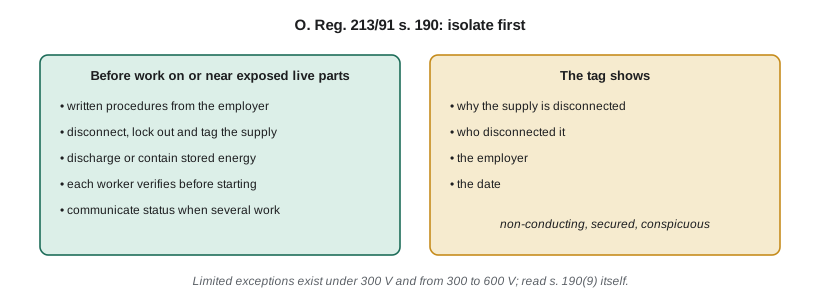
The tag has its own requirements. It must be made of non-conducting material, installed so that it cannot become energized, placed conspicuously and secured against inadvertent removal. It may be removed only when it is safe to do so. It must show the reason for the disconnection, the name of the person who disconnected the equipment, the name of that person's employer and the date of disconnection. Some industry guidance also suggests the time; the regulation itself requires the date, and the exam follows the regulation.
Section 190 allows limited exceptions to locking out. Locking out is not required for conductors that are adequately grounded with a visible grounding mechanism. For equipment under 300 volts that was not manufactured with a way to lock the breaker or fuse, a written procedure ensuring that the circuit is not inadvertently energized can take the place of the lock. Between 300 and 600 volts, the same conditions apply and the work must also be supervised by a competent worker. Read section 190(9) itself in your legislation book; exception questions are a favourite because the voltage limits and conditions are easy to mix up.
Worked problem
Isolating a motor starter at Conestoga Plastics
Grand River is replacing a 600 V motor starter on an extruder. The starter's disconnect has a provision for a lock. Liam and Tyler will do the work, with Maria supervising. What does section 190 require before they start?
Show solution
- The employer, Grand River, must have written procedures for this work, available to the workers.
- Because the disconnect can be locked, no exception applies: the supply must be disconnected, locked out and tagged.
- The tag must show the reason, the name of the person who disconnected it, the employer and the date.
- Stored energy, such as capacitors in a drive, must be discharged or contained.
- Both Liam and Tyler must verify the isolation before starting, and the status must be communicated to everyone involved.
Answer: Lock out and tag the disconnect, discharge stored energy, and have each worker verify before touching anything.
Overhead lines and approach distances
Construction work near overhead power lines is one of the leading causes of electrical fatalities. O. Reg. 213/91 sets minimum distances that equipment, materials and workers must keep from energized overhead conductors, increasing with voltage, and sets conditions under which work may proceed closer with precautions such as a signaller and an agreement with the line owner. The commonly quoted figures are 3 metres for lines from 750 volts to 150,000 volts, 4.5 metres above 150,000 to 250,000 volts and 6 metres above 250,000 volts, but check the current section before relying on those numbers.
def minimum_distance_m(voltage):
    # Commonly quoted O. Reg. 213/91 minimum distances for overhead lines; check the regulation.
    if voltage < 750:
        return None            # other rules apply below 750 V
    if voltage <= 150_000:
        return 3.0
    if voltage <= 250_000:
        return 4.5
    return 6.0

for kv in (0.6, 13.8, 27.6, 115, 230, 500):
    d = minimum_distance_m(kv * 1000)
print(f"{kv:>6} kV line: " + (f"keep at least {d} m" if d else "below 750 V; see other rules"))0.6 kV line: below 750 V; see other rules 13.8 kV line: keep at least 3.0 m 27.6 kV line: keep at least 3.0 m 115 kV line: keep at least 3.0 m 230 kV line: keep at least 4.5 m 500 kV line: keep at least 6.0 m
At Lakeview Condos, the parking lot where Grand River is trenching for EV chargers runs beside a 27.6 kV distribution line. The civil subcontractor's excavator must keep at least the minimum distance from the line, so Maria arranges a signaller and marks the limit on the ground before digging starts.
Rights, reporting and training
Workers in Ontario have the right to refuse work they believe is likely to endanger them, under section 43 of the Act, with a defined process: the worker reports to the supervisor or employer, there is an investigation with a worker representative, and if the worker still believes the work is unsafe, an inspector is called. Workers are protected from reprisal for exercising their rights. Workplaces with enough workers need a joint health and safety committee or a health and safety representative, with thresholds and rules for construction projects set out in the Act.
Serious incidents must be reported. If a worker is killed or critically injured, the employer must notify an inspector immediately and provide a written report within a short time, commonly 48 hours, and the scene must not be disturbed except as the Act allows. Other injuries, occupational illnesses and certain incidents have their own reporting rules. Separately, the OESC requires certain serious electrical incidents to be reported to ESA, as lesson 5 mentioned. A serious electrical accident on a construction site can therefore trigger reports to the Ministry, ESA and the WSIB.
Training is required by regulation, not just good practice. Workers and supervisors must complete basic health and safety awareness training. Construction workers who may use certain fall protection systems must complete approved working at heights training, which is valid for a set period and must be refreshed. Employers must also train workers on the hazards of their work and on procedures such as lockout. Aisha keeps training records for every Grand River employee, because an inspector may ask to see them and because a DME supervising work needs to know that each worker has been trained.
The Act also requires employers to prepare policies on workplace violence and workplace harassment, to develop programs to put them into practice and to review them as often as necessary, and in most workplaces to post a health and safety policy. For a contractor whose workers spend their days in other people's homes and businesses, the violence and harassment program has a practical side: workers need to know what to do if a client becomes aggressive, and how to report it. Grand River's program includes a simple rule that a worker who feels unsafe in a client's home may leave and call the office, with no questions asked.
Beyond the regulation: CSA Z462
CSA Z462, the national standard on workplace electrical safety, sets out a framework for electrical safety programs, risk assessment for shock and arc flash, and the selection of protective equipment. It is not adopted as law in the same way as the OESC, but it is widely used as the recognized standard of practice, and an employer that ignores it may find it hard to show that it took every precaution reasonable in the circumstances. Conestoga Plastics requires contractors to follow its Z462-based program, including arc flash labels and energized work permits. Maria briefs Liam and Tyler on the plant's program in addition to Grand River's own procedures.
Common mistakes
MistakeThinking the DME's supervision duty under the licensing regulation replaces the supervisor's duties under the Act.
InsteadThey are separate duties under separate laws; both apply.
MistakeTagging a lockout with only a name.
InsteadThe tag must show the reason, the person's name, the employer and the date.
MistakeApplying the under-300 V exception to equipment that can be locked.
InsteadThe exception applies only where the equipment was not made with a locking provision, and a written procedure is used.
MistakeReporting a critical injury only to the WSIB.
InsteadNotify a Ministry inspector immediately, follow up in writing, and report to ESA where the OESC requires it.
Summary and key terms
- The OHSA sets duties for employers, supervisors, workers, constructors and owners under an internal responsibility system.
- O. Reg. 213/91 contains the electrical hazards part for construction projects; section 183 requires every reasonable precaution.
- Section 190 requires written procedures, lockout and tagging, control of stored energy and verification by each worker, with limited exceptions.
- Overhead line distances increase with voltage; commonly 3 m, 4.5 m and 6 m above 750 V.
- Workers may refuse unsafe work; critical injuries must be reported immediately; required training must be recorded.
- Constructor
- The person who undertakes a project for an owner and is responsible for safety on the whole project.
- Competent worker
- A worker qualified by knowledge, training and experience to do the work safely, as defined in the Act.
- Lockout
- Disconnecting and locking the supply so that equipment cannot be energized during work.
- Internal responsibility system
- The principle that everyone in a workplace shares responsibility for safety.
- CSA Z462
- The national standard for workplace electrical safety, including arc flash risk.
Practice problems
Work each problem on paper first, then reveal the answer to check.
Which regulation contains the electrical hazards rules for construction projects?
Show answer
O. Reg. 213/91.
Name the four items a lockout tag must show.
Show answer
Reason, name of the person who disconnected, employer and date.
Under section 190, what extra condition applies to the 300 to 600 V exception?
Show answer
Supervision by a competent worker, along with a written procedure and no locking provision.
Which section of the OHSA gives the right to refuse unsafe work?
Show answer
Section 43.
Minimum distance from a 27.6 kV line, using the commonly quoted figures?
Show answer
3 metres.
Lesson quiz · 5 questions
Score 60% or more to complete this lesson.
Create a free account to save your progress, take quizzes and earn a certificate.