
MELC-205 · Lesson 2 of 12 · 20 min
Eligibility for the Master Electrician Licence
▶ Video coming soon A video version of this lesson is on the way.
Before Maria books an exam date, she needs to know whether she can actually be licensed once she passes. The two questions are linked in Ontario because a pass is only useful for a limited time: you must apply for the licence within a set period after passing, so writing the exam before you meet the other requirements can waste the attempt. This lesson sets out the eligibility requirements ESA publishes, explains what counts as qualifying experience, and works through the situations of several people at Grand River. As always, the official requirements are in Ontario Regulation 570/05 and on ESA's website, and they can change; use this lesson to understand the structure, then confirm the details before you apply.
The published requirements
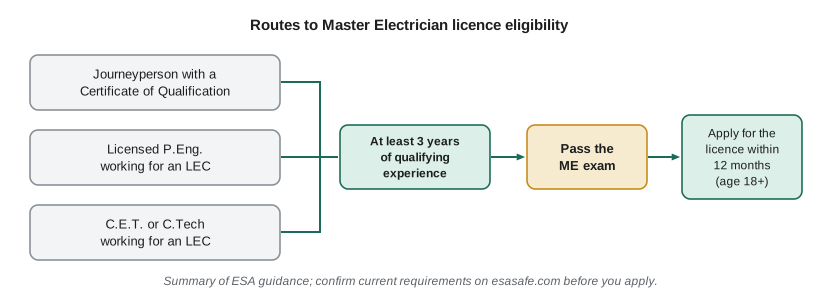
ESA's page on getting a Master Electrician licence lists the requirements in plain terms. An applicant must be at least 18 years of age. An applicant must have at least three years of experience in the electrical trade. And an applicant must have passed the Master Electrician examination within the previous 12 months. The application is made through ESA's online licensing platform, and if the conditions are not met, the Director of Licensing may refuse the licence and issue a notice of proposal explaining why. ESA states a service target of issuing most completed Master Electrician licences within about 30 business days of a complete submission; a missing document stops that clock, so a careful application saves time.
There is also a conduct element. ESA expects licence holders to act honestly, with integrity and within the law, and the licensing regulation allows the Director to consider an applicant's past conduct. In practice this means that a history of serious offences connected to electrical work, such as working without notifications or misrepresenting qualifications, can affect an application. Most candidates never meet this issue, but exam questions sometimes ask whether passing the exam guarantees a licence, and the answer is no: passing is one requirement among several.
What counts as experience
ESA describes several kinds of work that count toward the three years. The most common is working as a journeyperson under a valid Certificate of Qualification in an electrical trade. ESA's wording also refers to practising one of the listed electrician or powerline technician trades under a valid certificate. In Ontario that covers trades such as the construction and maintenance electrician, the industrial electrician, the domestic and rural electrician and the powerline technician, each with its own certificate issued through Skilled Trades Ontario. Two other routes are aimed at people who come to electrical contracting from engineering: working for an electrical contractor as a licensed professional engineer registered with Professional Engineers Ontario, or working for an electrical contractor as a Certified Engineering Technologist or Certified Technician registered with OACETT.
Look closely at the details in that list. The journeyperson route counts experience gained while holding a valid certificate, so apprenticeship years do not normally count toward the three years. The engineering routes require that the engineer or technologist work for an electrical contractor, not simply that they hold the designation; an engineer who spends three years designing distribution systems at a consulting firm is not working for an electrical contractor. And the certificate must be valid throughout: a certificate that lapsed because its holder stopped renewing it would interrupt the count. When an exam question gives a timeline, read it with these conditions in mind.
| Route | Who it suits | Key condition |
|---|---|---|
| Journeyperson with a Certificate of Qualification | Certified electricians and powerline technicians | Experience while the certificate is valid |
| Licensed P.Eng. | Engineers moving into contracting | Working for an electrical contractor |
| C.E.T. or C.Tech | Technologists and technicians | Working for an electrical contractor, registered with OACETT |
The people at Grand River
Maria received her Certificate of Qualification as a construction and maintenance electrician in 2019 and has worked as a journeyperson at Grand River since then. She has well over three years of qualifying experience, she is over 18, and her certificate is current. Once she passes the exam, she can apply. Her main risk is the 12-month window: if she passes in May and then gets busy, she must still submit her licence application before the following May, or she would need to pass the exam again.
Dev Patel has been certified for twelve years and has thought about writing the exam too. He meets the experience requirement easily. Frank points out that a company may designate more than one Master Electrician, and that having two licensed people protects Grand River if one is away or leaves. Dev decides to write the exam in the autumn, after Maria, so that the two of them can share study materials.
Liam O'Connor is a second-level apprentice. He cannot count his apprenticeship toward the three years, so even if he passed the exam he could not be licensed. ESA's own advice is that candidates who do not yet meet the experience requirement should wait to apply for the exam until they do, precisely because of the 12-month window. Liam can still study the Code and the safety law now, because the same knowledge helps him pass his certificate of qualification exam.
Tyler Chen holds a Red Seal endorsement from his Alberta training. Whether and how his out-of-province experience counts toward Ontario's three years depends on how Skilled Trades Ontario recognizes his certificate and how ESA treats experience gained outside Ontario. That is a question for ESA licensing staff, not for a guess, and Maria makes a note to suggest that he email them with his dates and documents.
Worked problem
When can Maria apply?
Maria was certified on 15 June 2019. She plans to write the exam on 8 April 2026 and receives a pass result by email in early May. Is she eligible, and what is her deadline to apply?
Show solution
- Experience: from June 2019 to April 2026 is almost seven years as a certified journeyperson, well over three.
- Age: she is over 18.
- Exam: she passed on 8 April 2026.
- Window: she must apply for the licence within 12 months of passing, so before 8 April 2027 (check whether ESA counts from the exam date or the result date, and apply early to be safe).
Answer: She is eligible and should apply as soon as her result arrives, well before April 2027.
from datetime import date

def years_between(start, end):
    years = end.year - start.year
    if (end.month, end.day) < (start.month, start.day):
        years -= 1
    return years

certified = date(2019, 6, 15)
exam = date(2026, 4, 8)
experience = years_between(certified, exam)
deadline = date(exam.year + 1, exam.month, exam.day)
print("Full years as a certified journeyperson:", experience)
print("Meets the 3-year requirement:", experience >= 3)
print("Apply for the licence before:", deadline.isoformat())Full years as a certified journeyperson: 6 Meets the 3-year requirement: True Apply for the licence before: 2027-04-08
A simple calculation like this is worth doing for any timeline question. Count full years only, check the condition that applies during those years, and then count forward from the exam to find the deadline.
Documents and records
The licensing platform asks for information that proves each requirement. Expect to provide identification showing your age, details of your trade certificate or professional registration, and information about your experience, which may include employer details. Aisha keeps a file for each employee at Grand River with copies of certificates, renewal dates and training records, because contractors are expected to employ properly qualified people and to show it. Maria asks Aisha for copies of her records before she applies, so that dates match exactly.
Name changes are a small but common snag. If your certificate, identification and employer records show different names, for example after marriage, include documents that link them so ESA staff do not have to ask. The same applies to dates: a certificate issue date entered from memory that does not match the record creates a query and delays the licence. Aisha suggests copying every date directly from the documents.
Keep your own copies too. If ESA audits your trade qualifications after you are licensed, which its renewal page says may happen, you will need to show that your certificate remained valid. A personal folder with your certificate, renewal confirmations, exam result and licence certificate takes ten minutes to set up and can save a great deal of trouble later.
If an application is refused
If the Director of Licensing proposes to refuse an application, the applicant receives a notice of proposal that sets out the reasons. ESA's guidance describes a short window, 15 business days, to request a hearing on a proposal. The hearing is an administrative process, not a court case, and the applicant can explain the facts, correct errors and provide documents. Many refusals come down to paperwork: experience that cannot be verified, a certificate that had lapsed, or a pass that fell outside the 12-month window. A careful applicant avoids most of these by gathering records before applying and by reading ESA's current requirements the week they apply, not the year before.
For the exam, remember the sequence: a notice of proposal comes first, the applicant may request a hearing within the stated time, and a decision follows. Questions sometimes give a scenario in which a contractor or applicant ignores a proposal; once the time to request a hearing passes, the Director may carry out the proposal.
Choosing when to write
Eligibility is only half of the timing decision. Maria also has to choose a date that leaves her enough preparation time and does not collide with Grand River's busiest weeks. Frank's advice is to book a date eight to twelve weeks out, which forces a steady study schedule without leaving room to drift. ESA publishes a yearly exam schedule, and applications must reach ESA at least 15 business days before the chosen date, so popular sessions can fill up. Maria picks an April date, before the spring rush of renovations, and plans four evenings a week of study plus a practice session every Saturday morning.
A good plan also accounts for the possibility of a second attempt. If Maria fails, she can apply again, but after two failed attempts she would need approved training before a third. Writing early in the year leaves room for a second attempt well inside her schedule, and it keeps the 12-month licensing window comfortable if she passes on either try.
Common misunderstandings
Several misunderstandings come up every year. Some candidates believe that the exam is restricted to people who already meet the experience requirement; in fact the exam and the licence are separate steps, and ESA warns that the pass expires for licensing purposes if you cannot apply in time. Others believe that any three years in the electrical industry count, including time as an apprentice, an electrical sales representative or an estimator; the routes ESA describes are narrower than that. Some engineers assume that a P.Eng. alone qualifies them; the route requires working for an electrical contractor. And some candidates assume that a Master Electrician licence lets them do hands-on electrical work; it does not replace a trade certificate, and the licensing guideline says a DME must hold a valid trade certificate for any electrical work they perform personally.
When an exam question describes a candidate and asks whether they can be licensed, check four things in order: age, qualifying experience under one of the routes, a pass within the previous 12 months, and any reason the Director might refuse. A candidate who fails any one of those cannot be licensed yet, however strong the others are.
One more practical point: eligibility is assessed when you apply for the licence, not when you write the exam. A candidate who is a few months short of three years at the exam date might become eligible before the 12-month window closes, but cutting it fine is risky. ESA's advice to wait until you meet every requirement before booking is the simplest way to avoid losing a pass.
Common mistakes
MistakeCounting apprenticeship years toward the three years.
InsteadThe journeyperson route counts experience while holding a valid Certificate of Qualification.
MistakeAssuming a pass is valid indefinitely.
InsteadApply for the licence within 12 months of passing, or the exam must be passed again.
MistakeAssuming any engineer qualifies.
InsteadThe P.Eng. and technologist routes require working for an electrical contractor.
MistakeThinking the ME licence lets you do hands-on work without a trade certificate.
InsteadA DME needs a valid trade certificate for electrical work they perform personally.
Summary and key terms
- An ME applicant must be 18 or older, have three years of qualifying experience and have passed the exam within the previous 12 months.
- Qualifying experience includes journeyperson work under a valid certificate and, for engineers and technologists, work for an electrical contractor.
- Passing the exam does not guarantee a licence; the Director may refuse an application that does not meet the requirements.
- ESA advises waiting to write the exam until you meet every licence requirement.
- Keep records of certificates and experience; licence holders may be audited.
- Qualifying experience
- Work that counts toward the three-year requirement under one of ESA's published routes.
- Licensing platform
- ESA's online system for exam applications, licences and renewals.
- OACETT
- The Ontario Association of Certified Engineering Technicians and Technologists.
- Red Seal
- An interprovincial endorsement on a trade certificate showing the holder passed the national exam.
- Director of Licensing
- The ESA official who decides on licence applications and proposals.
Practice problems
Work each problem on paper first, then reveal the answer to check.
What is the minimum age for an Ontario ME licence?
Show answer
18 years.
How many years of qualifying experience are required?
Show answer
At least three.
How long after passing must you apply for the licence?
Show answer
Within 12 months.
Does an engineer at a consulting firm qualify through the P.Eng. route?
Show answer
Not through that route as described; it requires working for an electrical contractor.
Do apprenticeship years count toward the journeyperson route?
Show answer
Not normally; the route counts experience under a valid Certificate of Qualification.
Lesson quiz · 5 questions
Score 60% or more to complete this lesson.
Create a free account to save your progress, take quizzes and earn a certificate.