
MELC-205 · Lesson 7 of 12 · 20 min
Duties and responsibilities of the Master Electrician Licence holder
▶ Video coming soon A video version of this lesson is on the way.
Passing the exam and receiving a Master Electrician licence does not, by itself, give Maria any new duties. Those come when Grand River designates her as a Designated Master Electrician, or DME. From that moment she shares legal responsibility for the company's electrical work, alongside the company as a Licensed Electrical Contractor. Ontario Regulation 570/05 sets out those duties, and ESA's Guideline on the Duties and Responsibilities of Licensed Electrical Contractors and Designated Master Electricians, 2025 edition, explains them section by section. The guideline is one of the permitted references in the exam room, and it is the single most useful document for Business Administration questions. This lesson summarizes what it says; read the guideline itself and the regulation it cites, because the guideline notes that it does not have the force of law and that the regulation prevails if they differ.
Two licences working together
The licensing system rests on two licences that depend on each other. The Electrical Contractor licence belongs to the business: the sole proprietor, partnership or corporation that offers electrical work to the public. The Master Electrician licence belongs to a person. Every licensed contractor must designate at least one licensed Master Electrician as its DME at all times, and a DME may act for only one contractor at a time. The guideline cites section 4 of the regulation for the contractor's duty to designate. A small company like Grand River might have one DME; a large one might have several, each designated for particular branches, divisions or types of work, and the contractor keeps a list showing each DME's name, designation date, effective period and scope.
The DME must be actively employed by the contractor as an employee, not engaged as an independent contractor, according to the guideline's reading of the regulation. This rules out a practice some small businesses have tried: paying a licensed ME a monthly fee to lend their name to a company they never visit. A DME has to be part of the business and involved in its work.
The contractor's duties
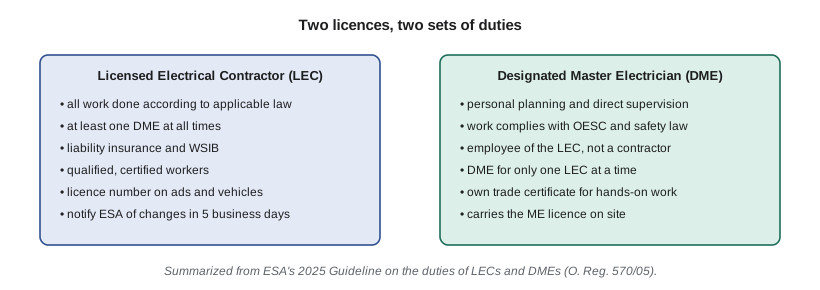
The guideline summarizes the contractor's main duty, from section 4(1) of the regulation, as ensuring that all electrical work is carried out in accordance with all applicable laws. That is broader than the OESC. It includes health and safety law, employment standards, consumer protection and business tax rules. A contractor whose wiring is perfect but who ignores the Employment Standards Act or the Consumer Protection Act is still failing that duty.
Other contractor duties follow from that core. The contractor must keep the liability insurance the regulation requires and maintain its WSIB registration; under section 8, if it stops meeting these requirements it must notify ESA immediately and stop operating until it complies again. It must employ qualified people who hold the trade qualifications the law requires; the guideline gives substituting unqualified labour for certified trades as an example of unauthorized work. It must not let unlicensed persons operate under its licence or take out notifications for them, and subcontractors whose work needs a contractor licence must hold one. It must keep application and renewal documents for the life of the licence, and keep its DME list. And it must notify ESA within 5 business days of any change to the information in its application or renewal, which includes a change of DME, under section 22.
The DME's duties
The DME's central duty, from section 6(a), is the personal planning and direct supervision of the electrical work the contractor carries out. The guideline gives examples of what that can involve, such as training workers, ensuring the use of personal protective equipment and lockout procedures, ensuring Code compliance, managing notifications and inspections, and being present on sites. It is careful to say these are examples rather than a checklist; the right level of supervision depends on the work, the workers and the risks.
The DME's second duty, from section 6(b), is to ensure that the work complies with the OESC and with health and safety and consumer protection law. The guideline notes that this is a separate duty from the contractor's similar duty, and that both apply. If a Grand River crew installs a panel without the required working clearance, both Grand River and its DME have failed in their duties, and ESA can hold either or both responsible.
The DME must hold a valid Master Electrician licence. If the DME personally does electrical work, they need a valid trade certificate for it as well; the guideline cites section 7(3). The DME must carry the ESA-issued licence while on site and produce it on request. For Maria, who will keep working with the tools as well as supervising, that means keeping both her ME licence and her Certificate of Qualification current.
| Duty | Contractor (LEC) | DME |
|---|---|---|
| All work done according to applicable law | Yes, s. 4(1) | Compliance with OESC, safety and consumer law, s. 6(b) |
| Planning and direct supervision | Must provide a DME | Yes, s. 6(a) |
| Insurance and WSIB | Yes, s. 8 | No |
| Notify ESA of changes | Within 5 business days, s. 22 | Keeps own licence current |
| Licence display | On correspondence, contracts, ads and vehicles | Carries licence on site |
When a DME leaves
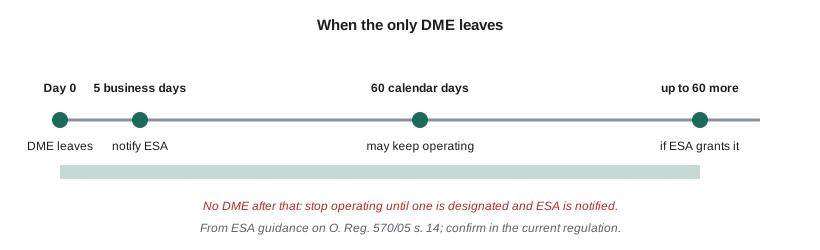
Frank's retirement plan raises the most important timing rule in the guideline. If a contractor loses a DME, it must notify ESA within 5 business days. If that DME was its only one, the contractor may continue operating for 60 calendar days while it finds a replacement, and ESA may grant up to a further 60 days on written application. If no DME is employed by the end of that period, the contractor must stop operating until one is designated and ESA has been notified. The guideline cites section 14 of the regulation for these rules.
This is why Frank wants Maria licensed and designated before he retires. With two DMEs, Frank's departure means only a notification to ESA within 5 business days; Grand River keeps operating normally because it still has a DME. With one DME, a sudden illness or departure would start the 60-day clock and put the business at risk.
Worked problem
Frank leaves unexpectedly
Suppose Frank, Grand River's only DME, leaves on Monday 1 June 2026, before Maria has her licence. What must Grand River do, and by when?
Show solution
- Notify ESA within 5 business days: by Monday 8 June 2026 (1 June is day 0; 2 to 5 June and 8 June are the five business days).
- Grand River may keep operating for 60 calendar days, to 31 July 2026, while it designates a new DME.
- If Maria is licensed by then, Grand River designates her and notifies ESA of the new DME.
- If no DME is in place, Grand River can apply in writing for up to 60 more days; otherwise it must stop operating.
Answer: Notify ESA by 8 June, designate a new DME by 31 July, or apply in writing for an extension.
from datetime import date, timedelta

def add_business_days(start, n, holidays=()):
    d, count = start, 0
    while count < n:
        d += timedelta(days=1)
        if d.weekday() < 5 and d not in holidays:
            count += 1
    return d

left = date(2026, 6, 1)
notify_by = add_business_days(left, 5)
operate_until = left + timedelta(days=60)
extended_until = operate_until + timedelta(days=60)
print("DME left:              ", left.isoformat())
print("Notify ESA by:         ", notify_by.isoformat())
print("Operate without a DME: ", operate_until.isoformat())
print("With an ESA extension: ", extended_until.isoformat())DME left: 2026-06-01 Notify ESA by: 2026-06-08 Operate without a DME: 2026-07-31 With an ESA extension: 2026-09-29
Change the date and add statutory holidays to the list to check other scenarios. Business days and calendar days are both used in the guideline, and mixing them up is an easy exam mistake.
Supervision in practice
What does direct supervision look like for a DME who also runs jobs? Maria sketches her own approach. She will review every job's scope and notification before work starts. She will visit each active site at least weekly, more often for larger or riskier work, and check that the work is following the plan. She will make sure every worker on site holds the right certificate or apprentice registration and that apprentices are supervised at the ratio the trades law requires. She will check that lockout procedures, personal protective equipment and safe work practices are being followed. She will track inspections and defects. And she will keep notes of all of this, because a DME who cannot show what supervision took place will struggle to answer ESA if a problem arises.
Frank adds a piece of advice from experience: supervision is not only about catching mistakes, it is about planning. A DME who reviews a job before it starts can spot a Code issue on the drawings, order the right material, and brief the crew on the hazards. That kind of planning is exactly what the regulation's words, personal planning and direct supervision, describe.
Planning the handover
Frank and Maria draw up a simple handover plan. Once Maria is licensed, Grand River designates her as a second DME and notifies ESA within 5 business days, with the designation date and scope recorded in the company's DME list. For a year, Frank and Maria share the role: Frank keeps the commercial and industrial jobs, Maria takes the residential work and the EV charging projects. Each reviews the other's files once a month. When Frank retires, Grand River removes his designation, notifies ESA within 5 business days, and Maria becomes the sole DME, with Dev expected to become a second one after his exam.
The plan has a second purpose. A DME's duties are personal, and Maria will be the person ESA contacts if a Grand River job goes wrong. Shadowing Frank for a year gives her a chance to see how he manages notifications, defects, inspectors, clients and crews before she carries that responsibility alone.
Consequences of failing the duties
When the duties are not met, ESA has several responses. An inspector can issue defect notices on the work itself. The Director of Licensing can propose to suspend or revoke a contractor's licence or a Master Electrician's licence, or to attach conditions, with the holder able to request a hearing within the stated time. Charges can be laid for offences under the Electricity Act. And since 2023, administrative penalties under Ontario Regulation 12/23 give ESA a way to impose monetary penalties for certain contraventions without going to court. The exam's Business Administration section includes administrative penalties, so read that regulation in the legislation book, paying attention to which contraventions it covers and how a penalty is reviewed.
Display and records
The guideline also covers how licences are displayed and how records are kept, citing sections 17 to 24 of the regulation. The contractor's licence number must appear in correspondence, contracts and advertisements and on business vehicles, and the licence certificate must be posted at each place of business, with 90 days allowed after a licence is issued to comply. Lesson 8 covers display in more detail. Licences must be returned to ESA within 5 business days of being suspended, revoked or expiring, unless the holder is renewing. And appeals of a notice of proposal must be requested within 15 business days.
Common mistakes
MistakeLending your ME licence to a company you do not work for.
InsteadA DME must be actively employed by the contractor as an employee.
MistakeBeing DME for two companies at once.
InsteadA DME may act for only one contractor at a time.
MistakeTreating the DME's compliance duty as the contractor's problem only.
InsteadThe contractor and the DME each have their own duty to ensure compliance.
MistakeWaiting until the 60 days are nearly up to tell ESA a DME left.
InsteadNotify ESA within 5 business days of losing a DME.
Summary and key terms
- Every LEC must designate at least one licensed ME as DME at all times; a DME acts for only one LEC and must be its employee.
- The LEC must ensure all electrical work complies with all applicable laws, keep insurance and WSIB, use qualified workers and notify ESA of changes within 5 business days.
- The DME is responsible for personal planning and direct supervision and for compliance with the OESC, safety and consumer law.
- A DME doing hands-on work needs a valid trade certificate and must carry the ME licence on site.
- Losing the only DME: notify within 5 business days, operate up to 60 days, plus up to 60 more if ESA grants it.
- Designation
- An LEC's formal naming of a licensed ME as its DME, with a date and scope.
- Direct supervision
- Active oversight of electrical work by the DME, as set out in O. Reg. 570/05 s. 6(a).
- DME list
- The LEC's record of each DME's name, designation date, effective period and scope.
- Calendar day
- Any day, including weekends and holidays.
- Applicable law
- All laws that apply to the work, including the OESC, safety, employment, consumer and tax law.
Practice problems
Work each problem on paper first, then reveal the answer to check.
How many DMEs must an LEC have at all times?
Show answer
At least one.
Can a DME be an independent contractor to the LEC?
Show answer
No; the guideline says the DME must be an employee.
How soon must an LEC notify ESA of a change of DME?
Show answer
Within 5 business days.
How long may an LEC operate after losing its only DME?
Show answer
60 calendar days, plus up to 60 more if ESA grants it in writing.
What must a DME carry on site?
Show answer
The ESA-issued ME licence.
Lesson quiz · 5 questions
Score 60% or more to complete this lesson.
Create a free account to save your progress, take quizzes and earn a certificate.