
MELC-205 · Lesson 3 of 12 · 20 min
Applying, approval and booking the exam
▶ Video coming soon A video version of this lesson is on the way.
Once Maria is sure she will be eligible for the licence, she has to get herself into the exam room. In Ontario that means an application to ESA, a fee, a chosen session from ESA's published schedule and a few weeks of lead time. The process is not difficult, but it has deadlines that catch people out, and the rules on retakes are stricter than many candidates expect. This lesson walks through the process as ESA describes it in its exam information package and on its exam web page, with the figures current at the time of writing. Fees and procedures change, so check the current package on esasafe.com before you apply.
Applying through the licensing platform
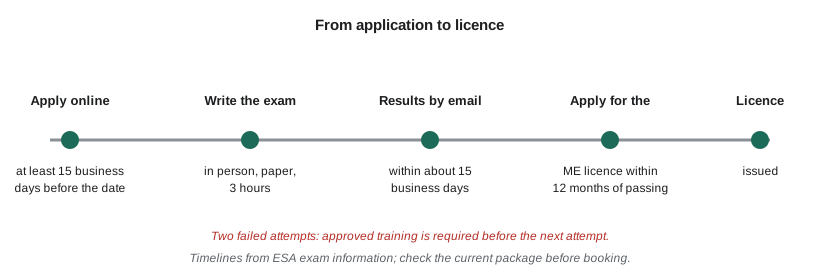
ESA has moved Master Electrician exam applications to its online self-serve licensing platform. Candidates create an account on the platform, even if they used an older ESA system in the past, and complete the exam application there. The application asks for personal and contact information, the session you want, any accommodation request and payment. Keep your email address current in the platform: ESA sends confirmations and results by email, and its information package says results are not given by telephone.
The exam fee in ESA's information package is about 164 dollars plus HST, a little over 185 dollars in total. The package itself shows two slightly different figures in different places, which is a good reminder to confirm the amount on the platform when you pay. Once ESA has processed an application, the fee is not refundable. If a candidate needs to move to another session and ESA approves the transfer, a transfer fee of about 32 dollars plus HST applies. Each new attempt after a failure requires a new application and a new fee.
Timing matters. ESA must receive a completed application at least 15 business days before the exam date, and it suggests applying at least a month ahead. Business days exclude weekends and statutory holidays, so 15 business days is three calendar weeks at a minimum and longer around holidays. A candidate who applies 14 business days before a session will not be scheduled for it, however well prepared they are.
Worked problem
Finding the last day to apply
Maria wants the session on Wednesday 8 April 2026. Good Friday, 3 April 2026, is a statutory holiday. What is the latest date ESA should receive her completed application?
Show solution
- Count back 15 business days from 8 April, skipping weekends and the holiday.
- Count back: 7 and 6 April are 2; skip the weekend and Good Friday; 2 and 1 April make 4; 31 and 30 March make 6.
- Then 27, 26, 25, 24 and 23 March make 11, and 20, 19, 18 and 17 March make 15.
- The fifteenth business day before the exam is Tuesday 17 March 2026.
Answer: Her application must reach ESA by 17 March 2026; applying in early March, as ESA suggests, leaves a margin.
from datetime import date, timedelta

def business_days_before(day, n, holidays):
    count = 0
    while count < n:
        day -= timedelta(days=1)
        if day.weekday() < 5 and day not in holidays:
            count += 1
    return day

exam = date(2026, 4, 8)
holidays = {date(2026, 4, 3)}          # Good Friday
latest = business_days_before(exam, 15, holidays)
print("Exam:", exam.isoformat())
print("Application must arrive by:", latest.isoformat(), latest.strftime("%A"))Exam: 2026-04-08 Application must arrive by: 2026-03-17 Tuesday
Edit the date and the holiday list to check your own session. Remember that ESA counts from when it receives a completed application, so an application missing information does not start the clock.
Choosing a session and place
ESA publishes its exam schedule for the year, with sessions in centres across Ontario. At the time of writing, the exam is offered in person only, in a paper-based format: candidates receive an exam booklet and answer sheet and write in pencil. ESA offered virtually proctored exams for a time, but its information package states that virtual exams were paused from 1 March 2024. If that changes, ESA will announce it, so check the current page rather than relying on older forum posts or articles.
Pick a centre you can reach easily on the day, and plan the trip. The exam runs for up to three hours, and arriving rushed costs concentration. Maria chooses the Kitchener session so that she can sleep at home the night before and walk in with time to spare. Dev, planning for the autumn, notes that sessions close to the end of the year fill quickly as candidates try to finish before the holidays.
Building a study plan around the date
Booking the exam turns a vague intention into a deadline, and Maria uses it to plan backwards. She has ten weeks between her application in late January and the April session. She divides them by exam section rather than by book: three weeks on the Ontario Electrical Safety Code, with emphasis on Section 2 and the Ontario amendments; two weeks on worker safety law; three weeks on business administration, including the licensing regulation and the guideline on duties; and two weeks of mixed timed practice. Each week ends with a short self-test on that week's material and a review of anything she got wrong.
She also keeps a running list of look-ups that took her too long. At the end of each week she adds a tab or an index note for each one, so that her Code and legislation book become faster to use as the date approaches. Frank, who wrote the exam long before the current format, tells her that the candidates who struggle are rarely those who know too little; they are the ones who know the material but cannot find it quickly enough.
Dev, writing in the autumn, copies her plan but stretches it over fourteen weeks because of his family commitments. The structure matters more than the exact length: cover every section, practise under time pressure, and finish with full-length mixed sets so that switching between the Code, safety law and business law feels routine by exam day.
Out-of-province candidates
ESA's exam page notes that applicants who hold a master credential from Alberta or British Columbia write a version of the exam focused on Ontario's amendments to the Canadian Electrical Code. The application route for those candidates is described on ESA's out-of-province page, and it uses its own forms. A candidate in that position should read that page before applying through the general route, because choosing the wrong application can cost time and fees.
Accommodations and interpreters
Candidates who need accommodation, for example extra time or a separate room because of a disability, request it as part of the registration, at least 15 business days before the desired date. ESA's page says approval is not guaranteed and that it reviews each request. A candidate who needs an interpreter must find and pay for one; the interpreter must hold current certification from the Ontario Council on Community Interpreting or be a certified member of the Association of Translators and Interpreters of Ontario. Interpreter sessions are scheduled separately from public sessions, on weekday mornings, and also need at least 15 business days' notice.
None of this is likely to appear as a detailed exam question, but it matters for planning. If you know you will need an accommodation, apply early and include the supporting information ESA asks for, so that a missing document does not push you past the cut-off.
Reference materials to buy before the exam
The exam is open book, but only for hard-copy materials, and the list of permitted materials is specific. Lesson 4 covers it in detail. For booking purposes, the important step is to order the materials early. ESA sells a hard copy of the 2024 Master Electrician Exam Relevant Legislation book for about 78 dollars plus HST; it can be requested during registration or by email. The Ontario Electrical Safety Code itself is sold by CSA Group, and ESA allows an electronic copy to be printed if the printout carries the purchaser's personal watermark with name and email. ESA's 2025 guideline on the duties of contractors and Master Electricians is a free download that can be printed.
Maria orders the legislation book the day she applies, prints the guideline, and starts tabbing her Code. Frank lends her his old Relevant Legislation book from a previous cycle, and she sets it aside: older editions may not match the current regulations, and ESA's package recommends against using outdated materials.
Results
ESA's information package says results are emailed within 15 business days of the exam date. They are not given over the phone, so a candidate who calls the office the day after the exam will be told to wait for the email. A candidate who has a question about their result must raise it in writing within 30 days of receiving it. Passing does not issue a licence automatically: the next step is a separate licence application on the platform, within 12 months of passing, as lesson 2 explained.
While she waits, Maria resists the urge to replay every question in her head. Instead she writes down, the same evening, which areas felt slow or uncertain. If she passes, the list tells her what to brush up on before she starts acting as a DME. If she does not, it becomes the starting point for her second attempt, which she could book straight away. Either way, the notes are more useful than a memory of individual questions, which she is not allowed to share in any case.
Keeping a booking file
Aisha suggests a simple booking file for each candidate at Grand River: the application confirmation, the receipt for the fee, the session details, the order confirmation for the legislation book, and later the result email and the licence application. It sounds bureaucratic, but each item answers a question that might come up. If the result email goes astray, the confirmation shows the exam date to quote to ESA. If the company claims the fee as a business expense, the receipt is there. If Maria's licence application is queried, the result email shows the pass date and so the start of her 12-month window. The file takes a few minutes to build and saves hours of searching.
Retakes and the training requirement
Ontario does not impose a waiting period between attempts. A candidate who fails can apply for another session straight away, if space is available, with a new application and fee. The limit comes after the second failure. ESA's rules say that after two failed attempts, a candidate must complete an approved training course before writing a third time. After completing that training, the candidate has two more attempts before training is required again. The rule applies regardless of how much time has passed between attempts, so a candidate who failed twice ten years ago and is trying again now still needs the training first.
The training must be approved by the Director of Licensing, and ESA asks candidates to send the course details to its exam office before enrolling, to confirm approval. Self-assessment tools, practice exam websites and private tutoring do not count. Proof of completion, such as a certificate or receipt, goes in with the new application. ESA also offers its own pre-exam training, which candidates may take at any time; it is not required for a first attempt.
| Attempt | What you need |
|---|---|
| First | Application and fee |
| Second | New application and fee |
| Third | Approved training completed, then application and fee |
| Fourth | New application and fee |
| Fifth | Approved training again, then application and fee |
Exam security
ESA treats the exam as confidential and has obtained a court order protecting its exam content from unauthorized use. Candidates should not copy, record or share questions, and study materials that claim to contain real exam questions should be treated with suspicion. Apart from the legal risk, memorized questions are a poor way to prepare: questions are revised, and a candidate who understands the Code and the law can answer a question they have never seen before. Every practice question in this course is original and written from public sources.
Common mistakes
MistakeApplying two weeks before the session.
InsteadESA needs a completed application at least 15 business days before the exam; apply about a month ahead.
MistakeExpecting results by phone the next day.
InsteadResults are emailed, generally within 15 business days, and are not given by phone.
MistakeWaiting a few years after two failures to avoid the training rule.
InsteadAfter two failed attempts, approved training is required regardless of elapsed time.
MistakeRelying on an old edition of the legislation book.
InsteadUse the current Relevant Legislation book and the current OESC.
Summary and key terms
- Apply on ESA's online licensing platform; the exam fee is about 164 dollars plus HST and is non-refundable once processed.
- ESA must receive a completed application at least 15 business days before the exam; ESA suggests a month.
- The exam is in person and paper-based; virtual exams were paused from 1 March 2024.
- Results are emailed within about 15 business days; questions about results go in writing within 30 days.
- There is no waiting period between attempts, but approved training is required after every two failures.
- Business day
- A weekday that is not a statutory holiday.
- Transfer fee
- A fee charged when ESA approves moving an exam booking to another session.
- Relevant Legislation book
- ESA's compilation of the laws and regulations covered by the exam.
- Approved training
- A course approved by the Director of Licensing that is required after two failed attempts.
- Accommodation
- An adjustment to exam conditions, such as extra time, approved for a candidate who needs it.
Practice problems
Work each problem on paper first, then reveal the answer to check.
How far ahead must ESA receive a completed exam application?
Show answer
At least 15 business days before the exam date.
Can you get your result by phone?
Show answer
No; results are emailed.
After how many failed attempts is approved training required?
Show answer
After two.
Is there a waiting period between attempts?
Show answer
No, but each attempt needs a new application and fee.
Who pays for an interpreter?
Show answer
The candidate, who must use a certified interpreter.
Lesson quiz · 5 questions
Score 60% or more to complete this lesson.
Create a free account to save your progress, take quizzes and earn a certificate.