
MELC-205 · Lesson 1 of 12 · 21 min
How electrical licensing works in Ontario
▶ Video coming soon A video version of this lesson is on the way.
Ontario regulates electrical work differently from every other province, and the difference shows up on the Master Electrician exam from the first page. In most of Canada, a provincial or territorial government department runs electrical safety directly. In Ontario, that job belongs to the Electrical Safety Authority, an administrative authority that the province has delegated to administer the electrical safety parts of the Electricity Act, 1998. ESA writes and enforces the Ontario Electrical Safety Code, receives notifications of work, carries out inspections, licenses electrical contractors and Master Electricians, and runs the Master Electrician exam. If you are preparing for that exam, you need a clear picture of who does what, because a good share of the Business Administration and Worker Safety questions are really questions about which organization or which document answers a particular problem.
This course follows Maria Santos, a construction and maintenance electrician who has held her Certificate of Qualification since 2019 and works for Grand River Electrical Contracting Ltd. in Kitchener. The company's owner, Frank DiMarco, has been its Designated Master Electrician for more than twenty years and wants to retire within three years. Grand River needs a second Master Electrician who can take over as DME, and Frank has asked Maria to write the exam this spring. Aisha Rahman runs the office and keeps the licence, insurance and WSIB records; Dev Patel is a senior journeyperson; Liam O'Connor is a second-level apprentice; and Tyler Chen, who trained in Alberta and moved to Ontario last year, has just joined the crew. Their jobs this season include a semi-detached house renovation on Elm Street, a café fit-out on Victoria Street for a general contractor, a motor control upgrade at Conestoga Plastics and an electric vehicle charging retrofit at Lakeview Condominiums.
Everything in this course is drawn from public sources: ESA's exam information, its guideline on the duties of contractors and Master Electricians, Ontario statutes and regulations on e-Laws, and the published structure of the Ontario Electrical Safety Code. Code text is not reproduced. Fees, timelines and exam details change, so treat every number here as a starting point and confirm it on esasafe.com and ontario.ca before you rely on it.
The legal framework in one picture
Start with the statute. The Electricity Act, 1998 covers the whole electricity sector, but Part VIII deals with electrical safety. It allows regulations that set an electrical safety code, require notification and inspection of electrical work, and license electrical contractors and Master Electricians. It also allows those safety functions to be delegated to a designated administrative authority, and ESA is that authority. ESA is not a government ministry, but it exercises powers given to it by law, and its directors and inspectors can make orders, refuse or revoke licences and lay charges where the Act allows.
Two regulations matter most for this exam. The first, Ontario Regulation 164/99, adopts the Ontario Electrical Safety Code by reference, so the Code has the force of law in Ontario. The second, Ontario Regulation 570/05, is the licensing regulation for electrical contractors and Master Electricians. It sets out who must hold a licence, what each licence holder must do and how licences are issued, renewed, suspended and revoked. ESA publishes a guideline on the duties of licensed electrical contractors and designated Master Electricians that explains the regulation section by section; the 2025 edition is one of the references allowed in the exam room, and you will meet it again in lesson 7.
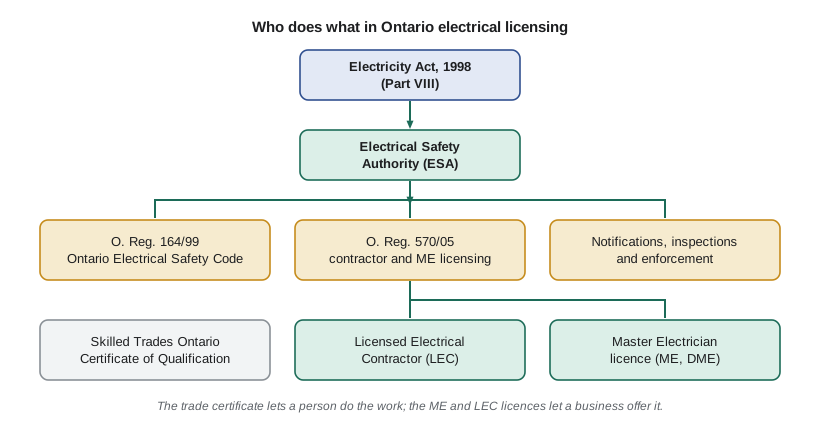
A third body sits alongside ESA. Skilled Trades Ontario, created under the Building Opportunities in the Skilled Trades Act, 2021, manages apprenticeship and issues Certificates of Qualification in the trades, including the construction and maintenance electrician trade and the industrial electrician trade. Electrician trades are compulsory in Ontario, which means that only certified journeypersons and registered apprentices may do the regulated work. Skilled Trades Ontario does not issue contractor or Master Electrician licences, and ESA does not issue trade certificates. Mixing the two up is one of the most common errors on practice exams.
Three different permissions
Ontario separates three things that people often blur together: the right to do electrical work with your own hands, the right to supervise it, and the right to offer it to the public as a business. A trade certificate gives the first. A Master Electrician licence shows the second: the holder has passed the exam and has the experience to plan and supervise work. An Electrical Contractor licence gives the third: a business may advertise, contract and take out notifications for electrical work done for others. The contractor licence depends on the Master Electrician licence, because every licensed contractor must have at least one licensed Master Electrician designated to supervise its work.
Maria's situation shows how the pieces fit. Her Certificate of Qualification lets her pull wire, terminate equipment and run jobs as a journeyperson. It does not let her open her own business and bid on work, and it does not let Grand River use her as its DME. Once she passes the exam and receives her Master Electrician licence, Grand River can designate her, and she takes on legal duties for the planning and supervision of the company's electrical work. If she ever started her own company, that company would need its own Electrical Contractor licence, with her as its DME.
| Permission | Document | Issued by |
|---|---|---|
| Do the regulated work | Certificate of Qualification (or apprentice registration) | Skilled Trades Ontario |
| Plan and supervise for a contractor | Master Electrician licence, designated as DME | ESA |
| Offer electrical work to the public | Electrical Contractor licence | ESA |
| Make the installation legal | Notification of work and inspection | ESA |
Who needs an Electrical Contractor licence
In general terms, a person or business that carries out or offers to carry out electrical work for others in Ontario needs an Electrical Contractor licence. That includes sole proprietors, partnerships and corporations, and it includes businesses whose main line of work is something else, such as a renovation company or a sign company that installs its own wiring. The licensing regulation contains exemptions, for example for certain work done by employees on their employer's own premises, for utilities working on their own distribution systems and for specific categories set out in the regulation. Exam questions often describe a scenario and ask whether a licence is needed, so read the facts closely: who is paying whom, whose premises the work is on and whether the person is an employee or a contractor.
Homeowners in Ontario may do electrical work in a dwelling they own and live in, provided they file a notification with ESA and have the work inspected. They may not do the work for anyone else, and they cannot hire an unlicensed person to do it for them. ESA spends a lot of effort on what it calls the underground economy: unlicensed contractors who offer cheap work without notifications or inspections. A licensed contractor who knowingly takes out a notification on behalf of an unlicensed person is helping that person break the law, and ESA's guidance says plainly that a contractor must not let an unlicensed person work under its licence.
Worked problem
Does this job need a licensed contractor?
A kitchen renovation company in Waterloo removes cabinets, moves two receptacles and adds under-cabinet lighting for a homeowner. The company's carpenter, who has no electrical certificate, offers to do the wiring.
Show solution
- The work is electrical work done for someone else, in the homeowner's dwelling.
- The carpenter is not a certified electrician, so the compulsory-trade rules forbid him from doing it.
- The renovation company is offering electrical work to the public, so it needs an Electrical Contractor licence, or it must subcontract the electrical scope to an LEC.
- Whoever does the work must file a notification with ESA before starting.
Answer: The renovation company should subcontract the wiring to a licensed contractor such as Grand River, which files the notification and has a certified electrician do the work.
The enforcement tools ESA uses
Licensing is enforced in several ways. ESA can refuse to issue or renew a licence, impose conditions, or propose to suspend or revoke one. A licence holder who receives a notice of proposal can request a hearing before the Director of Licensing, and the timeline for that request is short. ESA's inspectors can issue defect notices on installations, and the authority can lay charges under the Electricity Act for serious offences, such as doing electrical work without a licence or failing to file a notification. Ontario also introduced administrative penalties under Ontario Regulation 12/23, which let ESA impose monetary penalties for certain contraventions without going to court. The ME exam's Business Administration section expects you to know that these tools exist and roughly how they work; the 2024 Relevant Legislation book that ESA sells for the exam contains the regulations themselves.
For a working contractor, the practical message is that licensing is not a one-time event. Grand River must keep its licence information current with ESA, keep its insurance and WSIB status in force, keep a DME at all times and display its licence number correctly. Maria, once licensed, must renew her licence every year and keep her trade qualifications valid. The rest of this course works through those obligations one by one.
Coming from another province
Tyler Chen's move from Red Deer raises a question many candidates have: what happens to credentials earned elsewhere? Two separate things are involved. His trade certification is handled by Skilled Trades Ontario, which recognizes interprovincial Red Seal endorsements and has its own process for trade certificates from other jurisdictions. A Master Electrician licence is different. ESA has an out-of-province pathway for people who already hold a master-level credential in another province, and its exam page notes that applicants from Alberta and British Columbia write a version of the exam focused on Ontario's amendments to the Canadian Electrical Code rather than the full exam. Tyler does not hold Alberta's Master Electrician Certificate, so that pathway does not apply to him; if he wanted an Ontario ME licence, he would follow the regular route once he had the qualifying experience.
The out-of-province arrangements change as provinces sign or revise labour mobility agreements, so a candidate in Tyler's position should read ESA's out-of-province page and contact ESA licensing before assuming anything. On the exam itself, expect questions that test the principle rather than the paperwork: a trade certificate and a contractor or master licence are issued by different bodies under different laws, and holding one does not give you the other.
How the exam reflects this structure
The ME exam has three sections of roughly equal weight: the Ontario Electrical Safety Code, Worker Safety and Business Administration. Candidates who come from the field usually find the Code section the most familiar and the Business Administration section the most surprising. Business Administration covers the Electricity Act, the licensing regulation, the duties of contractors and Master Electricians, administrative penalties, consumer protection, construction law and general business matters. Worker Safety covers the Occupational Health and Safety Act and its construction regulation, especially the electrical provisions, along with workplace insurance. Lesson 4 covers the format in detail, and lessons 7 to 10 cover the business and safety law.
Maria's first study task is to build a one-page map like the figure above, with the statute at the top, ESA and its regulations underneath and Skilled Trades Ontario off to one side. Frank suggests she add a second column listing which document she would open to answer each kind of question. That habit pays off in the exam room, where the clock rewards knowing which book to reach for.
# Maria's question sorter: which reference answers which kind of question?
references = {
    "Can a carpenter wire receptacles?": "trades law (Skilled Trades Ontario)",
    "Minimum receptacle spacing in a kitchen": "Ontario Electrical Safety Code",
    "When must Grand River tell ESA about a new DME?": "O. Reg. 570/05 and the LEC/DME guideline",
    "Can work start before a notification is filed?": "Ontario Electrical Safety Code, Section 2",
    "Tag requirements for a locked-out panel": "O. Reg. 213/91 (construction projects)",
}
for question, source in references.items():
    print(f"{question:<50} -> {source}")
print(len(references), "questions sorted")Can a carpenter wire receptacles? -> trades law (Skilled Trades Ontario) Minimum receptacle spacing in a kitchen -> Ontario Electrical Safety Code When must Grand River tell ESA about a new DME? -> O. Reg. 570/05 and the LEC/DME guideline Can work start before a notification is filed? -> Ontario Electrical Safety Code, Section 2 Tag requirements for a locked-out panel -> O. Reg. 213/91 (construction projects) 5 questions sorted
The output is a reminder rather than a rule: some questions draw on more than one source, and the exam may ask you to combine them. But knowing where to start saves minutes on every question.
Common mistakes
MistakeThinking Skilled Trades Ontario issues the Master Electrician licence.
InsteadESA issues ME and contractor licences; Skilled Trades Ontario issues trade certificates.
MistakeTreating a Master Electrician licence as permission to run a business.
InsteadA business offering electrical work needs its own Electrical Contractor licence with a designated ME.
MistakeAssuming the national CE Code applies in Ontario as published.
InsteadOntario applies the Ontario Electrical Safety Code, which is the CE Code with Ontario amendments, adopted by regulation.
MistakeFiling a notification for a friend's unlicensed company.
InsteadNever take out a notification for someone else; the person doing the work files it.
Summary and key terms
- ESA administers electrical safety under Part VIII of the Electricity Act, 1998, including the Code, notifications, inspections and licensing.
- O. Reg. 164/99 adopts the Ontario Electrical Safety Code; O. Reg. 570/05 governs contractor and Master Electrician licences.
- Skilled Trades Ontario issues Certificates of Qualification; electrician trades are compulsory.
- Doing the work, supervising it and offering it to the public are three separate permissions.
- ESA enforces through licence decisions, defect notices, charges and administrative penalties under O. Reg. 12/23.
- ESA
- The Electrical Safety Authority, the administrative authority delegated to administer electrical safety in Ontario.
- LEC
- Licensed Electrical Contractor: a business licensed to carry out or offer electrical work for others.
- DME
- Designated Master Electrician: a licensed ME designated by an LEC to plan and supervise its electrical work.
- Compulsory trade
- A trade that only certified journeypersons or registered apprentices may practise.
- Proposal notice
- A written notice from the Director of Licensing proposing to refuse, suspend or revoke a licence.
Practice problems
Work each problem on paper first, then reveal the answer to check.
Which regulation adopts the Ontario Electrical Safety Code?
Show answer
Ontario Regulation 164/99.
Which regulation governs Electrical Contractor and Master Electrician licences?
Show answer
Ontario Regulation 570/05.
Who issues the construction and maintenance electrician Certificate of Qualification?
Show answer
Skilled Trades Ontario.
May a homeowner rewire a rental unit they own but do not live in?
Show answer
No; homeowner work is limited to a dwelling the owner occupies, and work for tenants needs a licensed contractor.
What are the three sections of the ME exam?
Show answer
Ontario Electrical Safety Code, Worker Safety and Business Administration.
Lesson quiz · 5 questions
Score 60% or more to complete this lesson.
Create a free account to save your progress, take quizzes and earn a certificate.