
MELC-205 · Lesson 4 of 12 · 20 min
The exam format and the references allowed
▶ Video coming soon A video version of this lesson is on the way.
Knowing the format of an exam is worth marks before you have learned a single rule. It tells you how much time each question deserves, which books to bring and how to organize them, and how to avoid failing an exam you could have passed. Ontario's Master Electrician exam has two features that surprise many candidates: a pass mark that applies to each section as well as to the whole paper, and a strict list of permitted references that the proctor enforces. This lesson sets out the format as ESA describes it on its exam page and in its exam information package, and then turns that information into a plan for Maria's books and her time.
The format at a glance
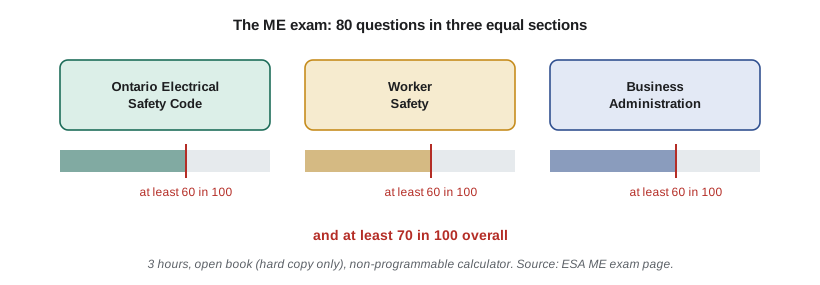
The exam consists of 80 multiple-choice questions to be answered in a maximum of three hours. The questions fall into three sections, each weighted at 33 in 100 of the total: the Ontario Electrical Safety Code, Worker Safety and Business Administration. The exam is written in person, on paper: ESA provides an exam booklet, an answer sheet and a pencil, and candidates mark their answers on the sheet. It is open book, but only hard-copy materials are allowed, and only from the permitted list.
To pass, a candidate needs an overall score of at least 70 in 100 and at least 60 in 100 in each of the three sections. That second condition is the one that catches people. A candidate who scores very well on the Code and Business Administration but poorly on Worker Safety can fail even though their overall score is above 70. Exam preparation therefore has to cover all three sections, even if one feels less natural.
Worked problem
Does this candidate pass?
Suppose the three sections had 27, 27 and 26 questions. A candidate answers 25 Code questions, 15 Worker Safety questions and 20 Business Administration questions correctly.
Show solution
- Overall: 25 + 15 + 20 = 60 correct out of 80, which is 75 in 100, above the 70 needed.
- Code: 25 / 27 is about 93 in 100.
- Worker Safety: 15 / 27 is about 56 in 100, below the 60 needed in each section.
- Business Administration: 20 / 26 is about 77 in 100.
Answer: The candidate fails, because one section is below 60 in 100, even though the overall score is 75 in 100. (The section sizes here are illustrative; ESA states the weights, not the exact counts.)
def passes(scores, overall_min=0.70, section_min=0.60):
    # scores: {section: (correct, out_of)}
    right = sum(c for c, n in scores.values())
    total = sum(n for c, n in scores.values())
    overall = right / total
    weak = [s for s, (c, n) in scores.items() if c / n < section_min]
    print(f"Overall {right}/{total} = {overall:.0%}")
    for s, (c, n) in scores.items():
        print(f"  {s:<24} {c}/{n} = {c/n:.0%}")
    return overall >= overall_min and not weak

attempt = {"Code": (25, 27), "Worker Safety": (15, 27), "Business Administration": (20, 26)}
print("Pass" if passes(attempt) else "Fail")Overall 60/80 = 75% Code 25/27 = 93% Worker Safety 15/27 = 56% Business Administration 20/26 = 77% Fail
Try changing the Worker Safety score to 17 out of 27 and run it again. Two more correct answers in the weak section turn a failure into a pass, which is why Maria's study plan gives every section real time.
Time per question
Three hours for 80 questions gives an average of 2.25 minutes, or two minutes and fifteen seconds, per question. That average hides a wide range. Some questions can be answered from memory in thirty seconds, especially in Worker Safety and Business Administration once you know the rules. Others need a look-up in the Code, a calculation or a careful reading of a regulation, and can take four or five minutes. The trick is to bank time on the quick questions so that the slow ones do not squeeze out the end of the paper. Lesson 12 builds a full time plan; for now, remember the average and the principle that no single question is worth more than any other.
Permitted reference materials
ESA's exam page and information package list what candidates may bring. The list is short and specific. Bring the latest version of the Ontario Electrical Safety Code in hard copy. If you bought an electronic copy, you may print it, but the printout must carry your personal watermark showing your name and email; an unmarked printout is not acceptable. ESA's package recommends against bringing the national Canadian Electrical Code or older editions of the OESC, because the exam is set on the current Ontario code with its amendments.
Bring the relevant legislation in non-electronic form. The usual choice is ESA's 2024 Master Electrician Exam Relevant Legislation book, which collects the statutes and regulations the exam draws on, together with ESA's Guideline on the Duties and Responsibilities of Licensed Electrical Contractors and Designated Master Electricians, 2025 edition, printed. Bring a non-programmable calculator and a pencil with an eraser. ESA provides the answer sheet and exam booklet.
| Permitted | Not permitted |
|---|---|
| Current OESC, hard copy or a watermarked printout | Electronic devices, including phones and tablets |
| Relevant legislation in non-electronic form | Electronic PDFs of the Code or legislation |
| The 2025 LEC/DME guideline, printed | Pre-master course workbooks and course manuals |
| Non-programmable calculator | Practice exams and dictionaries |
| Pencil and eraser | Pens, highlighters and personal scrap paper during the exam |
The prohibited list matters as much as the permitted one. Electronic devices of any kind are out, which includes smart watches. Electronic copies of the Code or legislation are not permitted, so a tablet with the Code on it stays at home. Pre-master course workbooks, course manuals, practice exams and dictionaries are not allowed. ESA's package also says pens and highlighters may not be used during the exam and that personal scrap paper is not allowed; you use the materials provided.
Tabs, highlighting and notes
ESA recommends tabbing and highlighting your Code as part of your preparation. Tabs on the main sections, the Ontario-specific rules and the tables you use most will save minutes. Highlighting the key words in rules you look up often helps you confirm you have the right rule. The limit is in the word excessive: ESA's package warns that proctors may confiscate approved materials that have excessive markings, or notes that appear suspicious. Notes are permitted only to clarify Code concepts or words, and only if they were written before the exam.
In practice, that means short index notes and tabs are fine, while pages of handwritten worked solutions, inserted summaries or anything that looks like copied exam questions are not. A confiscated Code is a disaster in an open-book exam, so Maria keeps her notes brief. Her tabs are labelled with section numbers and short topic words, and her margin notes are limited to cross-references such as a rule number written beside a related rule. Frank checks her book a week before the exam and suggests removing two pages of stapled notes she had added at the back.
Organizing the books
With three references on the desk, order matters. Maria puts her Code on the left, open to its index, the legislation book in the centre and the guideline on the right. For each question, she decides which book it needs before reaching for anything. A question about notification of work goes to Section 2 of the Code. A question about how long a contractor has to tell ESA about a change of DME goes to the guideline, which cites the regulation section. A question about lockout tags goes to the construction regulation in the legislation book. This habit, practised on every practice question, keeps her from flipping through the wrong book under pressure.
She also builds a one-page index of her own for the legislation book, listing the regulation sections she has looked up most often with their page numbers. The legislation book is long, and its own table of contents is organized by statute rather than by topic. A short personal index, written into the book before the exam, counts as a note that clarifies where to find things and is well within ESA's limits.
The calculator deserves a moment's thought too. A basic non-programmable scientific calculator is enough for every calculation on this exam, and it should be one you know well. Maria uses the same model for every practice set so that her fingers know where the square root and memory keys are. She brings a spare battery in her pocket on the day.
What the proctor checks
On exam day, expect the proctor to look through your reference materials before you start. That check is the moment when a watermark that is missing, a workbook packed by mistake or a stack of loose notes becomes a problem. The proctor can remove items that are not permitted and may confiscate approved items that break the rules on markings. A candidate who loses their Code at the door still writes the exam, but without the main reference. The way to avoid that is to pack the night before using the permitted list, and to leave everything else at home or in the car.
Maria packs a clear bag with four items: her tabbed OESC, the legislation book with her index page, the printed guideline in a binder and her calculator, plus two sharpened pencils and an eraser. Her phone stays in the car. She brings identification, as ESA's confirmation instructs, and a bottle of water if the centre allows it. Nothing else goes in.
Practising under exam conditions
The format suggests how to practise. Reading the Code at a kitchen table with a phone nearby and no clock is not the same as working through mixed questions against the time, with only the permitted books. In the last three weeks before the exam, Maria does one full practice session each Saturday: 80 original questions she and Dev have written from the Code and the legislation, mixed across the three sections, three hours on a timer, permitted books only. She marks the paper herself, scores each section separately using the 60 in 100 rule, and records how long the look-ups took.
The first session is sobering. She finishes with fifteen minutes to spare but scores 58 in 100 in Worker Safety, because she had assumed field experience would carry her. The second session, after a week on the construction regulation, brings that section to 72 in 100. By the third, all three sections are comfortably above the minimum and she has time to review flagged questions. The improvement comes less from new knowledge than from knowing where things are.
Writing practice questions is itself good preparation. To write a fair question about a regulation, you have to read the section closely, decide what a candidate should know, and think of plausible wrong answers. Dev and Maria swap their questions, which gives each of them fresh material and shows where the other has misread a rule.
Reading multiple-choice questions
Multiple-choice questions reward careful reading. Look for words that change the meaning: shall and may, not and except, minimum and maximum, before and after. Many wrong options are true statements that answer a different question, so check that the option you pick answers the one asked. When a question involves a calculation, work it out before looking at the options, then find the match; if none matches, recheck your working rather than picking the closest. When you have to guess, eliminate the options you know are wrong first, because there is no penalty for a wrong answer and an unanswered question scores nothing.
Business Administration questions often hinge on who is responsible. A question may describe a problem on a job site and ask whether it is the licensed contractor's duty, the designated Master Electrician's, the worker's or the owner's. The guideline sets out the split clearly, and some duties belong to both the contractor and the DME. Worker Safety questions often turn on a threshold or a condition, such as a voltage or a type of work, so find that detail in the question before you open the regulation.
One last habit: mark every answer on the answer sheet as you go, rather than saving them up to transfer at the end. Candidates who plan to copy answers from the booklet in the last ten minutes sometimes run out of time and lose marks they had already earned.
Common mistakes
MistakeAssuming a high overall score is enough.
InsteadEach section needs at least 60 in 100 as well as 70 in 100 overall.
MistakeBringing the Code on a tablet.
InsteadOnly hard-copy materials are permitted; a printed electronic copy must carry your personal watermark.
MistakeFilling the Code with pages of notes.
InsteadBrief tabs and clarifying notes only; proctors may confiscate heavily marked materials.
MistakeLeaving questions blank.
InsteadThere is no penalty for guessing; eliminate what you can and choose an answer.
Summary and key terms
- 80 multiple-choice questions in three sections weighted equally: the OESC, Worker Safety and Business Administration.
- Three hours maximum, in person, on paper, with a pencil.
- Pass: at least 70 in 100 overall and at least 60 in 100 in each section.
- Bring the current OESC, the relevant legislation in hard copy, the 2025 guideline, a non-programmable calculator and a pencil.
- Tabs and brief clarifying notes are allowed; electronic devices, PDFs, workbooks and practice exams are not.
- Section minimum
- The rule that each exam section must be passed at 60 in 100 or better.
- Watermark
- Personal identifying text (name and email) on a printed electronic copy of the Code.
- Open book
- An exam in which approved reference materials may be used.
- Non-programmable calculator
- A calculator that cannot store programs or text.
- Proctor
- The person who supervises the exam and enforces the rules on materials.
Practice problems
Work each problem on paper first, then reveal the answer to check.
How many questions are on the ME exam?
Show answer
80.
What is the time limit?
Show answer
Three hours.
What overall score is needed to pass?
Show answer
At least 70 in 100.
What is the minimum in each section?
Show answer
60 in 100.
May you bring a pen?
Show answer
Pens and highlighters may not be used during the exam; bring a pencil.
Lesson quiz · 5 questions
Score 60% or more to complete this lesson.
Create a free account to save your progress, take quizzes and earn a certificate.