
MELC-205 · Lesson 5 of 12 · 20 min
The Ontario Electrical Safety Code
▶ Video coming soon A video version of this lesson is on the way.
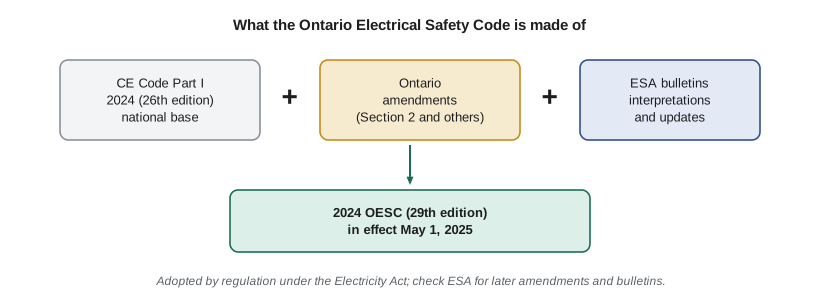
A third of the Master Electrician exam is set on the Ontario Electrical Safety Code, and much of the rest assumes you can find your way around it. The OESC is not a separate code written from scratch. It is the national Canadian Electrical Code, Part I, adopted with Ontario's own amendments and supported by ESA bulletins. Candidates who trained and worked in Ontario use it every day, but the exam asks about parts of it that rarely come up on a job, especially the administrative rules in Section 2 that Ontario writes for itself. This lesson explains how the current edition came into force, how it is built, which parts deserve the most attention and how bulletins fit in. As always, the Code's own text is not reproduced here; open your copy and read each rule mentioned.
The current edition
The 2024 Ontario Electrical Safety Code, the 29th edition, came into effect on 1 May 2025, according to ESA's announcement. It replaced the 2021 edition (the 28th). Each edition follows a new edition of the Canadian Electrical Code, Part I, which CSA Group publishes on a three-year cycle; the 2024 OESC follows the 2024 CE Code, the 26th edition. The province adopts the OESC through a regulatory amendment under the Electricity Act, and ESA's announcement notes that the responsible minister approved the amendment adopting the 2024 edition. Because the Code is adopted by regulation, it has the force of law: an installation that does not comply is a contravention, not just poor practice.
ESA's exam rules call for the latest version of the OESC. On exam day that means the edition in force when you write, which at the time of writing is the 2024 OESC. If a new edition takes effect before your exam date, check ESA's exam page to see which edition the exam uses; changes in the exam generally follow the edition change rather than happening on the same day, and ESA announces the switch.
How the Code is built
The Code follows the familiar CE Code structure. Section 0 sets out the object, scope and definitions. Section 2 contains the general rules, including the administrative rules about permits, inspections and approvals. The general sections that follow cover conductors, services and service equipment, demand loads, grounding and bonding, wiring methods, protection and control, and so on, with the even-numbered sections forming the core of everyday installations. Later sections deal with specific equipment and occupancies, such as motors, transformers, hazardous locations, healthcare facilities, pools, renewable energy and electric vehicle charging. Tables near the back give ampacities, demand factors, conduit fill and many other values, and the appendices explain the intent of rules and give additional information.
Ontario's amendments are concentrated in Section 2, because administration differs from province to province, but they are not limited to it. ESA publishes a document listing the Ontario-specific amendments for each edition, and the Code itself marks the Ontario changes so that they can be found. Candidates should know where the amendments are and should tab them, because an exam question about notification or inspection will be answered by an Ontario rule, not by the national text. An Alberta-trained electrician like Tyler, used to the national Section 2 with Alberta's variances, needs to relearn this part almost entirely.
| Part of the Code | What you will look for there |
|---|---|
| Section 0 | Definitions that decide what a rule means |
| Section 2 | Ontario administrative rules: notification, inspection, approvals, reporting |
| Sections 4 to 14 | Conductors, services, demand loads, grounding and bonding, wiring methods, protection |
| Later sections | Specific equipment and occupancies such as motors, hazardous locations, pools, EV charging |
| Tables and appendices | Values used in calculations, and the intent behind rules |
Section 2: the Ontario rules
Section 2 is where Ontario's legal requirements for electrical work live. It contains the rule on notification of work, which in Ontario means filing with ESA before starting; ESA's duties guideline refers to Rule 2-004 for permits and inspections. It deals with when work may be connected or energized, with inspections and the authorization that allows a utility to connect a service, and with the approval of electrical equipment, which must be certified or approved by an accepted certification or evaluation body before it is used. It includes rules on defects and on correcting them, and on reporting serious electrical incidents to ESA. Read each of these in your own copy, note the rule numbers on your tab sheet, and pay attention to who has each duty: the person doing the work, the contractor, the owner or the utility.
Lesson 6 covers notification and inspection in practice. For now, the exam point is that Section 2 rules are often the answer to Business Administration questions as well as Code questions. A question that asks whether a contractor may start work before filing, or who must request an inspection, can sit in either section of the exam, and the answer comes from Section 2.
Reporting serious electrical incidents is another Section 2 duty that field electricians rarely think about until it happens. If someone is seriously injured by electricity, or a fire or explosion results from an electrical cause, the Code requires a report to ESA within a set time, and the scene may need to be preserved. Grand River's safety binder has a one-page procedure for this, with the rule number and ESA's reporting contact, so that whoever is on site knows what to do. Look up the rule in your own Code and note the time limit and who must report.
Equipment approval deserves a special mention because it catches contractors on real jobs. The Code requires electrical equipment to be approved before it is sold or used, which in practice means it carries a mark from an accredited certification body or a special inspection label. Grand River once received a charger for the Lakeview Condos project that a supplier had imported without an accepted mark. Maria refused to install it until the supplier provided properly certified units, because installing unapproved equipment would have made Grand River responsible for a contravention.
ESA bulletins
Between editions, ESA issues bulletins that interpret rules, explain how ESA will apply them and deal with new technologies or recurring problems. Bulletins have covered topics such as electric vehicle charging, solar photovoltaic systems, energy storage, cannabis production facilities, and many installation details. ESA's announcement for the 2024 edition says bulletins are available on CSA's OnDemand platform, with free access during the code cycle for people who bought the Code book or PDF, and that a bulletin lookup is available on esasafe.com.
Bulletins matter for the exam in two ways. First, the exam is set on the Code as ESA applies it, so a question might reflect a bulletin's interpretation. Second, they show you which rules ESA thinks are misunderstood, which is a good hint about what examiners like to test. Maria reads the bulletins that relate to her tabbed sections and writes the bulletin number in the margin beside the rule; that is a short cross-reference, well within the limits on notes.
The permitted materials list does not include a separate bulletin binder, so check ESA's current exam page before planning to bring any. What you can do is learn the key interpretations well enough that you recognize them in a question.
Using the index
The index is the fastest way into the Code for anyone who has not memorized rule numbers. It is organized by subject and leads to rule numbers rather than page numbers. Good index technique has three steps: pick the most specific noun in the question, look it up, and then read the rule you find in full, including its subrules and any appendix note it points to. If the first search fails, try a synonym or a broader term. Maria keeps a list of words that failed her in practice and the words that worked, and writes the useful ones beside the index entries.
Worked problem
A look-up under time pressure
A practice question asks who must file the notification of work for an electrical installation done by a licensed contractor for a homeowner.
Show solution
- Most specific term: notification (also try permit, filing).
- Index entry leads to the Section 2 rule on notification of work; the duties guideline points to Rule 2-004.
- Read the rule and its subrules to see who must file and when.
- Confirm with ESA's guidance: the person doing the work files; an LEC files for its own jobs.
Answer: The contractor doing the work files the notification before starting; the homeowner does not file for the contractor.
# Build a tab plan: Code sections Maria tabs, with a colour for each exam theme
tabs = [
    ("0", "Definitions", "blue"),
    ("2", "Ontario rules: notification, inspection, approval", "red"),
    ("4", "Conductors", "green"),
    ("6", "Services", "green"),
    ("8", "Demand loads", "green"),
    ("10", "Grounding and bonding", "green"),
    ("12", "Wiring methods", "green"),
    ("14", "Protection and control", "green"),
    ("26", "Installation of equipment", "yellow"),
    ("28", "Motors", "yellow"),
    ("Tables", "Ampacity, fill, demand", "blue"),
]
for section, topic, tab in tabs:
    print(f"Section {section:<7} {tab:<7} {topic}")
print(len(tabs), "tabs planned")Section 0 blue Definitions Section 2 red Ontario rules: notification, inspection, approval Section 4 green Conductors Section 6 green Services Section 8 green Demand loads Section 10 green Grounding and bonding Section 12 green Wiring methods Section 14 green Protection and control Section 26 yellow Installation of equipment Section 28 yellow Motors Section Tables blue Ampacity, fill, demand 11 tabs planned
Her colour scheme is personal, but the principle is common: one colour for the Ontario administrative rules, one for core installation sections, one for equipment sections and one for reference material, so that she can reach the right part of the book without reading tab labels.
Keeping up with changes between editions
Each new edition changes rules that working electricians have used for years, and candidates who learned on an older edition need to update their knowledge deliberately. Three sources help. CSA Group publishes a summary of the main technical changes in each CE Code edition; for 2024 these included revisions to electric vehicle supply equipment and energy management, energy storage, hazardous location sealing and pool requirements, among others. ESA publishes the list of Ontario amendments for the new OESC, which shows what Ontario changed from the national text. And ESA's code training and its newsletters for contractors explain the changes that affect day-to-day work.
Maria works through the change list section by section and marks each changed rule in her Code with a small dot. When she meets a practice question on a marked rule, she reads it twice, because her memory of the old rule may mislead her. Frank, who learned on much older editions, finds the exercise humbling: several rules he would have quoted with confidence have moved or changed.
A look-up drill
Speed comes from repetition. Maria's drill takes ten minutes a day. Dev reads out a topic, such as the approval of equipment, reporting a serious electrical incident or the minimum clearance in front of a panelboard, and she has ninety seconds to find the governing rule and state its number. She records whether she found it and how long it took. After two weeks, her average time has halved, and the topics that still take too long tell her where to add an index note or a tab.
The drill also builds a sense of where things are not. Knowing that a question about who may do electrical work belongs to trades law, not the Code, saves time spent searching the Code for something that is not in it.
What to prioritize
With limited study time, Maria ranks the Code by exam value. Section 2 comes first, because it is Ontario-specific, appears in more than one exam section and is easy to get wrong if you learned the national text. Definitions come next, since many questions turn on a defined term. Then come the high-traffic installation sections: services, demand loads, grounding and bonding, wiring methods and protection. Equipment sections follow, with motors and hazardous locations getting extra time because they generate calculation and classification questions. The other provincial courses in this series and the core courses MELC-101 to MELC-105 cover the technical sections in depth; this course concentrates on what is distinctive to Ontario.
She also learns the vocabulary ESA uses in its guidance, because exam questions use the same words. Notification, authorization to connect, defect notice, certificate of acceptance and licensed electrical contractor are all terms with specific meanings in Ontario, and a question that uses them expects the Ontario meaning.
Common mistakes
MistakeStudying the national CE Code without the Ontario amendments.
InsteadThe exam uses the current OESC; learn and tab the Ontario amendments, especially Section 2.
MistakeTreating bulletins as optional background.
InsteadBulletins show how ESA applies the Code and point to commonly misunderstood rules.
MistakeReading only the first sentence of a rule.
InsteadRead the whole rule, its subrules and any appendix note it refers to.
MistakeBringing last cycle's Code.
InsteadBring the edition in force; check ESA's exam page around edition changes.
Summary and key terms
- The 2024 OESC, 29th edition, came into effect on 1 May 2025 and follows the 2024 CE Code Part I.
- The OESC is adopted by regulation under the Electricity Act, so compliance is a legal requirement.
- Ontario's amendments are concentrated in Section 2: notification, inspection, approvals, defects and reporting.
- ESA bulletins interpret rules between editions and are available through CSA OnDemand and ESA's website.
- Use the index, read rules in full and tab Section 2, definitions and the core installation sections.
- OESC
- The Ontario Electrical Safety Code, the CE Code Part I adopted with Ontario amendments.
- Ontario amendment
- A change to the national code text made for Ontario, often in Section 2.
- Bulletin
- An ESA document that interprets or clarifies Code rules between editions.
- Approved equipment
- Equipment certified or approved by an accepted body before sale or use.
- Code cycle
- The three-year period between editions of the CE Code and the OESC.
Practice problems
Work each problem on paper first, then reveal the answer to check.
When did the 2024 OESC come into effect?
Show answer
1 May 2025.
Which edition number is the 2024 OESC?
Show answer
The 29th edition.
Where are most Ontario amendments found?
Show answer
In Section 2.
Where can ESA bulletins be read?
Show answer
On CSA OnDemand and through ESA's bulletin lookup.
Why does equipment approval matter to a contractor?
Show answer
Installing unapproved equipment is a contravention the contractor is responsible for.
Lesson quiz · 5 questions
Score 60% or more to complete this lesson.
Create a free account to save your progress, take quizzes and earn a certificate.