
MELC-202 · Lesson 9 of 12 · 23 min
Contracts and builders' liens in British Columbia
▶ Video coming soon A video version of this lesson is on the way.
Electrical work is done under contracts, and contracts are where contractors make or lose money. A designated FSR is not a lawyer, and nothing in this lesson is legal advice, but the FSR exam and the daily work of a contractor both assume a working knowledge of how construction contracts and payment security work in British Columbia. This lesson covers the basics of quotes and contracts, change orders and records, the Builders Lien Act and its holdback and lien rules, and the new Construction Prompt Payment Act, which received Royal Assent in November 2025 but had not been brought into force when this course was written.
Construction law is changing in British Columbia. The prompt payment legislation will bring payment deadlines and adjudication into the system and will amend parts of the Builders Lien Act, including shortening the period for which holdback is retained. Until the new law comes into force, the existing Builders Lien Act rules apply. Before your exam, check which rules are in force on the provincial government's site or with a construction lawyer, and read the current Act rather than relying on summaries.
Quotes, estimates and contracts
A quote is an offer to do defined work for a stated price. An estimate is a forecast that may change as the work proceeds. The distinction matters, because a client who accepts a quote has agreed to a price, while a client who receives an estimate is expecting the final price to be close but not fixed. Sumas Ridge uses fixed-price quotes for defined residential and small commercial work, and time-and-materials pricing with written estimates for service calls and work where the scope cannot be known in advance, such as troubleshooting old wiring.
A contract can be formed by accepting a quote, but anything larger than a service call deserves a written contract that states the parties, the scope of work, the price and how it is paid, the schedule, how changes are handled, who obtains permits, warranties, and how disputes are resolved. On larger projects, the parties often use standard form contracts published by the Canadian Construction Documents Committee, such as the stipulated price contract for the owner and general contractor and a matching subcontract for trades like Sumas Ridge. Standard forms save negotiation, but they still need to be read: supplementary conditions often change the standard terms in ways that matter, such as stricter notice requirements for claims.
| Contract element | Why it matters for an electrical contractor |
|---|---|
| Scope of work | Defines what is included; everything else is a change |
| Price and payment terms | Sets progress billing, holdback and payment timing |
| Schedule | Affects crew planning and claims for delay |
| Changes | Sets how extra work is authorized and priced |
| Permits and inspections | Confirms the contractor obtains the electrical permit |
| Warranty | Sets how long the contractor must fix defects |
| Disputes | Sets negotiation, mediation, arbitration or court steps |
Change orders and records
Most payment disputes start with changes. The client asks for extra receptacles, a relocated panel or a different fixture package, the crew does the work, and the invoice later surprises the client. A written change order, signed before the work is done, prevents most of those disputes. It describes the change, the price or the basis for pricing it, and any effect on the schedule. When the work is urgent, a signed field instruction or an email confirming the change and the agreement to pay for it is far better than nothing.
Records also matter for the permit. A change that increases the value or scope of the electrical work may require the permit to be amended, as lesson 6 explained, and the final inspection request needs a permit that reflects the final value and scope. Grace links every change order to the permit file so that the permit and the contract never drift apart.
The Builders Lien Act
The Builders Lien Act gives people who supply work or materials to an improvement on land a way to secure payment: a lien against the land. If the owner or the party above them does not pay, the lien claimant can register a claim of lien in the land title office, which encumbers the title until the lien is cleared. Contractors, subcontractors, workers and suppliers can all have lien rights. The lien is a powerful tool, but it is governed by strict time limits, and a claim filed late is invalid.
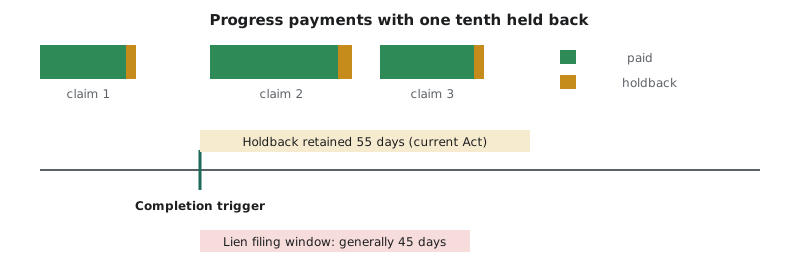
The Act also requires holdback. Under the current Act, the party paying under a contract or subcontract must retain a holdback equal to one tenth of the value of the work or materials as they are provided. The holdback protects lien claimants lower in the chain: it is a fund that the owner can pay into court or release once the lien period has passed. Under the current Act, holdback is retained for 55 days after a certificate of completion is issued or the head contract or subcontract is completed, abandoned or terminated, and then released if no claims of lien have been filed. Owners on larger contracts may also be required to keep holdback in a separate holdback account. The details depend on the contract value and type of improvement, so check the Act.
Lien claims must be filed within a fixed time, generally 45 days after the relevant trigger, such as the issue of a certificate of completion for the contract or subcontract, or the completion, abandonment or termination of the head contract. The exact trigger depends on who the claimant is and what certificates have been issued, which is why lien timing questions need care. A contractor who is not being paid should get legal advice early, before the deadline approaches, because a missed deadline cannot be repaired.
| Builders Lien Act concept (current Act) | General rule |
|---|---|
| Holdback amount | One tenth of the value of work and materials provided |
| Holdback retention | 55 days after completion trigger (to be shortened to 46 days when prompt payment amendments take effect) |
| Lien filing deadline | Generally 45 days after the relevant completion trigger |
| Where liens are filed | Land title office |
| Trust | Money received for work is generally held in trust for those who supplied it |
Worked problem
Calculating holdback on progress billing
Sumas Ridge has a subcontract for the Mill Lake townhouses worth 186,000 dollars before tax. It bills three progress claims: 48,000, 71,000 and 52,000 dollars of work completed. How much holdback does the general contractor retain on each, and in total?
Show solution
- Holdback is one tenth of the value of work provided.
- Claim 1: 48,000 x 0.10 = 4,800; paid 43,200.
- Claim 2: 71,000 x 0.10 = 7,100; paid 63,900.
- Claim 3: 52,000 x 0.10 = 5,200; paid 46,800.
- Total holdback after three claims: 4,800 + 7,100 + 5,200 = 17,100.
Answer: Holdback is 4,800, 7,100 and 5,200, a total of 17,100 dollars retained until it is released under the Act.
# Holdback on progress claims (one tenth retained under the current Builders Lien Act)
claims = [48000, 71000, 52000]
rate = 0.10
total_held = 0
for i, value in enumerate(claims, 1):
    held = value * rate
    total_held += held
    print(f"Claim {i}: work {value:>7,}  holdback {held:>7,.0f}  paid {value - held:>8,.0f}")
print(f"Total holdback retained: {total_held:,.0f}")Claim 1: work 48,000 holdback 4,800 paid 43,200 Claim 2: work 71,000 holdback 7,100 paid 63,900 Claim 3: work 52,000 holdback 5,200 paid 46,800 Total holdback retained: 17,100
Trust obligations
The Builders Lien Act also contains trust provisions. In general terms, money received by a contractor or subcontractor on account of the price of work is held in trust for the benefit of the people who supplied work and materials for that improvement, until they are paid. A contractor who receives a progress payment and uses it to pay unrelated debts while its own subcontractors and suppliers on that job go unpaid can breach the trust, and the people responsible can face personal liability. For a small contractor, the practical lesson is to track job revenue and job costs so that money received for a job pays that job's suppliers and workers first.
The Construction Prompt Payment Act
British Columbia's Construction Prompt Payment Act, SBC 2025, chapter 24, received Royal Assent on November 27, 2025. It comes into force on a date to be set by regulation, and when this course was written that date had not been announced. Once in force, it is expected to apply to contracts and subcontracts made after that date. It follows the approach already taken in Ontario and Alberta: it sets deadlines for paying proper invoices, requires written notice if payment will be withheld, and creates a fast adjudication process for payment disputes.
Commentary on the Act describes these key features. An invoice is deemed proper unless written notice identifying its deficiencies is delivered within 7 days, and a proper invoice is to be paid within 28 days of receipt. An owner who disputes an invoice must give a notice of non-payment within 14 days after receiving a proper invoice. Contractors and subcontractors down the chain have shorter windows, generally 7 days, to pass on notices or pay. Adjudication is available for payment disputes, with an adjudicator expected to decide within 30 days of receiving the records, and payment generally due within 15 days of a determination. The Act also amends the Builders Lien Act: holdback retention is shortened from 55 days to 46 days, the traditional holdback regime is kept without a mandatory annual release, and the stand-alone so-called Shimco lien against holdback is abolished.
| Prompt payment feature (when in force) | Timeline described in commentary |
|---|---|
| Invoice deemed proper unless deficiency notice given | Within 7 days of receipt |
| Payment of a proper invoice by the owner | Within 28 days of receipt |
| Owner's notice of non-payment | Within 14 days of a proper invoice |
| Adjudicator's determination | Within 30 days of receiving records |
| Payment after a determination | Within 15 days |
| Holdback retention under the amended Builders Lien Act | 46 days instead of 55 |
Worked problem
Which rules apply?
Linda signs a subcontract for a strata EV charger project. The general contractor proposes payment within 60 days of each invoice. Does the Construction Prompt Payment Act require faster payment?
Show solution
- First, check whether the Act is in force and whether this subcontract was made after its coming-into-force date.
- If the Act does not yet apply, the contract terms govern payment timing, subject to the Builders Lien Act holdback and lien rules.
- If the Act applies, its payment deadlines and notice requirements apply regardless of a longer contract term, and adjudication is available for disputes.
Answer: It depends on whether the Act is in force for this subcontract. Check before agreeing to 60-day terms.
Practical habits
Grace runs a payment calendar for every job: invoice dates, payment due dates under the contract, holdback amounts and their expected release dates, and the lien deadline for each job if payment problems arise. When a payment is late, she follows up in writing at once. When it is very late, Linda calls the company's lawyer well before the lien deadline. Those habits will carry over when the prompt payment rules come into force, with new dates added: deficiency notice windows, payment deadlines and adjudication timelines.
Warranties and deficiencies
Contracts usually include a warranty period, often one year from substantial performance or completion, during which the contractor must correct defects in its work at no charge. The warranty is a contractual promise; it sits beside the regulatory duty to do compliant work, not in place of it. A deficiency found by a safety officer must be corrected whether or not the warranty has expired, and correcting it may require a new declaration. Deficiency lists at the end of a project, sometimes called punch lists, are often tied to the release of final payments or holdback, so a contractor that leaves small deficiencies open can wait a long time for its money.
Harjit has always treated deficiency lists as a nuisance. As designated FSR, he will see them differently: every open item is both money held and a potential compliance problem. Grace adds the deficiency list to the payment calendar for each job, with a target date for each item, so that holdback release and final payment are not delayed by a missing cover plate or an unlabelled circuit.
Common mistakes
MistakeDoing extra work on a verbal request and billing it later.
InsteadGet a written change order or written confirmation before doing the work.
MistakeAssuming the prompt payment law already governs every contract.
InsteadCheck whether the Construction Prompt Payment Act is in force and applies to the contract date.
MistakeTreating the lien deadline as flexible.
InsteadLien claims filed after the deadline are invalid; get advice early.
MistakeUsing progress payments for unrelated debts while suppliers on that job wait.
InsteadMoney received for work is generally held in trust for those who supplied it.
MistakeCalculating holdback on the contract value instead of work provided.
InsteadHoldback is retained on the value of work and materials as they are provided.
Summary and key terms
- Use written contracts and signed change orders; keep the permit aligned with the final scope.
- The Builders Lien Act gives lien rights against land and requires a holdback of one tenth.
- Under the current Act, holdback is retained 55 days after completion triggers; liens are generally filed within 45 days.
- The Construction Prompt Payment Act (SBC 2025, c. 24) received Royal Assent on November 27, 2025 and awaits a coming-into-force date.
- When in force, it adds payment deadlines, notices and adjudication, and shortens holdback retention to 46 days.
- Holdback
- The portion of each payment retained under the Builders Lien Act to protect lien claimants.
- Claim of lien
- A claim registered in the land title office to secure payment for work or materials.
- Change order
- A written agreement changing the scope, price or schedule of a contract.
- Adjudication
- A fast process for deciding payment disputes under prompt payment law.
- Trust provisions
- Rules treating money received for work as held for the people who supplied it.
Practice problems
Work each problem on paper first, then reveal the answer to check.
What fraction of the value of work provided is held back under the Builders Lien Act?
Show answer
One tenth.
Under the current Act, how long is holdback retained after the completion trigger?
Show answer
55 days.
What is the general deadline for filing a claim of lien?
Show answer
45 days after the relevant completion trigger.
When did the Construction Prompt Payment Act receive Royal Assent?
Show answer
November 27, 2025.
How will the prompt payment amendments change holdback retention?
Show answer
From 55 days to 46 days.
Lesson quiz · 5 questions
Score 60% or more to complete this lesson.
Create a free account to save your progress, take quizzes and earn a certificate.