
MELC-202 · Lesson 6 of 12 · 23 min
Permits, inspections and the inspection authority
▶ Video coming soon A video version of this lesson is on the way.
The permit is where the FSR's responsibility becomes concrete. A permit authorizes regulated electrical work at a particular site, it belongs to a particular permit holder, and the FSR's declarations on it are the record that the work complies. This lesson covers the two families of electrical permit in British Columbia, installation permits and operating permits, together with homeowner permits, temporary construction service permits, declarations, the 180-day rules, and how Technical Safety BC and the local governments that administer their own permits decide when to inspect. It is the most heavily tested part of the regulatory share of the exam, and it is the part of the job Harjit has watched Linda do for years without doing it himself.
Procedures described here follow Technical Safety BC's published permit pages when the course was written. Local governments that administer electrical permits have their own procedures and forms. Always check the authority that applies where the work is located.
When a permit is needed
Technical Safety BC's general rule is that a permit is required before starting regulated electrical work unless an exemption applies. The exemptions are specific. Testing is generally exempt, as is the replacement of certain devices, such as some receptacles and switches of the same type and rating. The regulator gives an example that surprises many people: replacing a light fixture requires a permit, even though replacing some receptacles and switches does not. Exemptions are set out in the regulations and explained on the regulator's pages, and the safe working assumption is that a permit is needed unless you can point to the exemption that covers the work.
The permit must be in place before the work starts. A contractor who begins work and applies for the permit afterwards is doing regulated work without a permit, and the declaration that follows cannot fix that. Grace's rule at Sumas Ridge is simple: no crew goes to a site until the permit number is written on the work order.
Who applies
The person or company responsible for the regulated work is generally responsible for applying for the permit. For work done for others, that is normally the licensed electrical contractor hired to do it, and the permit is issued to the contractor with its designated FSR responsible for the declarations. Others may help prepare an application, but the responsible person must submit it. A permit is tied to the permit holder and the job site, so a permit issued to Sumas Ridge for a house on Mill Lake Road cannot be used by another contractor, or by Sumas Ridge for a different address.
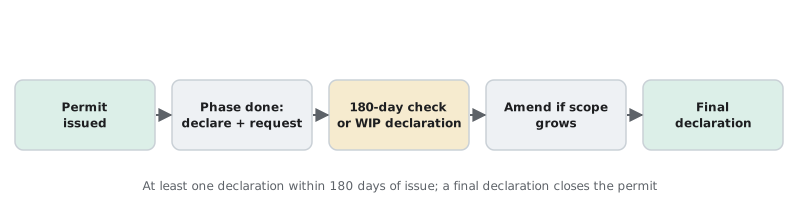
The permit must also reflect the value and scope of the work. If the job grows, the permit must be amended. Technical Safety BC notes that a permit for the final value and scope of work must be in place before a final inspection is requested, so a contractor who starts with a small permit and then doubles the job cannot leave the permit as it was.
Homeowner permits
A homeowner may obtain a permit for electrical work on their own property if they meet the eligibility rules. The Electrical Safety Regulation limits homeowner work to installations where the current does not exceed 200 amps, the voltage does not exceed 150 volts to ground, and the supply is single-phase. Other restrictions apply, including rules about ancillary buildings and vacation homes, and the regulator uses a separate process for homeowner permits rather than the standard contractor application. A homeowner permit authorizes the homeowner to do the work personally; it is not a way for an unlicensed person to do work for the homeowner.
Homeowner permit questions are common on the exam because the boundaries are precise. A homeowner adding circuits in their own single-family house supplied at 120/240 V, 200 A fits the limits. The same homeowner cannot use a homeowner permit to wire a rental house they own elsewhere if the conditions exclude it, cannot hire an unlicensed friend to do the work under the homeowner's permit, and cannot exceed the electrical limits. When a client mentions that a family member did some of the wiring, an FSR should ask whether it was done under a homeowner permit before agreeing to connect to it.
| Condition | Homeowner permit limit (Electrical Safety Regulation) |
|---|---|
| Current | Not exceeding 200 A |
| Voltage | Not exceeding 150 V to ground |
| Phases | Single-phase |
| Who does the work | The eligible homeowner, on their own property |
| Other restrictions | Including rules for ancillary buildings and vacation homes |
Declarations and inspection requests
Declarations are the heart of the system. Under Technical Safety BC's process, the FSR declares that work complies after each phase is complete and requests an inspection. The regulator's pages state that a declaration and inspection request must be made at least once within 180 days of the permit being issued. If no work has taken place in that time, the FSR can submit a 180-day safety check declaration or a work-in-progress declaration, which extends the permit for another 180 days. When the work is complete, a final declaration closes the permit.
A declaration is not a formality. It is the FSR's statement, on behalf of the employer, that the work covered complies with the Act, the regulations and the Code. The FSR must therefore have inspected the work, or had it inspected under their supervision, before declaring. The designated FSR's duties described on the licence pages include inspecting work, requesting the inspections that are required, and confirming that no work is concealed or energized without authorization. Concealing work, such as closing a wall or backfilling a trench, before the required declaration and inspection step can force the work to be exposed again at the contractor's cost.
| Situation | What the FSR does |
|---|---|
| A phase of work is complete | Declare compliance and request an inspection |
| 180 days since permit issue with no declaration yet | Submit a declaration, a 180-day safety check or a work-in-progress declaration |
| No work in the period | 180-day safety check or work-in-progress declaration extends 180 days |
| Scope or value has grown | Amend the permit before requesting the final inspection |
| Work complete | Final declaration to close the permit |
| Permit has expired | Pay the expiry amendment fee and submit a declaration to reactivate it |
Worked problem
Tracking the 180-day rule
Sumas Ridge has a permit for the Mill Lake townhouses issued on January 15. The rough-in for the first two units is ready for declaration on May 20. A second permit, for a client's shop, was issued on February 1, but the client delayed the project and no work has been done by July 25. What should Harjit do for each permit?
Show solution
- Mill Lake: January 15 plus 180 days is July 14. A declaration and inspection request for the rough-in on May 20 falls well within the 180 days.
- Shop: February 1 plus 180 days is July 31. No work has been done, so before July 31 Harjit submits a 180-day safety check or work-in-progress declaration to extend the permit by another 180 days.
- If he missed the date, the shop permit would expire, and reactivating it would require the expiry amendment fee and a declaration.
Answer: Declare the Mill Lake rough-in on May 20 as planned. Extend the shop permit with a work-in-progress or 180-day safety check declaration before July 31.
from datetime import date, timedelta

# 180-day check: when must each permit see a declaration?
permits = {
    "Mill Lake townhouses": date(2026, 1, 15),
    "Client shop": date(2026, 2, 1),
    "Strata EV chargers": date(2026, 3, 9),
}
today = date(2026, 7, 25)
for name, issued in permits.items():
    due = issued + timedelta(days=180)
    left = (due - today).days
    flag = "OVERDUE" if left < 0 else f"{left} days left"
print(f"{name:<22} issued {issued} declaration due by {due} ({flag})")Mill Lake townhouses issued 2026-01-15 declaration due by 2026-07-14 (OVERDUE) Client shop issued 2026-02-01 declaration due by 2026-07-31 (6 days left) Strata EV chargers issued 2026-03-09 declaration due by 2026-09-05 (42 days left)
How the regulator decides to inspect
A declaration and inspection request does not always lead to a physical visit. Technical Safety BC processes the request and decides whether a further physical assessment is needed. The regulator uses a risk-based approach, weighing factors such as the type of work and the contractor's record. A contractor with a strong compliance record may see fewer physical inspections on routine work; a contractor whose declarations have proved unreliable may see more. That makes accurate declarations valuable beyond any single job.
When an inspection does happen, it is carried out by a safety officer, a person designated under the Safety Standards Act with powers to enter places where regulated work is done, inspect and test equipment, require documents, and issue orders. If the officer finds non-compliance, the usual result is a deficiency notice or a safety order requiring correction, followed by another declaration from the FSR when the correction is made. Serious or repeated non-compliance can lead to enforcement action against the contractor's licence and the FSR's certificate, including monetary penalties, conditions, suspension or cancellation. The Act also provides routes to have certain decisions reviewed or appealed.
Temporary construction service
Construction sites often need temporary power before the permanent service is ready. Technical Safety BC issues temporary construction service operating permits for this purpose. The regulator's pages state that these permits cannot be extended. If the work continues beyond the permit, the existing permit must be closed with a final declaration and a new temporary construction service permit obtained, referencing the previous permit number. Harjit has seen sites where temporary power ran for two years on assumptions; under the current process, that is not an option.
Operating permits
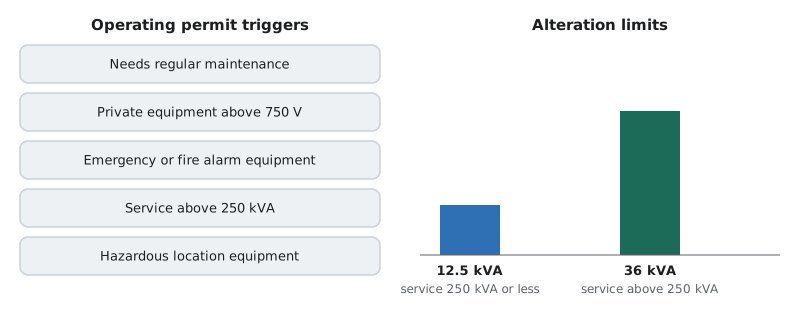
An installation permit covers work being done. An operating permit covers equipment being operated and maintained over time. Technical Safety BC explains that an operating permit ensures a qualified individual is responsible for technical equipment on a premises. According to the regulator, a facility needs an electrical operating permit if it has equipment that requires regular or ongoing maintenance to operate as designed, privately owned equipment supplied at more than 750 volts (with an exception for high-voltage neon signs), equipment used for emergency service or as part of a fire alarm system, a rated service capacity above 250 kVA, or equipment operating within hazardous location classes or zones.
A certified FSR must be named on the operating permit. Under that FSR's supervision, the owner's staff can carry out regular maintenance and minor alterations without a separate installation permit for each task, provided the work stays within limits. The regulator describes those limits as up to 12.5 kVA of added load for facilities whose main service is 250 kVA or less, and up to 36 kVA for facilities above 250 kVA, and maintenance must not push the main service past its capacity. Load calculations for alterations must be recorded in the log book. Operating permits are renewed annually. The FSR can change at any time, but the permit holder must notify Technical Safety BC.
Worked problem
Clearbrook Cold Storage
Clearbrook Cold Storage has a 347/600 V service rated at about 1,250 kVA, with Linda named as the FSR on its annual operating permit. Owen Patel wants his maintenance electrician to add two 15 kVA evaporator heaters, then later a 10 kVA dock door package. Can this be done under the operating permit?
Show solution
- The service is above 250 kVA, so the alteration limit under the operating permit is 36 kVA of added load.
- Two heaters at 15 kVA each add 30 kVA, within the 36 kVA limit, provided the service has capacity. The load calculation goes in the log book under Linda's supervision.
- Adding the 10 kVA dock door package would bring the total to 40 kVA, above the 36 kVA figure, so that work needs an installation permit, which Sumas Ridge would take out.
Answer: The heaters can be done under the operating permit with the calculation logged. The dock doors need an installation permit.
Local governments that issue permits
Most of British Columbia is served by Technical Safety BC for electrical permits and inspections. For installation permits, the regulator lists Burnaby, Maple Ridge, North Vancouver, Surrey, Victoria, Vancouver and West Vancouver as areas where the local government issues the permits. For operating permits, its guidance names Vancouver, Burnaby and Victoria. In those areas, contractors apply to the municipality, follow its procedures and pay its fees, and its inspectors carry out the inspections. The FSR certificate and the contractor licence are still provincial, and the duties of the FSR under the Act and regulations still apply.
Sumas Ridge works mostly in Abbotsford, Chilliwack and Mission, all served by Technical Safety BC, but it occasionally takes work in Surrey. Grace keeps a separate checklist for Surrey jobs because the municipal process differs.
Common mistakes
MistakeStarting work and applying for the permit later.
InsteadThe permit must be in place before regulated work starts.
MistakeLetting a permit pass 180 days without any declaration.
InsteadDeclare and request inspection within 180 days, or submit a 180-day safety check or work-in-progress declaration.
MistakeUsing a homeowner permit for work by an unlicensed helper.
InsteadA homeowner permit authorizes the eligible homeowner to do the work on their own property.
MistakeExtending a temporary construction service permit.
InsteadIt cannot be extended; close it with a final declaration and obtain a new one.
MistakeAdding load under an operating permit beyond the alteration limit.
InsteadAbove 12.5 kVA (service 250 kVA or less) or 36 kVA (service above 250 kVA), an installation permit is needed.
Summary and key terms
- A permit is required before regulated electrical work unless an exemption applies.
- Permits are tied to the permit holder and site, and must reflect the final value and scope.
- The FSR declares after each phase and must declare at least once within 180 days of issue, or extend with a safety check or work-in-progress declaration.
- Homeowner permits are limited to 200 A, 150 V to ground, single-phase, on the homeowner's own property.
- Operating permits name an FSR, renew annually and allow minor alterations up to 12.5 kVA or 36 kVA depending on service size.
- Installation permit
- A permit authorizing regulated electrical work at a site.
- Declaration
- The FSR's statement that the work covered complies.
- Work-in-progress declaration
- A declaration that extends a permit by 180 days when work is ongoing or paused.
- Operating permit
- An annual permit naming an FSR responsible for operating and maintaining certain equipment.
- Safety officer
- A person designated under the Act with powers to inspect, require documents and issue orders.
Practice problems
Work each problem on paper first, then reveal the answer to check.
Does replacing a light fixture require a permit in a Technical Safety BC area?
Show answer
Yes, according to the regulator's guidance.
A permit was issued on March 1. By when must a declaration, safety check or work-in-progress declaration be made?
Show answer
Within 180 days, by August 28.
Name two conditions that trigger an electrical operating permit.
Show answer
Any two of: regular maintenance needed, private equipment above 750 V, emergency or fire alarm equipment, service above 250 kVA, hazardous locations.
What is the alteration limit under an operating permit for a 600 kVA service?
Show answer
36 kVA of added load.
Can a temporary construction service operating permit be extended?
Show answer
No. Close it with a final declaration and obtain a new one.
Lesson quiz · 5 questions
Score 60% or more to complete this lesson.
Create a free account to save your progress, take quizzes and earn a certificate.