
MELC-202 · Lesson 7 of 12 · 23 min
Duties and responsibilities of a field safety representative
▶ Video coming soon A video version of this lesson is on the way.
An FSR certificate is a permission and a burden at the same time. It permits the holder to declare, on behalf of an employer, that regulated electrical work complies. It also makes the holder answerable for those declarations, for the supervision behind them and, if they are the designated FSR, for keeping the contractor's work within the rules. This lesson sets out those duties as Technical Safety BC describes them, explains how they play out on a typical job, and works through the situations in which an FSR's duties collide with commercial pressure. The exam tests the duties directly, and it tests them through scenarios in which the right answer is the one that follows the duty most strictly.
The duties described here come from the regulator's descriptions of the FSR role and of designated FSRs on its licence pages, and from the general structure of the Electrical Safety Regulation. Read the duties sections of the regulation itself, because questions can turn on its exact wording.
What an FSR declares
The FSR's core act is the declaration. When a phase of permitted work is complete, the FSR declares that the work complies with the Act, the regulations and the adopted Code, and requests an inspection. When the work is finished, the FSR makes a final declaration. Each declaration is made on behalf of the employer, the licensed contractor or permit holder, but it carries the FSR's name and certificate number. If the work does not comply, the declaration is false, and the regulator can act against the contractor and against the FSR.
To declare honestly, the FSR must know that the work complies. That does not mean the FSR personally installed every metre of cable. It means the FSR inspected the work, or had it checked under their supervision by competent workers, and is satisfied that it meets the requirements. On a small job, Harjit will look at everything himself. On a large job, he will rely on lead hands and checklists, but he will still walk the work before each declaration, look at the critical items himself, and keep a record of what was checked.
The designated FSR
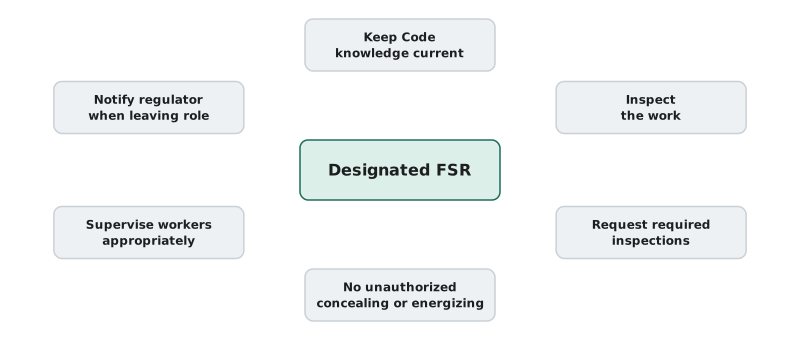
Every licensed electrical contractor designates one FSR. Technical Safety BC describes the designated FSR's duties in practical terms: keep their code knowledge current, inspect the work, request required inspections, confirm that no work is concealed or energized without authorization, supervise workers appropriately, and notify the regulator immediately when they stop acting in that role. Those six duties are the backbone of most FSR scenario questions.
Keeping code knowledge current is more than renewing the certificate. It means following new directives and bulletins and understanding the current edition well enough to spot problems. Inspecting the work and requesting inspections are the permit duties from lesson 6. Preventing unauthorized concealment and energizing protects the integrity of the inspection system: a wall that is closed or a circuit that is energized before the required step defeats the purpose of declaring and inspecting. Supervising workers appropriately covers apprentices, journeypersons and anyone else doing regulated work for the contractor. And the notification duty keeps the licence accurate, because a contractor without an active designated FSR cannot lawfully do regulated work.
| Designated FSR duty | What it looks like at Sumas Ridge |
|---|---|
| Keep Code knowledge current | Monthly check of new directives and bulletins; Code update course |
| Inspect the work | Walk every job before declaring; checklists for lead hands |
| Request required inspections | Declarations and inspection requests logged by Grace with dates |
| No unauthorized concealment or energizing | Drywall and backfill held until declaration; energizing only on the FSR's instruction |
| Supervise workers appropriately | Apprentices never alone on regulated work beyond what their level allows |
| Notify the regulator when leaving the role | Planned handover from Linda to Harjit with matching end and start dates |
One designated FSR at a time
A contractor licence names one designated FSR. When the designation changes, Technical Safety BC requires that there be no gaps or overlaps between the outgoing FSR's end date and the incoming FSR's start date; otherwise the licence may be suspended. That rule shapes how Linda and Harjit plan the handover. Linda will remain designated until a fixed date. On that date, Grace will record Linda's end and Harjit's start, so that the licence always has exactly one active designated FSR.
Other FSRs can work for the same contractor. Linda will remain a Class A FSR at Sumas Ridge after the handover, and she can still declare work within her class on the company's behalf. But only one person is the designated FSR, the person the licence depends on. If Harjit's Class B certificate becomes the designation, the licence scope becomes Class B. Any Class A work, such as the dairy co-op substation, would need Linda's declarations, and the contractor would have to make sure the licence still authorizes it. Grace confirms that point with the regulator before the handover date, because the scope question is exactly the kind of detail that is easy to get wrong.
Worked problem
A handover without a gap
Linda will step down as designated FSR at the end of the day on June 30. Harjit's Class B certificate is active from April 15. What dates should Grace record, and what changes for the licence?
Show solution
- Linda's designation ends June 30. Harjit's designation must start the next day, July 1, so there is neither a gap nor an overlap.
- From July 1, the licence scope follows Harjit's Class B certificate: installations under 1000 V, plus underground raceway at any voltage.
- Class A work after July 1 needs a Class A FSR, and Grace checks with the regulator how that work can continue under the licence.
Answer: End Linda on June 30 and start Harjit on July 1. The licence scope becomes Class B from July 1.
Supervising workers
Appropriate supervision depends on the worker. A certified journeyperson electrician can do regulated work independently within the contractor's procedures, with the FSR checking the results. An apprentice works under the supervision of a certified journeyperson, with the closeness of supervision depending on the apprentice's level and the task. British Columbia's Skilled Trades Certification system, administered by SkilledTradesBC, makes electrical trades certified trades, which means people working in them must be certified or registered apprentices, subject to the transition rules. The FSR is not the only person responsible for supervision, but the designated FSR is responsible for making sure the contractor's arrangements are appropriate.
On Harjit's crew, Mateo is a third-year apprentice. He can pull wire, terminate devices and install equipment under a journeyperson's direction, and he is learning to read drawings and check his own work. He does not decide when a circuit is energized, and he does not work alone on a job where no certified electrician is checking his work. When Harjit becomes designated FSR, he will be responsible for making sure every crew is arranged that way, including the crews he never sees in person.
| Worker | Typical supervision arrangement |
|---|---|
| Certified journeyperson | Works independently within company procedures; work checked before declaration |
| Senior apprentice | Direct supervision by a journeyperson on site, with independence growing by level |
| Junior apprentice | Close supervision; works alongside a journeyperson |
| Unregistered helper | May not do regulated electrical work in a certified trade |
When pressure meets the duty
Most of an FSR's difficult moments come from schedules. A general contractor wants drywall started before the electrical declaration has been made. An owner wants the power on for an opening day before the work is finished. A crew wants to energize a panel to test equipment because the inspection is not until next week. Each time, the duty is clear even when the conversation is not: work may not be concealed or energized without authorization. The FSR's job is to say no to the shortcut and yes to the fastest compliant path, which usually means declaring and requesting the inspection promptly.
The same applies to declarations themselves. An FSR may not declare work as compliant because the client is in a hurry, because a previous inspector accepted something similar, or because the deficiency is small. If the work does not comply, it must be corrected before the declaration. If an FSR is asked to declare work they have not seen and cannot check, they must refuse. Harjit already knows this in principle. What he finds harder is the practical part: saying it calmly to a general contractor's superintendent who controls the next six months of work. Linda's advice is to put it in writing, offer the compliant alternative and the date it can happen, and keep a record of the exchange.
Worked problem
Drywall before declaration
On the Mill Lake townhouses, the general contractor's superintendent tells Harjit that drywall crews will start in unit 3 tomorrow morning. The electrical rough-in in unit 3 is finished, but Harjit has not yet declared it or requested the inspection. What should he do?
Show solution
- Concealing the rough-in before the required declaration and inspection step would breach the designated FSR's duty.
- Harjit inspects the unit 3 rough-in that afternoon and, if it complies, submits the declaration and inspection request immediately.
- He tells the superintendent in writing that drywall in unit 3 must wait until the regulator has processed the request and authorized concealment, and gives the expected timing.
- If drywall goes up without authorization, the regulator may require it to be removed, at a cost someone will have to bear.
Answer: Declare and request the inspection promptly, and hold the drywall until concealment is authorized.
Incidents and hazards
The Safety Standards Act and its regulations require certain incidents and hazards involving regulated products to be reported to the regulator, such as incidents that cause injury or significant damage, or hazards that could do so. Occupational health and safety law separately requires employers to report certain workplace incidents to WorkSafeBC, as lesson 10 explains. An FSR who learns of an electrical incident on a job, such as a fire, a serious shock or an arc flash, should know both reporting routes and make sure the right reports are made promptly, and should preserve the scene as far as safety allows. Check the current reporting requirements, including what must be reported and how quickly, on the regulator's pages.
The BC Master Electrician designation in practice
Holders of the BC Master Electrician designation are described by the regulator as able to examine, oversee and validate whether electrical work is safe, identify and correct non-compliances, and submit a declaration that the work complies. In other words, the designation emphasizes the master's role in validating work, including work they did not personally perform. That role carries the same duties as any declaration: the holder must actually examine the work and be satisfied that it complies. The designation does not reduce any FSR duty; it recognizes a trade-qualified FSR who carries them out.
Consequences
When an FSR or contractor does not meet their obligations, Technical Safety BC can respond in several ways: warnings and safety orders, monetary penalties, conditions on a licence or certificate, and suspension or cancellation. The regulator's licence pages note that failing to meet obligations may lead to penalties, conditions, or the suspension or revocation of a licence or an FSR certificate. Decisions of this kind can generally be reviewed or appealed under the Act. The best protection is the ordinary habit of doing the duties every time: inspect, declare honestly, keep records, and keep the licence information current.
Records that prove the duties were done
Duties that are done but not recorded are hard to prove. If a safety officer asks how a declaration was supported, or a client disputes whether work was inspected before a wall was closed, the FSR's records are the answer. Linda keeps a simple record for every permit: the permit number, the address, each phase declared with the date, who inspected the work and what was checked, any deficiencies found and how they were corrected, and the regulator's response to each inspection request. For larger jobs she adds photographs of the rough-in before concealment, labelled with the unit and date. The record takes a few minutes per phase, and it has settled more than one argument.
Harjit will extend the system to supervision. Each crew's daily sheet will list who was on site, their certification status and who was supervising whom. That makes the supervision duty visible, and it gives Grace what she needs for apprenticeship hour records as well. Lesson 11 returns to records when it covers renewal and continuing education.
Common mistakes
MistakeDeclaring work you have not inspected or had checked under your supervision.
InsteadA declaration requires the FSR to know the work complies.
MistakeAllowing drywall or backfill before the required declaration and inspection step.
InsteadWork may not be concealed without authorization.
MistakeRecording the new designated FSR to start a week after the old one ends.
InsteadThere must be no gap or overlap; a gap can suspend the licence.
MistakeLetting an apprentice work alone on regulated work because they are experienced.
InsteadApprentices work under appropriate supervision by a certified journeyperson.
MistakeForgetting to tell the regulator when you stop being the designated FSR.
InsteadThe designated FSR must notify Technical Safety BC immediately.
Summary and key terms
- The FSR declares, on behalf of the employer, that regulated work complies.
- Designated FSR duties: keep Code knowledge current, inspect, request inspections, prevent unauthorized concealment or energizing, supervise, and notify the regulator when leaving the role.
- Only one designated FSR at a time, with no gap or overlap when it changes.
- Schedule pressure never justifies concealing, energizing or declaring non-compliant work.
- Failing duties can lead to penalties, conditions, suspension or revocation.
- Declaration
- An FSR's statement on behalf of the employer that work complies.
- Designated FSR
- The single FSR a licensed contractor names, on whom the licence depends.
- Concealment
- Covering work, such as closing walls or backfilling, so it cannot be inspected.
- Appropriate supervision
- Supervision suited to the worker's qualification and the task.
- Handover
- The planned change from one designated FSR to another without a gap or overlap.
Practice problems
Work each problem on paper first, then reveal the answer to check.
List three duties of a designated FSR.
Show answer
Any three of: keep Code knowledge current, inspect work, request required inspections, prevent unauthorized concealment or energizing, supervise workers, notify the regulator when leaving the role.
What happens if there is a gap between designated FSRs?
Show answer
The licence may be suspended.
May an FSR declare work they have not inspected because the client is in a hurry?
Show answer
No.
Whose certificate sets the licence scope after a handover?
Show answer
The new designated FSR's certificate class.
Does the BC Master Electrician designation reduce any FSR duties?
Show answer
No. It recognizes a trade-qualified FSR; all FSR duties still apply.
Lesson quiz · 5 questions
Score 60% or more to complete this lesson.
Create a free account to save your progress, take quizzes and earn a certificate.