
MELC-202 · Lesson 4 of 12 · 21 min
The exam format and the references allowed
▶ Video coming soon A video version of this lesson is on the way.
Every exam rewards the candidate who knows exactly what it will look like. The unrestricted FSR exams in British Columbia have a published format: how many questions, how long, how the questions divide between topics, what mark passes, and what materials may be on the desk. This lesson sets out that format as described by Technical Safety BC when the course was written, explains the reference list document by document, and turns the numbers into a working plan for the three and a half hours. Lesson 12 returns to exam strategy with a full practice set, but the planning starts here.
Two cautions apply throughout. First, the format can change, and the class page for your certificate is the authority. Second, the reference list is strict. A candidate who brings an unapproved book, or approved books with the wrong kind of notes in them, risks having materials removed before the exam starts. Read the list, follow it exactly, and ask the regulator before exam day about anything you are unsure of.
The format at a glance
For the unrestricted Class A, B and C exams, Technical Safety BC describes an open-book exam of 60 multiple-choice questions with a time limit of three and a half hours. About 35 out of every 100 marks come from the Safety Standards Act, the regulations and the directives, and about 65 from the Code. The pass mark is 70 out of 100. The exam can be written at most Technical Safety BC offices or online. Every class follows the same overall pattern, but the content differs with the scope of the class: a Class C candidate is not expected to know the high voltage requirements of Section 36, while a Class A candidate is.
| Feature | Unrestricted FSR exams (A, B, C) as published |
|---|---|
| Questions | 60 multiple choice |
| Time | 3.5 hours |
| Book policy | Open book, candidate supplies materials |
| Content split | About 35 parts Act, regulations and directives; about 65 parts Code |
| Pass mark | 70 out of 100 |
| Where | Most Technical Safety BC offices, or online |
| Attempts | Three; 30-day wait after a failure; permission needed after the third |
Turning the numbers into a plan
Three and a half hours is 210 minutes. Spread over 60 questions, that is three and a half minutes a question, which sounds generous until you remember that open-book questions take time to look up and confirm. The content split means roughly 21 questions on the Act, regulations and directives and roughly 39 on the Code. To pass, a candidate needs 42 correct answers, so they can afford to miss 18. That margin is real, but it disappears quickly if a candidate spends twenty minutes on one difficult calculation and then rushes the last fifteen questions.
Worked problem
Harjit's exam arithmetic
Using the published format, how many questions fall in each area, how many correct answers are needed to pass, and what is the average time available per question?
Show solution
- Regulatory questions: 35 parts of 100 of 60 is 21.
- Code questions: 65 parts of 100 of 60 is 39.
- Correct answers needed: 70 parts of 100 of 60 is 42.
- Average time: 210 minutes divided by 60 questions is 3.5 minutes each.
Answer: About 21 regulatory and 39 Code questions; 42 correct answers to pass; three and a half minutes per question on average.
# FSR exam pacing (published format; edit if the format changes)
questions = 60
minutes = 3.5 * 60
pass_share = 0.70
reg_share = 0.35
print("Regulatory questions:", round(questions * reg_share))
print("Code questions:", round(questions * (1 - reg_share)))
print("Correct answers to pass:", round(questions * pass_share))
print("Minutes per question:", minutes / questions)
# Checkpoints: where you should be at each hour
for hour in (1, 2, 3):
print(f"After {hour} h: about question {round(hour * 60 / (minutes / questions))}")Regulatory questions: 21 Code questions: 39 Correct answers to pass: 42 Minutes per question: 3.5 After 1 h: about question 17 After 2 h: about question 34 After 3 h: about question 51
The checkpoints in the calculator are a pacing aid, not a rule. Harjit plans to answer quickly the questions he knows, mark the ones that need a long lookup, and return to them in a second pass. If he reaches question 17 after the first hour, he is on pace. Lesson 12 develops the two-pass method in detail.
The reference list, document by document
Technical Safety BC publishes an electrical examination reference material list. For all electrical FSR candidates, it lists four regulatory documents, each in its current edition: the Safety Standards Act, the Safety Standards General Regulation, the Electrical Safety Regulation, and the regulation that adopts the BC Electrical Code. The class pages add the Canadian Electrical Code, Part I, as adopted in British Columbia by the Electrical Safety Regulation, together with the latest Code update materials. For Class A candidates, and for some other certificate types, the list also includes CSA C22.3 No. 1, the overhead systems standard, with its updates.
The class pages describe the Code reference slightly differently by class. The Class A page refers to the adopted Code with all sections. The Class B and C pages refer to the adopted Code except Section 36, which covers high voltage installations and lies outside their scope. That does not mean a Class B or C candidate cannot bring a complete Code book. It means the exam for those classes does not test Section 36.
| Document | All unrestricted classes | Note |
|---|---|---|
| Safety Standards Act | Yes | Current edition |
| Safety Standards General Regulation | Yes | Current edition |
| Electrical Safety Regulation | Yes | Current edition |
| BC Electrical Code Regulation | Yes | Adopts the Code |
| Canadian Electrical Code, Part I (2024) as adopted | Yes | Classes B and C exclude Section 36 from scope |
| Code update materials | Yes | Latest version |
| CSA C22.3 No. 1 Overhead Systems | Class A | With updates |
What the materials may contain
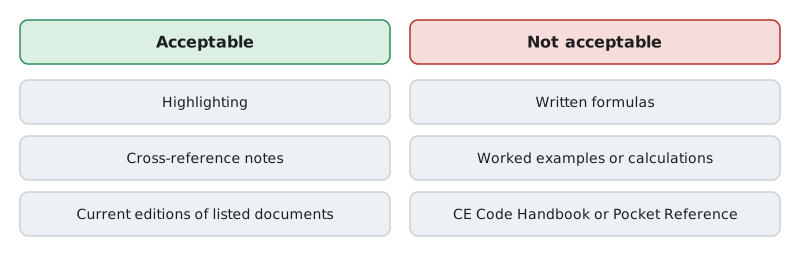
The reference list sets clear rules on markings. Candidates supply their own materials, and staff check them before and after the exam. Pages with markings such as formulas, examples or calculations must be removed before the exam date. Cross-referencing notes and highlighting are acceptable. Only the listed materials may be used. The list specifically states that the Canadian Electrical Code Handbook and the Canadian Electrical Code Pocket Reference are not allowed, even though both are published to accompany the Code.
The difference between a cross-reference and a worked example is worth thinking about before the exam, not during the check. A margin note that says see Rule 8-200 or see also Section 26 is a cross-reference. A margin note that works through a dwelling demand calculation is an example. A highlighted phrase is fine. A list of formulas copied onto the inside cover is not. Harjit goes through his Code page by page a week before the exam, with Grace checking a sample, and removes two pages from the regulation booklet where he had written out a calculation while studying.
The reference list page does not address permanent index tabs or calculators. Many candidates use tabs to find sections quickly, and most calculation questions need a calculator, but the safe course is to ask Technical Safety BC what it permits before exam day, and to follow the instructions in your booking confirmation. Do not assume that a practice allowed for another province's exam, or by another regulator, is allowed here.
How the two halves of the exam behave
The 35 per hundred share of regulatory questions behaves differently from the Code share. Regulatory questions are usually about definitions, duties, procedures and time limits. Who may apply for a permit? When must an FSR submit a declaration? What may a homeowner do? What must a licensed contractor notify the regulator about? The answers sit in a few documents that are much shorter than the Code, so a well-prepared candidate can answer them quickly and accurately. They are where Harjit plans to bank time.
The Code share mixes direct lookups with calculations and installation scenarios. A lookup might ask for a minimum clearance or the rule that applies to a particular location. A calculation might ask for a demand load, a conductor size after correction factors, or the rating of an overcurrent device. A scenario might describe an installation and ask what is wrong with it. Core courses MELC-101 to MELC-105 cover these skills. For the FSR exam, the extra skill is speed: finding the rule in the adopted 2024 edition, reading it carefully, checking for exceptions and appendix notes, and moving on.
| Question style | Typical source | How to approach it |
|---|---|---|
| Definition | Act or Electrical Safety Regulation | Go to the definitions section first |
| Duty or procedure | Regulation, directive or bulletin | Identify who the question is about: FSR, contractor, owner or homeowner |
| Code lookup | Code sections and tables | Use the index and section structure; check exceptions |
| Calculation | Code tables and rules | Write the steps on scrap paper; check units |
| Scenario | Mixed | List the facts, then find the rule that decides the case |
Directives and bulletins
The phrase Act, Regulations, and Directive on the class pages points to a category of material that electricians often overlook. Technical Safety BC issues directives under the Safety Standards Act. A directive is a binding instruction on a specific matter, such as how a requirement must be met or a variance from a normal process. It also issues information bulletins, which explain requirements or changes without being binding in the same way. The 2024 Code adoption, for example, was announced in an information bulletin that set out the transition rules described in lesson 5.
Directives and bulletins can be numerous, and not every one appears on the exam. Focus on those that apply to electrical work generally and to your class: permits, declarations, inspections, FSR duties, the Code adoption, and safety matters that affect most installations. The recognized code course you take for eligibility should point you to the ones that matter. Keep a short index of them, with the number, the date and one line describing what each requires. That index is a study aid at home. Whether you may bring printed directives into the exam depends on the reference list, so check it rather than assuming.
Exam day logistics
On the day, arrive early or start the online check-in early. Have your identification ready. Lay out your materials in a fixed order so your hands know where each document is: Code on the left, regulatory documents on the right, scrap paper and calculator in front if they are permitted. Read each question twice before opening a book, and decide which document it points to before you start turning pages. That one habit saves more time than any tabbing system.
Harjit's rehearsal exam taught him one more thing. In the last half hour, his accuracy dropped because he was tired. In the real exam he plans a two-minute break at the two-hour mark: hands off the books, a drink of water, and a check of his pace. Small habits like that matter over three and a half hours.
How questions tend to be worded
Multiple-choice questions on licensing exams are written to separate candidates who know the material from candidates who almost know it. That means the wrong answers are usually plausible. A question about who may obtain a homeowner permit might offer the owner who lives in the house, a tenant, the owner's relative who is an apprentice, and a landlord with several rental houses, and the differences between them come straight from the eligibility conditions in the regulation. A question about a declaration might offer four time limits that are all close to the right one. Reading the documents once is not enough to tell those answers apart; reading them carefully, with attention to the exact words, is.
Watch for qualifiers in the question stem: must, may, shall not, except, at least, not more than. Watch for who the question is about, because the same task can be permitted for one person and prohibited for another. And watch for questions that describe a situation outside the class you are writing for. A Class B question might describe a 25 kV installation precisely so that the correct answer is that a Class A FSR is required. Harjit practises by rewriting the wrong answers in his practice sets into correct statements. It forces him to see exactly what made each one wrong.
Common mistakes
MistakeBringing the Canadian Electrical Code Handbook or Pocket Reference.
InsteadBoth are named on the reference list as not allowed.
MistakeLeaving pages with written formulas or worked examples in your Code.
InsteadRemove them before the exam date; highlighting and cross-references are acceptable.
MistakeAssuming Class B candidates are tested on Section 36.
InsteadThe Class B and C pages exclude Section 36 from the Code reference.
MistakeSpending too long on one calculation early in the exam.
InsteadMark it, move on, and return in a second pass.
MistakeAssuming tabs or calculators are allowed because another exam allows them.
InsteadCheck with Technical Safety BC and follow your booking instructions.
Summary and key terms
- The unrestricted FSR exams have 60 multiple-choice questions in 3.5 hours, open book.
- About 35 parts in 100 cover the Act, regulations and directives; about 65 cover the Code.
- The pass mark is 70 out of 100, or 42 correct answers out of 60.
- The reference list names the Act, the general regulation, the Electrical Safety Regulation, the Code adoption regulation and the adopted Code, plus C22.3 No. 1 for Class A.
- Highlighting and cross-references are allowed; formulas, examples and calculations are not; the Handbook and Pocket Reference are not allowed.
- Reference material list
- Technical Safety BC's list of documents candidates may bring to an electrical exam.
- Code update materials
- The CSA material that accompanies a new Code edition, listed as an allowed reference.
- Directive
- A binding instruction issued by the regulator under the Safety Standards Act.
- Information bulletin
- A regulator notice that explains a requirement or change.
- Two-pass method
- Answering quick questions first and returning to marked, slower questions later.
Practice problems
Work each problem on paper first, then reveal the answer to check.
How many questions are on an unrestricted FSR exam, and how long is it?
Show answer
60 multiple-choice questions in 3.5 hours.
How many correct answers are needed to pass a 60-question exam at 70 out of 100?
Show answer
42.
Name two documents that are specifically not allowed.
Show answer
The Canadian Electrical Code Handbook and the Canadian Electrical Code Pocket Reference.
Which Code section is excluded from the Class B and C references?
Show answer
Section 36 (high voltage installations).
Which additional standard does the reference list include for Class A?
Show answer
CSA C22.3 No. 1, Overhead Systems, with updates.
Lesson quiz · 5 questions
Score 60% or more to complete this lesson.
Create a free account to save your progress, take quizzes and earn a certificate.