
MELC-202 · Lesson 12 of 12 · 25 min
Practice exam review and test-day strategy
▶ Video coming soon A video version of this lesson is on the way.
The last lesson brings the course together. It sets out a strategy for the three and a half hours of the FSR exam, works through a mixed practice set that combines the regulatory topics from this course with Code skills from the core courses, and shows how to analyse practice results so the final weeks of study go where they matter most. It ends with Harjit's exam day and what comes after. The practice questions are written for this course from the general structure of the rules; they are not taken from any real exam, and the regulator's current documents remain the authority for every answer.
A reminder about the format, from lesson 4: 60 multiple-choice questions, three and a half hours, open book, about 35 parts in 100 on the Act, regulations and directives and about 65 on the Code, and 42 correct answers needed to pass. Every strategy below is built on those numbers.
The two-pass method
The two-pass method is the single most useful exam technique for open-book licensing exams. On the first pass, answer every question you can answer confidently in under two minutes, and mark the rest. On the second pass, return to the marked questions, starting with the ones that looked most answerable. If time remains, use a third pass to check the questions where you changed or doubted your answer. The method works because it protects the easy marks. A candidate who works strictly in order can spend fifteen minutes on question 9 and then rush questions 50 to 60, losing marks they should have had.
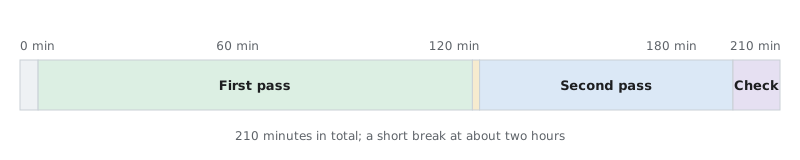
For the FSR exam, the regulatory questions are often the fast ones for a well-prepared candidate, because the documents are short and the answers are definitions and procedures. The Code questions include the slow ones: multi-step calculations, and scenarios that need several rules. Harjit's target is to finish the first pass in about two hours, with 40 or more questions answered, leaving ninety minutes for the marked questions and a check.
| Phase | Target time | What to do |
|---|---|---|
| Settle in | 5 minutes | Arrange references; read the instructions |
| First pass | About 2 hours | Answer quick questions; mark slow ones |
| Short break | 2 minutes | Hands off the books; check pace |
| Second pass | About 70 minutes | Work the marked questions, easiest first |
| Final check | Remaining time | Review doubtful answers; make sure every question has an answer |
Reading the question first
Before opening any book, read the question twice and decide three things: who it is about, what document it points to, and what kind of answer it wants. A question about whether a homeowner may do a certain task points to the Electrical Safety Regulation's homeowner conditions. A question about the latest date for a declaration points to the permit process. A question about the minimum size of a conductor points to the Code. A question that mentions 25 kV equipment in a Class B exam might be testing whether you know it is outside Class B scope. Thirty seconds of reading saves minutes of turning pages in the wrong document.
Then read the answers. Multiple-choice questions on licensing exams usually include two answers that are clearly wrong and two that are plausible. Eliminate the clearly wrong ones first. If you must guess between the last two, choose the one that follows the documents most literally. Never leave a question blank; there is no penalty for a wrong answer on a standard multiple-choice exam unless the instructions say otherwise.
Practice set: regulatory questions
The first ten practice questions cover the regulatory share. Work them with your reference documents open and a timer running, aiming for under two minutes each, then check the worked answers that follow.
1. A licensed contractor's designated FSR leaves the company on August 31. What must the FSR do, and what must the contractor do? 2. A permit was issued on April 2 and no work has started. By when must the FSR submit a 180-day safety check or work-in-progress declaration to keep the permit active? 3. A homeowner wants to wire a new 120/240 V, 100 A subpanel in the detached garage of the single-family house they own and live in. May they do it under a homeowner permit? 4. A facility has a 350 kVA service and an operating permit. Its maintenance staff want to add 30 kVA of load. Is this within the operating permit alteration limit? 5. A permit was issued on February 20, 2025, and the work was completed in May 2025. Which Code edition applies?
6. Which document is named on the reference list as not allowed in the exam: the Electrical Safety Regulation, the Code update materials, or the Canadian Electrical Code Pocket Reference? 7. An FSR certificate expired on July 1, 2026 and was never renewed. When does it close? 8. A contractor licence expires on March 31. From what date can the contractor start renewing it? 9. On the electrician pathway, a candidate has 2,400 hours of experience after receiving their Red Seal and has completed a recognized code course 18 months ago. Which unrestricted classes do they meet the experience requirement for? 10. A progress claim is for 62,000 dollars of work provided. How much holdback is retained under the current Builders Lien Act?
Worked problem
Worked answers to questions 1 to 5
Check your answers to the first five regulatory questions.
Show solution
- 1. The FSR must notify Technical Safety BC immediately that they have stopped acting as designated FSR. The contractor must designate a replacement whose start date follows the end date with no gap or overlap, or the licence may be suspended.
- 2. April 2 plus 180 days is September 29. The declaration must be submitted by then to extend the permit by another 180 days.
- 3. Yes, if the homeowner meets the eligibility conditions: the work is on their own home, single-phase, not exceeding 150 V to ground and 200 A. A detached garage is an ancillary building, so check the conditions for ancillary buildings in the regulation.
- 4. The service is above 250 kVA, so the alteration limit is 36 kVA. Adding 30 kVA is within the limit, provided the service has capacity and the load calculation is logged under the named FSR.
- 5. The permit was issued before March 4, 2025, so the 2021 edition applies by default. The 2024 edition may be used if the contractor declared it on the permit application. The editions cannot be mixed.
Answer: Score one mark for each question where your answer matches the key points.
Worked problem
Worked answers to questions 6 to 10
Check your answers to the remaining regulatory questions.
Show solution
- 6. The Canadian Electrical Code Pocket Reference (and the Handbook) are not allowed; the regulation and the update materials are on the list.
- 7. Certificates close three years after expiry: July 1, 2029.
- 8. Renewal can start up to six months before expiry: from about September 30 of the previous year.
- 9. Classes B and C need 1,800 hours; 2,400 meets them. Class A needs 3,600 hours and high voltage installations, so it is not met. The code course at 18 months is within the three-year limit.
- 10. One tenth of 62,000 is 6,200 dollars.
Answer: Most candidates who miss these questions do so by misreading who the question is about or by using an old rule.
Practice set: Code skills
The Code share of the FSR exam draws on the skills from the core courses: navigating the Code, calculations, wiring methods and protection, grounding and bonding, and special installations. The following questions check that you can still apply them under time pressure. They use simple numbers and refer to sections by number only; for real exam questions, you would look up the governing rule in your 2024 Code.
11. A single-phase 240 V heater draws 25 A. What is its power in kilowatts? 12. A three-phase 600 V motor load draws 40 A. Using the three-phase power formula with a power factor of 1 for this exercise, what is the apparent power in kVA? 13. Which section of the Code would you open first for demand load calculations for a dwelling unit, Section 8 or Section 26? 14. A Class B candidate is asked about the installation of a 25 kV switchgear lineup. Which certificate class covers that work? 15. Which Code section would you open first for the installation of electric vehicle supply equipment in a parkade?
Worked problem
Worked answers to questions 11 to 15
Check your Code skills answers.
Show solution
- 11. Power = voltage x current = 240 x 25 = 6,000 W = 6.0 kW.
- 12. Apparent power = square root of 3 x 600 x 40 = 1.732 x 24,000 = 41,569 VA, about 41.6 kVA.
- 13. Section 8, which covers circuit loading and demand factors, including dwelling unit calculations.
- 14. Equipment at 25 kV is high voltage and outside Class B scope; Class A covers it.
- 15. Section 86 covers electric vehicle charging systems, read together with Section 8 for the load calculations.
Answer: If calculations took more than three minutes, practise them until they are routine; they should be first-pass questions.
import math

# Quick exam calculations: check your answers to questions 11 and 12
v1, i1 = 240, 25
print("Q11 single-phase power:", v1 * i1 / 1000, "kW")
v3, i3 = 600, 40
kva = math.sqrt(3) * v3 * i3 / 1000
print("Q12 three-phase apparent power:", round(kva, 1), "kVA")Q11 single-phase power: 6.0 kW Q12 three-phase apparent power: 41.6 kVA
Analysing practice results
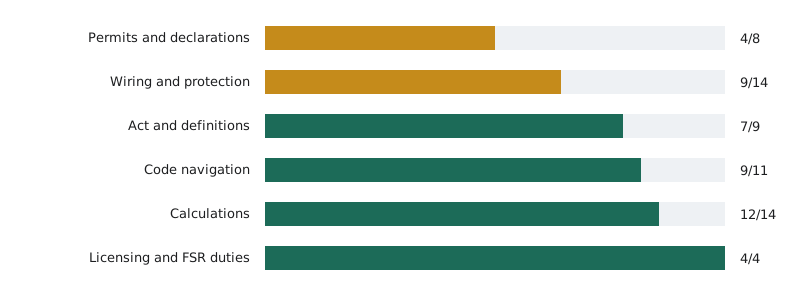
A practice exam is only useful if you learn from it. After each full mock exam, Harjit records every question by topic and whether he got it right, then calculates his score in each area. He also records the questions that took longer than four minutes, because a correct answer that took ten minutes is a problem on exam day. The analysis tells him where to spend the next week. After his first mock exam, he scored well on Code calculations and poorly on permits and declarations, which surprised him until he realized he had been answering from site habits rather than from the regulator's process.
# Practice exam analysis by topic (Harjit's first mock exam)
results = {
    "Act and definitions": (7, 9),
    "Permits and declarations": (4, 8),
    "Licensing and FSR duties": (4, 4),
    "Code navigation": (9, 11),
    "Calculations": (12, 14),
    "Wiring and protection": (9, 14),
}
total_right = sum(r for r, n in results.values())
total = sum(n for r, n in results.values())
print(f"Overall: {total_right}/{total} ({total_right * 100 // total} out of 100)")
for topic, (r, n) in sorted(results.items(), key=lambda kv: kv[1][0] / kv[1][1]):
print(f"{topic:<26} {r:>2}/{n:<2} {r * 100 // n:>3} out of 100")Overall: 45/60 (75 out of 100) Permits and declarations 4/8 50 out of 100 Wiring and protection 9/14 64 out of 100 Act and definitions 7/9 77 out of 100 Code navigation 9/11 81 out of 100 Calculations 12/14 85 out of 100 Licensing and FSR duties 4/4 100 out of 100
His overall score of 45 out of 60 would pass, but the analysis shows the weak area clearly. He spends the next week on permits and declarations, rereads the regulator's permit pages and the relevant parts of the regulation, and rewrites every question he missed as a correct statement. On his second mock exam, his permits score rises to seven out of eight.
The final week
In the last week, stop learning new material and consolidate. Do one final timed mock exam early in the week, review the questions you got wrong, and spend the remaining days on short, focused reviews of your weakest areas. Check your references against the reference list one last time and remove anything that is not allowed. Confirm your booking, the location or online requirements, and the identification you need. On the night before, put your materials together and stop studying early.
On the day, follow the plan. Arrive or log in early. Read each question twice. Answer the quick ones, mark the slow ones, and take the short break at two hours. Do not change an answer on the final check unless you find a specific reason it is wrong; first instincts on questions you knew are usually right.
Harjit's exam day
Harjit writes the Class B exam at the Technical Safety BC office on a Tuesday morning in April. His first pass takes one hour and fifty minutes and leaves him with eleven marked questions, most of them calculations and two about operating permits. He finishes the second pass with twenty-five minutes to spare and uses them to check four answers. Three weeks later, his notification letter arrives: a pass, with his strongest area in licensing and FSR duties, the area he once found the hardest.
On July 1, as planned, Grace records the change of designated FSR on the Sumas Ridge licence, with Linda's designation ending on June 30 and Harjit's beginning the next day. The licence scope becomes Class B. Linda remains a Class A FSR with the company for the dairy co-op substation work. Harjit's first act as designated FSR is to add his certificate expiry date and continuing education requirement to Grace's renewal register. His second is to walk the Mill Lake rough-in before declaring it.
Common mistakes
MistakeWorking through the exam strictly in order.
InsteadUse the two-pass method to protect the quick marks.
MistakeOpening a book before deciding which document the question points to.
InsteadRead the question twice, then go to the right reference.
MistakeLeaving questions blank.
InsteadAnswer every question unless the instructions say otherwise.
MistakeCounting only the overall practice score.
InsteadAnalyse results by topic and by time taken.
MistakeStudying new material the night before the exam.
InsteadConsolidate in the final week and rest the night before.
Summary and key terms
- Use the two-pass method: quick questions first, marked questions second, a final check last.
- Read each question for who it is about, which document it points to and what answer it wants.
- Practise both regulatory and Code questions under time pressure.
- Analyse practice exams by topic and by time taken, and study the weakest areas.
- After passing, the contractor records the new designated FSR with no gap or overlap.
- Two-pass method
- Answering quick questions first and returning to slower, marked ones afterwards.
- Mock exam
- A full-length practice exam taken under exam conditions.
- Topic analysis
- Scoring practice results by subject area to target study.
- Elimination
- Removing clearly wrong answers before choosing among the rest.
- Consolidation
- Reviewing known material instead of learning new material before an exam.
Practice problems
Work each problem on paper first, then reveal the answer to check.
What is the main purpose of the two-pass method?
Show answer
To answer quick questions first and protect those marks before spending time on slow ones.
A permit was issued on June 10 with no work since. By when is a work-in-progress or 180-day safety check declaration due?
Show answer
December 7 (180 days later).
A 208 V three-phase load draws 50 A. What is its apparent power at a power factor of 1?
Show answer
About 18.0 kVA (1.732 x 208 x 50).
How many correct answers out of 60 are needed to pass at 70 out of 100?
Show answer
42.
After passing, what must the contractor do to make the new FSR the designated FSR?
Show answer
Update the licence so the new designation starts the day after the old one ends, with no gap or overlap.
Lesson quiz · 5 questions
Score 60% or more to complete this lesson.
Create a free account to save your progress, take quizzes and earn a certificate.