
MELC-202 · Lesson 1 of 12 · 22 min
How electrical licensing works in British Columbia
▶ Video coming soon A video version of this lesson is on the way.
British Columbia does not have a provincial Master Electrician Certificate in the Alberta or Ontario sense. Instead, the person who takes legal responsibility for regulated electrical work is a Field Safety Representative, usually shortened to FSR. An FSR holds a certificate of qualification issued by Technical Safety BC, the independent, self-funded organization that administers the Safety Standards Act for electrical, gas, boiler, elevating device and several other technical systems across most of the province. The FSR certificate is the credential this course prepares you for. If you have taken the five core courses, you already know the Code side of the exam. This course adds the British Columbia side: the Act, the regulations, the directives, the permit system and the duties that come with the certificate.
This lesson builds the map. It explains who regulates electrical work in British Columbia, how the person and the business fit together, where the FSR sits in that system, how the classes of certificate divide the work, and how the newer BC Master Electrician designation relates to the FSR certificate. Every fact here was current when this course was written, but the regulator revises its pages, fees and requirements regularly. Before you book your exam, read the current Technical Safety BC certification pages for the class you are applying for and treat them as the final word.
Meet the team at Sumas Ridge Electric
This course follows one contractor through the FSR exam and the work that comes after it. Sumas Ridge Electric Ltd. is a small electrical contractor in Abbotsford, in the Fraser Valley. It employs eleven electricians and apprentices and does a mix of residential, commercial and light industrial work. The owner, Linda Brascoe, holds a Class A FSR certificate and has been the company's designated FSR for nineteen years. She plans to step back from the field within two years, and she wants someone in the company ready to take over the designation.
That person is Harjit Gill. Harjit is a Red Seal construction electrician who received his certificate of qualification four years ago, after a BC apprenticeship. He runs most of the company's commercial jobs and already understands the Code well. What he has never done is sign a declaration, deal with a safety officer, manage an operating permit or answer for a crew's work in front of the regulator. He will start by writing the Class B exam, which covers installations under 1000 volts, and later decide whether to pursue Class A.
Three others appear throughout the course. Grace Ho runs the office: permits, invoicing, insurance, payroll and the company's online services account with Technical Safety BC. Mateo Rivera is a third-year apprentice who works on Harjit's crew and will be the subject of the supervision questions. Owen Patel is the facilities manager at Clearbrook Cold Storage, a client whose warehouse holds an annual electrical operating permit with Linda named as its FSR. Their jobs give every lesson a concrete example.
| Person | Role | Credential |
|---|---|---|
| Linda Brascoe | Owner and current designated FSR | FSR Class A |
| Harjit Gill | Lead hand, commercial jobs; FSR candidate | Red Seal construction electrician |
| Grace Ho | Office manager: permits, invoices, insurance | None required |
| Mateo Rivera | Third-year apprentice | Registered apprentice |
| Owen Patel | Facilities manager, Clearbrook Cold Storage | Client; operating permit holder |
Who regulates electrical work in British Columbia
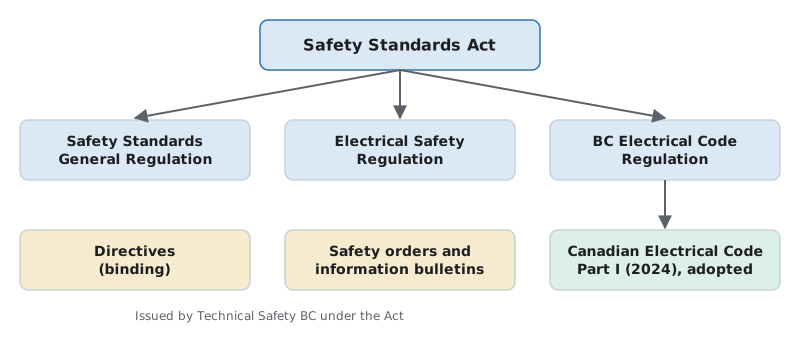
The legal foundation is the Safety Standards Act, a provincial statute that covers several technical systems rather than electrical work alone. Under it sit general regulations that apply to every technology and specific regulations for each one. For electrical work, the specific regulation is the Electrical Safety Regulation. Another regulation adopts the Canadian Electrical Code, Part I, as the BC Electrical Code. The Act also allows the regulator to issue directives, which are binding instructions on particular technical or administrative matters, and safety orders, which are directed at specific people or situations. The FSR exam tests all of these, which is why roughly a third of the exam is about the Act, regulations and directives rather than the Code.
Technical Safety BC administers the Act for most of the province. It certifies FSRs, licenses electrical contractors, issues permits, conducts inspections and audits, and takes enforcement action when work or conduct is unsafe. A handful of local governments administer electrical permits and inspections inside their own boundaries under their own bylaws and arrangements. For installation permits, Technical Safety BC lists those local governments as Burnaby, Maple Ridge, North Vancouver, Surrey, Victoria, Vancouver and West Vancouver. A contractor working in one of those areas applies to the municipality rather than to Technical Safety BC, and must follow that municipality's procedures. The FSR certificate and the contractor licence are still issued provincially.
The person and the business
British Columbia separates the qualification of the person from the licensing of the business. The person who is qualified to take responsibility for regulated electrical work holds an FSR certificate. The business that offers and performs regulated electrical work for others holds an electrical contractor licence from Technical Safety BC. The two are tied together by the designated FSR: every licensed electrical contractor must designate one FSR with an active certificate, and the scope of the licence follows the class of that FSR's certificate. A contractor whose designated FSR holds a Class C certificate cannot take on work that needs Class B, however experienced its electricians are.
The FSR does not have to own the business. Many FSRs are employees, like Harjit will be when Linda hands over the designation. What matters is that the FSR is the person who declares, on behalf of the employer, that regulated work complies with the Act and regulations. When a declaration is wrong, the regulator can act against the contractor's licence and the FSR's certificate. Both carry consequences, and both are tested.
There are other routes to doing regulated electrical work legally. An owner of a single-family home may obtain a homeowner permit and do limited work on their own home if they meet the eligibility conditions. An organization that maintains its own facility, such as Clearbrook Cold Storage, may hold an operating permit with a named FSR responsible for the equipment. An employee of a licensed contractor works under that contractor's licence and designated FSR. What no one may do is offer or perform regulated electrical work for others without a licence or the authority to do it.
Classes of FSR certificate
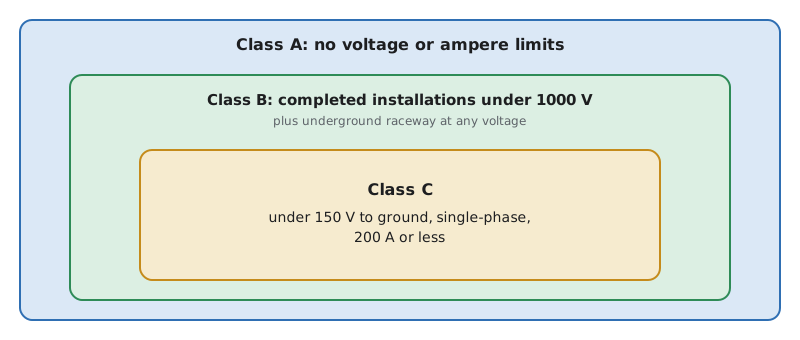
FSR certificates come in standard classes and restricted classes. The standard classes are A, B and C, and they divide work mostly by voltage and size. Technical Safety BC describes Class A as having no voltage or ampere limitations. Class B covers regulated electrical work where the completed installation is under 1000 volts, and it includes underground raceway work at any voltage. Class C covers installations under 150 volts to ground, single-phase, with ampacity of 200 amps or less, which is the range of most houses and small commercial buildings.
The restricted classes cover specialized trades. They include Class A-R for power line technicians, Class B-R for refrigeration and for full entertainment work, and several Class C-R certificates for limited entertainment, low energy systems, water wells, security alarms, instrument mechanics and underground raceway. Some class names have changed over the years, so older certificates and documents may use different labels. This course focuses on the unrestricted classes A, B and C, because they are what a construction or industrial electrician normally pursues.
| Class | General scope as described by Technical Safety BC | Typical Sumas Ridge job |
|---|---|---|
| A | Any regulated electrical work; no voltage or ampere limits | The dairy co-op's 25 kV substation upgrade |
| B | Completed installations under 1000 V, plus underground raceway at any voltage | Clearbrook Cold Storage, 347/600 V, 1200 A service |
| C | Under 150 V to ground, single-phase, 200 A or less | Mill Lake townhouses, 120/240 V, 200 A per unit |
Worked problem
Which class does each job need?
Linda asks Harjit which certificate class would be needed for three upcoming jobs: (1) a 120/240 V, 100 A subpanel in a detached garage at a house; (2) a 600 V, 400 A motor control centre at a gravel pit; (3) a new 12.47 kV pad-mounted transformer serving a farm processing plant.
Show solution
- Job 1 is single-phase, under 150 V to ground and under 200 A: Class C scope, which Class B and A also cover.
- Job 2 is under 1000 V but three-phase and larger than 200 A: Class B scope, which Class A also covers.
- Job 3 involves high voltage equipment: Class A scope.
Answer: C, B and A. Harjit's Class B certificate will cover the first two jobs. The third will need Linda's Class A until someone else qualifies.
The BC Master Electrician designation
Technical Safety BC now offers a BC Master Electrician designation. It is not a separate certificate that replaces the FSR. It is an add-on for qualified electricians who already hold, or are applying for, an FSR certificate in Class A, B or C. The regulator describes it as recognizing a qualified electrician who can examine, oversee and validate whether electrical work is safe, identify and correct non-compliances, and submit a declaration that the work complies. To be eligible, the applicant must hold the FSR certificate and a Canadian electrical trade qualification as a construction or industrial electrician, such as a Red Seal. Professional engineers and technologists, who can qualify for FSR certificates through their own pathways, do not qualify for the Master Electrician designation.
The designation is applied for together with the FSR application or at renewal, and the holder still has to meet every FSR training and renewal requirement. Harjit plans to request it when he applies for his Class B certificate, because he holds a Red Seal and the designation recognizes his trade background. The exam he writes is the FSR exam for his class; the designation does not add a separate exam according to the regulator's current page. If that changes, the class pages will say so.
Where the exam fits
To become certified, an applicant must meet the eligibility requirements for the class and pass the certification exam. Lesson 2 covers eligibility in detail, lesson 3 covers applying and booking, and lesson 4 covers the exam format and the references allowed. For now, two facts frame the whole course. First, the unrestricted FSR exams are open book and divide their questions between the Act, regulations and directives on one side and the Code on the other, with the Code taking the larger share. Second, the Code you use is the Canadian Electrical Code, Part I, as adopted in British Columbia, which since March 4, 2025 has been the 2024 edition. Lesson 5 explains the adoption.
Harjit's study plan follows the exam split. He already knows the Code well, so he gives the regulatory side more time than its share of questions alone would suggest. The questions on the Act and regulations are where experienced electricians lose marks, because the answers depend on definitions and procedures they rarely deal with on site.
# Harjit's study hours by exam area (edit to fit your own plan)
exam_share = {"Act, regulations and directives": 35, "Code": 65}  # parts of 100
weeks = 8
hours_per_week = 7
total = weeks * hours_per_week
# He weights the regulatory side up because it is new to him.
weight = {"Act, regulations and directives": 1.6, "Code": 1.0}
raw = {k: exam_share[k] * weight[k] for k in exam_share}
scale = total / sum(raw.values())
for area, r in raw.items():
    print(f"{area:<34} {r * scale:5.1f} h")
print("Total hours:", total)Act, regulations and directives 25.9 h Code 30.1 h Total hours: 56
The weights in the calculator are Harjit's own judgment. A candidate who already works with permits and declarations every day might weight the Code more heavily. Change the numbers and rerun it to see how the split moves.
Words that carry legal meaning
The Act and regulations use words with specific meanings, and exam questions depend on them. Regulated work is work on regulated products that the Act and regulations require to be done by a qualified person or under a permit. A permit authorizes regulated work at a particular site, and it belongs to the permit holder. A declaration is the FSR's statement that the work covered by a permit, or a stage of it, complies. An installation permit authorizes new work or alterations, while an operating permit makes a named, qualified person responsible for ongoing operation and maintenance of certain equipment. A safety officer is a person designated under the Act with powers to inspect, audit and order corrections. Lesson 6 develops these terms, but start reading the definitions section of the Act and the Electrical Safety Regulation now.
Read the definitions as written, not as you use the words on site. On site, a contractor is whoever is doing the work. In the regulations, a licensed contractor has specific obligations, and an unlicensed person who offers electrical work for others is committing an offence. On site, an inspection means a visit from an inspector. Under the permit system, a declaration and inspection request does not always lead to a physical visit; the regulator decides whether a further assessment is needed. These distinctions turn into exam questions.
Common mistakes
MistakeAssuming British Columbia uses a provincial Master Electrician certificate like Alberta or Ontario.
InsteadIn British Columbia the responsible person is a Field Safety Representative; the BC Master Electrician designation is an add-on to an FSR certificate.
MistakeThinking the FSR must own the contracting business.
InsteadThe FSR can be an employee; the contractor designates one FSR whose class sets the scope of the licence.
MistakeApplying to Technical Safety BC for permits in every municipality.
InsteadA few local governments, such as Vancouver and Surrey, issue electrical installation permits themselves.
MistakeTreating restricted classes as smaller versions of A, B or C.
InsteadRestricted classes cover specific trades and systems; check the scope of each one.
MistakeStudying from an old edition of the Code.
InsteadSince March 4, 2025, British Columbia uses the 2024 Canadian Electrical Code, Part I.
Summary and key terms
- Technical Safety BC administers the Safety Standards Act for electrical work in most of British Columbia.
- The responsible person is a Field Safety Representative; the business holds an electrical contractor licence.
- Every licensed contractor designates one FSR, and the licence scope follows that FSR's class.
- Standard classes are A (no limits), B (under 1000 V) and C (under 150 V to ground, single-phase, 200 A or less).
- The BC Master Electrician designation is an add-on for FSRs who hold a construction or industrial electrician qualification.
- Field Safety Representative (FSR)
- A person certified by Technical Safety BC to take responsibility for regulated electrical work and declare that it complies.
- Technical Safety BC
- The organization that administers the Safety Standards Act for electrical work in most of British Columbia.
- Designated FSR
- The one FSR a licensed electrical contractor names as responsible for its regulated work.
- Restricted class
- An FSR certificate limited to a specific trade or system, such as refrigeration or low energy.
- BC Master Electrician
- A designation added to an FSR certificate for holders who are qualified construction or industrial electricians.
Practice problems
Work each problem on paper first, then reveal the answer to check.
Which statute is the legal foundation for electrical safety regulation in British Columbia?
Show answer
The Safety Standards Act.
What does a licensed electrical contractor need before its licence is valid, in terms of people?
Show answer
A designated FSR with an active certificate.
Which standard FSR class covers a 600 V, 800 A three-phase service?
Show answer
Class B (Class A also covers it).
Name two local governments that issue their own electrical installation permits.
Show answer
Any two of Burnaby, Maple Ridge, North Vancouver, Surrey, Victoria, Vancouver and West Vancouver.
Does the BC Master Electrician designation replace the FSR certificate?
Show answer
No. It is an add-on; the holder keeps the FSR certificate and its renewal requirements.
Lesson quiz · 5 questions
Score 60% or more to complete this lesson.
Create a free account to save your progress, take quizzes and earn a certificate.