
MELC-202 · Lesson 3 of 12 · 21 min
Applying, approval and booking the exam
▶ Video coming soon A video version of this lesson is on the way.
Eligibility gets a candidate to the door. This lesson covers walking through it: submitting the application, getting approval to write, booking a seat, preparing for exam day, and what happens after the result. None of this is difficult, but each step has rules, and a candidate who learns them the hard way loses weeks. The steps are also tested indirectly, because the same administrative habits that get an application approved, such as reading the regulator's instructions closely and keeping records complete and current, are the habits an FSR needs every day.
As with every lesson in this course, dates, fees and procedures change. Technical Safety BC publishes its fee schedules separately from the certification pages, and it updates its online services from time to time. Read the current pages before you apply, and keep a copy of anything you rely on.
Starting the application
Applications for FSR certification go to Technical Safety BC, normally through its online services. Grace already has a company account for permits and the contractor licence, but Harjit needs his own account as an individual, because the certificate is issued to him personally, not to Sumas Ridge. That distinction will matter later. If Harjit ever leaves the company, his FSR certificate goes with him. The contractor licence stays with the company, which then needs to designate another FSR.
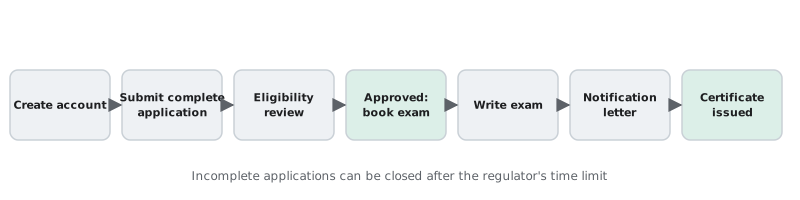
The application asks for the class being applied for, the pathway, the supporting documents described in lesson 2, and the application fee from the current fee schedule. Applicants for the BC Master Electrician designation enter their trade or Red Seal number and attach a copy of the trade certificate at this stage. Technical Safety BC notes that applicants have a set period, one year at the time of writing, to complete an application, and that incomplete applications can be closed with fees and progress forfeited. A file that sits waiting for one missing employer letter can expire.
The eligibility review
Once the file is complete, the regulator reviews it against the requirements for the class. A reviewer checks that the trade credential is genuine and of the right type, that the experience letters show enough hours after the certificate date, that the code course is recognized and recent enough, and, for Class A, that the high voltage installations are documented. If something is missing or unclear, the reviewer asks for it. If everything is in order, the candidate is approved to book the exam.
The review is also where the class is fixed. A candidate approved for Class B writes the Class B exam. If the candidate later wants Class A, they apply again for that class and meet its additional requirements. Harjit asks whether he should apply for Class A straight away to save time. Linda's advice is to pass Class B first: he meets its requirements cleanly, it covers almost all of the company's work, and it gives him a year or two of experience as an FSR before he takes on the larger scope. Many contractors follow the same sequence.
Booking a seat
Technical Safety BC holds FSR exams at most of its offices in British Columbia and also offers an online option. The office exam is supervised in person. The online exam is taken remotely under the rules the regulator sets for online exams, which typically cover identification, the room you write in, the materials on your desk and the equipment you use. If you choose the online option, read those rules in advance and test your equipment, because a technical problem on the day can cost an attempt or a rebooking.
The choice is partly practical. Harjit lives twenty minutes from a Technical Safety BC office and prefers to write in person, with his Code books on a desk rather than balanced around a laptop. A candidate in a remote community might find the online option far more convenient. Either way, the exam is open book, and the materials must meet the reference list described in lesson 4. Book early in your study plan, not late; a fixed date is the best motivation there is.
| Decision | In-person at an office | Online |
|---|---|---|
| Travel | Required | None |
| Space for references | Desk provided | Your own desk; room rules apply |
| Technical risk | Low | Depends on your equipment and connection |
| Identification check | In person | Remote, by the method the regulator uses |
Attempts, waiting periods and rewrites
The unrestricted FSR class pages describe a fixed number of attempts. At the time of writing, a candidate has three chances to pass. After a failed attempt, the candidate must wait 30 days before booking again. After a third failure, the candidate must ask the regulator for permission to make further attempts, and additional waiting time applies between them. Each attempt after the first carries a rewrite fee from the fee schedule.
After each attempt, the candidate receives a notification letter with their marks and the areas where they need to improve. That letter is valuable. A candidate who fails narrowly should study the areas listed before rebooking, not simply rewrite at the first opportunity. The 30-day wait is a minimum, not a recommendation. Plan your study so that the first attempt is the one you pass.
Worked problem
Planning around the attempt rules
Harjit books his first attempt for April 2. If he were to fail, what is the earliest date he could book a second attempt, and how should he plan his time?
Show solution
- The rule requires a 30-day wait after a failed attempt before booking again.
- April 2 plus 30 days is May 2.
- He would use the notification letter to focus on the weak areas listed, rather than repeating his whole study plan.
- He would keep at least one attempt in reserve, because after the third failure he would need permission and longer waits.
Answer: The earliest rebooking would be around May 2. The better plan is to prepare well enough that April 2 is the only attempt he needs.
from datetime import date, timedelta

# Exam planning: study weeks before the first attempt and the 30-day rebooking rule
first_attempt = date(2026, 4, 2)
study_weeks = 10
start_study = first_attempt - timedelta(weeks=study_weeks)
earliest_rebook = first_attempt + timedelta(days=30)
print("Start studying:", start_study.isoformat())
print("First attempt: ", first_attempt.isoformat())
print("Earliest rebooking if needed:", earliest_rebook.isoformat())Start studying: 2026-01-22 First attempt: 2026-04-02 Earliest rebooking if needed: 2026-05-02
Preparing for exam day
Exam day preparation starts with the reference materials. Lesson 4 covers the list in detail, but the practical point belongs here: assemble your materials early, and make sure every document is the current edition required by the reference list. Remove any pages with your own formulas, worked examples or calculations, because the regulator checks materials before and after the exam and does not permit them. Cross-referencing notes and highlighting are acceptable according to the reference list. If you are unsure whether something you have written counts as a cross-reference or as a worked example, take it out.
Then there is the ordinary preparation that matters in any long exam. The unrestricted FSR exams allow three and a half hours. Sleep properly the night before, eat something before you start, and arrive early enough to settle in. Bring the identification the booking confirmation asks for. For an online exam, clear the room and desk according to the rules and start the check-in early. Harjit does a full dress rehearsal two weeks before the exam: all of his references, a three-and-a-half-hour mock exam, at the same time of day as the real one.
If you need an accommodation because of a disability or another reason recognized under human rights law, ask for it when you book, not on the day. Regulators generally have a process for requests such as extra time or a separate room, and they need time to arrange it.
Results and the certificate
The pass mark for the unrestricted FSR exams is 70 out of 100 at the time of writing. Results arrive through the notification letter. A candidate who passes is issued a certificate of qualification for the class, and the BC Master Electrician designation if it was requested and approved. The certificate has a term and must be renewed, with proof of continuing education, as lesson 11 explains. The regulator also aligns renewal dates with the holder's birth date, so the first term can be a little shorter or longer than a standard term, and a pro-rated fee may apply.
Passing the exam does not by itself make Harjit the designated FSR for Sumas Ridge. The contractor licence names one designated FSR at a time. To change it, Grace will update the licence with Harjit's certificate number and last name, and she must make the change so that there is no gap or overlap between Linda's end date and Harjit's start date. A gap or an overlap can lead to the licence being suspended. Lesson 8 covers that process.
Keeping your details current
Once you hold a certificate, you have obligations that have nothing to do with wiring. Keep your contact information current with the regulator. If you are a designated FSR and you stop acting in that role, notify the regulator immediately, and make sure the contractor knows, because the contractor must replace you. Keep your continuing education records, because you will need them to renew. If a certificate expires and is not renewed, Technical Safety BC closes electrical certificates three years after the expiry date, and a closed certificate cannot be renewed: the holder must reapply and pass the exam again.
These obligations are easy to forget because they are rarely urgent. The FSRs who end up in trouble with the regulator over administrative matters are usually not careless electricians. They are busy people who let a renewal date or a change of role slip. Put the dates in a calendar the day the certificate arrives.
Fees and budgeting
Technical Safety BC sets its fees in published fee schedules rather than on the certification pages, and it revises them periodically. A candidate should budget for the application fee, a possible rewrite fee for each attempt after the first, the cost of the recognized code course, the current Code book and the regulatory documents on the reference list, and the renewal fee at the end of the first term. Some employers pay these costs for staff they are preparing to become designated FSRs, sometimes with an agreement about repayment if the employee leaves soon afterwards. Linda pays for Harjit's course and books, and Sumas Ridge pays the application fee. Grace records each cost against the company's training budget so that next year's plan reflects what it really costs to develop an FSR.
Fees for the contractor licence, permits and operating permits are separate again, and they are the contractor's costs rather than the FSR's. A designated FSR does not pay them personally, but a good FSR knows roughly what they are, because they affect quotes and the timing of applications.
Study resources
The best study resources are the documents on the reference list themselves. Read the Safety Standards Act, the general regulation and the Electrical Safety Regulation from start to finish at least once, then return to the parts that matter for your class. Read the definitions sections twice. Work through the regulator's directives and information bulletins that relate to electrical work, especially any about permits, declarations, the adoption of the 2024 Code and the duties of FSRs. Add the material from your recognized code course and the Code update materials. Commercial practice exams can help with timing, but they are written by third parties, and their questions may not reflect the current rules. Treat any answer key that contradicts the current documents as wrong.
Harjit forms a small study group with two electricians from other contractors who are also writing in the spring. They meet every Thursday for two hours. Each week one person prepares twenty practice questions from a section of the regulations, and the others answer them under time pressure. Explaining why an answer is right turns out to be the most effective study method any of them try.
If an application is refused
Occasionally an application is refused, usually because the experience or training does not meet the requirements. The refusal letter should explain the reason. Read it carefully, because the remedy is often simple: more hours, a recognized course, or better documentation. The Safety Standards Act provides review and appeal routes for certain decisions made under it, and the refusal letter or the regulator can explain which applies. In practice, most candidates fix the gap and reapply rather than appeal.
Common mistakes
MistakeApplying under the company's account instead of an individual account.
InsteadThe FSR certificate is issued to the person, so the application is personal.
MistakeLetting an incomplete application sit until it expires.
InsteadComplete the file within the regulator's time limit or risk losing the fee and progress.
MistakeRebooking immediately after a failed attempt without studying the weak areas.
InsteadUse the notification letter to target the areas listed, and respect the 30-day minimum wait.
MistakeBringing pages with personal formulas or worked examples to the exam.
InsteadRemove them; highlighting and cross-referencing notes are acceptable, worked examples are not.
MistakeAssuming the new certificate automatically makes you the designated FSR.
InsteadThe contractor must update the licence, with no gap or overlap between FSRs.
Summary and key terms
- Apply as an individual, with complete documents, within the regulator's time limit.
- The eligibility review fixes the class you are approved to write.
- Exams are held at most Technical Safety BC offices, with an online option.
- Candidates have three chances, with a 30-day wait after a failure and permission needed after the third.
- After passing, the contractor must update its licence to name the new designated FSR without a gap or overlap.
- Notification letter
- The letter sent after an attempt showing marks and areas for improvement.
- Rewrite fee
- The fee charged for each exam attempt after the first.
- Online services account
- The account used to apply for certificates, licences and permits with Technical Safety BC.
- Closed certificate
- A certificate that has been expired for three years and can no longer be renewed.
- Accommodation
- An adjustment to exam conditions for a disability or other recognized reason, requested in advance.
Practice problems
Work each problem on paper first, then reveal the answer to check.
How long must a candidate wait after a failed FSR exam attempt before booking again?
Show answer
At least 30 days.
What happens after a third failed attempt?
Show answer
The candidate must request permission for further attempts, and additional waiting time applies.
What pass mark applies to the unrestricted FSR exams?
Show answer
70 out of 100, at the time of writing.
Why should Harjit apply through an individual account rather than the company account?
Show answer
The certificate is issued to him personally and stays with him if he changes employers.
When are electrical certificates closed?
Show answer
Three years after their expiry date if not renewed.
Lesson quiz · 5 questions
Score 60% or more to complete this lesson.
Create a free account to save your progress, take quizzes and earn a certificate.