
MELC-202 · Lesson 11 of 12 · 20 min
Renewal and continuing education
▶ Video coming soon A video version of this lesson is on the way.
Passing the FSR exam is the start of a cycle, not the end of one. An FSR certificate has a term, and to keep it the holder must renew on time with proof of continuing education. A contractor licence renews every year. An operating permit renews every year. And the designated FSR has a standing duty to keep their code knowledge current between renewals. This lesson covers the renewal rules for FSR certificates as Technical Safety BC described them when the course was written, the continuing education requirement and how it relates to the 2024 Code, what happens when a certificate lapses or closes, and how to build a calendar that keeps every renewal in a contractor's office on time.
Renewal rules are among the details the regulator changes most often, particularly when a new Code edition is adopted. The figures here are a guide to the structure of the rules. Read the current renewal page before you renew, and before you answer an exam question that depends on a number.
The renewal cycle
FSR certificates must be renewed every three years, with proof of continuing education. Technical Safety BC allows renewal up to one year before the expiry date, and renewing early does not shorten the certificate's active period. A holder who renews after the expiry date pays late renewal fees. The regulator aligns certificate renewal dates with the holder's birth date, so when a certificate is first issued or when renewal dates are adjusted, the holder may be charged a pro-rated fee covering the period between the old expiry date and the new renewal date.
For Harjit, these rules mean his first certificate term will run to a birthday roughly three years after he passes, and he can renew any time in the twelve months before that date. He puts the expiry date in his own calendar and in Grace's licence file, because as designated FSR his certificate status is also the licence's status. If his certificate expires, the contractor no longer has an active designated FSR.
| Renewal rule (FSR certificates) | As described by Technical Safety BC |
|---|---|
| Term | Renew every three years |
| Earliest renewal | Up to one year before expiry, without shortening the term |
| Late renewal | Late fees apply after expiry |
| Renewal date | Aligned with the holder's birth date; pro-rated fees may apply |
| Proof required | Continuing education completion record |
| Closure | Certificate closes three years after expiry if not renewed |
Continuing education requirements
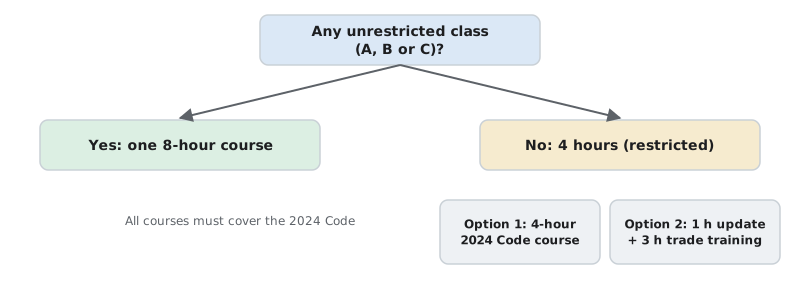
Continuing education for FSRs is measured in hours with a recognized training provider. For holders of the unrestricted Class A, B or C certificates, the requirement is 8 hours. A person holding several classes does not multiply the requirement: if they hold any unrestricted A, B or C certificate, they take an 8-hour course, and if they hold only restricted classes, they take a 4-hour course. Restricted class holders have two options for their 4 hours: a single course of at least 4 hours on the 2024 Code, including the code update content described in the regulator's syllabus and recognized by Technical Safety BC; or at least 1 hour of a recognized 2024 code update course plus additional trade-specific safety or technical training to make up 4 hours. Holders of grandparented classes take a 4-hour online course from a recognized provider.
The content requirement follows the Code cycle. Renewal courses must cover the 2024 Canadian Electrical Code. Technical Safety BC stated that 2021 code update training completed before the 2024 Code was adopted is no longer accepted as of March 3, 2026. The regulator also notes that retaking a full 2024 certification code course, covering all relevant sections rather than only the updates, may qualify for renewal. Keep the course completion document, because it is part of the renewal application.
| Certificate held | Continuing education for renewal |
|---|---|
| Any unrestricted class (A, B or C) | 8 hours with a recognized provider |
| Several classes including an unrestricted one | 8 hours (one course) |
| Restricted classes only | 4 hours: a recognized 4-hour 2024 Code course, or 1 hour of recognized code update plus 3 hours of trade-specific safety or technical training |
| Grandparented classes | 4-hour online course from a recognized provider |
| All | Must cover the 2024 Code; 2021 update training not accepted from March 3, 2026 |
Worked problem
Linda's renewal
Linda holds a Class A certificate and a Class C-R low energy certificate from years ago. Her certificates expire on her birthday, May 12. She took a 2021 code update course in 2023. What does she need for her next renewal?
Show solution
- She holds an unrestricted class (A), so she needs one 8-hour course, not separate courses for each class.
- Her 2021 update course does not count: renewal courses must cover the 2024 Code, and 2021 update training is no longer accepted from March 3, 2026.
- She can renew up to a year before May 12 without losing any of her term.
- If she wants the BC Master Electrician designation, she can request it at renewal, since she holds a construction electrician qualification.
Answer: One recognized 8-hour course covering the 2024 Code, completed before she submits her renewal, which she can do any time in the year before May 12.
Lapsed and closed certificates
A certificate that is not renewed by its expiry date has expired. The holder cannot act as an FSR while it is expired, and late fees apply when they renew. If the certificate stays expired for three years, Technical Safety BC closes it. A closed certificate cannot be renewed. To get it back, the person must reapply and pass the relevant certification exam again, as if they were a new candidate, which also means meeting the current eligibility requirements, including a recent recognized code course.
Closure is the outcome every FSR should design their habits to avoid. It usually happens to people who change careers or leave the province and assume they can pick up the certificate later. Harjit's study group includes an electrician who let a Class C certificate close while working in Alberta for four years, and who is now writing the exam again. It is not a disaster, but it is an expensive way to relearn a lesson about calendars.
from datetime import date

# FSR certificate dates: renewal window and closure (structure of the rules)
expiry = date(2029, 5, 12)          # aligned with the birth date
renew_from = date(expiry.year - 1, expiry.month, expiry.day)
closes = date(expiry.year + 3, expiry.month, expiry.day)
today = date(2028, 9, 1)
print("Renewal window opens:", renew_from)
print("Expiry:", expiry)
print("Certificate would close if not renewed:", closes)
print("Can renew today?", renew_from <= today)Renewal window opens: 2028-05-12 Expiry: 2029-05-12 Certificate would close if not renewed: 2032-05-12 Can renew today? True
Other renewals in the same office
The FSR certificate is one of several renewals a designated FSR needs to keep track of. The contractor licence renews annually, can be renewed from six months before expiry, and depends on an active designated FSR certificate and a valid surety bond, as lesson 8 explained. Operating permits for client facilities where the contractor's FSR is named renew annually, as lesson 6 explained. Insurance policies, the surety bond and WorkSafeBC registration each have their own cycles. And apprentices' training levels and hours need to be tracked with SkilledTradesBC.
Grace keeps all of these in one renewal register, sorted by date, with the person responsible for each, the documents needed and the date of the first reminder. When Harjit becomes designated FSR, his certificate expiry and continuing education status go into the register next to the licence, so that a lapse in one cannot catch the other by surprise.
| Item | Cycle | Depends on | First reminder |
|---|---|---|---|
| Harjit's FSR certificate | Three years, birth date | Continuing education (8 h) | Twelve months before |
| Contractor licence | Annual | Active designated FSR and valid bond | Six months before |
| Surety bond | Annual | Surety's renewal | Ninety days before |
| Clearbrook operating permit | Annual | Named FSR | Sixty days before |
| Liability insurance | Annual | Broker renewal | Ninety days before |
| WorkSafeBC account | Ongoing | Payroll reporting and premiums | Each reporting period |
Keeping code knowledge current between renewals
Continuing education every three years is the minimum. The designated FSR's duty to keep their code knowledge current runs all the time. In practice, that means checking Technical Safety BC's regulatory notices regularly for new directives and information bulletins, reading the regulator's newsletters and safety updates, taking manufacturer and safety training relevant to the work, and paying attention to deficiencies found on the company's jobs, because each one points to something the crews need to learn. When a new Code edition is announced, it means planning update training for the whole company, not only for the FSR.
Linda runs a fifteen-minute code topic at the start of each monthly safety meeting. One month it is a new directive, another month a rule that caused a deficiency on a recent job, another a question from the FSR exam study group. It costs almost nothing, and it is the reason Sumas Ridge's crews rarely see the same deficiency twice.
The BC Master Electrician designation at renewal
Holders of the BC Master Electrician designation keep their FSR certificate and must meet all of its training and renewal requirements. The designation can also be requested at renewal by an existing FSR who qualifies, by entering their trade or Red Seal number and attaching a copy of the trade certificate. That makes renewal a natural moment for experienced FSRs like Linda to add the designation if they want it.
Choosing a continuing education course
Because continuing education must come from a recognized training provider, the first step is to confirm that the course you plan to take is recognized for FSR renewal, and recognized for the right purpose. A general safety course from an unrecognized provider will not satisfy the 8-hour requirement for an unrestricted class, however useful it is. Technical Safety BC lists or describes the recognition it gives, and providers usually state on their course pages whether a course is recognized for FSR renewal. If you are unsure, ask the provider for written confirmation and ask the regulator before you rely on it.
Beyond recognition, choose a course that teaches you something. An FSR who has worked mostly in houses might choose a 2024 Code course with an emphasis on commercial and industrial changes. An FSR who works in facilities with operating permits might look for content on maintenance, hazardous locations and the 2024 changes to energy storage and EV supply equipment. The best renewal courses include practice questions and real deficiency examples, not only a reading of the changes. Harjit's college offers an evening version of the 8-hour course in two sessions, which suits a working contractor better than a full day away from the crews.
Renewal when circumstances change
An FSR certificate belongs to the person, so it travels with them when they change employers. A designated FSR who leaves a contractor must notify Technical Safety BC immediately that they have stopped acting in that role, and the contractor must designate a replacement without a gap. The certificate itself stays active until its expiry date and is renewed in the usual way. If the FSR joins another contractor as its designated FSR, that contractor records the designation on its licence.
An FSR who leaves British Columbia for a few years faces a choice. They can keep the certificate active by renewing every three years with the required continuing education, which is the safest course if they expect to return. Or they can let it expire, accepting that if they are away for more than three years after expiry, the certificate will close and they will need to apply and write the exam again. The cost of keeping a certificate active is small compared with the cost of starting over, and many electricians who work away for a time choose to keep theirs.
A change of name, address or contact details should be reported to the regulator promptly, so that renewal notices reach you. Renewal notices are a courtesy, not a guarantee: the responsibility for renewing on time rests with the holder whether or not a notice arrives.
Common mistakes
MistakeWaiting until after expiry to renew.
InsteadRenew up to a year before expiry; late fees apply after expiry.
MistakeUsing a 2021 code update course for a renewal after March 3, 2026.
InsteadRenewal courses must cover the 2024 Code.
MistakeTaking separate 8-hour courses for each class held.
InsteadOne 8-hour course covers holders of any unrestricted class.
MistakeLetting a certificate stay expired for years.
InsteadCertificates close three years after expiry and then require a new exam.
MistakeTracking the FSR renewal separately from the contractor licence.
InsteadThe licence depends on an active designated FSR; keep both in one register.
Summary and key terms
- FSR certificates renew every three years, aligned to the holder's birth date, with proof of continuing education.
- Renewal can be done up to a year early without losing time; late fees apply after expiry.
- Unrestricted class holders need 8 hours; restricted-only holders need 4 hours; all must cover the 2024 Code.
- 2021 code update training is not accepted from March 3, 2026.
- A certificate closes three years after expiry and must then be reissued through a new application and exam.
- Continuing education
- Recognized training completed during a certificate term and required for renewal.
- Recognized training provider
- A provider whose courses Technical Safety BC recognizes for FSR purposes.
- Pro-rated fee
- A fee covering the partial period when a renewal date is aligned with the birth date.
- Closed certificate
- A certificate expired for three years that cannot be renewed.
- Renewal register
- A list of every renewal date, dependency and reminder for a contractor.
Practice problems
Work each problem on paper first, then reveal the answer to check.
How often must an FSR certificate be renewed?
Show answer
Every three years.
How many hours of continuing education does a Class B holder need?
Show answer
8 hours with a recognized provider.
Can a holder with Class A and a restricted class take one 8-hour course?
Show answer
Yes. Holders of any unrestricted class take one 8-hour course.
What happens to a certificate expired for three years?
Show answer
It closes and must be reissued through a new application and exam.
Is 2021 code update training accepted for renewal after March 3, 2026?
Show answer
No.
Lesson quiz · 5 questions
Score 60% or more to complete this lesson.
Create a free account to save your progress, take quizzes and earn a certificate.