
MELC-202 · Lesson 2 of 12 · 21 min
Eligibility for the Field Safety Representative (FSR) Certificate
▶ Video coming soon A video version of this lesson is on the way.
Before Technical Safety BC lets a candidate write an FSR exam, the candidate has to show that they meet the eligibility requirements for the class they are applying for. Eligibility is the first gate, and it is where many applications stall: an hours log that does not add up, experience gained before the trade certificate rather than after it, or a code course completed too long ago. This lesson walks through the requirements for the unrestricted classes A, B and C, the three pathways the regulator recognizes, the documents that prove each requirement, and the common reasons an application is sent back. It also covers the eligibility rules for the BC Master Electrician designation and what changes for electricians who trained outside British Columbia.
The figures in this lesson are taken from the Technical Safety BC class pages as they stood when the course was written. Eligibility rules are the kind of detail regulators revise without much notice, so confirm every number against the current class page before you apply. The method in this lesson, building a clean record of credentials, experience and training that maps to each stated requirement, does not change even when the numbers do.
Three pathways to an FSR certificate
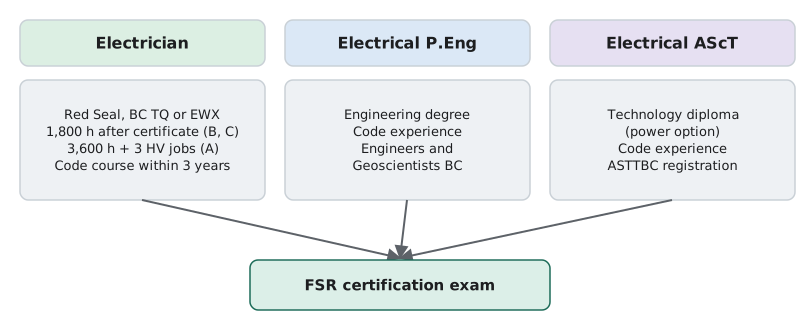
Technical Safety BC recognizes three professional backgrounds for the unrestricted FSR classes. The first and most common is the electrician pathway, for people who hold an electrical trade qualification. The second is the electrical engineer pathway, for people with an electrical engineering degree who are registered and in good standing as professional engineers with Engineers and Geoscientists BC. The third is the electrical technologist pathway, for people with an electrical engineering technology qualification in the power option who are registered and in good standing with the Applied Science Technologists and Technicians of BC. Each pathway has its own evidence requirements, and the applicant only needs to satisfy one.
The engineer and technologist pathways require relevant work experience using the Canadian Electrical Code. They exist because many people who design and oversee electrical installations in industry are engineers or technologists rather than tradespeople. They also explain one of the eligibility rules for the BC Master Electrician designation: because that designation recognizes trade qualifications specifically, applicants who qualified for the FSR certificate through the engineer or technologist pathway are not eligible for it.
The electrician pathway
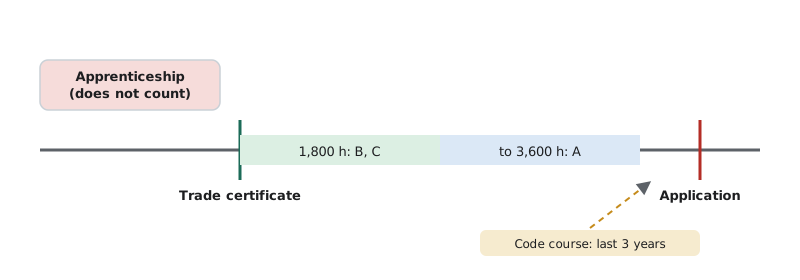
Harjit is applying through the electrician pathway, and so will most readers of this course. The pathway has three parts for Class B and Class C. First, a trade credential: a Red Seal electrician qualification, a BC Trade Qualification in Electrical Work for construction or industrial electricians, or a BC Exemption Permit, sometimes abbreviated EWX. Second, experience: at least one year, which the regulator expresses as 1,800 hours, of acceptable electrical work under the Canadian Electrical Code, gained after receiving the trade certificate. Third, training: a recognized electrical code course from a recognized training provider, completed within three years of the application date.
Class A adds to all three. The experience requirement doubles to at least two years, or 3,600 hours, after the trade certificate. The applicant must also document at least three high voltage installations completed since receiving the trade certificate, and the regulator notes that a high voltage training course may count toward this requirement. The extra requirements make sense when you remember that Class A has no voltage limit: an FSR who declares work on a substation or a medium-voltage feeder must have seen that kind of work done properly.
| Requirement (electrician pathway) | Class C | Class B | Class A |
|---|---|---|---|
| Trade credential | Red Seal, BC TQ or EWX | Red Seal, BC TQ or EWX | Red Seal, BC TQ or EWX |
| Experience after the trade certificate | 1,800 h (1 year) | 1,800 h (1 year) | 3,600 h (2 years) |
| Recognized code course | Within 3 years of applying | Within 3 years of applying | Within 3 years of applying |
| High voltage installations | Not required | Not required | At least 3 documented |
Experience that counts
The phrase that trips up applicants is after receiving the trade certificate. Hours worked as an apprentice do not count toward the FSR experience requirement, no matter how many there were or how responsible the work was. The clock starts on the date the certificate of qualification was issued. A journeyperson who received their Red Seal in March and wants to apply for Class B the following January has not yet reached a year of post-certificate experience, even if they have worked full-time throughout.
The work must also be acceptable electrical work under the Canadian Electrical Code. In practice that means installation, alteration or maintenance of electrical equipment governed by the Code. Time spent as an estimator, a salesperson for an electrical wholesaler, or an instructor may or may not be accepted, depending on what it involved. If your experience is unusual, describe the work precisely and let the regulator decide, rather than stretching the description of ordinary work. An application that overstates experience can be refused, and a certificate obtained on false information can be cancelled.
Experience is normally documented through letters from employers on company letterhead that state the dates of employment, the position, the hours worked and the nature of the electrical work. For self-employed electricians, invoices, permits, and contracts can support the record. Keep copies of everything you submit, and keep your own running log of jobs, dates and hours from the day you receive your trade certificate. The log makes the employer letters easy to request and easy to check.
Worked problem
Counting Harjit's hours
Harjit received his Red Seal certificate on September 15, four years ago. Since then he has worked full-time at Sumas Ridge, averaging 38 hours a week, with about four weeks off each year. Does he meet the 1,800-hour requirement for Class B, and the 3,600-hour requirement for Class A?
Show solution
- Working weeks per year: 52 - 4 = 48.
- Hours per year: 48 x 38 = 1,824.
- Hours over four years: 4 x 1,824 = 7,296.
- Class B needs 1,800 hours after the certificate: met with a wide margin.
- Class A needs 3,600 hours after the certificate: met, but Class A also needs three documented high voltage installations.
Answer: Harjit meets the experience requirement for both classes. For Class A he would still need to document high voltage installations, which he has only helped with twice.
# Post-certificate experience check (edit the numbers for your own record)
years = 4
weeks_off_per_year = 4
hours_per_week = 38
hours = years * (52 - weeks_off_per_year) * hours_per_week
need = {"Class C": 1800, "Class B": 1800, "Class A": 3600}
print("Post-certificate hours:", hours)
for cls, n in need.items():
    status = "meets" if hours >= n else "short by " + str(n - hours)
print(f"{cls}: needs {n} h, {status}")Post-certificate hours: 7296 Class C: needs 1800 h, meets Class B: needs 1800 h, meets Class A: needs 3600 h, meets
The recognized code course
The training requirement is a recognized electrical code course from a recognized training provider, completed within three years of the date you apply. Technical Safety BC maintains the recognition, so a course from a provider that the regulator has not recognized may not count, even if it covers the same material. Several BC colleges and private training organizations offer courses designed for FSR candidates, usually covering the Code sections that the exam draws on together with the Act and regulations. Many candidates take the course in the months before the exam, which also satisfies the recency rule comfortably.
Three years is a hard limit. Harjit took a Code course during his last apprenticeship level, more than four years ago, so it does not count. He enrols in a recognized FSR preparation course at a nearby college that runs on weekday evenings for ten weeks. The certificate of completion goes into his application file. Linda points out that the course has a second benefit: it covers the 2024 edition of the Code, which changed several rules that Harjit learned on the 2018 and 2021 editions.
Credentials from outside British Columbia
Electricians move between provinces. A Red Seal endorsement is recognized across Canada, so a journeyperson who trained in Alberta or Ontario and holds the Red Seal can use it for the trade credential part of the electrician pathway. The experience and code course requirements still apply. Technical Safety BC also has a transfer process for people who hold equivalent credentials from other Canadian jurisdictions, and Canada's labour mobility rules generally require regulators to recognize certified workers from other provinces and territories. Because the details depend on the exact credential held, a person moving to British Columbia should read the regulator's transfer page and contact it before assuming that an existing master or contractor credential converts automatically.
There is also the separate matter of the trade itself. British Columbia brought electricians into its Skilled Trades Certification system, administered by SkilledTradesBC, beginning in December 2022. Under that system, people working in certified trades must hold a certificate of qualification or be registered apprentices, subject to the transition rules. That requirement is about working in the trade at all, not about the FSR certificate, but it matters for supervision questions in lesson 7 and for the BC Master Electrician designation, which depends on the trade qualification. Confirm current trade certification requirements with SkilledTradesBC.
Eligibility for the BC Master Electrician designation
The BC Master Electrician designation has its own eligibility rules, which sit on top of the FSR requirements. The applicant must hold, or be applying for, an FSR Class A, B or C certificate. They must hold a Canadian electrical trade credential, such as a Red Seal, and a qualification as a construction or industrial electrician. Professional engineers and applied science technologists do not qualify for the designation, even if they hold an FSR certificate through their own pathways. The application asks for the trade or Red Seal number and a copy of the trade certificate, and it can be made with the FSR application or at renewal.
Harjit qualifies on every point and will request the designation with his Class B application. Linda, who holds a Class A certificate and a construction electrician qualification, can add it at her next renewal if she wants to. The designation matters most to clients and to the public, because it signals a trade-qualified person behind the declarations.
Assembling the application file
Grace builds Harjit's file the way she builds a permit package: a checklist first, then one document per line. The checklist has five lines for Class B: proof of identity as required by the application form, the trade certificate, employer letters covering at least 1,800 hours after the certificate date, the code course certificate dated within three years, and the request for the BC Master Electrician designation with the Red Seal number. For a Class A application she would add the high voltage installation records. She also adds a sixth line that is not on any form: a one-page summary that maps each document to the requirement it proves.
The summary sheet is worth copying. It lets the person reviewing the application see at a glance that each requirement is met, and it forces the applicant to notice gaps before the regulator does. If one employer letter is missing the hours or the nature of the work, the summary sheet shows it immediately.
| Requirement | Document | Checked |
|---|---|---|
| Trade credential | Red Seal certificate of qualification (copy) | Yes |
| 1,800 h after the certificate | Two employer letters, total 7,296 h | Yes |
| Code course within 3 years | College FSR preparation course certificate | Yes |
| Master Electrician designation | Red Seal number on the application form | Yes |
| High voltage installations (Class A only) | Not applicable to this application | n/a |
Why applications are returned
Technical Safety BC gives applicants a period to complete an application, and incomplete applications can be closed with fees forfeited. The most common problems are predictable. Experience letters include apprenticeship hours, or do not state hours at all. The code course certificate is older than three years, or comes from a provider the regulator does not recognize. The applicant applies for Class A without documenting high voltage installations. The trade credential is a provincial certificate from another province that does not map clearly to a BC credential. The application asks for the BC Master Electrician designation when the applicant qualified through the engineer pathway.
Each of these is avoidable with a careful file. Harjit's application goes in complete, and he receives approval to book the exam a few weeks later. Lesson 3 follows that step.
Common mistakes
MistakeCounting apprenticeship hours toward the FSR experience requirement.
InsteadOnly experience gained after receiving the trade certificate counts.
MistakeUsing a code course taken during the apprenticeship years ago.
InsteadThe recognized code course must be completed within three years of the application date.
MistakeApplying for Class A without high voltage records.
InsteadClass A requires at least three documented high voltage installations, in addition to 3,600 hours.
MistakeSubmitting employer letters that only state dates of employment.
InsteadLetters should state dates, position, hours and the nature of the electrical work.
MistakeAssuming an engineer who holds an FSR can add the Master Electrician designation.
InsteadThe designation requires a construction or industrial electrician trade qualification.
Summary and key terms
- There are three eligibility pathways: electrician, electrical engineer and electrical technologist.
- On the electrician pathway, Classes B and C need 1,800 hours after the trade certificate and Class A needs 3,600.
- A recognized code course must be completed within three years of applying.
- Class A also needs at least three documented high voltage installations.
- The BC Master Electrician designation needs an FSR certificate plus a construction or industrial electrician trade qualification.
- Trade credential
- A Red Seal, BC Trade Qualification in Electrical Work or BC Exemption Permit, used for the electrician pathway.
- Post-certificate experience
- Electrical work under the Code performed after the trade certificate was issued.
- Recognized code course
- A Code course from a provider recognized by Technical Safety BC, completed within three years of applying.
- High voltage installation
- An installation above the low voltage range, documented for Class A eligibility.
- Labour mobility
- Rules requiring regulators to recognize workers certified in other Canadian jurisdictions.
Practice problems
Work each problem on paper first, then reveal the answer to check.
How many hours of post-certificate experience does Class B require on the electrician pathway?
Show answer
At least 1,800 hours (one year).
A candidate took a recognized code course 40 months ago. Does it count?
Show answer
No. It must be within three years (36 months) of the application date.
Do apprenticeship hours count toward FSR experience?
Show answer
No. Only hours after the trade certificate count.
What extra evidence does Class A require besides 3,600 hours?
Show answer
At least three documented high voltage installations (a high voltage course may count toward this).
Which three pathways can lead to an unrestricted FSR certificate?
Show answer
Electrician, electrical professional engineer, and electrical applied science technologist.
Lesson quiz · 5 questions
Score 60% or more to complete this lesson.
Create a free account to save your progress, take quizzes and earn a certificate.