
MELC-202 · Lesson 5 of 12 · 20 min
The BC Electrical Code and Technical Safety BC directives
▶ Video coming soon A video version of this lesson is on the way.
The Code half of the FSR exam is based on the Canadian Electrical Code, Part I, as British Columbia adopts it. This lesson explains how that adoption works: which edition is in force, when it took effect, how jobs that straddled the change are handled, and whether British Columbia made any changes of its own. It then looks at the regulator's other instruments, the directives, information bulletins and safety orders that sit alongside the Code and make up a large part of the regulatory share of the exam. By the end, Harjit should be able to answer two questions instantly for any job: which edition of the Code applies, and which regulator documents beyond the Code he needs to check.
As in the core courses, this lesson does not reproduce Code text. It refers to rules and sections by number only. Read them in your own copy of the 2024 Code.
How British Columbia adopts the Code
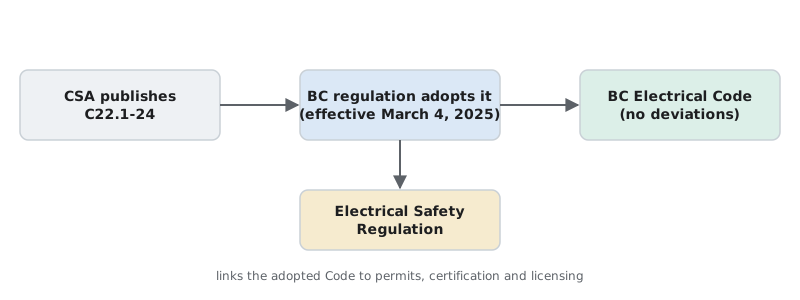
The Canadian Electrical Code, Part I, is published by CSA Group as standard C22.1. It has no legal force on its own. A province gives it force by adopting it in legislation, often with amendments. In British Columbia, the adoption is made through a regulation under the Safety Standards Act, the regulation that the reference list calls the BC Electrical Code Regulation. The Electrical Safety Regulation then connects the adopted Code to the rest of the regime: permits, certification, licensing and the duties of the people involved. When the reference list and the class pages refer to the Code as adopted in British Columbia by the Electrical Safety Regulation, that is what they mean.
The adopted Code is called the BC Electrical Code. In some cycles, British Columbia has adopted the national Code with deviations, which are provincial changes to particular rules. For the current cycle, the regulator's adoption bulletin states that there are no deviations from the Canadian Electrical Code. In practice, the BC Electrical Code for the 2024 cycle is the 26th edition of the Canadian Electrical Code, Part I, CSA C22.1-24, as published.
The 2024 edition and the effective date
Technical Safety BC announced the adoption in an information bulletin. The 2024 edition took effect on March 4, 2025. From that date, regulated electrical work under a permit issued on or after March 4, 2025 must follow the 2024 edition. That is also the edition the FSR exam now tests, and the edition the recognized code courses and the renewal code update courses teach. Earlier editions remain relevant only for older permits, as the transition rules below explain.
The 2024 edition brought a substantial set of changes across many sections. CSA's own summary of the edition, and the regulator's blog on the main changes, describe revisions in areas such as electric vehicle supply equipment, energy storage, hazardous location sealing, swimming pool bonding and temporary installations. The core courses MELC-102 to MELC-105 discuss several of these. For the FSR exam, the practical point is that a candidate who learned the Code on the 2018 or 2021 edition must study the update material, because exam questions are written to the 2024 rules.
Transition rules
When an edition changes, some jobs are already under way. The adoption bulletin set out rules for those jobs. Work under a permit issued before March 4, 2025 generally follows the 2021 edition, even if the work is completed after the effective date. There is an exception: work under a permit issued before March 4, 2025 may follow the 2024 edition if it is completed after March 4, 2025 and the licensed electrical contractor declares that choice on the permit application. Work under a permit issued on or after March 4, 2025 must follow the 2024 edition. And one rule applies in every case: a job may not mix sections from different editions.
The bulletin also reminded contractors who work in areas where a local government administers electrical permits to check that government's own transition policy. A municipality that issues electrical permits under its own arrangements may set its own effective date or transition rules, so the provincial bulletin is not automatically the answer inside those boundaries.
| Permit issued | Work completed | Edition | Condition |
|---|---|---|---|
| Before March 4, 2025 | Before March 4, 2025 | 2021 | None |
| Before March 4, 2025 | After March 4, 2025 | 2021 by default | May use 2024 if the contractor declares it on the permit application |
| On or after March 4, 2025 | Any time after | 2024 | Required |
| Any | Any | Never a mix | Sections from different editions may not be combined |
Worked problem
Which edition applies?
Sumas Ridge has three jobs: (1) a strata parkade EV charger installation under a permit issued February 20, 2025, finished in May 2025; (2) a warehouse lighting retrofit under a permit issued March 12, 2025; (3) a house renovation under a permit issued January 10, 2025, finished in February 2025. Which edition applies to each, and what choice is available?
Show solution
- Job 1: permit before March 4, 2025, work completed after it. The 2021 edition applies by default, but the contractor may declare on the permit application that the 2024 edition will be used. Given the 2024 changes to EV supply equipment, Linda chooses to declare the 2024 edition.
- Job 2: permit issued after March 4, 2025. The 2024 edition is required.
- Job 3: permit and completion both before March 4, 2025. The 2021 edition applies.
Answer: Job 1: 2021 by default or 2024 by declaration (not a mix). Job 2: 2024. Job 3: 2021.
from datetime import date

EFFECTIVE = date(2025, 3, 4)

def edition(permit_issued, completed, declared_2024=False):
    # Transition logic from the adoption bulletin (Technical Safety BC areas)
    if permit_issued >= EFFECTIVE:
        return "2024 (required)"
    if completed > EFFECTIVE and declared_2024:
        return "2024 (declared on the permit application)"
    return "2021"

jobs = [
    ("EV chargers", date(2025, 2, 20), date(2025, 5, 15), True),
    ("Warehouse lighting", date(2025, 3, 12), date(2025, 6, 1), False),
    ("House renovation", date(2025, 1, 10), date(2025, 2, 25), False),
]
for name, issued, done, declared in jobs:
print(f"{name:<20} {edition(issued, done, declared)}")EV chargers 2024 (declared on the permit application) Warehouse lighting 2024 (required) House renovation 2021
Where the Code meets the regulations
The adopted Code and the Electrical Safety Regulation fit together but do different jobs. The Code sets technical requirements for installations: wiring methods, protection, grounding and bonding, clearances, and the rest. The regulation sets out who may do regulated work, when permits are required, what declarations and inspections involve, and the duties of FSRs, contractors and owners. Some exam questions require both. A question might ask whether a particular alteration requires a permit and, if it does, what the Code requires for the installation. The first part is answered in the regulation; the second in the Code.
Section 2 of the Code, the general rules, also contains requirements that overlap with the regulatory regime: rules about permits, inspections, approval of equipment and the marking of equipment. In British Columbia, those Code rules operate alongside the provincial regulation. Where a question turns on the permit or inspection process specifically, the provincial documents are the more direct source, because they describe how the process actually works in this province.
Directives
Under the Safety Standards Act, a provincial safety manager can issue directives. A directive is a binding instruction. It may set out how a requirement must be met, clarify the application of a rule, or impose a requirement on a class of people or equipment. Because directives are binding, they carry the same practical weight as the regulations for the people they apply to. That is why the class pages describe the regulatory share of the exam as covering the Act, regulations and directive.
Directives are published on Technical Safety BC's regulatory resources pages with a number and an effective date. Electrical directives have addressed matters such as the use of particular equipment, installation methods and administrative requirements. Some are short-lived, issued to deal with a specific problem until the next Code cycle addresses it. A candidate cannot memorize every directive, but should know what a directive is, that it is binding, where to find the current ones, and the handful that apply to most electrical work. When you start working as an FSR, reviewing new directives becomes part of keeping your code knowledge current, which is one of the designated FSR's duties.
Information bulletins and safety orders
An information bulletin explains a requirement, a change or a regulator position. The 2024 adoption bulletin is an example: it announced the effective date and set out the transition rules. Bulletins are not always binding in themselves, but they often describe binding requirements found elsewhere, so treat them as authoritative descriptions of how the regulator applies the rules. When a bulletin and your memory of the rules disagree, trust the bulletin, and check the regulation it refers to.
A safety order is different again. It is directed at a specific person or situation, usually after a safety officer finds non-compliance or a hazard. An order might require a contractor to correct a deficient installation by a deadline, or require an owner to stop using equipment until it is made safe. Safety orders are enforceable, and failing to comply can lead to further enforcement such as monetary penalties. Lesson 6 covers safety officers and the inspection process in more detail.
| Instrument | Issued by | Applies to | Binding? |
|---|---|---|---|
| Act | Legislature | Everyone in the regime | Yes |
| Regulation | Government under the Act | Classes of people, work and equipment | Yes |
| Directive | Provincial safety manager | A class of people, equipment or work | Yes |
| Safety order | Safety officer or manager | A specific person or situation | Yes, for that person |
| Information bulletin | Technical Safety BC | Anyone affected by the topic | Explains requirements found elsewhere |
Variances and alternative approaches
Sometimes an installation cannot practically meet a specific requirement, or an owner wants to use a method the Code does not address. The Safety Standards Act provides for variances in certain circumstances, where the regulator is satisfied that an alternative provides an equivalent level of safety. A variance is a formal decision, not a field agreement between an electrician and an inspector, and it applies only to the installation and conditions it describes. For the exam, the key points are that variances exist, that they are granted by the regulator under the Act, and that an FSR may not declare non-compliant work as compliant on the strength of an informal understanding.
Harjit has seen one variance in his career, for a heritage building where a particular raceway route was impossible. Linda applied for it, with drawings and a description of the alternative, months before the work. That is the normal pattern: the request comes first, the work follows.
Building a regulator documents index
Harjit's study group builds a single index of the regulator documents most relevant to electrical FSRs: the adoption bulletin, the directives currently in force that apply to general electrical work, and the bulletins about permits, declarations and FSR duties. Each entry has a number, a title, a date and one sentence saying what it requires or explains. The index takes two evenings to build, and it does two jobs. At home, it is a study guide for the regulatory share of the exam. At work, it becomes the starting point for the designated FSR's habit of checking for new instruments every month.
Studying the update efficiently
An experienced electrician does not need to relearn the whole Code for a new edition. The efficient approach is to work from the change summary outward. Start with the list of changes in the Code update materials and the regulator's summary of the main changes. For each change, open the new rule in your 2024 Code, read it in full with its exceptions and any appendix note, and write a one-line cross-reference in the margin of the old location if a requirement moved. Then work two or three practice questions on that rule. Harjit keeps a list of every rule he has studied this way, with the date, so he can see which sections he has covered and which he has not.
Pay particular attention to changes in definitions and in Section 2, because they affect how other rules are read, and to sections that cover the kinds of installations your class includes. A Class B candidate gains little from studying the details of Section 36, but a great deal from understanding what changed in Sections 8, 12, 26, 64 and 86.
Common mistakes
MistakeStudying the 2021 Code for the current exam.
InsteadThe 2024 edition has applied in British Columbia since March 4, 2025, and the exam tests it.
MistakeAssuming British Columbia changed the 2024 Code with provincial deviations.
InsteadThe adoption bulletin states there are no deviations this cycle.
MistakeMixing 2021 and 2024 rules on one job to get the most convenient result.
InsteadCombining sections from different editions on one job is not allowed.
MistakeTreating a directive as optional guidance.
InsteadDirectives are binding instructions issued under the Act.
MistakeRelying on an informal inspector agreement instead of a variance.
InsteadVariances are formal decisions by the regulator and must come before the work.
Summary and key terms
- British Columbia adopts the Canadian Electrical Code, Part I, by regulation under the Safety Standards Act.
- The 2024 (26th) edition took effect on March 4, 2025, with no BC deviations this cycle.
- Pre-March 4 permits use the 2021 edition unless the contractor declares the 2024 edition for work completed after that date; editions may never be mixed.
- Directives are binding; information bulletins explain requirements; safety orders target specific people or situations.
- Variances are formal regulator decisions under the Act, obtained before the work.
- BC Electrical Code
- The Canadian Electrical Code, Part I, as adopted in British Columbia by regulation.
- Deviation
- A provincial change to a rule in the adopted national Code.
- Transition rule
- A rule deciding which Code edition applies to work that straddles an effective date.
- Safety order
- An enforceable order directed at a specific person or situation.
- Variance
- A formal regulator approval of an alternative that provides an equivalent level of safety.
Practice problems
Work each problem on paper first, then reveal the answer to check.
On what date did the 2024 Code take effect in British Columbia?
Show answer
March 4, 2025.
Did British Columbia adopt the 2024 Code with deviations?
Show answer
No. The adoption bulletin states there are no deviations this cycle.
A permit was issued on February 1, 2025 and the work finished in April 2025. Which edition applies?
Show answer
The 2021 edition, unless the contractor declared the 2024 edition on the permit application.
Is a directive binding?
Show answer
Yes. Directives are binding instructions issued under the Safety Standards Act.
May a job use some 2021 sections and some 2024 sections?
Show answer
No. Mixing editions on one job is not allowed.
Lesson quiz · 5 questions
Score 60% or more to complete this lesson.
Create a free account to save your progress, take quizzes and earn a certificate.