
MELC-202 · Lesson 10 of 12 · 21 min
Occupational health and safety law for electrical contractors
▶ Video coming soon A video version of this lesson is on the way.
An FSR's responsibility for compliant installations sits beside a contractor's responsibility for the people who build them. In British Columbia, workplace health and safety is governed by the Workers Compensation Act and the Occupational Health and Safety Regulation, administered by WorkSafeBC. This lesson covers the parts of that regime that matter most to an electrical contractor: the duties of employers, supervisors and workers, the right to refuse unsafe work, prime contractors at multiple-employer sites, electrical safety and lockout requirements, incident reporting and investigation, and WorkSafeBC registration and clearance letters. The FSR exam focuses on the Safety Standards Act side, but scenario questions and the work itself regularly cross into occupational health and safety.
WorkSafeBC publishes the regulation, guidelines and many practical resources. Section and part numbers below are given to help you find the material; read the current text before relying on a detail, because both the Act and the regulation are amended from time to time.
Two regimes, one job
The Safety Standards Act and the Workers Compensation Act protect different things. The first is about the safety of regulated products and installations, for the public and for users, now and in the future. The second is about the health and safety of workers while they work. On a construction site, both apply at once. When Harjit's crew installs a new panel, the Safety Standards Act asks whether the installation complies and was properly permitted and declared. The Workers Compensation Act asks whether the crew was protected while doing it: whether the supply was locked out, whether the work was planned, whether the workers were trained and supervised, and whether the right equipment was used.
Breaches of either regime can lead to enforcement. Technical Safety BC can act against a licence or certificate; WorkSafeBC can issue orders and administrative penalties against an employer. A serious incident can trigger both. An FSR who understands both regimes can prevent the conflicts that sometimes arise between them, such as pressure to energize equipment for testing before the lockout procedure is complete.
Duties of employers, supervisors and workers
The Workers Compensation Act sets general duties for each workplace party. Employers must ensure the health and safety of their workers, and of other workers at a workplace where their work is carried out, so far as is reasonably practicable. That includes providing information, instruction, training and supervision, establishing a health and safety program, and ensuring equipment and procedures are safe. Supervisors must ensure the health and safety of the workers under their direct supervision and know the requirements that apply to the work. Workers must take reasonable care for their own safety and that of others, follow safe work procedures, use required protective equipment and report hazards.
At Sumas Ridge, Harjit is already a supervisor in the legal sense, because he directs the work of a crew. When he becomes designated FSR, he will also be the person the company relies on for electrical compliance, but his supervisor duties under the Workers Compensation Act do not change. The two roles reinforce each other: a crew that follows safe work procedures is usually a crew that also does compliant work.
| Party | Core duties (general summary) |
|---|---|
| Employer | Ensure worker health and safety; program, training, supervision, safe equipment and procedures |
| Supervisor | Ensure the safety of workers under direct supervision; know and apply the requirements |
| Worker | Take reasonable care; follow procedures; use protective equipment; report hazards |
| Prime contractor | Coordinate health and safety at a multiple-employer workplace |
| Owner | Provide information about hazards on the site and maintain the land and premises they control |
Prime contractors at multiple-employer sites
Many electrical jobs take place at workplaces with several employers: a general contractor, framers, plumbers, mechanical trades and the electrical contractor. At these multiple-employer workplaces, the Workers Compensation Act requires a prime contractor to coordinate health and safety activities. The owner and the prime contractor usually designate the prime contractor in writing; if no one is designated, the law assigns the role to the owner. The prime contractor must coordinate the activities of the employers, workers and others at the site, and set up a system that ensures compliance with the Act and regulation there.
A subcontractor such as Sumas Ridge does not escape its own duties by working under a prime contractor. Its workers still need training, supervision, lockout procedures and protective equipment, and it must cooperate with the prime contractor's coordination. On the Mill Lake townhouses, the general contractor is the prime contractor, runs the site orientation and the weekly coordination meeting, and expects Sumas Ridge's safe work procedures for energized work and lockout to be on file before the crew starts.
The right to refuse unsafe work
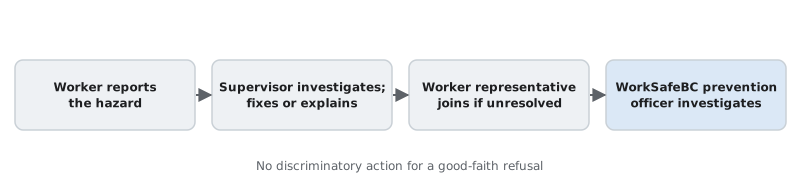
Workers in British Columbia have the right to refuse work they have reasonable cause to believe would create an undue hazard to the health and safety of any person. The regulation sets out a process, often taught as a series of steps: the worker reports the hazard to the supervisor or employer, who investigates and fixes it or explains why it is not undue. If the worker is still not satisfied, the investigation continues with a worker representative or another worker the refusing worker chooses, and if the matter is still unresolved, a WorkSafeBC prevention officer can be called in. A worker must not be subject to discriminatory action for exercising the right in good faith.
Electrical work produces some of the clearest refusal situations: a request to work on equipment that has not been locked out, a panel that appears damaged, or a task requiring protective equipment that is not available. An FSR who hears an apprentice raise such a concern should treat it as an opportunity to fix a problem, not as an obstacle to the schedule.
Electrical safety and lockout
The Occupational Health and Safety Regulation contains a part devoted to electrical safety, Part 19, and a part on de-energization and lockout, Part 10. In general terms, they require that work on electrical equipment be done with the equipment de-energized and locked out where practicable, under a written lockout procedure, with each worker applying a personal lock. Where work on or near energized equipment cannot be avoided, the regulation requires additional safeguards: qualified workers, safe work procedures, appropriate protective equipment, and limits on how close unqualified people may approach exposed energized parts. WorkSafeBC guidance refers to the CSA Z462 workplace electrical safety standard for practices such as arc flash risk assessment.
For a contractor, the practical requirements become a short list that every crew member should know: confirm the equipment is de-energized and locked out before work; verify absence of voltage with a tested meter; never rely on someone else's lock; never work energized unless the task has been assessed, planned and approved under the company's energized work procedure; and wear the protective equipment the assessment specifies. Linda's rule at Sumas Ridge is that energized work needs her written approval for each task, and that the approval states why de-energizing is not practicable.
Worked problem
Energized testing at Clearbrook
Owen Patel asks the Sumas Ridge crew to test the new evaporator heater circuits at Clearbrook Cold Storage while the warehouse stays in operation. Mateo suggests leaving the panel energized while terminating the last circuit to save time. What should Harjit do?
Show solution
- Terminating conductors is work that can be done de-energized: the branch circuit breaker can be opened and locked out under the lockout procedure.
- Absence of voltage is verified at the work location with a meter tested before and after use.
- Testing the circuits after termination may require the circuit to be energized; that step is planned with the appropriate safeguards and protective equipment.
- Working on the panel energized to save time is not justified, and Mateo's suggestion is a supervision moment rather than a decision for him to make.
Answer: Lock out the branch circuit for termination, verify absence of voltage, then energize only for planned testing with the right safeguards.
Incident reporting and investigation
When a workplace incident happens, the Workers Compensation Act requires the employer to report certain serious incidents to WorkSafeBC immediately, such as those causing serious injury or death, major structural failure, or a major release of a hazardous substance. Employers must also investigate incidents. The Act sets out a preliminary investigation, generally to be completed within 48 hours, and a full investigation, generally within 30 days, with reports kept and provided as required. Injuries also need to be reported for compensation purposes within the time limits WorkSafeBC sets.
Electrical incidents may also need to be reported to Technical Safety BC under the Safety Standards Act, as lesson 7 mentioned. An arc flash during maintenance at a client's facility could need a report to WorkSafeBC by the employer of the injured worker, and a report to Technical Safety BC about the equipment involved. Sumas Ridge's incident procedure lists both, with the person responsible for each and the timing to check, and it starts with the most important step: make the scene safe and get help for anyone injured.
| Step after a workplace incident | General requirement (check the Act for details) |
|---|---|
| Immediate | Make safe; first aid; call emergency services if needed |
| Immediate report | Report serious incidents to WorkSafeBC immediately |
| Preliminary investigation | Generally within 48 hours |
| Full investigation | Generally within 30 days |
| Electrical equipment incident | Check reporting requirements to Technical Safety BC |
| Records | Keep investigation reports and corrective actions |
from datetime import datetime, timedelta

# Investigation deadlines after an incident (general timelines; check the Act)
incident = datetime(2026, 9, 14, 10, 30)
preliminary_due = incident + timedelta(hours=48)
full_due = incident + timedelta(days=30)
print("Incident:", incident.isoformat(sep=" ", timespec="minutes"))
print("Preliminary investigation due:", preliminary_due.isoformat(sep=" ", timespec="minutes"))
print("Full investigation due:", full_due.date().isoformat())Incident: 2026-09-14 10:30 Preliminary investigation due: 2026-09-16 10:30 Full investigation due: 2026-10-14
Committees, programs and training
Larger employers need formal health and safety structures. In British Columbia, an employer with a sufficient number of workers must establish a joint health and safety committee, and smaller employers above a lower threshold must have a worker health and safety representative; the thresholds are set in the Act, commonly 20 or more workers for a committee and 10 to 19 for a representative. Employers must also have a health and safety program suited to the size and hazards of the workplace, and must give young and new workers an orientation before they start work, covering hazards, procedures, rights and responsibilities.
Sumas Ridge has eleven workers, so it has a worker health and safety representative rather than a joint committee. Its program includes written safe work procedures for lockout, energized work, working at heights, confined spaces and trenching, a training record for each worker, and a monthly safety meeting. When Mateo started as a first-year apprentice, his orientation was documented before he went to a site.
WorkSafeBC registration and clearance letters
Employers in British Columbia must register with WorkSafeBC and pay premiums based on their payroll and industry classification. The coverage provides compensation to injured workers and protects employers from being sued by their own workers for workplace injuries. General contractors and owners commonly ask subcontractors for a clearance letter, which shows whether the subcontractor's account is in good standing, because a party that hires a contractor with unpaid premiums can become liable for those premiums. Grace requests clearance letters for Sumas Ridge's own subcontractors, such as the excavation company it hires for trenching, and provides its own clearance letter to general contractors at the start of each job and periodically during long jobs.
First aid and emergency planning
The regulation also requires employers to provide first aid equipment, supplies and trained attendants suited to the number of workers, the hazards and the distance to medical help, based on a written first aid assessment. Electrical contractors working on construction sites often rely partly on the prime contractor's first aid arrangements, but they must confirm that those arrangements cover their workers, and they need their own arrangements for small jobs where they are the only employer. Crews working on energized equipment or in remote locations need particular attention, because an electrical injury can require rapid response.
Sumas Ridge reviews its first aid assessment each year and before any unusual job. For the dairy co-op substation, which is twenty minutes from the nearest hospital, the plan includes a trained attendant on site, a written emergency response plan with the access route marked for ambulance crews, and a rescue procedure for workers in the substation yard. The plan is discussed at the pre-job meeting and posted in the site trailer.
Common mistakes
MistakeThinking that working under a prime contractor removes the subcontractor's own duties.
InsteadEach employer keeps its own duties; the prime contractor coordinates.
MistakeWorking energized because de-energizing is inconvenient.
InsteadLock out where practicable; energized work needs assessment, procedure, qualified workers and protection.
MistakeTreating a worker's safety refusal as insubordination.
InsteadWorkers have the right to refuse undue hazards; discriminatory action is prohibited.
MistakeReporting an electrical incident to only one regulator.
InsteadCheck both WorkSafeBC and Technical Safety BC reporting requirements.
MistakeHiring a subcontractor without checking its WorkSafeBC account.
InsteadRequest a clearance letter to avoid liability for unpaid premiums.
Summary and key terms
- WorkSafeBC administers the Workers Compensation Act and the Occupational Health and Safety Regulation.
- Employers, supervisors and workers each have general duties; a prime contractor coordinates multiple-employer sites.
- Workers may refuse undue hazards under a set process, without discriminatory action.
- Parts 10 and 19 of the regulation cover lockout and electrical safety; WorkSafeBC guidance refers to CSA Z462.
- Serious incidents are reported immediately; preliminary investigations generally within 48 hours and full ones within 30 days.
- WorkSafeBC
- The organization that administers workplace health and safety and workers' compensation in British Columbia.
- Prime contractor
- The party that coordinates health and safety at a multiple-employer workplace.
- Lockout
- Securing energy-isolating devices with personal locks so equipment cannot be energized.
- Right to refuse
- A worker's right to refuse work that would create an undue hazard.
- Clearance letter
- A WorkSafeBC letter showing whether an employer's account is in good standing.
Practice problems
Work each problem on paper first, then reveal the answer to check.
Which organization administers occupational health and safety in British Columbia?
Show answer
WorkSafeBC.
Who coordinates health and safety at a multiple-employer workplace?
Show answer
The prime contractor (the owner if no one is designated).
Which parts of the OHS Regulation deal with lockout and electrical safety?
Show answer
Part 10 (de-energization and lockout) and Part 19 (electrical safety).
Within what time is a preliminary incident investigation generally due?
Show answer
Within 48 hours.
Why does a general contractor ask for a WorkSafeBC clearance letter?
Show answer
To confirm the subcontractor's account is in good standing and avoid liability for unpaid premiums.
Lesson quiz · 5 questions
Score 60% or more to complete this lesson.
Create a free account to save your progress, take quizzes and earn a certificate.