
MELC-202 · Lesson 8 of 12 · 23 min
Contractor licensing, insurance and bonding
▶ Video coming soon A video version of this lesson is on the way.
The FSR certificate qualifies a person. The electrical contractor licence authorizes a business. In British Columbia, a business that offers or performs regulated electrical work for others must hold a licence from Technical Safety BC, and that licence depends on a designated FSR with an active certificate. This lesson covers who needs a licence, what the application involves, the surety bond the regulator requires, annual renewal and what happens when a licence lapses, and the separate world of insurance and contract bonds that every contractor deals with. The licensing rules are tested in the regulatory share of the FSR exam. The insurance and bonding material is the practical knowledge a designated FSR needs to keep a business running.
The details here come from Technical Safety BC's licence pages as published when the course was written. The regulator publishes fees and bond requirements separately and can change them. Confirm current requirements before applying or renewing.
Who needs a licence
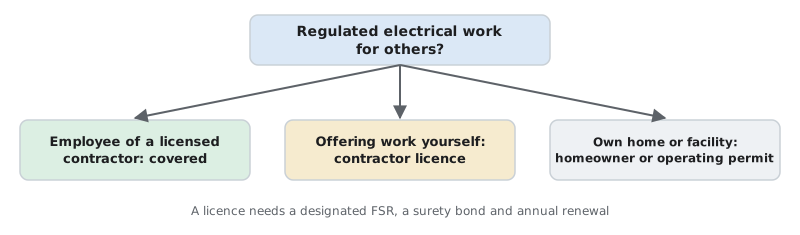
Technical Safety BC's rule is that to do regulated electrical work in British Columbia, a person must be licensed by the regulator, be employed by a licensed electrical contractor, or be authorized to do the work themselves, for example under a homeowner permit or an operating permit. A business that offers electrical work to the public, or performs it for others, needs a licence. An electrician who works for wages for a licensed contractor does not need their own licence, because they work under the employer's licence and its designated FSR. An electrician who starts doing side jobs for neighbours does need one, however small the jobs are.
The regulator actively pursues unlicensed contracting, because unlicensed work is more likely to be done without permits and without anyone accountable for its safety. Advertising electrical services without a licence can itself be a problem, since soliciting regulated work is part of what the licence authorizes. When a homeowner calls Sumas Ridge to fix wiring done by an unlicensed person, Harjit will treat that wiring with great care, and the job will need its own permit.
The licence application
A licence application goes to Technical Safety BC through its online services. The main elements are the business identity, the designated FSR, the surety bond and the fee. A business operating under a name other than the owner's legal name must register that name with the BC Business Registry and provide its nine-digit Business Number. A sole proprietor operating under their own legal name does not need to register a business name. A corporation will already have its registration from incorporation. The designated FSR is identified by their full certificate number and last name, and their certificate must be active.
The regulator gives applicants a period, one year at the time of writing, to complete an application. Incomplete applications are closed, and fees and progress are forfeited. That is the same rule that applies to certificate applications, and it catches the same people: those who start an application, wait for one document and forget about it.
| Application element | What is needed |
|---|---|
| Business identity | Legal name; registered business name and 9-digit Business Number if operating under a business name |
| Designated FSR | Full certificate number and last name of an FSR with an active certificate |
| Surety bond | A bond meeting Technical Safety BC's requirements |
| Fee | From the current fee schedule |
| Contact details | Kept current with the regulator after licensing |
The licensing surety bond
Technical Safety BC requires a licensed contractor to hold a surety bond. A surety bond is a three-party arrangement: the contractor is the principal, a surety company guarantees the contractor's obligations, and the obligee is the party protected by the bond. A licensing bond of this kind protects against the contractor failing to meet its obligations under the regulatory regime; the regulator's surety bond pages explain how the bond works, what it covers and how claims are made. The required amount and form are set by the regulator, so check its current requirements rather than relying on a figure from another province or an older document.
Two practical points matter for designated FSRs. First, the bond must stay valid. Before renewing the licence, the regulator asks contractors to confirm with their insurer or surety that the bond remains in force. Second, the bond is tied to the business name. If the business changes its name, the contractor needs a bond rider from the surety reflecting the new name. Grace keeps the bond certificate in the licence file with a note of its renewal date, because a bond that lapses quietly can stop a licence renewal.
Renewal and lapse
Electrical contractor licences are renewed annually. Technical Safety BC allows renewal to start up to six months before expiry. Before renewing, the contractor should confirm that the surety bond is valid and that the designated FSR's certificate is active. The renewal fee is non-refundable.
An expired licence is treated as suspended. The contractor cannot solicit or perform regulated work until it is renewed, permits tied to the licence are put on hold, and late fees apply. For a busy contractor, that is a serious disruption: crews stop, inspections stop, and clients wait. It is also easy to avoid. Grace sets two reminders, one at six months before expiry when renewal opens and one at sixty days, and she checks the bond and Linda's certificate dates at the first reminder.
Worked problem
Planning a licence renewal
The Sumas Ridge licence expires on October 31. Linda's FSR certificate is active until her birthday, May 12 of the following year. The surety bond renews on September 30. When can Grace start the renewal, and what should she check?
Show solution
- Renewal can start up to six months before expiry: from about April 30.
- Check the designated FSR's certificate: active until May 12 of the following year, so it will be active at renewal.
- Check the surety bond: it renews September 30, before the licence expiry, so Grace confirms with the surety that it will be renewed, and gets confirmation in writing.
- Submit the renewal well before October 31 to avoid a lapse that would suspend the licence and put permits on hold.
Answer: Start from about April 30, confirm the FSR and bond dates, and renew well before October 31.
from datetime import date

# Licence renewal check: is everything valid on the renewal date?
licence_expiry = date(2026, 10, 31)
renewal_opens = date(licence_expiry.year, licence_expiry.month - 6, licence_expiry.day - 1)  # about six months before
fsr_expiry = date(2027, 5, 12)
bond_renewal = date(2026, 9, 30)
planned_submission = date(2026, 8, 15)

print("Renewal opens about:", renewal_opens)
print("FSR active at submission:", fsr_expiry > planned_submission)
print("Bond renewal before licence expiry:", bond_renewal < licence_expiry)
print("Days of margin before expiry:", (licence_expiry - planned_submission).days)Renewal opens about: 2026-04-30 FSR active at submission: True Bond renewal before licence expiry: True Days of margin before expiry: 77
Keeping the licence information current
A licence is only as good as the information behind it. Technical Safety BC requires licensed contractors to keep their information current, including contact details and changes of designated FSR. The designated FSR change is the most important, and it has its own rule: only one FSR at a time, with no gaps or overlaps between the outgoing and incoming dates, or the licence may be suspended. Lesson 7 walked through Linda's handover to Harjit. A change of business name, address or ownership also needs to be reported, and a name change needs the bond rider described above.
Contractors sometimes appear unlicensed on the regulator's public lookup because their information is out of date, for example when a designated FSR's certificate lapses without the contractor noticing. The regulator has published guidance on this exact problem. Clients and general contractors increasingly check licence status before awarding work, so an out-of-date record can cost jobs as well as create regulatory trouble.
Insurance
Technical Safety BC's licence pages focus on the surety bond and do not set general liability insurance requirements for the licence. Insurance is nonetheless essential, and most clients will not award work without it. The core policy for an electrical contractor is commercial general liability insurance, which covers claims by third parties for bodily injury and property damage arising from the contractor's operations and completed work. Contractors also carry commercial automobile insurance for their vehicles, property or equipment coverage for tools and stock, and often professional or errors and omissions coverage if they do design work. Larger clients and general contractors set minimum limits in their contracts and require certificates of insurance naming them as additional insureds.
Workers' compensation coverage is not optional in the same way. In British Columbia, employers must register with WorkSafeBC and pay premiums, and general contractors usually ask subcontractors for a clearance letter showing their account is in good standing. Lesson 10 covers WorkSafeBC in more detail. For a designated FSR, the point is that a contractor without valid coverage exposes itself and its clients to serious risk, and that checking coverage is part of keeping the business able to work.
| Coverage | What it protects | Who usually requires it |
|---|---|---|
| Commercial general liability | Third-party injury and property damage claims | Clients and general contractors, by contract |
| Commercial automobile | Vehicle accidents | Law and contracts |
| Property and equipment | Tools, stock, equipment | The contractor's own decision; lenders |
| Professional or errors and omissions | Claims from design or advice | Clients when design is included |
| WorkSafeBC coverage | Workers injured on the job | Law; clearance letters requested by general contractors |
| Licensing surety bond | Obligations under the regulatory regime | Technical Safety BC |
Contract bonds
The licensing surety bond is different from the bonds that appear in construction contracts. On larger projects, especially public ones, owners often require the contractor to provide a performance bond, which protects the owner if the contractor fails to complete the work, and a labour and material payment bond, which protects subcontractors and suppliers if the contractor fails to pay them. Bid bonds may be required with a tender to guarantee that the bidder will enter into the contract if awarded. These bonds are issued by sureties that assess the contractor's finances, experience and capacity, so a small contractor that wants to bid bonded work needs to build a relationship with a surety and keep clean financial records.
Sumas Ridge has never bid bonded public work, but the dairy co-op substation contract requires a performance bond. Grace works with the company's broker to arrange it, and the surety asks for two years of financial statements and a work-in-progress schedule. Harjit realizes that being designated FSR will involve conversations he had never imagined: the surety wants to know who will be responsible for the technical side of the work, and the answer is now partly him.
Worked problem
Licensing bond or contract bond?
Classify each requirement: (1) Technical Safety BC requires Sumas Ridge to hold a bond as a condition of its licence; (2) the dairy co-op requires a bond guaranteeing completion of the substation work; (3) a public tender requires a bond with the bid; (4) the co-op also requires a bond protecting subcontractors and suppliers.
Show solution
- 1 is the licensing surety bond required by the regulator.
- 2 is a performance bond, a contract bond protecting the owner.
- 3 is a bid bond, guaranteeing the bidder will sign the contract if awarded.
- 4 is a labour and material payment bond, protecting those who supply the job.
Answer: Licensing bond, performance bond, bid bond and labour and material payment bond.
Starting your own contracting business
Some FSR candidates are not planning to become an employer's designated FSR at all. They want to start their own contracting business. Marcus Okafor, in the core courses, had that ambition in Alberta; in British Columbia, the path runs through the licence. The order matters. The person needs an active FSR certificate first, because the licence application requires a designated FSR. Then the business needs its legal form and, if applicable, a registered business name and Business Number. Then the surety bond, then the licence application, and only then the first advertisement or quote. Insurance and WorkSafeBC registration come before the first job, and a contractor who will hire employees needs payroll, source deductions and employment standards in order as well.
A new contractor should also expect the regulator's risk-based inspection approach to apply. A business with no compliance history may see more physical inspections at first, which is a reason to make the first dozen declarations impeccable. Harjit's study group includes one electrician who plans exactly this path, and Linda's advice to him is blunt: get the paperwork right before the work, because the paperwork is what the regulator sees first.
Common mistakes
MistakeDoing side jobs for neighbours without a contractor licence.
InsteadDoing regulated work for others requires a licence or another authorization.
MistakeLetting the licensing surety bond lapse.
InsteadConfirm the bond is valid before renewal; a lapse can block renewal.
MistakeChanging the business name without a bond rider.
InsteadA name change needs a bond rider from the surety.
MistakeAssuming an expired licence can still be used for a few weeks.
InsteadAn expired licence is treated as suspended: no soliciting or performing regulated work, and permits go on hold.
MistakeConfusing the licensing bond with performance or payment bonds.
InsteadThe licensing bond is a regulator requirement; contract bonds come from owners and tenders.
Summary and key terms
- A business that offers or performs regulated electrical work for others needs a Technical Safety BC licence.
- The licence requires a designated FSR, business registration where applicable, a surety bond and a fee.
- Licences renew annually; renewal can start six months before expiry.
- An expired licence is treated as suspended, with permits on hold and late fees.
- Insurance, WorkSafeBC coverage and contract bonds are separate from the licensing bond but essential to the business.
- Electrical contractor licence
- Technical Safety BC's authorization for a business to offer and perform regulated electrical work.
- Surety bond
- A guarantee by a surety company of the contractor's obligations.
- Bond rider
- An amendment to a bond, for example to reflect a new business name.
- Performance bond
- A contract bond protecting the owner if the contractor fails to complete the work.
- Clearance letter
- A WorkSafeBC document showing an employer's account is in good standing.
Practice problems
Work each problem on paper first, then reveal the answer to check.
Does an electrician who works for wages for a licensed contractor need their own licence?
Show answer
No. They work under the employer's licence and designated FSR.
How early can a licence renewal start?
Show answer
Up to six months before expiry.
What is the status of an expired licence?
Show answer
It is treated as suspended.
What must a contractor obtain from its surety when it changes its business name?
Show answer
A bond rider.
Which bond protects subcontractors and suppliers on a project?
Show answer
A labour and material payment bond.
Lesson quiz · 5 questions
Score 60% or more to complete this lesson.
Create a free account to save your progress, take quizzes and earn a certificate.