
MELC-106 · Lesson 9 of 12 · 20 min
Supervising apprentices and journeypersons
▶ Video coming soon A video version of this lesson is on the way.
A certificate holder rarely does all the work on a permit personally. On most jobs, the installation is done by a crew: journeypersons, apprentices at different levels, and sometimes helpers or workers from other trades doing related tasks. The permit holder is responsible for all of it. That responsibility is enforced through three sets of rules: the apprenticeship and trade certification legislation, which decides who may do electrical work and under what supervision; health and safety law, which requires competent supervision and safe work; and the electrical regulator's rules, which hold the permit holder or designated master electrician responsible for the work. Master and contractor exams test supervision because poor supervision is a common thread in both unsafe installations and workplace injuries.
This lesson covers compulsory trades and certification, apprentice supervision and ratios, the meaning of direct supervision, working alone, the duties of the certificate holder toward the crew, and the records that show supervision happened. It uses Parkland Valley's crew as the example, especially Tyler Chen, the third-year apprentice, and a new first-year apprentice the company has just hired.
Compulsory trades and who may do electrical work
In most provinces, construction electrician is a compulsory or designated trade. That means a person may only do the work of the trade if they are a certified journeyperson, a registered apprentice working under the required supervision, or otherwise authorized by the legislation. Alberta governs trades under the Skilled Trades and Apprenticeship Education Act, which replaced the earlier apprenticeship legislation in 2022. Ontario governs them through Skilled Trades Ontario and the Building Opportunities in the Skilled Trades Act. British Columbia reintroduced compulsory certification for electrical trades through SkilledTradesBC. The names change, but the principle is the same: electrical work is reserved for people who are certified or properly supervised apprentices.
The Red Seal endorsement allows a journeyperson certified in one province to work in others without rewriting the exam, because it is earned through the interprovincial exam. A Red Seal does not make a person a master electrician or a permit holder. It certifies trade competence. On the exam, a common distractor is the idea that a journeyperson's certificate allows them to contract for work on their own. In most provinces it does not: that requires the master or contractor credential covered in lesson 1.
Apprentices and supervision ratios
Apprentices learn on the job under the supervision of certified journeypersons. Apprenticeship legislation sets the supervision requirements, usually as a ratio of apprentices to journeypersons on a job or in a company, and sometimes with stricter rules for first-year apprentices. Ratios differ between provinces and between trades, and some provinces have changed them in recent years to allow more apprentices per journeyperson. The current ratio for your trade and province is a common exam question, and it is a number you must check in the current regulation or the apprenticeship authority's trade profile rather than recall from an old textbook.
Ratios are minimums, not targets. A ratio may allow two apprentices per journeyperson, but if one of those apprentices is in the first month of their first year and the work is in an energized motor control centre, competent supervision may require the journeyperson to work alongside that apprentice the whole time. Health and safety law requires supervision appropriate to the worker's experience and the hazards of the task, regardless of what the apprenticeship ratio allows.
| Worker | Typical status | What supervision usually means |
|---|---|---|
| Certified journeyperson | May perform the work of the trade | Works under the employer's procedures and the certificate holder's direction |
| Senior apprentice | Registered apprentice, later period | Supervised by a journeyperson on the job, with growing independence on routine tasks |
| First-year apprentice | Registered apprentice, first period | Close supervision, often working alongside a journeyperson |
| Unregistered helper | Not in the trade | May not do electrical work in a compulsory trade; limited to non-trade tasks |
| Other trades | Certified in their own trade | May do only the electrical tasks their trade or the law permits |
What direct supervision means
Apprenticeship rules commonly require apprentices to work under the direct supervision of a journeyperson. Direct supervision does not always mean the journeyperson is standing beside the apprentice, but it does mean the journeyperson is on the same job, is responsible for the apprentice's work, assigns tasks suited to the apprentice's level, is available to guide them, and checks the work. Some provinces define the term in regulation. Others leave it to policy. In every case, the journeyperson must be able to answer for what the apprentice did.
Priya applies the definition practically. Tyler, in his third year, can rough in a basement suite at Aspen Ridge while she works on the panel upstairs, because he knows the task, she is in the same house, and she checks his work before cover-up. The new first-year apprentice cannot do that yet. On his first week, he works beside Marcus, pulling wire and installing boxes under instruction. Neither apprentice works alone in a different building, and neither works on energized equipment.
Working alone
Health and safety legislation has rules for working alone, meaning working where help is not readily available in an emergency or if the worker is injured. Alberta's OHS Code and Ontario's legislation require employers to assess the hazards of working alone and to have a system for checking on the worker, such as regular contact by phone or radio at set intervals. For electrical work, the bar is especially high. Energized work and work near energized parts should never be done alone, because a person who is shocked or burned may be unable to call for help. Apprentice supervision rules usually make working alone impossible for apprentices anyway.
Marcus raises a common situation: a journeyperson sent alone to a farm service call in a remote location. Is that allowed? Generally yes, if the hazard assessment covers working alone, the worker has a reliable way to call for help, someone checks in at agreed intervals, and the task does not involve energized work that requires a second person. Parkland Valley's procedure requires a check-in call every hour and a call at the end of the job, and prohibits energized work on solo calls.
The certificate holder's duties to the crew
The certificate holder or designated master electrician is responsible for planning and supervising the electrical work done under their permits or licence. Ontario's guideline for designated master electricians describes this as personal planning and direct supervision of the work, ensuring compliance with the Code, health and safety law and consumer protection law, and lists examples such as training workers, making sure protective equipment is used, overseeing lockout procedures and correcting defects promptly. Alberta's framework places similar responsibility on the certificate holder named on the permit.
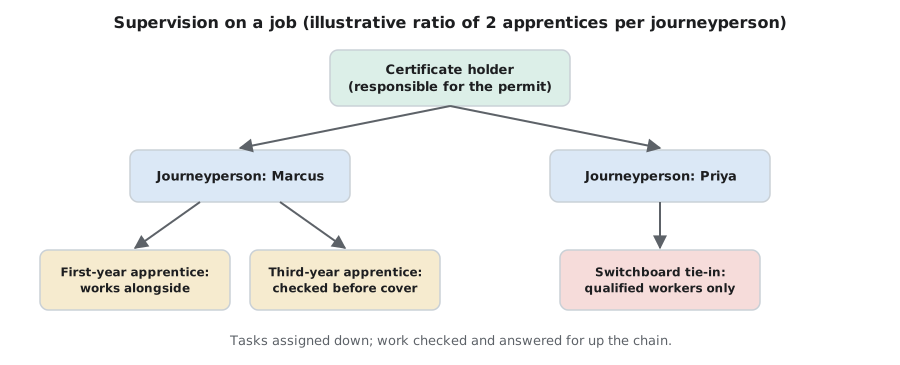
That responsibility cannot be delegated away. Priya can assign tasks to journeypersons and apprentices, but if the work under her permit is wrong, she answers for it. In practice, this means four habits. Plan each job, including which workers are qualified for which tasks. Brief the crew before work starts. Inspect the work as it progresses, especially before cover-up. Keep records of who did what. A certificate holder who never visits the site and signs whatever the crew installs is exposed both to regulatory action and, if someone is hurt, to health and safety charges.
Training and mentoring
Supervision is also teaching. Apprentices complete technical training periods at a college or training provider and must log their on-the-job hours and, in many provinces, the competencies they have demonstrated. The employer and journeyperson usually sign off on those hours and competencies. Signing for hours that were not worked, or competencies that were not demonstrated, is a serious matter: it can affect the apprentice's certification and the employer's standing with the apprenticeship authority.
Good contractors build mentoring into their business. Gord pairs each apprentice with a journeyperson for at least a few months at a time, rotates them through residential, commercial and agricultural work so they see the full range of the trade, and holds a short review with each apprentice every few months. He also pays attention to the journeypersons who supervise. A journeyperson who is excellent at the work but impatient with apprentices may need training too. On the exam, questions about mentoring usually test the employer's duty to provide training appropriate to the worker's level and the records that support it.
Worked problem
Planning the crew for the Riverbend EV retrofit
The Riverbend Condos retrofit involves installing 24 EV chargers in the parkade, a new feeder from the main switchboard and a load management system. Parkland Valley has two journeypersons (Marcus and Priya), one third-year apprentice (Tyler) and one first-year apprentice available. Assume the province allows a ratio of up to two apprentices per journeyperson on the job (illustrative: check your province).
Show solution
- Ratio check: two journeypersons can supervise up to four apprentices; two apprentices is within the limit.
- Task planning: Priya, the certificate holder, handles the switchboard tie-in, which requires a shutdown and lockout; Marcus is the second qualified person.
- Tyler installs charger rough-ins on parkade level 1 under Marcus's direction, with work checked before cover.
- The first-year apprentice works alongside Marcus, pulling conductors and mounting chargers under instruction.
- Records: daily crew sheet, task assignments, sign-off on apprentice hours, and the lockout record for the tie-in.
Answer: A crew plan that meets the ratio, matches tasks to qualification, keeps the first-year apprentice under close supervision and is documented.
# Ratio check for each job on a given day (illustrative ratio)
max_apprentices_per_journeyperson = 2
jobs = {
    "Riverbend EV retrofit": {"journeypersons": 2, "apprentices": 2},
    "Aspen Ridge suite": {"journeypersons": 1, "apprentices": 1},
    "Hartley Farms dryer": {"journeypersons": 1, "apprentices": 3},
}
for job, crew in jobs.items():
    allowed = crew["journeypersons"] * max_apprentices_per_journeyperson
    status = "OK" if crew["apprentices"] <= allowed else "over the ratio: reassign"
print(f"{job:<24} {crew['apprentices']} apprentices / {crew['journeypersons']} jp -> {status}")Riverbend EV retrofit 2 apprentices / 2 jp -> OK Aspen Ridge suite 1 apprentices / 1 jp -> OK Hartley Farms dryer 3 apprentices / 1 jp -> over the ratio: reassign
Set the ratio in the first line to the value in your province's current trade regulation. The script flags Hartley Farms, where three apprentices are assigned to one journeyperson, because that exceeds the illustrative ratio.
Supervising journeypersons and other trades
Supervision is not only about apprentices. Journeypersons work under the certificate holder's direction too, and they vary in experience. A journeyperson who has spent ten years in residential work may be fully competent to wire a house but new to motor control or hazardous locations. The certificate holder must match tasks to each journeyperson's experience, provide training where there are gaps, and check the work, just as with apprentices but with more independence. Z462's idea that qualification is task-specific applies here: a qualified worker for one task may be unqualified for another.
Other trades sometimes do work that touches electrical systems: mechanical contractors connecting equipment, low voltage installers, solar installers, or general labourers digging trenches for conduit. The certificate holder must know which of those tasks the law allows non-electrical workers to do, make sure electrical work under the permit is done by the right people, and coordinate with the other trades so that no one is exposed to energized parts. On the exam, a common question asks whether a helper or another trade may terminate conductors in a panel. In a compulsory trade, the answer is usually no.
Supervision records close the loop. A daily crew sheet showing who worked on which task, under whose supervision, with which apprentice hours signed, protects the company in an apprenticeship audit, a health and safety investigation or a dispute about who installed a defective connection.
Common mistakes
MistakeTreating the apprenticeship ratio as the only supervision requirement.
InsteadHealth and safety law also requires supervision suited to the worker's experience and the task.
MistakeAssuming a Red Seal journeyperson can contract and pull permits.
InsteadRed Seal certifies trade competence, not master or contractor status.
MistakeSending an apprentice alone to a separate job site.
InsteadApprentices need direct supervision by a journeyperson on the job.
MistakeAllowing energized work on a solo call.
InsteadEnergized work needs a second qualified person and an emergency plan.
MistakeSigning apprentice hours or competencies that were not earned.
InsteadSign only for hours worked and competencies demonstrated.
Summary and key terms
- Construction electrician is a compulsory trade in most provinces: work is reserved for journeypersons and supervised apprentices.
- Apprentice ratios are set by provincial regulation and are minimums, not targets.
- Direct supervision means a responsible journeyperson on the same job who assigns, guides and checks work.
- Working alone needs a hazard assessment and check-in system, and excludes energized work.
- The certificate holder plans and supervises the work and cannot delegate away responsibility.
- Compulsory trade
- A trade whose work may only be done by certified journeypersons or registered apprentices under supervision.
- Red Seal
- An interprovincial endorsement on a trade certificate, earned through the interprovincial exam.
- Direct supervision
- Supervision by a journeyperson on the same job who assigns, guides and checks an apprentice's work.
- Apprentice ratio
- The maximum number of apprentices per journeyperson set by regulation.
- Working alone
- Working where help is not readily available if the worker is injured or ill.
Practice problems
Work each problem on paper first, then reveal the answer to check.
Does a Red Seal endorsement allow a journeyperson to take out permits for work for others?
Show answer
No; it certifies trade competence, not master or contractor status.
What does direct supervision usually require?
Show answer
A journeyperson on the same job who is responsible for, guides and checks the apprentice's work.
Why are ratios described as minimums?
Show answer
Health and safety law may require closer supervision than the ratio allows, depending on experience and hazards.
What must an employer have before a worker works alone?
Show answer
A hazard assessment and a reliable check-in or communication system.
Who answers for the electrical work done under a permit?
Show answer
The certificate holder or designated master electrician named for it.
Lesson quiz · 5 questions
Score 60% or more to complete this lesson.
Create a free account to save your progress, take quizzes and earn a certificate.