
MELC-106 · Lesson 6 of 12 · 21 min
Running a compliant electrical business
▶ Video coming soon A video version of this lesson is on the way.
The previous lessons dealt with individual jobs: permits, contracts, payment, liens, insurance and bonds. This lesson steps back to look at the business that does those jobs. An electrical contracting business has legal obligations that exist whether or not it has a job on the go this month: registration, licensing or certification, tax accounts, employment standards, workers' compensation, privacy, consumer protection, advertising, record keeping and financial management. A certificate holder or designated master electrician does not have to be an accountant or a lawyer, but master and contractor exams expect them to know what the obligations are and who is responsible for each one.
Gord's succession plan makes this lesson personal for Priya. When Gord retires, Parkland Valley will need a new certificate holder to keep taking out permits, and Priya may also buy part of the business. Marcus has his own plan: to start a small contracting company in a few years. The two of them work through the same checklist from different directions. Priya asks what she will be responsible for in an existing company. Marcus asks what he must set up from nothing.
Business structure
A business can operate as a sole proprietorship, a partnership or a corporation. A sole proprietor is the business: profits are personal income, and the owner is personally liable for business debts. A partnership is similar, with two or more owners sharing profits and liabilities. A corporation is a separate legal person: it owns assets, signs contracts and owes debts in its own name, and shareholders are generally not personally liable for its debts beyond what they invested. Corporations file their own tax returns, and their directors have legal duties.
Incorporation is common for contractors because it limits some personal risk, but it does not remove all of it. As lesson 5 explained, directors can be personally liable under some statutes, such as occupational health and safety laws, which can impose duties on directors to take reasonable care that the corporation complies, and the trust provisions of lien laws. Lenders and sureties usually require owners to give personal guarantees. Businesses also register their names provincially, and corporations file annual returns. Marcus will need a lawyer and an accountant to choose the right structure, but he needs to understand the trade-offs before he meets them.
| Structure | Liability for business debts | Taxed as | Typical use |
|---|---|---|---|
| Sole proprietorship | Owner personally liable | Owner's personal income | Small one-person contractors starting out |
| Partnership | Partners personally liable (with some limited forms) | Partners' personal income | Two or more trades people sharing a business |
| Corporation | Generally limited to the corporation, subject to guarantees and statutory duties | Corporate income, with dividends or salary to owners | Most established contracting firms |
Licensing and certification of the business
Lesson 1 described how provinces split the person and the business. In practice, that split creates obligations for the business as well as for the certificate holder. In Ontario, a Licensed Electrical Contractor must keep at least one Designated Master Electrician at all times, must notify ESA within a short period of changes such as its address, business name or structure, insurance, workers' compensation account or designated master electrician, and must stop operating if it loses its only designated master electrician and cannot replace one within the period the rules allow. In Alberta, there is no separate provincial electrical contractor licence, but a business cannot obtain electrical permits for work for others without a Master Electrician Certificate holder, so losing that person has a similar effect.
For Parkland Valley, this is the central business risk of Gord's retirement. If Gord retires before Priya passes her exam, the company will have no certificate holder and cannot pull permits. That is why the timeline in Priya's study plan matters to everyone in the company. On the exam, questions about what happens when a contractor loses its certificate holder or designated master electrician are common, and the answer always involves notifying the regulator and either replacing the person within the allowed time or stopping regulated work.
Tax and payroll
A contracting business deals with several taxes. It charges and remits sales taxes on its work: in Alberta, the federal goods and services tax; in Ontario, the harmonized sales tax; and in some provinces, a separate provincial sales tax that may apply to materials and certain services. It must register for sales tax once its revenue passes the small supplier threshold, which has been 30,000 dollars of taxable supplies over four consecutive calendar quarters. It withholds income tax, Canada Pension Plan contributions and employment insurance premiums from employees' pay and remits them with its own share. It files income tax returns for the business. Businesses that pay subcontractors in construction must also report those payments to the Canada Revenue Agency under the contract payment reporting rules.
Gord's accountant handles the filings, but Priya needs to understand the cash flow. Sales tax collected from customers is not company money. Payroll deductions withheld from employees are not company money. Both must be remitted on time, and directors can be personally liable for unremitted payroll deductions and sales tax. A business that uses those amounts to cover short-term cash shortages is borrowing from the government on terms it will not like.
Employment standards
Provincial employment standards laws set minimum terms for most employees: minimum wage, hours of work, overtime, vacation and vacation pay, statutory holidays, leaves of absence, notice of termination and record keeping. Construction workers in some provinces have special rules, for example on overtime or vacation pay, and unionized workers are covered by collective agreements, which must provide at least the statutory minimums. Apprentices are employees and are entitled to the same protections, with wage rates for apprentices in some trades set by regulation or agreement.
Employment standards breaches often start with good intentions: paying a worker straight time for a long week because they asked, or letting someone work without recording hours. Both can lead to claims for unpaid wages, and the employer bears the burden of proving hours worked if records are missing. Priya's rule is simple: record actual hours every day, pay what the law requires, and if a worker asks for something unusual, check the employment standards rules before agreeing.
Consumer protection and advertising
Work for homeowners is often covered by consumer protection laws. These laws can require written contracts for certain amounts, give consumers a cooling-off period to cancel some contracts signed at home, restrict deposits, prohibit unfair practices and misrepresentation, and require certain information in contracts. In Ontario, the regulator's guideline for licensed electrical contractors specifically mentions avoiding misrepresenting repairs, substituting parts, charging for services not provided and charging permit fees when no permit was taken out. Alberta has its own consumer protection legislation, including rules for prepaid contracting and door-to-door sales.
Advertising rules also matter. A business advertising electrical services in Ontario must be a licensed electrical contractor and include its licence number in advertising. In other provinces, advertising requirements are set by the regulator or general consumer law. On the exam, if a question describes an unlicensed person advertising electrical services, or a contractor charging a homeowner for a permit that was never obtained, the answer will be that the conduct breaks the rules, often in more than one statute.
Financial health
A business can be profitable on paper and still fail because it runs out of cash. Contractors are especially exposed because they pay wages and suppliers before they are paid, and holdback ties up part of every invoice for months. Gord tracks four numbers every month: cash on hand, accounts receivable by age, accounts payable by due date, and work in progress compared with billing. He also watches the backlog of signed work and the gross margin on finished jobs compared with the estimate. When margins on finished jobs are lower than estimated, he looks for the cause before bidding the next similar job.
Sureties and lenders look at the same numbers when deciding whether to support a contractor. A contractor with strong working capital, which is current assets minus current liabilities, can take on larger bonded jobs. A contractor with weak working capital may find its bonding capacity limited no matter how good its work is. Priya's practical step is to learn to read Parkland Valley's monthly financial statements with the accountant before she becomes a part-owner.
# Cash flow on a job with holdback: when does the money arrive?
monthly_work = [30000, 52000, 61000, 41000]    # value of work each month (illustrative)
costs_paid_same_month = 0.85                    # share of work value spent as cost that month
holdback_rate = 0.10
payment_lag_months = 2                          # invoice paid about two months after the work

cash = 0
paid = [0] * (len(monthly_work) + payment_lag_months)
for m, value in enumerate(monthly_work):
    paid[m + payment_lag_months] += value * (1 - holdback_rate)
for m in range(len(paid)):
    spent = monthly_work[m] * costs_paid_same_month if m < len(monthly_work) else 0
    cash += paid[m] - spent
    print(f"Month {m + 1}: received {paid[m]:>8.0f}  spent {spent:>8.0f}  running cash {cash:>9.0f}")
print("Holdback still owed:", round(sum(monthly_work) * holdback_rate))Month 1: received 0 spent 25500 running cash -25500 Month 2: received 0 spent 44200 running cash -69700 Month 3: received 27000 spent 51850 running cash -94550 Month 4: received 46800 spent 34850 running cash -82600 Month 5: received 54900 spent 0 running cash -27700 Month 6: received 36900 spent 0 running cash 9200 Holdback still owed: 18400
The running cash figure goes negative in the early months even though the job is profitable overall. That gap is what working capital, a line of credit or prompt payment legislation must cover. Edit the payment lag or the cost share to see how quickly cash pressure builds.
A compliance checklist
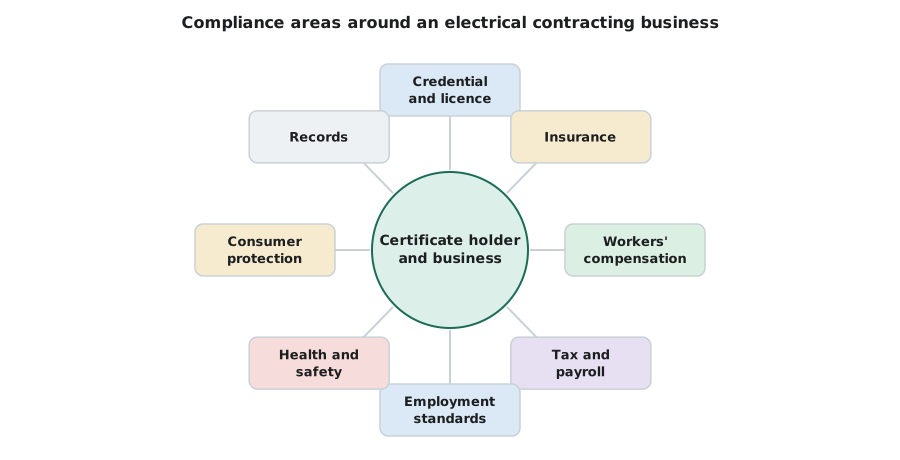
Priya and Marcus finish with a checklist that applies to any electrical contracting business, with provincial details to fill in. Credential and licence: who holds it, when it renews, who is the backup. Business registration and annual filings. Insurance: policies, limits, renewal dates, certificates on file. Workers' compensation: account, premiums, clearance letters, injury reporting. Tax: sales tax registration and filings, payroll remittances, contract payment reporting. Employment standards: hours records, overtime, vacation pay, apprentice wages. Health and safety program: covered in lessons 7 and 8. Consumer contracts and advertising. Records retention: covered in lesson 10.
Worked problem
A change in the business
Parkland Valley is buying a small contractor in Lacombe and moving its office to a new address in Red Deer. The company will also change its legal name to include both businesses. Using the Ontario guideline as an example, what must a licensed electrical contractor in Ontario in the same situation do?
Show solution
- Identify the changes: address, business name and possibly business structure.
- Notify the regulator within the period set in its rules, which ESA's guideline describes as within 5 business days of such changes.
- Update the insurance policies, workers' compensation account and certificates of insurance to the new name and address.
- Check that the designated master electrician arrangement still meets the rules after the acquisition.
- Update advertising, contracts and invoices with the new name and licence number.
Answer: All regulators, insurers and records are updated promptly, and the contractor keeps operating legally through the change.
Privacy and customer information
Contractors collect personal information every day: customer names, addresses, phone numbers, access codes, photos of the inside of homes, and employee records such as social insurance numbers and banking details. Private-sector privacy law applies to that information. Alberta has its own Personal Information Protection Act, and in provinces without similar legislation the federal Personal Information Protection and Electronic Documents Act applies to commercial activity. The basic duties are similar: collect only what is needed, use it for the purpose it was collected for, protect it with reasonable safeguards, and let people see what is held about them.
For a small contractor, that means practical habits: locking the filing cabinet, protecting the office computer and job management software with strong passwords, not leaving customer keys and alarm codes in a truck, and deleting site photos that show personal belongings once the job file no longer needs them. A lost phone with hundreds of customer photos and addresses is a privacy problem as well as a security one.
Common mistakes
MistakeAssuming incorporation removes all personal liability.
InsteadDirectors can be liable under some statutes, and lenders often require personal guarantees.
MistakeUsing collected sales tax or payroll deductions as working cash.
InsteadRemit them on time; directors can be personally liable for unremitted amounts.
MistakeLetting the only certificate holder leave without a plan.
InsteadNotify the regulator and replace the person within the allowed time or stop regulated work.
MistakeFailing to record actual hours worked.
InsteadKeep daily hours records; the employer must prove hours in a wage dispute.
MistakeCharging a homeowner for a permit that was not obtained.
InsteadThis is misrepresentation and can breach both licensing and consumer protection rules.
Summary and key terms
- Business structure affects liability and tax, but incorporation does not remove all personal exposure.
- Businesses must keep their credential holder, licence and regulator notifications current.
- Sales tax and payroll deductions belong to the government and must be remitted on time.
- Employment standards and consumer protection laws apply to most contracting work.
- Cash flow, working capital and margins decide whether a profitable business survives.
- Corporation
- A business that is a separate legal person, owning assets and owing debts in its own name.
- Working capital
- Current assets minus current liabilities; a measure of short-term financial strength.
- Small supplier threshold
- The revenue level below which a business does not have to register for sales tax.
- Employment standards
- Provincial minimum terms of employment such as wages, hours, overtime and vacation.
- Contract payment reporting
- The federal requirement for construction businesses to report payments to subcontractors.
Practice problems
Work each problem on paper first, then reveal the answer to check.
Name two personal liabilities a corporate director in construction can face.
Show answer
Any two of: statutory health and safety duties, lien trust breaches, unremitted payroll deductions, unremitted sales tax, personal guarantees.
What must an Ontario licensed electrical contractor do if it loses its only designated master electrician?
Show answer
Notify ESA and replace the person within the allowed period, or stop operating.
Why is collected sales tax not company money?
Show answer
It is collected on behalf of the government and must be remitted.
What is working capital?
Show answer
Current assets minus current liabilities.
What employment record is most important in a wage dispute?
Show answer
Accurate records of actual hours worked.
Lesson quiz · 5 questions
Score 60% or more to complete this lesson.
Create a free account to save your progress, take quizzes and earn a certificate.