
MELC-106 · Lesson 10 of 12 · 20 min
Records, declarations and inspection reports
▶ Video coming soon A video version of this lesson is on the way.
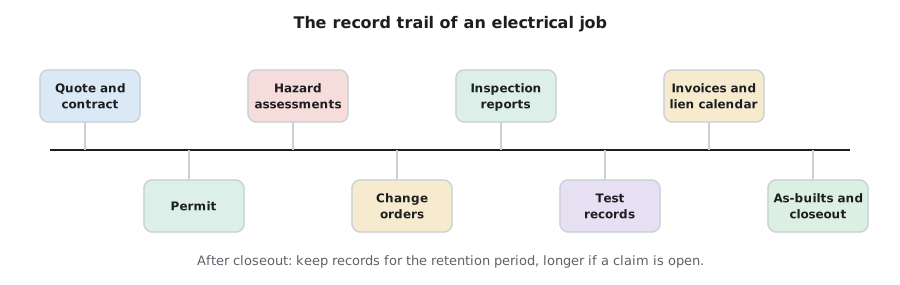
Every topic in this course ends in a record. A permit is a record. An inspection report is a record. A change order, a proper invoice, a lien calendar, a certificate of insurance, a hazard assessment, a training matrix and a crew sheet are all records. Records matter for three reasons. They are required by law: regulators, tax authorities, workers' compensation boards and apprenticeship authorities all require specific records to be kept for specific periods. They are evidence: when something goes wrong, the party with good records can prove what happened. And they are a management tool: a contractor that can find its records can close jobs, collect money and answer questions quickly. Master and contractor exams test records because each of the regulators behind the exam relies on them.
This lesson covers the records a certificate holder deals with directly: permits and declarations, inspection reports and certificates, test and commissioning records, drawings and as-builts, safety records, employment and apprenticeship records, and financial records. It ends with a retention table and a practical filing system. Retention periods and required forms are set by provincial and federal law and differ between jurisdictions. The periods in this lesson are examples or general guidance only.
Permits and declarations
The permit file is the core electrical record for each job. It includes the permit application and the permit itself, any drawings or specifications submitted, correspondence with the inspection authority, inspection requests and results, deficiency notices and corrections, and the final record that closes the permit. Some jurisdictions require the permit holder to make a written declaration that the work complies with the Code, either at completion or at stated stages. Others treat the request for final inspection, or the act of energizing with authorization, as the permit holder's statement that the work is complete and compliant. Either way, the permit holder is putting their credential behind the work.
A declaration should never be made casually. If Priya declares that the Gaetz Avenue work complies, and a later inspection finds that a required GFCI was never installed, the false or careless declaration can be a separate problem from the defect itself. Regulators treat falsified inspection or permit documents seriously; Ontario's guideline for contractors lists falsifying inspection documents as a compliance failure, and most provinces can suspend or cancel credentials for it. Priya's rule is to declare only what she or a journeyperson she supervises has personally checked, and to keep the checklist that shows it.
Inspection reports and certificates
Inspection authorities issue reports after each inspection: a pass, a pass with conditions, or a list of deficiencies. When an installation is accepted, Ontario's ESA issues a certificate of acceptance, which owners, insurers and utilities often require. In Alberta, the permit issuer records the inspection results and closes the permit when the work is accepted. Utilities usually need confirmation that a service has passed inspection before they connect supply. Contractors should keep a copy of every inspection report and acceptance document in the job file, and give copies to the owner as part of the closeout package.
Deficiency reports deserve special care. The report lists what was wrong and when it must be corrected. The contractor's record should show what was done, when, by whom, with photographs where useful, and the result of the re-inspection. Gord files the original report, the correction photos and the re-inspection result together, so that anyone reading the file later sees the full story in one place.
Test and commissioning records
Many installations require testing before they are put into service, and the results should be recorded. Typical records include insulation resistance tests on feeders and motors, continuity of bonding conductors, ground electrode resistance where measured, polarity checks, GFCI and AFCI function tests, phase rotation checks before connecting motors, and torque records for large terminations. Larger projects may require formal commissioning, in which systems such as emergency lighting, fire alarm interfaces, standby generators, transfer switches and load management systems are tested against the design and the results are documented and signed.
At Riverbend Condos, Parkland Valley tested each EV charger circuit after installation, recorded the breaker size, conductor size, insulation resistance and charger function, and tested the load management system by simulating all 24 chargers drawing at once and recording that the total stayed within the managed limit. Those records answered the property manager's questions when a resident complained about slow charging, and they proved the installation matched the design. Test records are also part of due diligence if a fault later causes harm.
| Record | Typical contents | Why it matters |
|---|---|---|
| Permit file | Application, permit, drawings, correspondence, inspections, closure | Proves the work was registered and accepted |
| Inspection report | Date, inspector, result, deficiencies, deadlines | Shows what was found and required |
| Test record | Circuit, test, instrument, values, date, tester | Shows the installation was verified before use |
| As-built drawings | Final routing, panel schedules, changes from design | Helps future maintenance and inspections |
| Change orders | Scope, price, time, approvals | Supports payment and resolves disputes |
| Hazard assessments and permits | Tasks, hazards, controls, sign-offs | Due diligence and incident investigation |
| Training matrix | Workers, tasks qualified for, training dates | Shows workers were qualified |
| Crew and hours records | Daily crew, hours, apprentice supervision | Employment standards, apprenticeship, job costing |
Drawings, as-builts and panel schedules
The drawings an installation was built from rarely match what was built exactly. Routes change around obstacles, circuits are added by change order, and equipment is relocated. As-built drawings record the final installation. Panel schedules, which list each circuit, its breaker and the load it serves, must be completed and accurate; Section 2 of the Code contains requirements for identifying circuits at panelboards, and inspectors check them. Accurate panel schedules are also a safety record: Z462's electrically safe work procedure starts with identifying all sources of supply, and a wrong panel schedule is one of the most common causes of workers being shocked on circuits they believed were off.
Parkland Valley's practice is to mark up a copy of the drawings on site every day, update panel schedules as circuits are terminated, and hand both to the owner at closeout, keeping a copy. On the Hartley Farms job, the as-builts show the actual route of the underground feeder to the bin yard, including its depth under the truck lane, which will matter to anyone who digs there later.
Safety, employment and apprenticeship records
Health and safety law requires records of hazard assessments, safety inspections, training, incident reports and investigations, health and safety committee or representative activities, and, where applicable, equipment inspections such as lift and fall protection checks. Lesson 7 explained that these records are the evidence for due diligence. Lesson 8 added the electrical safety program records: job briefings, energized work permits, lockout records, PPE inspections, training and qualification, and field audits.
Employment standards laws require employers to keep records of each employee's hours, wages, overtime, vacation and statutory holiday pay for set periods. Payroll records are also needed for tax and workers' compensation. Apprenticeship authorities require records of apprentices' hours and, in many provinces, competencies, signed by the employer or journeyperson. Workers' compensation boards require injury reports and payroll declarations for premium calculation. Many of these records overlap, and a good daily crew sheet that records who worked where, for how long and under whose supervision serves several purposes at once.
Financial and contract records
Contracts, quotes, change orders, invoices, payment records, lien calendars, holdback statements and correspondence form the financial record of each job. Tax law requires businesses to keep books and records, generally for six years from the end of the tax year they relate to, and longer in some situations. Contract records should be kept at least as long as claims can be brought, which depends on the province's limitation period and on when a defect could reasonably be discovered. Construction defects can surface years after completion, so many contractors keep job files for much longer than the minimum.
Electronic records are acceptable for most purposes if they are complete, readable and retrievable, and if the business can produce them when asked. Parkland Valley scans paper records into a job folder structure on a shared drive, backed up off site, with the same folder names for every job. Priya likes that a new office manager can find the Hartley Farms lien calendar in under a minute.
A retention table
Priya builds a retention table for Parkland Valley with the accountant and the safety coordinator. Each row lists a record type, the law or reason that requires it, the retention period, and where it is kept. Some periods are set by statute, such as tax records, workers' compensation records, health and safety records for certain hazards and employment records. Others are business decisions based on limitation periods and risk. Where two rules apply, she uses the longer period.
# Retention check: which job files can be archived or destroyed?
from datetime import date

retention_years = {          # business policy (illustrative; check statutes for minimums)
    "tax and financial": 6,
    "employment and payroll": 6,
    "permit and inspection": 10,
    "test and as-built": 15,
}
files = [
    ("Aspen Ridge original wiring", "permit and inspection", date(2013, 5, 2)),
    ("Hartley Farms invoices", "tax and financial", date(2026, 12, 31)),
    ("Gaetz Ave as-builts", "test and as-built", date(2027, 3, 15)),
    ("2018 payroll", "employment and payroll", date(2018, 12, 31)),
]
today = date(2026, 11, 10)
for name, kind, closed in files:
    keep_until = date(closed.year + retention_years[kind], closed.month, closed.day)
    action = "keep" if today < keep_until else "eligible for archiving or destruction"
print(f"{name:<30} {kind:<24} keep until {keep_until} -> {action}")Aspen Ridge original wiring permit and inspection keep until 2023-05-02 -> eligible for archiving or destruction Hartley Farms invoices tax and financial keep until 2032-12-31 -> keep Gaetz Ave as-builts test and as-built keep until 2042-03-15 -> keep 2018 payroll employment and payroll keep until 2024-12-31 -> eligible for archiving or destruction
The retention periods in the script are a company policy, not legal minimums. Check the statutes that apply in your province, and remember that records relevant to an open claim, investigation or audit must be kept regardless of the policy.
Worked problem
Answering an insurer's request
Three years after the Aspen Ridge basement suite was finished, a small fire starts in a wall cavity. The homeowner's insurer asks Parkland Valley for its records of the work.
Show solution
- Retrieve the job file: contract and change orders, permit, inspection reports, test records, as-builts and panel schedule.
- Confirm the permit was closed after final inspection with no outstanding deficiencies.
- Provide the records requested, after notifying Parkland Valley's own liability insurer, as the policy requires.
- Do not alter, add to or discard any record; preserve everything related to the job.
- Let the insurers and investigators determine the cause, with Parkland Valley's records showing what was installed and tested.
Answer: Complete, unaltered records retrieved quickly, with the company's insurer notified, so the cause can be investigated fairly.
The closeout package
At the end of a job, the owner receives a closeout package. For electrical work it typically includes the as-built drawings and panel schedules, the inspection acceptance or permit closure, test and commissioning records, equipment manuals and warranties, the arc flash study and labels where applicable, spare parts lists, and the contractor's warranty letter with its start date. Larger projects may also require operation and maintenance training for the owner's staff, recorded with attendance.
A complete closeout package helps the contractor get its final payment and holdback released, because many contracts make delivery of closeout documents a condition of final payment. It also reduces warranty calls, because the owner knows how to operate the systems. Parkland Valley's checklist for the Gaetz Avenue clinic has twenty-two items; each is ticked off and the package is delivered in both paper and electronic form, with a copy kept in the job file.
Common mistakes
MistakeSigning a completion declaration without checking the work.
InsteadDeclare only what you or your supervised crew have verified, and keep the checklist.
MistakeLeaving panel schedules incomplete or outdated.
InsteadUpdate schedules as circuits are terminated; wrong schedules cause shocks.
MistakeKeeping test results only in a worker's memory or notebook.
InsteadRecord tests on the job file with values, dates, instruments and testers.
MistakeDestroying records when a claim or investigation is open.
InsteadPreserve all relevant records until the matter is fully resolved.
MistakeUsing different filing systems for every job.
InsteadUse one consistent structure so any record can be found quickly.
Summary and key terms
- Records are legal requirements, evidence and management tools.
- Permit files, declarations and inspection reports show work was registered, checked and accepted.
- Test, commissioning and as-built records prove what was installed and verified.
- Safety, employment, apprenticeship and financial records each have their own legal requirements.
- A retention table and a consistent filing system make records usable.
- Declaration
- A permit holder's statement, written or implied, that work complies with the Code.
- Certificate of acceptance
- In Ontario, ESA's document confirming that inspected electrical work is accepted.
- As-built drawings
- Drawings updated to show the installation as actually built.
- Panel schedule
- A list of each circuit in a panel, its overcurrent device and the load it serves.
- Retention period
- The length of time a record must or should be kept.
Practice problems
Work each problem on paper first, then reveal the answer to check.
Name three things in a complete permit file.
Show answer
Any three of: application, permit, drawings, correspondence, inspection reports, deficiency corrections, closure record.
Why is an accurate panel schedule a safety record?
Show answer
Workers rely on it to identify sources of supply before de-energizing; errors lead to shocks.
How long are tax records generally kept in Canada?
Show answer
Generally six years from the end of the tax year they relate to, sometimes longer.
What should a contractor do with records related to an open claim?
Show answer
Preserve them unaltered until the matter is resolved.
What does a certificate of acceptance show in Ontario?
Show answer
That ESA has accepted the inspected electrical work.
Lesson quiz · 5 questions
Score 60% or more to complete this lesson.
Create a free account to save your progress, take quizzes and earn a certificate.