
MELC-106 · Lesson 4 of 12 · 21 min
Builders' liens and holdbacks
▶ Video coming soon A video version of this lesson is on the way.
Construction is unusual in one way that matters a great deal to contractors: the people who do the work are usually paid after they do it, and they are often paid by someone other than the owner who benefits. An electrical subcontractor is paid by the general contractor, who is paid by the owner. If the money stops anywhere in that chain, the people below can be left unpaid for work that is now permanently part of someone else's building. Every province has legislation that addresses this risk. The traditional tools are the lien, which gives unpaid contractors and suppliers a claim against the property itself, and the holdback, which keeps a fund in the owner's hands to protect those lower in the chain. Newer prompt payment rules add deadlines for paying invoices and a fast dispute process called adjudication.
The names differ. Alberta's statute was the Builders' Lien Act until 2022, when it was renamed the Prompt Payment and Construction Lien Act. Ontario's Construction Act replaced the Construction Lien Act. British Columbia has a Builders Lien Act and passed a Construction Prompt Payment Act in 2025 that was not yet in force when this course was written. Other provinces have their own lien statutes, and some have added or are adding prompt payment. Quebec uses legal hypothecs under its Civil Code. The principles are similar, but the numbers, especially deadlines in days, are specific to each province and change with amendments. This lesson uses Alberta and Ontario as examples. Check the current statute in your province before relying on any number.
The payment chain
Picture the chain at the Gaetz Avenue dental clinic. The owner, a dental corporation, has a prime contract with a general contractor. The general contractor has a subcontract with Parkland Valley Electric for the electrical work. Parkland Valley buys wire, panels and fixtures from a supplier, and rents a lift from an equipment company. Each link is a separate contract. The owner owes the general contractor; the general contractor owes Parkland Valley; Parkland Valley owes its supplier and the rental company. If the owner pays the general contractor and the general contractor fails, Parkland Valley may never see its money unless the law gives it another route.
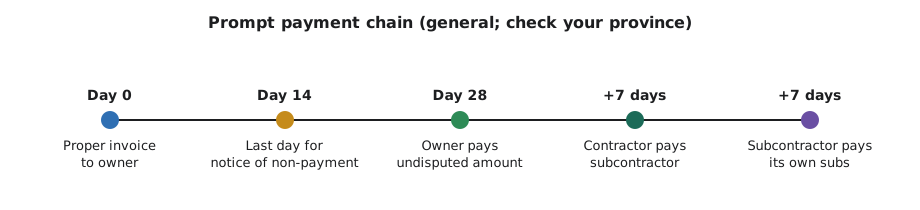
Prompt payment legislation sets deadlines along the chain. In both Alberta and Ontario, an owner must generally pay a proper invoice within 28 days of receiving it, unless the owner gives a notice of non-payment, which must be delivered within 14 days of receiving the invoice and must state the amounts in dispute and the reasons. A contractor that is paid must then pay its subcontractors within 7 days of receiving payment. Ontario also sets fallback deadlines when the owner does not pay, and has amended its rules on invoices, holdback release and adjudication again in 2026. Alberta requires a proper invoice to be issued at least every 31 days and to identify itself as a proper invoice.
| Item | Alberta example | Ontario example |
|---|---|---|
| Statute | Prompt Payment and Construction Lien Act (in force August 29, 2022) | Construction Act (prompt payment in force October 1, 2019, amended since) |
| Owner pays a proper invoice | Within 28 days of receipt | Within 28 days of receipt |
| Owner's notice of non-payment | Within 14 days of receipt | Within 14 days of receipt |
| Contractor pays subcontractor | Within 7 days of receiving payment | Within 7 days of receiving payment |
| Statutory holdback | 10 in 100 of the value of work done and materials furnished | 10 in 100 of the price of services and materials supplied |
| Lien deadline (general) | 60 days, with 90 days for concrete and some oil and gas work | Set by the Act from completion, abandonment or termination; check the current period |
| Adjudication | Available for payment disputes; government-appointed adjudicators | Available for a range of disputes; expanded in 2026 |
Holdback
The holdback is the oldest protection in lien law. The owner keeps back a fraction of each payment to the contractor, usually 10 in 100 of the value of the work, and holds it until the lien period has passed. If a subcontractor or supplier registers a valid lien during that period, the holdback is a fund from which the claim can be paid. If no liens are registered, the holdback is released. Each contractor down the chain usually holds back the same fraction from its own subcontractors, so the protection repeats at every level.
In Alberta, the holdback is 10 in 100 of the value of work actually done and materials actually furnished, and it must be kept for at least 60 days after the certificate of substantial performance is issued, or 90 days for concrete and some oil and gas work. The fund is split into a major lien fund, for work done before substantial performance, and a minor lien fund, for work done afterward. In Ontario, the holdback is also 10 in 100, and the 2026 amendments require it to be released annually on most contracts rather than only at the end of the job. A contractor working in either province must know when its holdback becomes payable and must invoice for it at the right time, because holdback that nobody asks for often goes unpaid.
# Holdback on a progress invoice (illustrative numbers)
contract_price = 184000          # electrical subcontract, dollars
work_done_to_date = 0.45         # fraction complete this month
previously_billed = 51520        # amount billed before holdback in earlier months
holdback_rate = 0.10             # 10 in 100 (check your province)

value_to_date = contract_price * work_done_to_date
this_period = value_to_date - previously_billed
holdback = this_period * holdback_rate
payable = this_period - holdback
print("Value of work to date:", round(value_to_date))
print("This invoice before holdback:", round(this_period))
print("Holdback retained:", round(holdback))
print("Payable this period:", round(payable))
print("Total holdback to date:", round(value_to_date * holdback_rate))Value of work to date: 82800 This invoice before holdback: 31280 Holdback retained: 3128 Payable this period: 28152 Total holdback to date: 8280
Run the calculator, then change the fraction complete to see how the holdback grows with the work. On a real job, the progress fraction comes from a schedule of values agreed at the start of the contract, and the invoice must meet the statute's requirements for a proper invoice.
Liens
A lien is a claim registered against the owner's interest in the land, or in Alberta also against certain interests in oil and gas sites, by a person who supplied work or materials to improve it and has not been paid. Registering a lien does not by itself collect the money. It secures the claim, puts the owner and lenders on notice, and creates pressure to pay, because a property with a registered lien is difficult to sell or refinance. If the claim is not resolved, the lien claimant must start a court action within a set period and register a certificate of lis pendens or equivalent, or the lien expires.
Deadlines are the heart of lien law, and they are unforgiving. In Alberta, the general period for registering a lien is 60 days, running from the last day work or materials were supplied or from the completion or abandonment of the claimant's contract. In Ontario, the period is also tied to completion, abandonment or termination of the contract, and preservation and perfection steps each have their own timelines in the Act. Missing a lien deadline usually means losing the lien completely, although the debt itself remains and can still be pursued as an ordinary contract claim. Gord's rule is to calendar the lien deadline for every job the day the last work is done, not the day the invoice is overdue.
Lien rights cannot usually be signed away in advance in a way that defeats the statute, and owners cannot normally contract out of the holdback. Statutes also limit liens in some places: for example, liens generally cannot be registered against public highways or certain Crown land, where other remedies such as claims against the holdback or labour and material payment bonds may apply instead. Small claims under a minimum amount may not qualify for a lien.
Trust provisions
Many lien statutes also create trusts. Money received by an owner, contractor or subcontractor for an improvement is held in trust for those who supplied work and materials to it, until they are paid. A contractor that receives a progress payment from the owner and uses it to pay unrelated debts, while leaving its own subcontractors unpaid, may be in breach of trust. In some provinces, directors and officers who control that misuse can be personally liable. For a certificate holder who is also a company director, this is one of the most important business rules on the exam: job money belongs to the job until the people who did the work are paid.
Adjudication
Prompt payment legislation introduced adjudication: a fast, interim dispute process run by a qualified adjudicator. A party starts it by giving notice, the adjudicator is appointed, each side submits documents, and a written decision follows within a short period, often around a month. The decision is binding on an interim basis, which means it must be paid now, even though the parties can later take the dispute to court or arbitration. In Alberta, adjudicators are appointed through a government-approved authority. In Ontario, adjudication is administered by the Ontario Dispute Adjudication for Construction Contracts authority, and the 2026 amendments broadened the kinds of disputes that can be adjudicated.
For a small electrical contractor, adjudication changes the balance of power. Before prompt payment, a general contractor could delay paying a subcontractor for months, knowing that a court action would take years. Now the subcontractor can ask an adjudicator to decide within weeks. Priya does not expect Parkland Valley to use adjudication often, but she wants every invoice prepared as if it might be reviewed by an adjudicator: clear, on time, matched to the schedule of values and supported by change orders.
Worked problem
A late payment at Gaetz Avenue
Parkland Valley gave the general contractor its October invoice on October 31. The general contractor included it in its own proper invoice to the owner on November 2. The owner paid the general contractor in full on November 25 and gave no notice of non-payment. By December 6, Parkland Valley still has not been paid. Use the Alberta example rules.
Show solution
- The owner had 28 days from November 2, so payment on November 25 was on time.
- The general contractor had 7 days from receiving payment on November 25, so it had to pay Parkland Valley by December 2.
- On December 6, the payment is late, and interest under the Act may apply.
- Parkland Valley sends a written reminder citing the Act and the dates, and calendars its lien deadline based on its last day of work.
- If the money is still not paid, Parkland Valley can refer the dispute to adjudication or take lien and court steps within the statutory periods.
Answer: The general contractor is late; Parkland Valley documents the dates and uses the statutory remedies if needed.
A payment and lien calendar
Priya builds a simple calendar for each job: invoice dates, the 14-day notice window, the 28-day owner payment date, the 7-day subcontractor payment date, the expected substantial performance date, the holdback release date and the lien deadline. Each date is linked to the statute section in her one-page sheet. The calendar is a business tool, but it is also an exam tool, because most lien questions are date questions.
# Payment and lien calendar from an invoice date and last day of work
from datetime import date, timedelta

invoice_to_owner = date(2026, 11, 2)
owner_paid = date(2026, 11, 25)
last_day_of_work = date(2027, 2, 12)

notice_window = invoice_to_owner + timedelta(days=14)
owner_due = invoice_to_owner + timedelta(days=28)
sub_due = owner_paid + timedelta(days=7)
lien_deadline = last_day_of_work + timedelta(days=60)   # general period in the Alberta example

print("Last day for notice of non-payment:", notice_window)
print("Owner payment due:", owner_due)
print("Subcontractor payment due:", sub_due)
print("Lien registration deadline:", lien_deadline)Last day for notice of non-payment: 2026-11-16 Owner payment due: 2026-11-30 Subcontractor payment due: 2026-12-02 Lien registration deadline: 2027-04-13
The calculator counts calendar days. Statutes have rules about how to count days, what happens when a deadline falls on a holiday, and whether certain periods are business days. On the exam and on the job, use the counting rule in the statute.
Common mistakes
MistakeWaiting until an invoice is badly overdue before checking the lien deadline.
InsteadCalendar the lien deadline from the last day of work as soon as work stops.
MistakeForgetting to invoice for holdback when it becomes due.
InsteadTrack holdback release dates and invoice for them.
MistakeTreating job money as general company money.
InsteadLien statutes create trusts; pay those who supplied the job first.
MistakeIgnoring a notice of non-payment deadline.
InsteadAn owner must give notice within the statutory window or pay the undisputed invoice.
MistakeUsing another province's deadlines.
InsteadLien and prompt payment numbers are province-specific and change with amendments.
Summary and key terms
- Liens give unpaid suppliers of work and materials a claim against the improved property.
- Holdback, usually 10 in 100, keeps a fund in the owner's hands during the lien period.
- Prompt payment rules set deadlines such as 28 days for owners and 7 days down the chain.
- Trust provisions make job money belong to those who supplied the job until they are paid.
- Adjudication gives a fast, interim decision on payment disputes.
- Lien
- A registered claim against property by an unpaid supplier of work or materials to improve it.
- Holdback
- A fraction of each payment retained to protect lien claimants until the lien period ends.
- Proper invoice
- An invoice meeting the statute's requirements, which starts the payment clock.
- Non-payment notice
- A written notice disputing all or part of a proper invoice within the statutory window.
- Adjudication
- A fast, interim, binding decision on a construction dispute by a qualified adjudicator.
Practice problems
Work each problem on paper first, then reveal the answer to check.
What fraction of the value of work is the usual statutory holdback in Alberta and Ontario?
Show answer
10 in 100.
Within how many days must an owner generally pay a proper invoice under Alberta and Ontario prompt payment rules?
Show answer
28 days, unless a valid notice of non-payment is given within 14 days.
What is the general lien registration period in the Alberta example?
Show answer
60 days, or 90 days for concrete and some oil and gas work.
What happens if a lien deadline is missed?
Show answer
The lien is usually lost, though the debt may still be pursued as a contract claim.
Why are trust provisions important for company directors?
Show answer
Misusing job money can make directors personally liable in some provinces.
Lesson quiz · 5 questions
Score 60% or more to complete this lesson.
Create a free account to save your progress, take quizzes and earn a certificate.