
MELC-106 · Lesson 12 of 12 · 23 min
Full mixed review
▶ Video coming soon A video version of this lesson is on the way.
This final lesson brings the whole Canadian master electrician core together. MELC-101 taught navigation of the CE Code Part I. MELC-102 taught the calculations: demand loads, voltage drop, transformers and motors. MELC-103 covered conductors, wiring methods and overcurrent protection. MELC-104 covered grounding and bonding. MELC-105 covered motors, hazardous locations and special installations. This course covered the business, legal and safety knowledge that a certificate holder needs. A real exam mixes all of these, often in the same scenario, and expects you to switch between the Code, a calculator and a statute in a few minutes.
The lesson is built around a single mixed review session at Denise's Tuesday study group, three weeks before Priya's exam date. It walks through a set of scenario problems drawn from Parkland Valley's jobs, explains the reasoning for each, and then gives a practice set for you to work on your own with your Code and your statute sheets. Code rules are cited by number only. Read each one in your own copy of the 2024 CE Code before checking the reasoning, and confirm any provincial facts against current legislation.
How to use this review
Treat the worked problems as a mock exam first. Read each scenario, decide which type of question it is, decide which reference to open, and write down your answer before reading the explanation. Time yourself: aim for an average of about two to three minutes per question, which is typical of many master exams. Then read the reasoning and record whether you got it right, and if not, why. The goal is not to memorize these answers. It is to practise the sequence of identifying the question type, choosing the reference and checking the details.
| Course | Topics to review | Main references |
|---|---|---|
| MELC-101 | Code structure, definitions, Section 2 general rules, lookup technique | Sections 0 and 2, index, appendices |
| MELC-102 | Dwelling and apartment loads, voltage drop, transformer and motor calculations | Section 8, Section 26 transformer rules, Section 28 |
| MELC-103 | Conductors, ampacity, Section 12 wiring methods, boxes, overcurrent protection | Sections 4, 12 and 14, Tables 1 to 4 and 19 |
| MELC-104 | System grounding, bonding, conductor sizing for bonding | Section 10, Tables 16 and 17 |
| MELC-105 | Motors, hazardous locations, special installations | Sections 28, 18, 64, 68, 86 and others |
| MELC-106 | Permits, contracts, liens, insurance, safety, supervision, records, exam technique | Provincial statutes, CSA Z462, contracts |
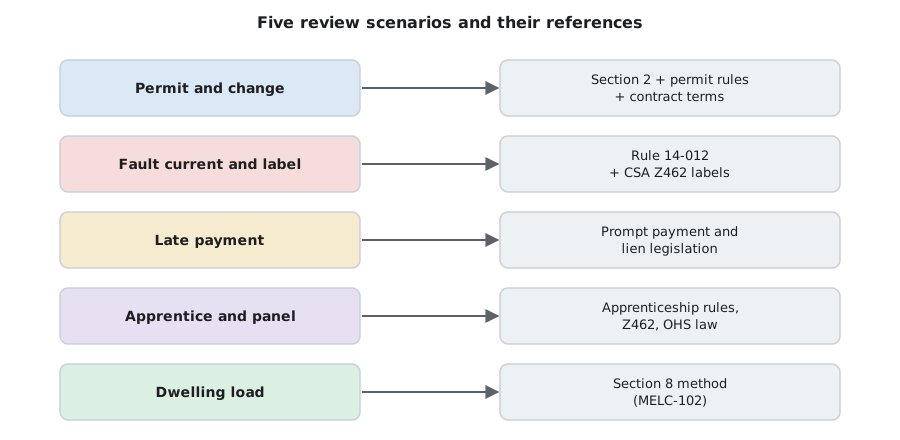
Scenario 1: the permit and the change
Halfway through the Hartley Farms job, the farm owner asks Parkland Valley to add a 30 A, 240 V welder receptacle in the shop. Marcus wants to install it the same afternoon. Three questions follow. Is a permit needed? Yes, adding a new circuit is new work, so it must be covered by a permit; the simplest approach is to update the existing permit description with the permit issuer. What contract step comes first? A written change order with scope, price and time, signed by the owner, as lesson 3 described. What Code checks apply? The receptacle configuration must match the circuit rating, the conductors must be sized for the load and protected under Rule 14-104, and any GFCI requirements for the location must be checked. Three different references for one simple request.
Denise points out that the exam would usually ask only one of those questions, but a real certificate holder must answer all three before the receptacle goes in. That is the point of a mixed review: to practise moving between the business and the technical sides without losing track of either.
Scenario 2: the calculation and the label
The new 400 A service at Hartley Farms raises the available fault current at the motor control centre. Two questions follow. A technical one: are the existing breakers in the MCC still adequate? Rule 14-012 requires equipment to have an interrupting rating not less than the available fault current at its line terminals, so the new fault current must be compared with each breaker's rating, and any breaker below it must be replaced or protected by a tested series combination, as MELC-103 explained. A safety one: is the old arc flash label still valid? No: lesson 8 explained that labels must be reviewed when fault current or protective devices change, so a new study and new labels are needed before anyone works on the MCC energized.
This pairing is common in practice and increasingly common on exams: a change to the electrical system has both a Code consequence and a safety program consequence. Candidates who see only one of them lose marks.
Scenario 3: the late payment and the lien
Parkland Valley finished the Gaetz Avenue clinic on February 12. The general contractor has not paid the last progress invoice, and it is now March 20. Using the Alberta example rules: the general lien period is 60 days from the last day of work, so the deadline is April 13. Priya should already have calendared it. The holdback on the subcontract, 10 in 100, is also outstanding and must be tracked separately. If the general contractor was paid by the owner and has not paid Parkland Valley within 7 days, the payment is late under prompt payment rules, and Parkland Valley can pursue adjudication. Whatever happens with adjudication, the lien deadline does not move, so Priya registers the lien before April 13 if the money has not arrived.
# Lien deadline from the last day of work (Alberta example: 60 days general)
from datetime import date, timedelta
last_day = date(2027, 2, 12)
lien_deadline = last_day + timedelta(days=60)
today = date(2027, 3, 20)
print("Lien deadline:", lien_deadline)
print("Days remaining:", (lien_deadline - today).days)Lien deadline: 2027-04-13 Days remaining: 24
Scenario 4: the apprentice and the panel
On the Riverbend Condos retrofit, a general contractor's site superintendent asks Tyler, the third-year apprentice, to swap a breaker in an energized panel while Priya and Marcus are at lunch, because the condo board does not want the power off again. Three answers. Under apprenticeship rules, Tyler needs direct supervision by a journeyperson on the job, and with both journeypersons away, he should not be doing trade work unsupervised. Under CSA Z462, energized work is not justified by inconvenience; the panel should be de-energized and locked out. Under health and safety law, Tyler has the right to refuse work he reasonably believes is dangerous, and the superintendent, who is not his employer, has no authority to direct his electrical work. Tyler should decline, and tell Priya.
Gord adds a business point. If Tyler had done the swap and been injured, Parkland Valley would face a health and safety investigation, a workers' compensation claim, possible charges against Priya as supervisor, and damage to its relationship with the general contractor and the condo board. A clear safety program and a crew that knows it protects the company as well as the workers.
Scenario 5: the dwelling load
A purely technical one to balance the set. The Aspen Ridge homeowners want to add a 7.2 kW EV charger to the house, which already has a basement suite. The service was upgraded to 400 A in MELC-102 when the suite was added. Using the Rule 8-200 method and the values worked out in MELC-102, Priya recalculates the load with the charger added at its full rating unless an energy management system under the Code's provisions controls it. Then she compares the new calculated current with the service rating. The exam version of this question usually gives all the areas and loads, and the trap is forgetting that some loads are taken at their full rating rather than at a demand factor. Work it through with your own Code and MELC-102's method, and check whether the 400 A service still has capacity.
Final checklist before the exam
Priya's last week checklist covers both halves of the exam. Technical: lookup drills on the twenty most common rules and tables, one timed calculation set per day, a final read of every exception she has listed. Business: one pass through each statute sheet per day, with the deadlines read aloud; one pass through the Z462 summary; one pass through the records retention table. Logistics: the candidate guide reread, materials prepared exactly as allowed, the route to the exam centre checked, and an early night.
Denise's final advice to the study group is the same as on the first night: read the whole rule, then read the definitions in it. She adds a second line for the business half: read the whole question, then read the role of every party in it. Most wrong answers on master exams come from reading too quickly, not from not knowing.
Worked problem
A mixed mini-exam
Denise gives Priya five questions with a 12-minute limit: (1) the owner has 28 days to pay a proper invoice unless what is given within 14 days? (2) Which control is most effective for working on a panel? (3) Who may hold an electrical permit for work for others in Alberta? (4) What must equipment interrupting ratings be compared with? (5) What fraction of the value of work is the usual statutory holdback?
Show solution
- Question 1: a notice of non-payment, from the prompt payment rules in lesson 4.
- Question 2: elimination, by de-energizing and establishing an electrically safe work condition, from lessons 7 and 8.
- Question 3: a Master Electrician Certificate holder, or a contractor through one, from lessons 1 and 2.
- Question 4: the available fault current at the equipment's line terminals, from Rule 14-012 and MELC-103.
- Question 5: 10 in 100, from lesson 4.
Answer: Five correct answers in about 6 minutes, leaving time to check, which is the pace Priya needs on exam day.
Practice set
Work the following problems with your Code, a calculator and your statute sheets, under a time limit of about 30 minutes for all of them. The answers are in the practice section at the end of the lesson. Where a question depends on a province, use the Alberta and Ontario examples from this course, and then check what your own province says.
- A homeowner asks a journeyperson to rewire their kitchen privately on the weekend. Can the journeyperson take out the permit?
- An owner receives a proper invoice on June 3. By what date must any notice of non-payment be given under the Alberta and Ontario rules?
- A subcontract is worth 96,000 dollars and is 60 in 100 complete. What is the total holdback to date at 10 in 100?
- Which bond guarantees that a contractor will pay its suppliers?
- A worker is asked to test for absence of voltage. Is this energized work under CSA Z462?
- Which record helps prevent shocks during future maintenance by identifying every circuit in a panel?
- Name the first step in establishing an electrically safe work condition.
- An exam has 110 questions in 4 hours 30 minutes. What is the average time per question?
After the exam
Whatever the result, the exam is not the end of the learning. If Priya passes, she will become the person whose name sits on Parkland Valley's permits, and the knowledge in this core becomes daily work. She plans to keep her statute sheets up to date as laws change, review each new Code edition when it is adopted, and renew her Z462 training on schedule. If she does not pass, the regulator will usually provide a result showing her performance by topic, and she can rebuild her study plan around the weak areas and retake the exam after any waiting period the rules require.
Common mistakes
MistakeAnswering only the Code side of a scenario that also has a permit, contract or safety side.
InsteadCheck every reference the scenario touches before choosing an answer.
MistakeLetting an adjudication or negotiation run past the lien deadline.
InsteadRegister the lien before the deadline if payment has not arrived; the deadline does not move.
MistakeAccepting direction on electrical work from someone who is not your employer.
InsteadFollow your employer's procedures and supervisor; refuse unsafe work.
MistakeForgetting that system changes affect both Code ratings and arc flash labels.
InsteadRecheck interrupting ratings and the arc flash study when fault current changes.
MistakeStudying only one half of the exam in the final week.
InsteadReview both the technical and business halves every day before the exam.
Summary and key terms
- Real exam scenarios often combine Code, calculation, business and safety questions.
- Identify the question type and the reference before answering.
- System changes can affect Code compliance and the safety program at the same time.
- Deadlines in lien and payment law do not move while other remedies are pursued.
- In the final week, review both halves of the exam and prepare materials and logistics.
- Mixed scenario
- An exam question that draws on more than one subject area, such as the Code and a statute.
- Interrupting rating
- The highest fault current a device can safely interrupt.
- Statute sheet
- A one-page summary of a statute's purpose, definitions, duties and key numbers.
- Electrically safe work condition
- Disconnected, locked out, tested for absence of voltage and grounded if needed.
- Holdback
- A fraction of each payment retained to protect lien claimants.
Practice problems
Work each problem on paper first, then reveal the answer to check.
Can a journeyperson take out a permit for a private weekend kitchen job for someone else?
Show answer
Generally no; permits for work for others go to certificate holders or licensed contractors.
A proper invoice is received June 3. When is the last day for a notice of non-payment?
Show answer
June 17, 14 days after receipt.
A 96,000-dollar subcontract is 60 in 100 complete. What is the holdback to date at 10 in 100?
Show answer
96,000 x 0.6 = 57,600 of work; 57,600 x 0.10 = 5,760 dollars.
Which bond guarantees payment of suppliers?
Show answer
The labour and material payment bond.
Is testing for absence of voltage energized work?
Show answer
Yes; it is treated as energized until it proves the equipment is dead.
Which record identifies every circuit in a panel?
Show answer
The panel schedule (directory).
What is the first step toward an electrically safe work condition?
Show answer
Identify all possible sources of supply.
What is the average time per question for 110 questions in 4 hours 30 minutes?
Show answer
270 minutes / 110 questions, about 2.45 minutes.
Lesson quiz · 5 questions
Score 60% or more to complete this lesson.
Create a free account to save your progress, take quizzes and earn a certificate.