
MELC-106 · Lesson 8 of 12 · 21 min
CSA Z462 and electrical safety programs
▶ Video coming soon A video version of this lesson is on the way.
CSA Z462, Workplace electrical safety, is the Canadian standard for protecting workers from electrical hazards: shock, electrocution, arc flash and arc blast. The current edition is CSA Z462:24, published in 2024. It is updated on a three-year cycle and is closely aligned with NFPA 70E, its American counterpart. Z462 is not the CE Code. The Code governs how installations are built so they are safe to use. Z462 governs how work is done on and near those installations so the people doing it are not hurt. A master electrician needs both: the Code to make the installation compliant, and Z462 to get the crew home safely.
Z462 is a voluntary standard in itself, but it becomes binding in several ways. Provincial health and safety legislation requires employers to protect workers from electrical hazards and, in some cases, refers to recognized standards. Regulators and courts treat Z462 as the benchmark for what a reasonable employer does about electrical safety. Clients and general contractors increasingly require contractors to have a Z462-based electrical safety program before they can work on site. This lesson explains the main ideas of the standard and how to build a program around them. It does not reproduce the standard's tables or text; if your work involves energized equipment, your employer should have a current copy and you should study it directly.
The core principle: an electrically safe work condition
The most important idea in Z462 is that work on electrical equipment should be done de-energized, in an electrically safe work condition, whenever possible. An electrically safe work condition is a state in which the conductors and circuit parts to be worked on have been disconnected from energized parts, locked and tagged out, tested to verify the absence of voltage and, where necessary, temporarily grounded. Until all of those steps are complete, the equipment must be treated as energized.
The usual sequence is: identify all possible sources of supply using up-to-date drawings and labels; disconnect each source after properly interrupting the load; visually verify that disconnecting devices are open where possible; apply lockout and tagout devices under the employer's procedure; test each phase conductor or circuit part with a properly rated test instrument, checking the instrument on a known live source before and after the test; and, where stored energy or induced voltage is possible, discharge and ground the conductors. CSA Z460 deals with the control of hazardous energy, including lockout, and the employer's lockout procedure must be followed exactly.
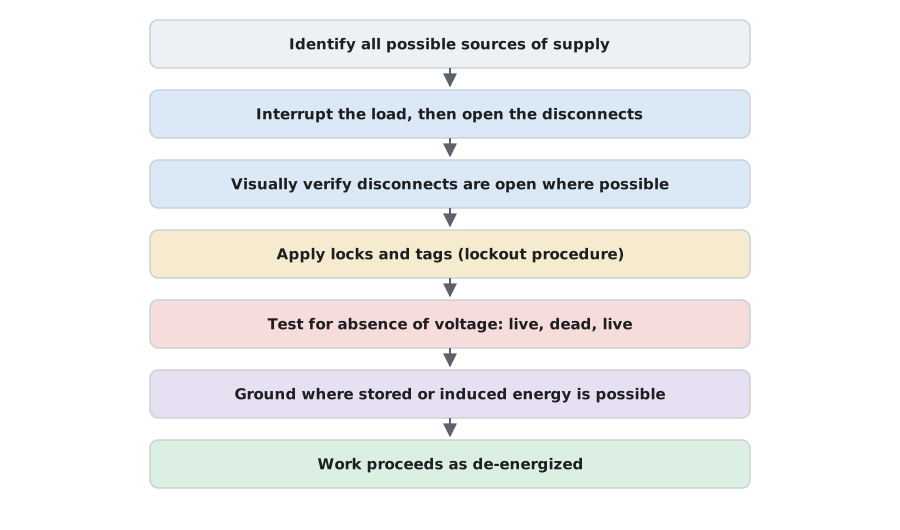
Testing for absence of voltage is itself energized work until it proves the equipment is dead. That is why the worker doing the test wears the protective equipment the risk assessment calls for. Priya's crew uses a live-dead-live routine on every test: check the tester on a known source, test the equipment, then check the tester again. A tester that fails on the second check means the dead reading cannot be trusted.
When energized work is allowed
Z462 allows energized work only when de-energizing would create a greater hazard or is infeasible because of equipment design or operational limits, or for certain tasks that inherently require energized equipment, such as diagnostic testing and voltage measurement. Convenience and cost are not acceptable reasons. Shutting down a grain dryer for an hour, inconvenient as it is, is not a reason to work live. Shutting down life-support equipment in a hospital might be.
When energized work is justified, the standard requires a risk assessment and, for most tasks beyond testing and troubleshooting, a written energized electrical work permit. The permit describes the work and the equipment, explains why it cannot be done de-energized, records the shock and arc flash risk assessments, lists the safe work practices, boundaries and protective equipment, describes how unqualified people will be kept away, and is approved by the responsible management or safety authority before the work starts.
Risk assessment: shock and arc flash
Z462 requires two kinds of risk assessment for work on or near exposed energized parts. The shock risk assessment identifies the voltage, the approach boundaries, and the protective equipment and work practices needed to prevent shock. The arc flash risk assessment determines whether an arc flash hazard exists, estimates the likelihood and severity of injury, and sets the arc flash boundary and the protective equipment required. Severity is usually expressed as incident energy, the heat energy a worker could be exposed to at a given working distance, measured in calories per square centimetre or joules per square centimetre.
Two methods are used to choose arc flash protective equipment. The incident energy analysis method calculates the incident energy at each piece of equipment from the system's fault current and the clearing time of the protective devices, usually in an engineering study, and the result appears on equipment labels. The arc flash PPE category method uses tables in the standard that assign a PPE category to common tasks on common equipment, within stated limits of fault current and clearing time. The two methods must not be mixed for the same equipment. If equipment is labelled with an incident energy value, that value governs.
| Boundary or term | Meaning (general) | Who may cross |
|---|---|---|
| Limited approach boundary | Distance from exposed energized parts within which a shock hazard exists | Qualified persons, or unqualified persons only when escorted and advised by a qualified person |
| Restricted approach boundary | Closer distance where there is an increased risk of shock from inadvertent movement | Qualified persons only, with shock protection and a justified plan |
| Arc flash boundary | Distance at which incident energy would equal the threshold for a second-degree burn | Anyone inside must wear arc-rated PPE suitable for the hazard |
| Incident energy | Heat energy at a working distance from an arc, in cal/cm2 | Used to select arc-rated clothing and equipment |
| Working distance | Distance from the arc source to the worker's face and chest | Used in incident energy calculations |
Note that the boundary distances themselves are not in this table. They depend on voltage and on the arc flash analysis, and they are set out in the standard and on the equipment label. On an exam, if a question gives you a label with an arc flash boundary and incident energy, use those values; do not try to recall a distance from memory.
Qualified and unqualified persons
Z462 distinguishes between qualified persons, who have the skills, knowledge and training to recognize and avoid electrical hazards for a particular task and equipment, and unqualified persons. Being qualified is task-specific. A journeyperson may be qualified to work on 120/240 V panels and not qualified to rack out 4160 V breakers. The employer decides who is qualified for which tasks, based on training and demonstrated ability, and documents it. Unqualified persons, including apprentices who have not yet been trained for a task, may not cross the limited approach boundary unless escorted and continuously advised by a qualified person, and may never cross the restricted approach boundary.
Training must be repeated and documented. Z462 calls for retraining at intervals and when there is a change in job duties, equipment or procedures, or when an audit shows a worker is not following the safety-related work practices. Emergency response training, including release from contact and first aid, is required for workers exposed to shock hazards. Priya keeps a training matrix for Parkland Valley that lists each worker, the tasks and voltage levels they are qualified for, and the dates of their training and retraining.
Equipment labels and maintenance
Electrical equipment such as panelboards, switchboards and motor control centres that is likely to be examined, adjusted, serviced or maintained while energized must be marked with a label that warns of the arc flash hazard and gives information such as the nominal voltage, the arc flash boundary, and either the incident energy at the working distance or the required PPE category. Section 2 of the CE Code also contains marking requirements, so the two documents work together.
Labels are only correct if the equipment is maintained. A breaker that takes longer to trip than its settings say, because of age or poor maintenance, can expose a worker to far more energy than the label shows. That is why Z462 links to CSA Z463, Maintenance of electrical systems, and why arc flash studies are reviewed when the system changes or at regular intervals. At Hartley Farms, the new 400 A service changes the available fault current at the MCC, so the old label can no longer be trusted. Parkland Valley's contract includes a new arc flash study and new labels as part of the work.
Worked problem
Reading an arc flash label
Before testing the Hartley Farms MCC, Priya reads its new label: nominal voltage 600 V, arc flash boundary 1.4 m, incident energy 6.8 cal/cm2 at a working distance of 455 mm, limited approach boundary 1.0 m, restricted approach boundary 0.3 m (all values from the label, illustrative for this example).
Show solution
- The arc flash boundary is 1.4 m: anyone closer must wear arc-rated PPE suitable for at least 6.8 cal/cm2.
- Priya's arc-rated clothing and face protection are rated 8 cal/cm2, which exceeds 6.8, so they are suitable.
- The limited approach boundary is 1.0 m: Tyler, not yet qualified for this equipment, stays outside it unless escorted and advised.
- The restricted approach boundary is 0.3 m: only Priya, as the qualified person with shock protection, crosses it to test.
- She tests for absence of voltage using live-dead-live before locking out and working.
Answer: Use the label values directly; PPE rated above the label's incident energy, and boundaries enforced for each person.
Building an electrical safety program
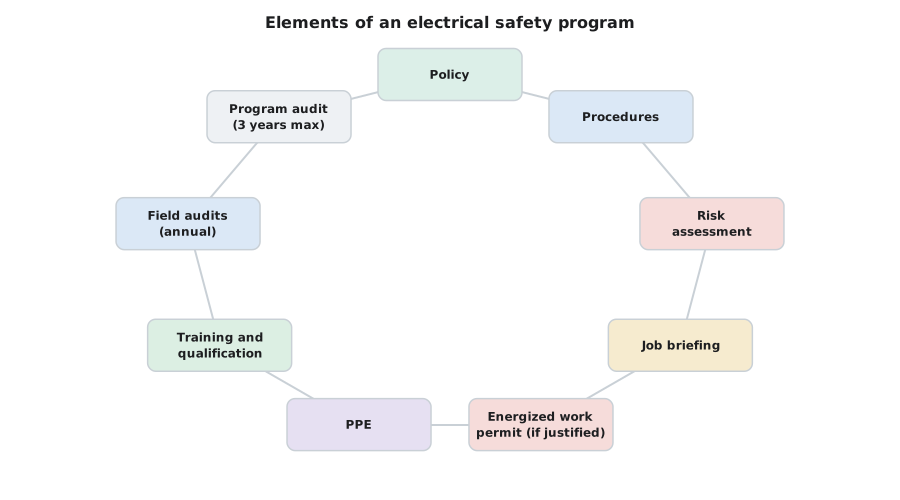
Z462 requires employers to implement and document an electrical safety program, and it describes the elements: a policy and the principles behind it; the procedures for establishing an electrically safe work condition; risk assessment procedures; a job briefing before each job; the energized work permit process; PPE selection, care and inspection; training and qualification; auditing of field work and of the program itself; incident investigation; and the hierarchy of risk controls. The program must be appropriate for the work the employer does. A residential contractor's program will be shorter than an industrial maintenance contractor's, but both must exist in writing.
Job briefings are the part of the program crews see every day. Before each job, the person in charge reviews the hazards, the procedures, the special precautions, the energy source controls, the PPE and the emergency plan with everyone involved. A good briefing takes a few minutes and is recorded. Audits close the loop. Z462 calls for field work to be audited at least annually to verify that procedures are being followed, and for the program itself to be audited at intervals of not more than three years.
# Is the arc-rated PPE enough for the label?
labels = {"MCC-1": 6.8, "Panel SP-2": 1.9, "Main switchboard": 14.2}   # cal/cm2 from labels (illustrative)
ppe_kits = {"Kit A (8 cal)": 8, "Kit B (25 cal)": 25}
for equipment, energy in labels.items():
    suitable = [k for k, rating in ppe_kits.items() if rating >= energy]
    choice = min(suitable, key=lambda k: ppe_kits[k]) if suitable else "none: do not work energized"
print(f"{equipment:<18} {energy:>5} cal/cm2 -> {choice}")MCC-1 6.8 cal/cm2 -> Kit A (8 cal) Panel SP-2 1.9 cal/cm2 -> Kit A (8 cal) Main switchboard 14.2 cal/cm2 -> Kit B (25 cal)
The job briefing in practice
Priya's job briefing at the Hartley Farms MCC takes about five minutes and follows a short card: what the job is and who is doing each part; which equipment will be de-energized and how the sources were identified; who applies locks and who tests; the boundaries and PPE for the testing step; where the nearest phone, first aid kit and AED are, and who calls for help in an emergency; and what each person will do if anything unexpected happens. Everyone signs the card. If the plan changes during the job, the crew stops and briefs again.
Common mistakes
MistakeWorking live because a shutdown is inconvenient or costly.
InsteadConvenience and cost do not justify energized work; de-energize unless it is infeasible or creates a greater hazard.
MistakeTreating equipment as dead before testing for absence of voltage.
InsteadTreat it as energized until the electrically safe work condition is fully established.
MistakeMixing the incident energy method and the PPE category tables for the same equipment.
InsteadUse one method; if the label gives incident energy, it governs.
MistakeAssuming a journeyperson is qualified for every voltage and task.
InsteadQualification is task-specific and must be documented by the employer.
MistakeTrusting an old arc flash label after system changes.
InsteadReview the study and labels when fault current or protective devices change.
Summary and key terms
- CSA Z462:24 is the Canadian workplace electrical safety standard, aligned with NFPA 70E.
- Work should be done in an electrically safe work condition whenever possible.
- Energized work needs justification, risk assessment and usually a written permit.
- Shock and arc flash risk assessments set boundaries and PPE; labels give key values.
- An electrical safety program includes procedures, briefings, training, PPE and audits.
- Electrically safe work condition
- A state in which conductors are disconnected, locked out, tested for absence of voltage and grounded if needed.
- Arc flash boundary
- The distance at which incident energy would equal the threshold for a second-degree burn.
- Incident energy
- The heat energy a worker could receive from an arc at a working distance.
- Qualified person
- A person trained and able to recognize and avoid electrical hazards for a specific task and equipment.
- Energized electrical work permit
- A written authorization documenting justification, risk assessment and controls for energized work.
Practice problems
Work each problem on paper first, then reveal the answer to check.
What is the preferred way to work on electrical equipment under Z462?
Show answer
De-energized, in an electrically safe work condition.
Is the cost of a shutdown a valid reason for energized work?
Show answer
No; only infeasibility or a greater hazard, or tasks like testing that require energy, justify it.
Who may cross the restricted approach boundary?
Show answer
Only qualified persons with appropriate shock protection and a justified plan.
A label shows 6.8 cal/cm2. Is PPE rated 8 cal/cm2 suitable?
Show answer
Yes, because its rating exceeds the incident energy shown.
How often should field work be audited under the program?
Show answer
At least annually, with the program itself audited at intervals of not more than three years.
Lesson quiz · 5 questions
Score 60% or more to complete this lesson.
Create a free account to save your progress, take quizzes and earn a certificate.