
MELC-106 · Lesson 1 of 12 · 22 min
What master and contractor exams cover
▶ Video coming soon A video version of this lesson is on the way.
The first five courses of this core were about the CE Code itself: how to find a rule, how to run a calculation, how to choose conductors and wiring methods, how to ground and bond, and how to handle motors, hazardous locations and special installations. A master or contractor exam tests all of that, but it also tests something the Code does not cover on its own: whether the candidate can run electrical work as the person legally responsible for it. That means permits and inspections, contracts and payment, liens and holdbacks, insurance and bonding, occupational health and safety, electrical safety programs, supervision of workers, and records. This course covers that second half of the exam, and finishes with a strategy for sitting a timed open-book exam and a full mixed review.
None of this course depends on reproducing the Code. Where a Code rule matters, it is cited by number only, and you should read it in your own copy of the 2024 CE Code Part I. Most of the content comes from provincial legislation, contract practice and safety standards, which change more often than the Code does. Every fact that depends on a province is presented as an example, usually from Alberta and Ontario, and you should check the current version of the law where you will write your exam. Laws are amended, regulators reorganize and exam outlines are revised. A candidate who studies last year's rules can lose marks on questions that look easy.
Priya's next problem
Priya Raman has finished the technical courses. Her lookup times are under ninety seconds, her calculation practice sets are clean, and Denise Lafleur's Tuesday study group has moved on to what Denise calls the paperwork half of the exam. Priya is the one who sounds least confident about it. She has been a lead hand for years, but Gord Tremblay, the owner of Parkland Valley Electric, has always pulled the permits, signed the contracts, chased the payments and dealt with the insurer. When Gord retires, Priya will be the certificate holder whose name sits on every permit the company takes out. The exam wants to know whether she is ready for that.
Gord has agreed to help. Over the next twelve lessons he will hand Priya the real files from Parkland Valley's current jobs: the Hartley Farms grain-drying shop, the Gaetz Avenue dental clinic, the Aspen Ridge bungalow with its basement suite, and the Riverbend Condos EV charger retrofit. Marcus Okafor, who wants his own contracting business one day, will work through the files with her. Tyler Chen, the third-year apprentice, will sit in, because the supervision lesson is partly about him.
Who sets the exam
Electrical work in Canada is regulated by the provinces and territories. Each one adopts the CE Code Part I, usually with amendments, and each one decides who may take out permits, who may operate an electrical contracting business, and what exams those people must pass. The names of the credentials differ, and so does the split between the person and the business. In Alberta, the Safety Codes Council issues the Master Electrician Certificate, and a permit for electrical work is generally issued to the holder of that certificate or to a homeowner doing work on their own home. In Ontario, the Electrical Safety Authority licenses both the business, as a Licensed Electrical Contractor, and the person, as a Master Electrician, and every contractor must designate a Master Electrician who is responsible for planning and supervising its work.
Other provinces use different models. British Columbia uses a Field Safety Representative certificate for the person responsible for electrical work, alongside a contractor licence from Technical Safety BC. Quebec licenses electrical contractors through the Corporation des maîtres électriciens du Québec. Saskatchewan and Prince Edward Island have master electrician credentials. Several provinces and the territories license the contractor and rely on trade certification for the individual. The provincial courses that follow this core each cover one jurisdiction in detail. In this course, the goal is to learn the shared ideas well enough that the provincial details make sense.
| Example | Credential for the person | Licence for the business | Who issues it |
|---|---|---|---|
| Alberta | Master Electrician Certificate | No separate provincial contractor licence; permits need a certificate holder | Safety Codes Council |
| Ontario | Master Electrician licence | Licensed Electrical Contractor, with a Designated Master Electrician | Electrical Safety Authority |
| British Columbia | Field Safety Representative | Electrical contractor licence | Technical Safety BC |
| Quebec | Qualified representative of the business | Electrical contractor licence | Corporation des maîtres électriciens du Québec |
What the business half of the exam covers
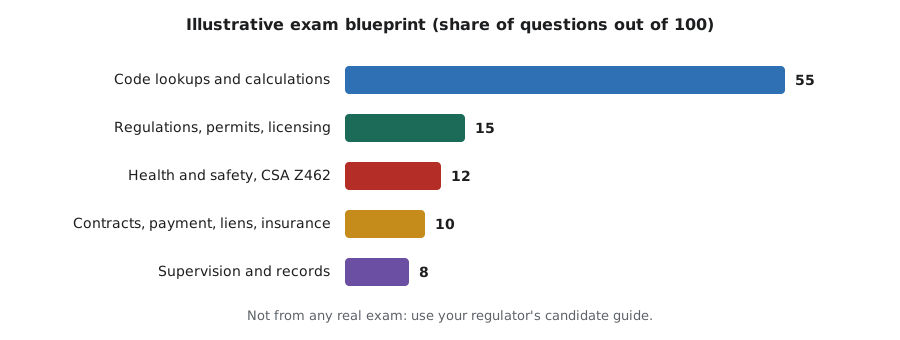
The exact outline depends on the jurisdiction, but the business half of master and contractor exams tends to fall into the same groups. Regulatory knowledge: the Act and regulations that adopt the Code, permit rules, inspection rules, the powers of inspectors and safety codes officers, and the duties of the permit holder. Contract knowledge: quotes, tenders, standard form contracts, scope, change orders, warranties and dispute resolution. Payment and lien knowledge: prompt payment timelines, holdbacks, lien deadlines and adjudication. Risk knowledge: insurance, bonding, liability and workers' compensation. Safety knowledge: employer duties under occupational health and safety law, CSA Z462 and electrical safety programs. Supervision knowledge: apprentice ratios, direct supervision and training records. Records: what must be kept, for how long and why.
Some jurisdictions test these topics in a separate business and law exam. Others fold them into one exam with the Code questions. In Ontario, for example, the Master Electrician exam draws on the Ontario Electrical Safety Code and a booklet of relevant legislation, and candidates bring approved materials. In Alberta, the Master Electrician exam is an open-book code exam with questions on the regulatory framework. Your regulator's candidate guide is the only reliable source for the outline, the materials allowed, the number of questions, the time limit and the pass mark. Download it, read it twice, and build your study plan around its headings rather than around this course's lesson order.
Why the business questions feel different
Code questions usually have one rule behind them. You find the rule, read it carefully, check the exceptions and answer. Business questions are often about duties and sequences: who must do what, in which order, and by when. They also test definitions in the legislation, which are not always the same as the everyday meaning of the word. A contractor in a lien statute, an employer in an occupational health and safety statute and a permit holder in a safety codes statute may all be the same company on the same job, but each word carries different duties. The exam rewards candidates who read the definitions in the legislation, exactly as Denise insists on reading the definitions in the Code.
Business questions also come in scenario form. A question might describe a homeowner who refuses to pay the last invoice, a general contractor who asks the electrical contractor to start work before the permit is issued, or an apprentice working alone in a panel. The question will ask what the contractor must do, may do or must not do. The right answer is usually the one that follows the legislation most literally, even when a real contractor might be tempted to solve the problem more informally.
Worked problem
Classifying exam questions
Denise gives the group five practice questions and asks them to classify each one before answering: (1) the minimum burial depth for a direct-buried cable under a driveway; (2) how many days an owner has to pay a proper invoice; (3) who must sign an energized electrical work permit; (4) the ampacity of a conductor after correction for ambient temperature; (5) what a Designated Master Electrician must do when the contractor loses its liability insurance.
Show solution
- Question 1 depends on a Code rule and table: a Code lookup.
- Question 2 depends on provincial prompt payment legislation: payment and liens.
- Question 3 depends on the employer's electrical safety program and CSA Z462: safety.
- Question 4 depends on Code tables and correction factors: a Code calculation.
- Question 5 depends on the licensing regulation and the regulator's guideline: regulatory knowledge.
Answer: Two Code questions, one payment question, one safety question and one regulatory question. Knowing the type tells Priya which reference to open first.
Reference materials for the business half
For the Code half of the exam, the reference is the Code. For the business half, the references are scattered: the provincial safety codes or electrical safety Act and its regulations, the occupational health and safety Act, regulation and code, the workers' compensation Act, the lien or construction Act, the apprenticeship Act, and the regulator's own guidelines and bulletins. Some exams supply a legislation booklet. Others expect you to know the main points. Priya makes a single sheet for each statute: its full name, what it covers, the definitions that matter, the main duties, and any numbers the exam is likely to test, such as deadlines in days.
She also keeps a short list of the standards that come up in business and safety questions: CSA Z462 for workplace electrical safety, CSA Z463 for maintenance of electrical systems, CSA Z460 for lockout and other methods of controlling hazardous energy, and the standard form construction contracts published by the Canadian Construction Documents Committee. She does not need to memorize these documents. She needs to know what each one is for, so she recognizes which one a question is pointing at.
| Topic | Typical source | What questions test |
|---|---|---|
| Permits and inspections | Provincial electrical or safety codes Act and permit regulation | Who may take out a permit, when it is needed, inspection steps |
| Licensing | Licensing regulation and regulator guidelines | Duties of the certificate or licence holder, notifications, renewals |
| Payment and liens | Provincial lien or construction Act | Payment timelines, holdback, lien deadlines, adjudication |
| Workers and safety | Occupational health and safety Act, regulation or code | Employer, supervisor and worker duties, hazard assessment |
| Compensation | Workers' compensation Act | Coverage, clearance letters, injury reporting |
| Apprentices | Apprenticeship legislation | Ratios, supervision, records of hours |
| Electrical safety | CSA Z462 and the employer's safety program | Safe work conditions, boundaries, permits for energized work |
A study plan for the business half
Priya's technical study plan worked because it was concrete: fourteen weeks, timed lookup drills from week three, and three full mock exams. She builds the business half the same way. Week one: download the candidate guide and the listed legislation, and make a one-page sheet for each statute. Weeks two and three: permits, inspections and records, using the real Parkland Valley permit files. Weeks four and five: contracts, change orders, payment and liens. Week six: insurance, bonding and workers' compensation. Weeks seven and eight: occupational health and safety and CSA Z462. Week nine: supervision and apprenticeship. Week ten: two full mixed mock exams under exam conditions, then a review of every wrong answer.
Marcus asks whether ten weeks is too long for paperwork. Gord's answer is that the paperwork is what puts contractors out of business. A wiring mistake is usually caught by an inspector and fixed. A missed lien deadline, a lapsed insurance policy or an unreported injury can cost the whole company, and none of them is caught by anyone until it is too late. The exam asks business questions because regulators have seen what happens when certificate holders do not know the answers.
# Priya's business-half study plan: weeks per topic and hours per week
plan = [
    ("Candidate guide and statute sheets", 1),
    ("Permits, inspections and records", 2),
    ("Contracts, payment and liens", 2),
    ("Insurance, bonding and compensation", 1),
    ("Health and safety and CSA Z462", 2),
    ("Supervision and apprenticeship", 1),
    ("Mock exams and review", 1),
]
hours_per_week = 6
total_weeks = sum(w for _, w in plan)
print("Total weeks:", total_weeks)
print("Total study hours:", total_weeks * hours_per_week)
for topic, weeks in plan:
print(f"{topic:<40} {weeks} wk {weeks * hours_per_week:>3} h")Total weeks: 10 Total study hours: 60 Candidate guide and statute sheets 1 wk 6 h Permits, inspections and records 2 wk 12 h Contracts, payment and liens 2 wk 12 h Insurance, bonding and compensation 1 wk 6 h Health and safety and CSA Z462 2 wk 12 h Supervision and apprenticeship 1 wk 6 h Mock exams and review 1 wk 6 h
The calculator above is deliberately simple. Edit the hours per week and the weeks per topic to fit your own schedule. The point is that a plan with numbers in it gets followed, and a plan without numbers usually does not.
How this course is organized
Lessons 2 to 6 follow a job from start to finish: the permit and inspections, the contract and change orders, payment and liens, insurance and bonding, and the business compliance that sits around all of it. Lessons 7 to 10 cover people and paper: health and safety duties, CSA Z462 and electrical safety programs, supervising apprentices and journeypersons, and the records that prove it all happened. Lesson 11 is exam technique for a timed open-book exam, and lesson 12 is a full mixed review that combines business questions with the Code and calculation topics from the first five courses.
Every lesson uses a real Parkland Valley file as its example. By the end of the course, Priya will have a binder of her own: one-page statute sheets, a permit and inspection checklist, a contract and change order checklist, a payment calendar, an insurance summary, a safety program outline, a supervision log template, and a records retention table. The binder is also her study guide.
Common mistakes
MistakeStudying only the Code and leaving the business questions for the last week.
InsteadPlan the business half as carefully as the Code half; it can decide a pass or a fail.
MistakeAssuming every province uses the same credential and licence names.
InsteadCheck your province: the split between the person and the business differs, and so do the names.
MistakeRelying on this course for deadlines in days.
InsteadUse the current legislation and candidate guide; amendments change numbers.
MistakeReading business questions with everyday meanings.
InsteadUse the definitions in the legislation: contractor, employer, owner and permit holder have legal meanings.
MistakeBringing unapproved materials to the exam.
InsteadCheck the materials policy in the candidate guide before you tab or annotate anything.
Summary and key terms
- Master and contractor exams test the Code and the business of being legally responsible for electrical work.
- Each province sets its own credentials; some license the person, the business or both.
- Business topics include permits, contracts, payment and liens, insurance, safety, supervision and records.
- The regulator's candidate guide is the only reliable source for the exam outline and allowed materials.
- A one-page sheet per statute is an efficient way to study legislation.
- Certificate holder
- The person whose credential allows permits for electrical work to be issued in their name.
- Designated Master Electrician
- In Ontario, the Master Electrician a Licensed Electrical Contractor designates as responsible for planning and supervising its work.
- Candidate guide
- The regulator's document describing the exam outline, format, materials and pass mark.
- Regulator
- The provincial body that issues credentials and enforces electrical safety rules.
- Statute sheet
- A one-page summary of a statute's purpose, definitions, duties and key numbers.
Practice problems
Work each problem on paper first, then reveal the answer to check.
Name two topics in the business half of a master electrician exam.
Show answer
Any two of: permits and inspections, licensing duties, contracts, payment and liens, insurance and bonding, health and safety, CSA Z462, supervision, records.
Who licenses electrical contractors and Master Electricians in Ontario?
Show answer
The Electrical Safety Authority.
Who issues the Master Electrician Certificate in Alberta?
Show answer
The Safety Codes Council.
Where should a candidate find the materials allowed in the exam room?
Show answer
In the regulator's candidate guide or exam information.
Why does reading definitions in legislation matter?
Show answer
Words like contractor, employer and owner carry specific legal meanings and duties that differ from everyday use.
Lesson quiz · 5 questions
Score 60% or more to complete this lesson.
Create a free account to save your progress, take quizzes and earn a certificate.