
MELC-106 · Lesson 2 of 12 · 21 min
Permits, inspections and the authority having jurisdiction
▶ Video coming soon A video version of this lesson is on the way.
Every province that adopts the CE Code also sets up a system to make sure the Code is followed. The core of that system is the permit: a record, held by the regulator or its agent, that a specific person or business is doing specific electrical work at a specific place. The permit tells the inspector what to inspect and tells the regulator who is responsible. Rule 2-004 in Section 2 of the Code deals with permits, and the rules that follow it deal with inspections and related duties, but the details of who may take out a permit, which work is exempt, how inspections are booked and what the fees are come from provincial legislation. This lesson covers the shared structure and shows how two provinces fill it in.
Read Section 2 of your copy of the Code now, focusing on the rules about permits, plans and specifications, inspections, notices and the authority of the inspection department. Then open your province's Act and permit regulation. See how the Code sets out the general duties and the provincial law adds the specific rules. Exam questions often combine the two: a Code rule says a permit is required, and the provincial regulation says who may hold it.
The authority having jurisdiction
The phrase authority having jurisdiction, often shortened to AHJ, appears throughout codes and standards. It means the organization, office or person responsible for enforcing a requirement in a particular place. For electrical installations, that is usually the provincial electrical safety regulator or an agency it accredits. In Alberta, electrical permits and inspections are handled by municipalities that are accredited under the Safety Codes Act, or, in areas without an accredited municipality, through agencies accredited by the province. Inspections are carried out by safety codes officers designated in the electrical discipline. In Ontario, the Electrical Safety Authority is the AHJ for the Ontario Electrical Safety Code throughout the province, except where a utility or other body has its own arrangement for specific equipment.
The AHJ matters on the exam because many Code rules leave decisions to it. Phrases such as acceptable to the inspection department, unless otherwise permitted and as approved appear throughout the Code. When a question asks who decides whether an alternative method is acceptable, the answer is almost always the AHJ, not the contractor, the engineer or the owner. Engineers can propose and stamp designs, and owners can request variances, but the final decision on compliance belongs to the inspection authority.
When a permit is needed
The general rule in every province is that installing, altering or extending an electrical installation requires a permit, and that a small list of minor work is exempt. Typical exemptions include replacing a receptacle, switch or luminaire with an equivalent one, replacing fuses, and some maintenance work, but the list is different in each province and has conditions attached. Some exemptions apply only to the occupant of a dwelling, and some apply only to certain voltages or ratings. New circuits, service changes, new equipment installations and anything in hazardous locations always need a permit.
Priya's Hartley Farms file shows the problem with relying on memory. The job includes a new 400 A service, a grain dryer, motor circuits, an underground feeder to the bin yard and a washdown area. Every part of that clearly needs a permit. But halfway through, the farm owner asks Parkland Valley to replace three yard lights with LED fixtures on the existing circuits. Is that covered by the existing permit, exempt, or a separate permit? Gord's answer is that the replacement is probably exempt as like-for-like maintenance in Alberta, but since the yard lights are on the same property and the company already holds a permit there, he adds them to the permit description. If in doubt, include it. Inspectors rarely object to more information on a permit, and they often object to work that was not on one.
Who may take out a permit
This is where provinces differ most, and where exam questions are most specific. In Alberta, a permit for electrical work in a building other than a homeowner's own dwelling is issued to the holder of a Master Electrician Certificate, or to an electrical contractor on the strength of a certificate holder who works for it. The certificate holder is responsible for the work done under the permit. A homeowner can obtain a permit to do electrical work on their own single-family dwelling that they live in, subject to conditions set by the permit issuer, and must do the work themselves. In Ontario, the person or business doing electrical work for others must be a Licensed Electrical Contractor, and the contractor files a notification of work with ESA before starting. A homeowner may do work on their own home and file the notification themselves.
The common thread is accountability. The permit names someone who answers for the installation. That person must be qualified, must supervise the work, and must correct defects found at inspection. On the exam, a question that asks whether a journeyperson can take out a permit in their own name for a neighbour's house is testing exactly this. In most provinces the answer is no: the journeyperson's trade certificate allows them to do the work for an employer, but it does not make them a permit holder or a contractor.
| Question | Alberta example | Ontario example |
|---|---|---|
| Who enforces? | Accredited municipalities or agencies under the Safety Codes Act; safety codes officers | Electrical Safety Authority inspectors |
| Who may hold a permit for work for others? | Master Electrician Certificate holder (or a contractor through one) | Licensed Electrical Contractor, with a Designated Master Electrician |
| How is work registered? | Electrical permit applied for before work starts | Notification of work filed with ESA before work starts |
| Homeowner work? | Permit possible for a homeowner's own single-family dwelling, with conditions | Homeowner may notify ESA for work on their own home |
| Proof of completion | Permit closed after final inspection or as the issuer requires | Certificate of acceptance issued when the work is accepted |
Inspections
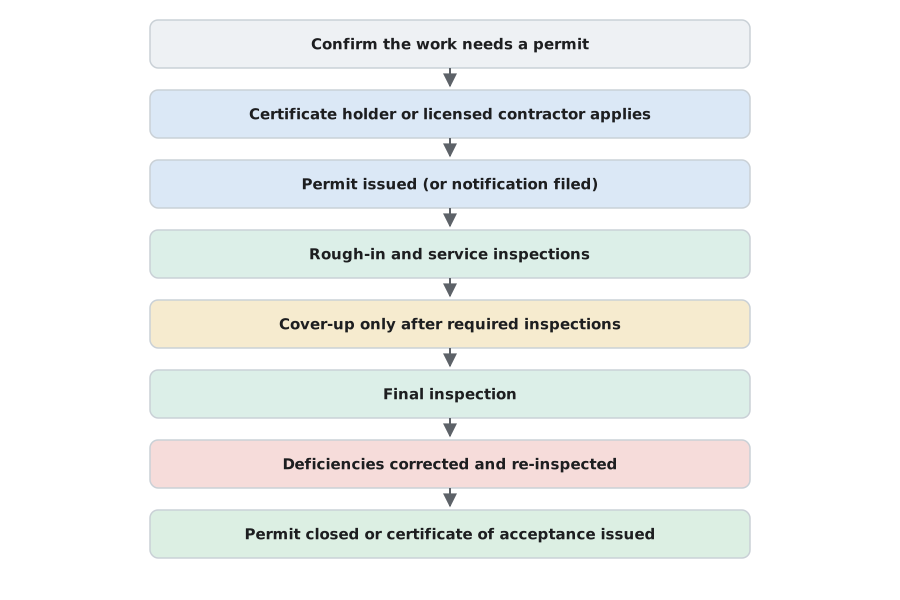
Once a permit is issued, the work is inspected. The usual pattern is a rough-in inspection before walls and ceilings are closed, a service inspection before the utility connects the supply, and a final inspection when the work is complete. Some provinces use risk-based inspection programs, in which the regulator decides how many and which jobs to inspect based on the type of work and the contractor's history. In those systems, not every permit gets a site visit, but the permit holder is still responsible for compliance and must not cover work that the regulator has said it wants to see.
The inspector has wide powers. Safety codes officers and electrical inspectors can enter premises, examine installations, require tests, order work to be corrected, refuse to authorize connection of supply, and in serious cases order the supply disconnected. The Code itself, in Section 2, sets out the duty to correct defects and to give the inspector access. Provincial law adds the enforcement tools: orders, notices of violation, fines and, for credential holders, possible suspension. On the exam, if a question asks what a contractor must do when an inspector issues a deficiency, the answer is to correct it within the time allowed and request re-inspection, not to argue that the inspector is wrong while leaving the deficiency in place.
Disagreement is allowed, but it has its own process. If Priya believes an inspector has misread a rule, she can discuss it, provide documentation, and, if necessary, appeal through the process set out in provincial law. In Alberta, orders issued under the Safety Codes Act can be appealed to the Safety Codes Council. In Ontario, ESA has an internal review process and decisions can be taken further under the Act. Exam questions on appeals usually test two things: that an appeal exists, and that work must not proceed in violation of an order while the appeal is pending unless the order is stayed.
Plans and specifications
Section 2 of the Code also deals with plans and specifications. For larger installations, the inspection authority may require drawings and specifications to be submitted before work starts, and some provinces require them to be prepared and sealed by a professional engineer above certain sizes or for certain occupancies. The Gaetz Avenue dental clinic is a good example. The clinic has a transformer, a new panel, medical equipment and essential electrical loads. Its electrical design was prepared by an engineering firm, and the permit application includes the stamped drawings. Parkland Valley is responsible for installing the work in accordance with the drawings and the Code, and for raising questions when the drawings and the Code disagree.
The exam likes the boundary between the engineer and the contractor. If the drawings show a conductor size that is too small under the Code, the contractor does not simply follow the drawings. The contractor raises a request for information with the engineer, documents the answer, and, if necessary, the drawings are revised. The permit holder remains responsible for a compliant installation even when the error originated in someone else's design.
Worked problem
Reading a deficiency notice
After the rough-in inspection at Gaetz Avenue, the safety codes officer leaves a notice listing three deficiencies: (1) missing bonding jumper on a metal box in the operatory; (2) cables not supported within the required distance of a box in the ceiling; (3) a receptacle within the required distance of the hand-wash sink is not on a GFCI-protected circuit. The notice gives 14 days to correct the work and requires re-inspection before cover-up.
Show solution
- List each deficiency with the rule the inspector cited, and look up each rule in your copy of the Code.
- Assign each correction to a worker, with a target date before the 14-day limit.
- Correct the work, and photograph each correction for the job file.
- Request re-inspection through the permit issuer and keep the drywall crew out of the operatory ceiling until it is passed.
- File the notice, the photos and the re-inspection result in the permit file.
Answer: The deficiencies are corrected and re-inspected before cover-up, and the job file shows exactly what was found and fixed.
The permit holder's ongoing duties
Holding a permit carries duties that continue until the permit is closed. The permit holder must make sure the work matches the permit description, update the permit if the scope grows, keep the work accessible for inspection, correct deficiencies, and not energize or allow energization before the authority permits it. Most provinces also require the permit holder to declare that the work complies with the Code, either in writing or by the act of requesting final inspection. Some permits expire if work is not started within a set period, or if no inspection is requested for a long time, and an expired permit may have to be renewed or reissued.
Gord keeps a permit log for every open job: permit number, address, description, date issued, inspections requested and passed, deficiencies and corrections, and date closed. Priya adds a column for the person on site responsible for each permit. The log is a business tool, but it also answers exam questions. If you can say what goes in a good permit log, you can answer most questions about the permit holder's duties.
# A permit log check: which open permits need attention this week?
from datetime import date

permits = [
    # (permit, job, issued, last inspection, status)
    ("E-24117", "Hartley Farms service", date(2026, 7, 6), date(2026, 10, 20), "rough-in passed"),
    ("E-24390", "Gaetz Ave dental clinic", date(2026, 8, 18), date(2026, 11, 2), "deficiencies open"),
    ("E-23055", "Aspen Ridge suite", date(2026, 3, 2), None, "no inspection yet"),
    ("E-24512", "Riverbend EV chargers", date(2026, 9, 28), date(2026, 10, 30), "final passed"),
]
today = date(2026, 11, 10)
for no, job, issued, last, status in permits:
    age = (today - (last or issued)).days
    flag = ""
    if status == "deficiencies open":
        flag = "correct and request re-inspection"
    elif last is None and age > 180:
        flag = "check permit has not lapsed"
    elif status == "final passed":
        flag = "close permit and file records"
print(f"{no} {job:<26} {status:<20} {age:>3} days {flag}")E-24117 Hartley Farms service rough-in passed 21 days E-24390 Gaetz Ave dental clinic deficiencies open 8 days correct and request re-inspection E-23055 Aspen Ridge suite no inspection yet 253 days check permit has not lapsed E-24512 Riverbend EV chargers final passed 11 days close permit and file records
The numbers in the log above are invented, and the 180-day check is only an example: permit expiry periods are set by each permit issuer. Change the dates and statuses to see which permits the script flags.
Common mistakes
MistakeStarting work before the permit is issued or the notification is filed.
InsteadApply first; most provinces treat work without a permit as an offence even if the work is perfect.
MistakeAssuming a journeyperson can hold a permit for work for others.
InsteadPermits for work for others go to certificate holders or licensed contractors, depending on the province.
MistakeCovering work that the inspector asked to see.
InsteadHold cover-up until the required inspection is passed or waived in writing.
MistakeFollowing drawings that conflict with the Code.
InsteadRaise a request for information; the permit holder answers for compliance.
MistakeIgnoring an order while appealing it.
InsteadComply with the order unless it is formally stayed during the appeal.
Summary and key terms
- The permit records who is responsible for specific electrical work at a specific place.
- The authority having jurisdiction enforces the Code and decides on acceptability.
- Who may hold a permit, and what work is exempt, is set by provincial law.
- Inspectors can order corrections, refuse connection and order disconnection.
- The permit holder's duties continue until the permit is closed.
- Authority having jurisdiction
- The organization or person responsible for enforcing a code requirement in a particular place.
- Permit
- Authorization from the AHJ to do specific electrical work, naming the responsible person or business.
- Safety codes officer
- In Alberta, a person designated under the Safety Codes Act to inspect and enforce in a discipline.
- Notification of work
- In Ontario, the filing with ESA that registers electrical work before it starts.
- Deficiency
- A part of the installation that the inspector has found not to comply.
Practice problems
Work each problem on paper first, then reveal the answer to check.
Which rule in Section 2 of the Code deals with permits?
Show answer
Rule 2-004 (read it in your own copy).
Who decides whether an alternative method is acceptable under a Code rule that refers to the inspection department?
Show answer
The authority having jurisdiction.
Can a journeyperson usually take out a permit for work on a neighbour's house?
Show answer
No; permits for work for others go to certificate holders or licensed contractors.
What should a contractor do when a deficiency notice is issued?
Show answer
Correct the work within the time allowed and request re-inspection, keeping records.
What happens to work during an appeal of an inspector's order?
Show answer
The order must still be followed unless it is formally stayed.
Lesson quiz · 5 questions
Score 60% or more to complete this lesson.
Create a free account to save your progress, take quizzes and earn a certificate.