
MELC-106 · Lesson 5 of 12 · 21 min
Insurance, bonding and liability
▶ Video coming soon A video version of this lesson is on the way.
Electrical work carries risks that no amount of skill removes completely. A fire can start years after a job is finished. A worker can be injured. A customer's equipment can be damaged by a surge during a tie-in. A contractor can go out of business halfway through a project and leave the owner with half a building. Insurance and bonding are how the construction industry spreads those risks, and liability law decides who pays when something goes wrong. Master and contractor exams test this area because regulators, owners and general contractors all rely on contractors carrying the right coverage, and because a certificate holder who lets coverage lapse can expose the company, and sometimes themselves, to losses far beyond the value of any job.
This lesson explains the main kinds of insurance and bonds that electrical contractors carry, how workers' compensation fits in, and the basic principles of liability. Insurance policies are contracts with detailed wording, and bonds are three-party guarantees with their own rules. Treat the descriptions here as general. When an exam question depends on specific coverage, it will give you the facts you need.
Why owners and regulators ask for insurance
Before Parkland Valley could start the Gaetz Avenue clinic, the general contractor asked for three documents: a certificate of insurance showing commercial general liability coverage with the general contractor and owner named as additional insureds, a workers' compensation clearance letter, and the bonds required by the tender. Before Ontario issues or renews an electrical contractor licence, ESA requires proof that the contractor holds the liability insurance set by the regulation and has the required workers' compensation coverage. In Alberta, permit issuers and customers routinely ask for similar proof. Each request has the same purpose: to make sure that if the contractor causes a loss, there is money to pay for it.
Commercial general liability
Commercial general liability, or CGL, insurance is the basic policy every contractor carries. It covers the contractor's legal liability to others for bodily injury and property damage caused by its operations, and usually for completed operations, which means work that has been finished and handed over. If a wiring fault at Aspen Ridge causes a fire two years after the job, the homeowner's insurer may pay for the damage and then pursue Parkland Valley, and Parkland Valley's CGL insurer would defend and, if the claim succeeds, pay up to the policy limits.
CGL policies have limits, deductibles and exclusions. A typical policy has a per-occurrence limit and an aggregate limit for the policy year. Common exclusions include the cost of redoing the contractor's own faulty work, pollution, professional design errors, and damage to property in the contractor's care, custody or control. Contractors who do design work, such as design-build projects, may need professional liability insurance, often called errors and omissions coverage. Contractors with vehicles need commercial auto insurance, and equipment such as lifts and tools may be covered by an equipment floater.
| Coverage | What it protects against | Typical requester |
|---|---|---|
| Commercial general liability | Injury and property damage to others from operations and completed work | Owners, general contractors, regulators |
| Professional liability (errors and omissions) | Losses caused by design or professional advice errors | Owners on design-build or design-assist work |
| Commercial auto | Liability and damage involving company vehicles | Required by provincial law for vehicles |
| Equipment floater | Loss or damage to the contractor's tools and equipment | The contractor itself |
| Builder's risk (course of construction) | Damage to the work under construction, such as fire or theft | Usually the owner or general contractor |
| Workers' compensation | Workers' injuries and illnesses arising from work | Required by provincial law; requested by general contractors |
Certificates and additional insureds
A certificate of insurance is a summary issued by the insurer or broker showing the policy types, numbers, limits and dates. It is evidence of coverage, not the policy itself. Owners and general contractors often require to be named as additional insureds on the contractor's CGL policy, so that claims arising from the contractor's work are defended by the contractor's insurer rather than their own. Contracts may also require the insurer to give notice before cancelling the policy, and a waiver of subrogation, which stops the insurer from suing other parties that the contract protects.
Gord keeps a certificate folder for every client and a calendar of policy renewal dates. Priya learns why when a renewal arrives late one year: the general contractor on another job refused to let the crew on site until a current certificate arrived. On the exam, if a question asks what a contractor should do when its liability insurance is about to lapse, the answer is to renew it before it lapses, notify the regulator if the licensing rules require it, and stop work if coverage cannot be maintained. In Ontario, for example, the regulator's guideline requires a contractor whose required insurance lapses to notify ESA and stop operating until the requirement is met.
Workers' compensation
Every province has a workers' compensation system that provides no-fault benefits to workers injured at work, paid from premiums charged to employers. In exchange, workers covered by the system generally cannot sue their employer for the injury. Coverage is compulsory for most construction employers. Alberta's system is run by the Workers' Compensation Board, often called WCB-Alberta. Ontario's is run by the Workplace Safety and Insurance Board, or WSIB. Each province sets its own rules on who must register, how premiums are calculated, and how quickly injuries must be reported.
Two workers' compensation rules matter on almost every job. First, a principal, such as a general contractor or owner, can become liable for unpaid premiums of contractors it hires if those contractors do not have coverage, so general contractors ask for a clearance letter showing the subcontractor is registered and in good standing. Second, employers must report injuries to the board within a set period, keep records, and cooperate with return-to-work programs. A small contractor that treats an injury informally, paying for a worker's time off without reporting it, can face penalties and lose the protection the system provides.
Premiums depend on the industry rate group and the employer's own claims history. Contractors with fewer and less costly claims can earn rebates or lower rates, and contractors with many claims can pay surcharges. That gives safety a direct financial value, which is one reason the safety program in lessons 7 and 8 is also a business decision.
Surety bonds
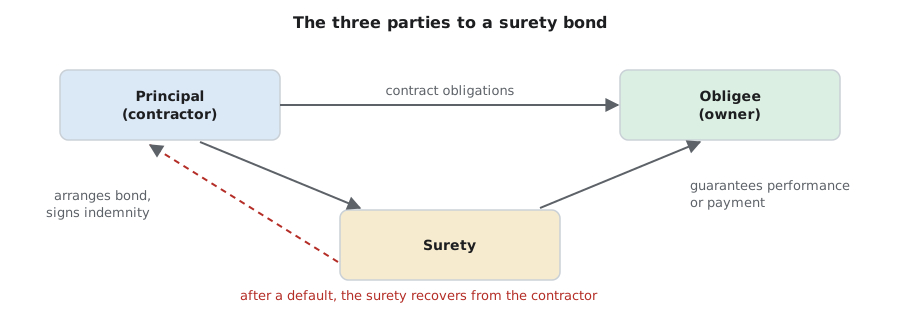
A surety bond is a three-party guarantee. The contractor, called the principal, arranges for a surety company to guarantee its performance or payment obligations to the owner, called the obligee. If the contractor fails, the surety pays or completes the work, up to the bond amount, and then seeks to recover its loss from the contractor and, usually, its owners under an indemnity agreement. A bond is therefore not insurance for the contractor. It is credit, and the surety only issues it after examining the contractor's finances, experience and capacity.
Three bonds are common on Canadian construction projects. A bid bond, submitted with a tender, guarantees that a successful bidder will enter into the contract and provide the required performance and payment bonds. A performance bond guarantees that the contractor will perform the contract. A labour and material payment bond guarantees that the contractor will pay its subcontractors and suppliers. On public projects and many larger private ones, performance and payment bonds are each commonly set at half the contract price, and standard bond forms are published by the Canadian Construction Documents Committee.
Worked problem
Bonding the Gaetz Avenue subcontract
The tender for the Gaetz Avenue clinic requires the electrical subcontractor to provide a bid bond for 10 in 100 of its bid, and, if successful, a performance bond and a labour and material payment bond each for half of the subcontract price. Parkland Valley's bid is 184,000 dollars.
Show solution
- Bid bond: 184,000 x 0.10 = 18,400 dollars, submitted with the bid.
- Performance bond: 184,000 x 0.5 = 92,000 dollars, provided after award.
- Labour and material payment bond: 184,000 x 0.5 = 92,000 dollars, provided after award.
- The surety charges a premium based on the bond amounts and Parkland Valley's financial strength, and Gord signs an indemnity agreement.
- Priya adds the bond premium to the estimate as a job cost, because it is a cost of winning and doing this particular job.
Answer: Bonds of 18,400 dollars (bid), 92,000 dollars (performance) and 92,000 dollars (payment), with the premium included in the price.
Liability basics
Liability is the legal responsibility to compensate someone for a loss. For contractors, it comes from three main sources. Contract liability arises when the contractor breaks a promise in the contract, such as failing to complete on time or failing to meet the specifications. Negligence arises when the contractor fails to take the care a reasonable contractor would take, and someone is harmed as a result. Statutory liability arises when a law imposes a duty, such as the duties of permit holders, employers and constructors, and a breach causes harm or results in penalties.
Negligence is the source of most serious claims. To succeed, a person who was harmed generally must show that the contractor owed them a duty of care, that the contractor fell below the standard of care, and that the failure caused the harm. The standard of care for electrical work is closely tied to the Code and the manufacturer's instructions. A contractor whose work violates the Code will find it very hard to argue that it took reasonable care. Following the Code does not guarantee that a contractor will never be liable, but failing to follow it makes liability far more likely.
Liability can also be personal. Employees can be personally liable for their own negligence, although employers are usually vicariously liable for employees acting in the course of their work. Directors and officers can face personal liability under some statutes, such as occupational health and safety laws, which can impose duties on directors to take reasonable care that the corporation complies, and the trust provisions of lien laws. Incorporating a business limits some risks, but it does not remove all personal exposure.
Limiting liability in contracts
Contracts often contain clauses that allocate liability: indemnities, in which one party agrees to cover another's losses; limitations of liability, which cap damages; and exclusions of certain kinds of damages, such as lost profits. Owners and general contractors often try to pass as much risk as possible down to subcontractors. Contractors should read these clauses carefully, compare them with their insurance coverage, and negotiate when a clause would make them responsible for risks their insurance does not cover. A broad indemnity that makes Parkland Valley responsible for losses caused by others' negligence, for example, may be uninsurable.
Courts look closely at exclusion and limitation clauses and may refuse to enforce them in some circumstances, such as when they are unconscionable or contrary to public policy. Consumer protection laws also limit what contractors can exclude in contracts with homeowners. The safest approach is to do the work properly, document it, carry insurance that matches the contract's risk allocation, and get advice from a broker or lawyer on unusual clauses.
# Does the CGL policy cover what the contracts require?
policy = {"per_occurrence": 2_000_000, "aggregate": 5_000_000, "completed_operations": True}
contracts = [
    ("Gaetz Ave clinic", 5_000_000, True),
    ("Hartley Farms", 2_000_000, True),
    ("Riverbend EV retrofit", 2_000_000, False),
]
for job, required, needs_completed_ops in contracts:
    ok = policy["per_occurrence"] >= required and (policy["completed_operations"] or not needs_completed_ops)
    gap = "" if ok else "  -> raise limit or add an umbrella policy"
print(f"{job:<24} requires {required:>9,} covered: {ok}{gap}")Gaetz Ave clinic requires 5,000,000 covered: False -> raise limit or add an umbrella policy Hartley Farms requires 2,000,000 covered: True Riverbend EV retrofit requires 2,000,000 covered: True
The limits in the calculator are invented. Real requirements come from each contract and from licensing rules. When a contract requires a higher limit than the base policy, contractors often add an umbrella or excess liability policy rather than raising every limit.
Reporting a claim
Insurance policies require the insured to report claims and circumstances that could lead to a claim promptly, often as soon as practicable. A contractor that hears a customer blame its work for a fire, a flood or an injury should notify its broker or insurer right away, even if the contractor believes the claim has no merit. Late notice can give the insurer grounds to deny coverage. The contractor should also avoid admitting liability or promising to pay, because that can prejudice the insurer's defence, and should preserve all records and physical evidence related to the job.
Common mistakes
MistakeTreating a certificate of insurance as the policy.
InsteadA certificate summarizes coverage; the policy wording decides what is covered.
MistakeLetting liability insurance lapse between renewals.
InsteadCalendar renewal dates; in some provinces a lapse requires notifying the regulator and stopping work.
MistakeTreating a surety bond as insurance for the contractor.
InsteadA bond is a guarantee to the owner; the surety recovers its losses from the contractor.
MistakePaying for a worker's injury informally instead of reporting it.
InsteadReport injuries to the workers' compensation board within the required time.
MistakeSigning broad indemnities without checking insurance.
InsteadCompare risk allocation clauses with coverage and negotiate uninsurable terms.
Summary and key terms
- CGL insurance covers liability for injury and property damage from operations and completed work.
- Certificates of insurance and additional insured status are common contract requirements.
- Workers' compensation is compulsory for most construction employers and requires prompt injury reporting.
- Bid, performance and payment bonds guarantee the contractor's obligations to the owner.
- Liability arises from contract, negligence and statute, and can sometimes be personal.
- Commercial general liability
- Insurance covering a business's liability to others for injury and property damage.
- Additional insured
- A party added to another's policy so that claims arising from that party's work are covered.
- Clearance letter
- A workers' compensation document confirming a contractor's account is in good standing.
- Surety bond
- A three-party guarantee by a surety of a contractor's obligations to an owner.
- Indemnity
- A promise by one party to cover another party's losses.
Practice problems
Work each problem on paper first, then reveal the answer to check.
What is the difference between a certificate of insurance and an insurance policy?
Show answer
The certificate summarizes coverage; the policy contains the actual terms.
Who are the three parties to a surety bond?
Show answer
The principal (contractor), the surety and the obligee (owner).
What does a labour and material payment bond guarantee?
Show answer
That the contractor will pay its subcontractors and suppliers.
Why do general contractors ask subcontractors for workers' compensation clearance letters?
Show answer
A principal can be liable for unpaid premiums of contractors it hires that lack coverage.
Name the three elements a claimant generally must prove in negligence.
Show answer
A duty of care, a breach of the standard of care, and harm caused by the breach.
Lesson quiz · 5 questions
Score 60% or more to complete this lesson.
Create a free account to save your progress, take quizzes and earn a certificate.