
MELC-106 · Lesson 7 of 12 · 21 min
Occupational health and safety duties of employers
▶ Video coming soon A video version of this lesson is on the way.
Every province and territory has occupational health and safety legislation that sets duties for employers, supervisors, workers and others at work sites. Federally regulated workplaces, such as some telecommunications and interprovincial transportation operations, fall under the Canada Labour Code instead. For an electrical contractor, health and safety law is not a separate subject from the Code. The Code protects the people who will use an installation. Health and safety law protects the people building and maintaining it. A certificate holder who runs crews is almost always also a supervisor under health and safety law, and often the person who carries the employer's duties on site. Master and contractor exams test these duties because electrical work is high-risk and because regulators hold employers and supervisors accountable when workers are hurt.
This lesson covers the structure of health and safety law, the main duties of each party, hazard assessment, worker rights, incident reporting and enforcement. It uses Alberta and Ontario as examples. Alberta's framework is the Occupational Health and Safety Act, the OHS Regulation and the OHS Code. Ontario's is the Occupational Health and Safety Act and its regulations, including Ontario Regulation 213/91 for construction projects. The electrical-specific requirements and CSA Z462 are covered in lesson 8.
The internal responsibility system
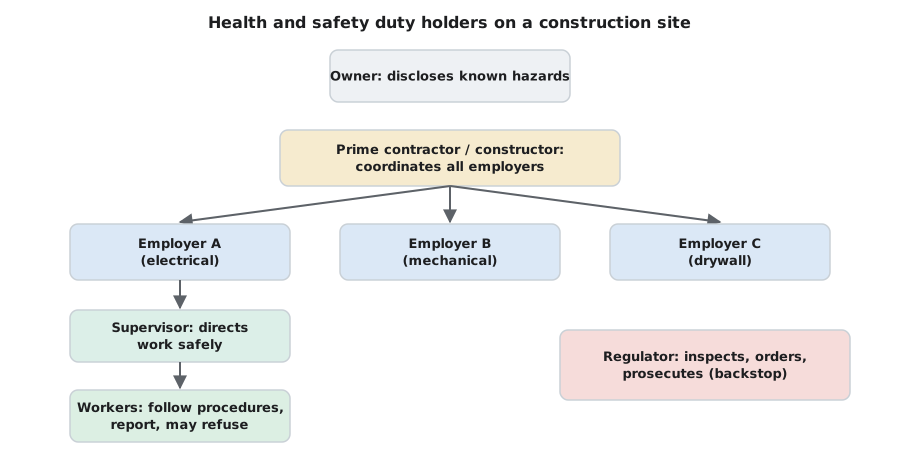
Canadian health and safety law is built on the idea of an internal responsibility system. Everyone at a work site has a role in safety, matched to their authority and knowledge. Employers have the broadest duties because they control the work, the equipment and the money. Supervisors direct the work and must make sure it is done safely. Workers must follow safe procedures, use protective equipment and report hazards. Owners, prime contractors, constructors, suppliers and service providers have duties too. The regulator's inspectors are a backstop, not the main mechanism. Safety is supposed to be managed inside the workplace, every day, by the people doing the work.
On a construction site, several employers may be working at once, and the law needs a single party to coordinate them. Alberta calls that party the prime contractor. Ontario calls it the constructor. On the Gaetz Avenue clinic, the general contractor is the prime contractor, responsible for coordinating health and safety among all employers on site. Parkland Valley remains responsible for its own workers and its own work, but must follow the site rules and cooperate with the prime contractor. On a small job like the Aspen Ridge basement suite, Parkland Valley may be the only employer on site and may become the prime contractor or constructor itself.
Employer duties
Employer duties are written broadly. In general terms, an employer must ensure, as far as is reasonably practicable, the health and safety of its workers and of other people affected by its work. In practice, that means identifying hazards, eliminating or controlling them, providing and maintaining safe equipment and protective equipment, providing training, instruction and competent supervision, establishing safe work procedures, preparing for emergencies, investigating incidents, involving workers through health and safety committees or representatives, and keeping records. Many provinces also require employers above a certain size to have a written health and safety program or policy, and to address workplace violence and harassment.
The phrase reasonably practicable matters. It means taking the precautions that a reasonable employer would take, considering the severity and likelihood of the hazard and the cost and availability of controls. It does not mean every possible precaution regardless of cost, but for serious hazards like electrical shock and arc flash, the bar is high. Employers are expected to know the standards that apply to their work, such as CSA Z462 for electrical safety, and to follow them or achieve an equivalent level of protection.
| Duty holder | Typical duties (general) | Example on a Parkland Valley job |
|---|---|---|
| Employer | Hazard assessment, controls, training, equipment, supervision, procedures, records | Parkland Valley's safety program and job hazard assessments |
| Supervisor | Ensure work is done safely, workers know hazards, procedures are followed | Priya as lead hand on Hartley Farms |
| Worker | Follow procedures, use protective equipment, report hazards, refuse unsafe work | Tyler reporting a damaged extension cord |
| Prime contractor or constructor | Coordinate safety among employers on a multi-employer site | The general contractor at Gaetz Avenue |
| Owner | Provide information about known hazards on their site | The farm owner disclosing an old buried line |
| Supplier | Provide safe equipment and safety information | A rental company supplying an inspected lift |
Supervisor duties
A supervisor is a person who has charge of a workplace or authority over a worker. A lead hand who assigns work and directs a crew is usually a supervisor in the legal sense, even if the job title says otherwise. Supervisors must make sure workers do their work safely and in accordance with the law and the employer's procedures, must advise workers of hazards they know about, must make sure workers use the required protective equipment, and must take every reasonable precaution for workers' safety. Several provinces require supervisors to be competent, which usually means qualified by knowledge, training and experience to organize the work, familiar with the law, and aware of the hazards.
Priya realizes she has been a supervisor for years without thinking about the legal side. When she assigns Tyler to pull wire in the Hartley Farms dryer room, she is responsible for making sure he knows the hazards, has the right equipment and is working under a safe procedure. When she leaves him to work alone while she goes to the supplier, she must make sure the arrangement meets the working alone rules in the province's legislation. If Tyler is hurt, the investigation will ask what Priya knew, what she told him and what she did.
Worker rights
Health and safety law gives workers three basic rights. The right to know means workers must be told about hazards in their work and given the information and training they need. The right to participate means workers can take part in health and safety committees or as representatives, and must be consulted on health and safety matters. The right to refuse means a worker can refuse work that they reasonably believe is dangerous, without being punished for doing so. Alberta and Ontario both set out a procedure for work refusals: the worker reports the concern, the employer investigates, and if the matter is not resolved, an inspector may be called. Employers cannot retaliate against workers for exercising these rights.
Tyler tests this in a practice discussion. Suppose a foreman tells him to replace a breaker in an energized panel because shutting down the farm's grain dryer would cost the owner money. Tyler believes the work is dangerous without an energized work permit and arc flash protection. Can he refuse? Yes, if he reasonably believes the work is dangerous. Must the employer investigate? Yes. Can the employer discipline him for refusing? Not lawfully. Exam questions on refusals usually test this sequence and the prohibition on reprisals.
Hazard assessment and control
Hazard assessment is the core tool of the employer's safety program. Alberta's OHS Code requires employers to assess a work site and identify existing and potential hazards before work begins, to prepare a written assessment, to involve workers, and to repeat the assessment when conditions change. Ontario's construction regulation and general duties lead to the same practice. A good hazard assessment for electrical work lists each task, the hazards it creates, and the controls that will be used, and it is reviewed with the crew at the start of each shift or task.
Controls follow a hierarchy. The most effective is elimination: removing the hazard, such as de-energizing equipment before working on it. Next is substitution, such as using a lower-voltage control circuit. Then engineering controls, such as barriers, insulated tools and remote racking devices. Then administrative controls, such as procedures, permits, signs and training. Last is personal protective equipment. The hierarchy matters on the exam because questions often ask which control is most effective, and the answer is almost always the one highest in the hierarchy that is practical for the task.
Worked problem
A hazard assessment for the dryer room tie-in
Priya prepares a hazard assessment for connecting the new grain dryer feeder to the motor control centre at Hartley Farms. The MCC is energized and supplies the existing aeration fans.
Show solution
- Task: terminate the dryer feeder in a spare MCC bucket and test.
- Hazards: shock and arc flash from adjacent energized buckets; grain dust; working at height on a ladder; manual handling of heavy conductors.
- Elimination: shut down and lock out the MCC during the tie-in, scheduled with the farm owner for a morning when the fans can be off.
- Engineering and administrative: verify absence of voltage, apply locks under the lockout procedure, clean dust from the work area, use a platform ladder.
- PPE: arc-rated clothing and gloves for the verification step; standard PPE once the electrically safe work condition is established.
Answer: A written assessment that de-energizes the MCC, with the remaining hazards controlled and reviewed with the crew.
Incidents and reporting
When an incident happens, the employer must respond, investigate and report. Serious injuries, fatalities and certain dangerous occurrences must be reported to the regulator immediately or within a short period, and the scene usually must be preserved until an inspector releases it, except to save life or prevent further injury. Alberta requires the prime contractor or employer to report serious injuries and certain incidents to the regulator as soon as possible. Ontario requires the constructor and employer to notify the ministry immediately of critical injuries and deaths, and to provide a written report within a set number of hours. Employers must also report injuries to the workers' compensation board within its deadlines, which are separate from the health and safety reporting rules.
Investigations look for root causes, not only the immediate act. If Tyler gets a shock because a circuit was mislabelled, the investigation will ask why the circuit was mislabelled, why the absence of voltage was not verified, and whether the procedure and training were adequate. The output is corrective action that prevents a repeat. For the exam, remember three things: report to the right agency within its deadline, preserve the scene, and investigate to find and fix the cause.
Enforcement and penalties
Health and safety inspectors can enter work sites, inspect, ask questions, take samples and photographs, and issue orders requiring compliance, stopping work or prohibiting the use of equipment. Alberta and Ontario both allow administrative penalties or tickets for some violations, and prosecution for serious ones. Penalties on conviction can reach hundreds of thousands of dollars per count for corporations, and individuals, including supervisors and directors, can be fined and, in some cases, imprisoned. The Criminal Code of Canada also contains provisions, added in 2004 after the Westray mine disaster, that make organizations and individuals criminally responsible for failing to take reasonable steps to prevent bodily harm to workers.
Due diligence is the main defence for employers and supervisors charged under health and safety law. It means showing that every reasonable precaution was taken to prevent the incident. Due diligence is proved with records: the hazard assessment, the training records, the safe work procedures, the inspections, the toolbox talk sign-in sheets and the disciplinary records showing that rules were enforced. That is why lesson 10 on records matters so much. In a prosecution, a safety program that exists only in people's heads does not count.
# Which hazard control is highest in the hierarchy?
hierarchy = ["elimination", "substitution", "engineering", "administrative", "PPE"]
options = {
    "Work on the panel de-energized and locked out": "elimination",
    "Wear arc-rated clothing while working live": "PPE",
    "Install a barrier over adjacent live terminals": "engineering",
    "Use an energized work permit and an attendant": "administrative",
}
best = min(options, key=lambda o: hierarchy.index(options[o]))
for option, level in sorted(options.items(), key=lambda kv: hierarchy.index(kv[1])):
    print(f"{hierarchy.index(level) + 1}. {level:<15} {option}")
print("Most effective:", best)1. elimination Work on the panel de-energized and locked out 3. engineering Install a barrier over adjacent live terminals 4. administrative Use an energized work permit and an attendant 5. PPE Wear arc-rated clothing while working live Most effective: Work on the panel de-energized and locked out
Common mistakes
MistakeThinking a lead hand is not a supervisor because of the job title.
InsteadAnyone with charge of a workplace or authority over workers is usually a supervisor in law.
MistakeChoosing PPE first when a higher control is practical.
InsteadFollow the hierarchy: eliminate, substitute, engineer, administer, then PPE.
MistakeDisciplining a worker for refusing dangerous work.
InsteadReprisals for exercising the right to refuse are prohibited.
MistakeCleaning up an incident scene before the regulator arrives.
InsteadPreserve the scene except to save life or prevent further harm.
MistakeKeeping safety procedures only in people's heads.
InsteadDue diligence is proved with written assessments, training records and inspections.
Summary and key terms
- Health and safety law sets duties for employers, supervisors, workers, prime contractors, owners and suppliers.
- The internal responsibility system makes safety everyone's job, with the regulator as a backstop.
- Workers have the rights to know, to participate and to refuse dangerous work without reprisal.
- Hazard assessments identify hazards and apply controls in the order of the hierarchy.
- Serious incidents must be reported and investigated; due diligence is the main defence.
- Internal responsibility system
- The principle that everyone at a workplace shares responsibility for safety according to their role.
- Prime contractor
- In Alberta, the party responsible for coordinating health and safety on a multi-employer work site.
- Constructor
- In Ontario, the party responsible for health and safety on a construction project.
- Hierarchy of controls
- The order of preference for hazard controls from elimination down to PPE.
- Due diligence
- Taking every reasonable precaution to prevent harm; the main defence to health and safety charges.
Practice problems
Work each problem on paper first, then reveal the answer to check.
What are the three basic worker rights under health and safety law?
Show answer
The right to know, the right to participate and the right to refuse dangerous work.
What does Alberta call the party that coordinates safety on a multi-employer site, and what does Ontario call it?
Show answer
Prime contractor in Alberta; constructor in Ontario.
Which control is most effective for work on electrical equipment?
Show answer
Elimination, usually by de-energizing and establishing an electrically safe work condition.
What must usually happen to the scene of a serious incident?
Show answer
It must be preserved until released by an inspector, except to save life or prevent further harm.
How is due diligence proved?
Show answer
With records showing reasonable precautions: hazard assessments, training, procedures, inspections and enforcement.
Lesson quiz · 5 questions
Score 60% or more to complete this lesson.
Create a free account to save your progress, take quizzes and earn a certificate.