
MELC-106 · Lesson 11 of 12 · 20 min
Open-book exam technique and time management
▶ Video coming soon A video version of this lesson is on the way.
Most Canadian master and contractor exams are open book, timed and multiple choice. Open book sounds like an advantage, and it is, but only for candidates who have practised using the book under time pressure. A candidate who tries to look up every question will run out of time. A candidate who looks up nothing will miss questions that depend on exact wording and numbers. The skill the exam rewards is knowing which questions to answer from knowledge, which to look up, and how long to spend on each. This lesson brings together the technique Priya has built over the whole core, with specific attention to the business and legislation questions from this course.
Exam formats differ between provinces and change over time. The number of questions, the time limit, the pass mark, the materials allowed, whether notes in the code book are permitted, and whether a calculator must be non-programmable are all set by the regulator. Ontario's ESA, for example, allows the latest Ontario Electrical Safety Code, a booklet of relevant legislation and a non-programmable calculator for the Master Electrician exam, and allows notes in the code book only if they clarify Code content. Read your own candidate guide for the current rules before you prepare your materials, and again the week before the exam.
Preparing the materials
If tabs are allowed, a well-tabbed code book is worth several marks. Priya's colour scheme from MELC-101 still works: blue for general sections, green for supplementary sections, yellow for tables, orange for the appendix and red for the index and her lookup sheet. For this course, she adds a second set of tabs to the legislation booklet, if one is allowed, or prepares a short list of statute sections she needs to know from memory if it is not. Every tab must be of a type the regulator allows, and nothing written on a tab may go beyond what the rules permit.
She also prepares the physical kit the week before: the approved calculator with fresh batteries and a spare, photo identification, the exam confirmation, pencils and erasers if the format needs them, a watch if allowed, and the materials exactly as approved. Arriving with a wrong edition of the Code, an unapproved calculator or a book with prohibited notes can mean being refused entry or having materials removed. Those are avoidable losses.
The two-pass method
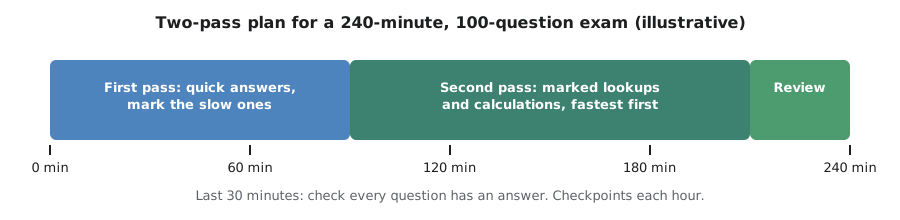
The most reliable way to manage time in a long multiple-choice exam is to make two passes. On the first pass, answer every question you can answer confidently in under a minute, from knowledge or with a quick, certain lookup. Mark every question that needs a longer lookup or calculation, and move on without answering it, or with a best guess you can revisit if the format allows. On the second pass, work through the marked questions in order of how quickly you expect to solve them. Leave the slowest and least certain for last.
The two-pass method works because exam questions are worth the same marks whether they are easy or hard. Spending eight minutes on one difficult calculation while three easy questions at the end go unanswered is a poor trade. It also reduces panic. By the end of the first pass, most candidates have answered well over half the questions and can see how much time is left for the rest.
A time budget
Before the exam starts, divide the time available by the number of questions to get an average time per question, then plan the passes around it. If an exam had 100 questions in 4 hours, the average would be 2.4 minutes per question. A sensible plan might use about 90 minutes for the first pass, about 120 minutes for the second pass and 30 minutes for review. Priya writes checkpoint times on her scrap paper: where she should be at the end of each hour. If she falls behind, she speeds up her first pass, guesses on the slowest marked questions and keeps moving.
# Exam time budget and checkpoints
questions = 100
minutes = 240
first_pass, second_pass, review = 90, 120, 30
assert first_pass + second_pass + review == minutes

print("Average minutes per question:", round(minutes / questions, 2))
for hour in range(1, minutes // 60 + 1):
    elapsed = hour * 60
    if elapsed <= first_pass:
        target = round(questions * elapsed / first_pass)
        print(f"After hour {hour}: first pass at about question {target}")
    else:
print(f"After hour {hour}: second pass and review under way")Average minutes per question: 2.4 After hour 1: first pass at about question 67 After hour 2: second pass and review under way After hour 3: second pass and review under way After hour 4: second pass and review under way
The exam size and length in the script are an example only. Enter the numbers from your own candidate guide and adjust the passes to suit your speed, which you should measure on full mock exams.
Lookup technique for Code questions
MELC-101 covered lookup technique in detail. The short version: identify the topic and the section before opening the book, go to the section or table directly using your tabs, use the index when you do not know the section, read the whole rule including its subrules and exceptions, check the definitions of any term that matters, and check the appendix notes when the rule refers to them. For calculation questions, write down what is given, what is asked and which rule or table applies before calculating. Most errors in calculation questions come from misreading what is asked, not from arithmetic.
Be especially careful with questions that test exceptions and conditions. A question may describe a situation that looks like the general rule, but includes one detail, such as a dwelling unit, a wet location or a conductor of a certain size, that brings in an exception. Before choosing an answer, scan the question for details you have not used. In a well-written exam question, every detail is there for a reason.
Technique for business and legislation questions
Business and legislation questions need a slightly different approach. First, identify which statute or document the question is about: the safety codes or electrical Act and regulations, the occupational health and safety law, the lien or prompt payment Act, workers' compensation, apprenticeship, contract terms or CSA Z462. Second, identify the parties and their roles: owner, prime contractor, contractor, subcontractor, employer, supervisor, worker, permit holder. Third, look for the deadline, duty or prohibition the question is testing. If a legislation booklet is allowed, look up the section. If not, rely on your one-page statute sheets, which you have studied until the main numbers and duties are automatic.
When two answers both seem reasonable, choose the one that follows the legislation most literally and most conservatively. Exam writers write questions to test the rule, not the workaround. If a question asks what a contractor should do when an owner asks them to start before the permit is issued, the answer is to wait for the permit, even though some contractors might start and apply the same day. If a question asks what a supervisor should do when a worker refuses unsafe work, the answer is to investigate without reprisal, not to reassign the work to someone who will do it.
| Question type | First step | Typical trap |
|---|---|---|
| Code lookup | Identify section, go directly to it, read the whole rule | Missing an exception or a definition |
| Code calculation | Write given, asked and applicable rule before calculating | Answering a different question from the one asked |
| Regulatory | Identify the statute and the role of each party | Using another province's rule |
| Payment and liens | Find the deadline and the starting event | Counting from the wrong date |
| Safety | Apply the hierarchy of controls and Z462 principles | Choosing PPE when elimination is possible |
| Contracts | Look for scope, notice and change clauses | Assuming verbal changes are binding enough |
Guessing, changing answers and checking
If the exam does not penalize wrong answers, never leave a question blank. Eliminate any choices you can rule out, then choose from what remains. On a four-choice question, eliminating two choices doubles your chance of guessing correctly. Most candidates should change an answer only when they find a specific reason, such as a misread question or a rule they overlooked, not because of a vague feeling. In the final review, check that every question has an answer and that answers are recorded where the exam requires them.
Watch for distractors built from common errors. In calculation questions, wrong choices often match the result of a typical mistake: forgetting a demand factor, using the wrong temperature column or misreading units. In legislation questions, wrong choices often use real numbers from a different context, such as a 60-day lien period offered as an answer to a payment deadline question. Recognizing that a choice is the right number for the wrong rule is a useful way to eliminate it.
Practising under exam conditions
Technique only becomes reliable through practice. Priya's plan includes three full mock exams for the technical half and two full mixed mock exams in the last two weeks. Each mock is done in one sitting, with only the approved materials, a real time limit and no interruptions. After each mock, she reviews every question she got wrong and every question she got right but was unsure about, and records why: missing knowledge, slow lookup, misread question, calculation error or time pressure. The pattern tells her what to study next.
She also practises the day itself: sleeping normally the week before, eating before the exam, arriving early, and taking a short pause at each checkpoint to breathe and reset. These sound minor, but candidates who are rested and calm read questions more accurately, and reading accuracy is what this kind of exam tests most.
Worked problem
Recovering from a slow start
In a mock exam with 100 questions and 4 hours, Priya reaches question 40 at the end of the first hour, behind her checkpoint of about question 67 for the first pass. She has marked 12 questions for later.
Show solution
- Recognize the problem at the checkpoint instead of at the end.
- For the rest of the first pass, answer only questions she can do from knowledge or with an immediate lookup, marking everything else.
- Finish the first pass by about 1 hour 40 minutes, accepting that more questions are marked.
- Use the second pass on marked questions in order of expected speed, guessing on any that would take more than about 5 minutes.
- Keep the last 20 minutes for checking that every question is answered.
Answer: A recovered schedule with every question answered and time used where it gains the most marks.
Handling calculation questions efficiently
Calculation questions take the most time, so they deserve a routine. Write the knowns in a column with units. Write the question in your own words: what exactly is being asked for, and in what unit. Identify the rule or table and note its number on your scrap paper so you can find it again quickly. Do the calculation once, carefully, then check it with a quick estimate: is the answer roughly the size you would expect? A 200 A dwelling service calculated at 2,000 A, or a voltage drop of 40 V on a short branch circuit, signals an error in units or a missed step.
If the answer choices are close together, the question is testing a specific step, such as rounding a conductor size up or applying a demand factor. If the choices are far apart, the question is testing whether you used the right method at all. Either way, matching your result exactly to one choice is a good sign; if your result matches none, recheck the units and what was asked before guessing.
Keep the calculator simple and familiar. Practise with the exact model you will bring, including its square root key and its order of operations, so there are no surprises on exam day.
Common mistakes
MistakeLooking up every question in an open-book exam.
InsteadAnswer known questions from knowledge and save lookups for questions that need them.
MistakeSpending many minutes on one hard question early.
InsteadMark it, move on and return in the second pass.
MistakeBringing materials the regulator does not allow.
InsteadCheck the candidate guide and prepare materials exactly as approved.
MistakeLeaving questions blank when there is no penalty for guessing.
InsteadEliminate what you can and choose from the rest.
MistakeChanging answers on a vague feeling.
InsteadChange only when you find a specific reason.
Summary and key terms
- Open-book exams reward knowing what to look up and how long to spend.
- The two-pass method answers quick questions first and marked questions later.
- A time budget with checkpoints shows early when to speed up.
- Business questions need the right statute, the parties' roles and the deadline or duty tested.
- Full mock exams under real conditions build reliable technique.
- Two-pass method
- Answering quick questions first and returning to marked, slower questions in a second pass.
- Checkpoint
- A planned point in the exam time at which progress is compared with the time budget.
- Distractor
- A wrong answer choice designed to attract candidates who make a common error.
- Approved materials
- The references and equipment the regulator allows in the exam room.
- Mock exam
- A full-length practice exam taken under real time and material limits.
Practice problems
Work each problem on paper first, then reveal the answer to check.
An exam has 120 questions in 4 hours. What is the average time per question?
Show answer
2 minutes.
What is the purpose of marking questions on the first pass?
Show answer
To save slow questions for later so quick marks are collected first.
When should you change an answer?
Show answer
When you find a specific reason, such as a misread question or overlooked rule.
What should you identify first in a legislation question?
Show answer
Which statute or document applies, and the role of each party.
What should you record after a mock exam?
Show answer
Why each question was missed or uncertain, to guide further study.
Lesson quiz · 5 questions
Score 60% or more to complete this lesson.
Create a free account to save your progress, take quizzes and earn a certificate.