
MELC-106 · Lesson 3 of 12 · 20 min
Contracts, quotes and change orders
▶ Video coming soon A video version of this lesson is on the way.
An electrical contractor sells two things: a finished installation and a promise about it. The contract is where the promise is written down. It says what work will be done, for what price, by when, to what standard, and what happens when something changes or goes wrong. Most disputes on construction projects are not about bad wiring. They are about what was in the scope, what was extra, who caused a delay and who pays for it. Master and contractor exams test contracts because a certificate holder who signs a careless contract can lose more money on one job than a bad estimate would cost in a year.
This lesson covers the life of a contract on a typical electrical job: the estimate, the quote or tender, the contract form, the scope and exclusions, the schedule, change orders, warranties and closing the contract. Contract law in the common law provinces is broadly similar, and Quebec's civil law reaches similar practical results by a different route. Treat everything here as general principles. When an exam question depends on a specific contract form or statute, the question will usually tell you, and you should answer from that document.
From estimate to quote
The estimate is the contractor's internal calculation of what the job will cost. It starts with a take-off: counting devices, measuring runs and listing equipment from the drawings or a site visit. Material is priced from supplier quotes. Labour is estimated in hours using the company's own production rates or a published labour unit system, then multiplied by a loaded labour rate that includes wages, benefits, payroll taxes, workers' compensation premiums and vacation pay. Equipment such as lifts and trenchers, permit fees, engineering, disposal and travel are added. Then come overhead, which covers the cost of running the business, and profit.
The quote is the price offered to the customer, with the conditions that go with it. A good quote states exactly what is included, what is excluded, which drawings and specifications it is based on, how long the price is valid, the payment terms, and any assumptions. Marcus thinks the exclusions are the most important part. A quote for the Aspen Ridge basement suite that says supply and install wiring for the suite as shown on drawing E1 is far safer than one that says wire the basement, because the first one ties the price to a defined scope.
| Line | Basis | Amount (illustrative) |
|---|---|---|
| Material | Supplier quotes for wire, boxes, devices, panel and fixtures | 6,850 dollars |
| Labour | 96 hours at a loaded rate of 88 dollars per hour | 8,448 dollars |
| Permit and inspection fees | Permit issuer fee schedule | 420 dollars |
| Equipment and disposal | Rented core drill, bin share | 310 dollars |
| Direct cost subtotal | 16,028 dollars | |
| Overhead | 12 dollars per 100 dollars of direct cost | 1,923 dollars |
| Profit | 10 dollars per 100 dollars of cost plus overhead | 1,795 dollars |
| Quoted price before tax | 19,746 dollars |
Note the difference between markup and margin. Overhead and profit in the table are added as a fraction of cost: that is markup. Margin is profit as a fraction of the selling price. A 10 in 100 markup on cost gives a margin of a little over 9 in 100 of the price. Exam questions sometimes test the difference, and contractors who confuse the two routinely underprice their work.
# Markup on cost versus margin on price
def price_from_cost(cost, overhead_rate, profit_rate):
    with_overhead = cost * (1 + overhead_rate)
    return with_overhead * (1 + profit_rate)

direct = 16028
price = price_from_cost(direct, 0.12, 0.10)
profit = price - direct * 1.12
print("Quoted price:", round(price))
print("Profit:", round(profit))
print("Margin on price, per 100 dollars:", round(100 * profit / price, 2))Quoted price: 19746 Profit: 1795 Margin on price, per 100 dollars: 9.09
Tenders and bids
On larger commercial and public jobs, contractors bid on tender documents rather than writing their own scope. The owner or general contractor issues drawings, specifications and instructions to bidders, and electrical contractors submit prices by a deadline. In Canada, the courts have long treated a formal tender call as creating a preliminary contract, often called Contract A, between the owner and each compliant bidder. That preliminary contract can bind the bidder not to withdraw its bid during the acceptance period, and can bind the owner to treat bidders fairly according to the tender rules. The main construction contract, Contract B, is formed when the owner accepts a bid.
Two practical consequences follow. First, a bidder who discovers a mistake in its price after the close of tenders may not be able to withdraw without losing its bid security. Second, a bid that does not comply with the tender instructions can be rejected. Bid depositories, which some regions use for trade bids on larger projects, add their own rules for how and when trade prices are submitted to general contractors. Priya's practical lesson from the Gaetz Avenue clinic, which Parkland Valley won on a tender, is to check the bid form line by line before submitting: every addendum acknowledged, every alternate price filled in, and every requested document attached.
Standard form contracts
Much Canadian construction work uses standard form contracts published by the Canadian Construction Documents Committee. CCDC 2 is the stipulated price contract between an owner and a general contractor, and there are standard forms for subcontracts, construction management, cost-plus work and design-build. Standard forms divide risk in a way the industry knows well, and they include definitions, payment terms, change procedures, insurance requirements, warranty periods and dispute resolution. Owners often add supplementary conditions that change the standard terms, and those changes are where the contractor's risk usually hides.
For small jobs, Parkland Valley uses its own short contract: a quote signed by the customer, with written terms on the back. Gord's terms cover scope and exclusions, payment, extras, the warranty, what happens if the customer delays the work, who obtains the permit, and that the price excludes concealed conditions such as hidden aluminum branch wiring or asbestos. A short written contract is far better than a verbal agreement. Verbal contracts can be binding, but proving their terms is difficult, and some provinces' consumer protection laws require written contracts for work on homes above certain amounts.
| Contract type | How the price works | Who carries cost risk |
|---|---|---|
| Stipulated (lump sum) price | One price for a defined scope | Mainly the contractor |
| Unit price | Price per unit of work, total depends on quantities | Shared: quantities with the owner, unit costs with the contractor |
| Cost plus fee | Actual costs plus a fixed fee or a fee calculated as a share of cost | Mainly the owner |
| Time and material | Hours at agreed rates plus material at agreed markup | Mainly the owner |
| Design-build | One party designs and builds for a price | Mainly the design-builder |
Scope, schedule and conditions
A contract is only as clear as its scope. Electrical scopes should name the drawings and specifications by number and revision, list the work included, list exclusions, state who supplies equipment such as fixtures or appliances, and state who is responsible for items that sit on trade boundaries: trenching, core drilling, fire stopping, patching, utility connection fees, temporary power, low voltage systems and equipment start-up. Every one of those items has caused disputes on real jobs.
The schedule matters as much as the price. A contract should say when work starts, when it must be substantially complete, and what happens if either party delays it. Owners sometimes add liquidated damages, a fixed daily amount the contractor pays for late completion. Contractors should look for clauses that require written notice of delays within a short period, because missing that notice can waive the right to an extension. On the exam, if a question describes a contractor who was delayed by the owner but never gave written notice as the contract required, the likely answer is that the contractor's claim is weakened or lost.
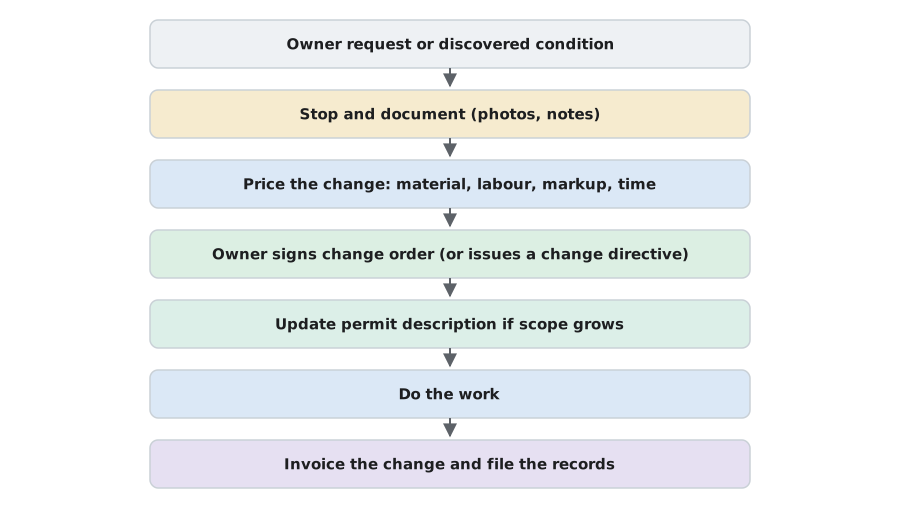
Concealed or changed conditions deserve special care in renovation work. At Aspen Ridge, Tyler opens a wall and finds an old splice buried without a box. The quote said concealed conditions were excluded. Gord stops the work in that wall, photographs the condition, explains it to the homeowner, and prices the correction as an extra before doing it. The splice must be fixed for the installation to comply, but who pays for it is a contract question, and the answer is in the quote.
Change orders
A change order is a written agreement to change the contract: the scope, the price, the time, or all three. Changes are normal. Owners change their minds, designs have errors, and site conditions differ from the drawings. What matters is that each change is documented before or as it happens, with an agreed price or an agreed method of pricing. Standard form contracts usually distinguish between a change order, which both parties sign, and a change directive, which the owner issues to make the contractor proceed while the price is still being settled.
Contractors lose money on changes in three predictable ways: doing extra work on a verbal request and never getting paid, pricing changes without including the time and disruption they cause, and missing the contract's deadline for submitting claims. Priya's rule from now on is no change without paper. Even a text message from the owner confirming the change is better than nothing, but the contract's change procedure should be followed whenever it exists.
Worked problem
Pricing a change on the Hartley Farms job
The farm owner asks Parkland Valley to add two 20 A, 120 V receptacle circuits and a 30 A, 240 V welder receptacle in the shop. Material is 640 dollars, labour is 11 hours at 88 dollars, and the contract allows overhead and profit on changes of 15 dollars per 100 dollars of cost combined. The change adds one day to the schedule.
Show solution
- Labour: 11 x 88 = 968 dollars.
- Direct cost: 640 + 968 = 1,608 dollars.
- Overhead and profit at 15 per 100: 1,608 x 0.15 = 241.20 dollars.
- Change order price: 1,608 + 241.20 = 1,849.20 dollars before tax, plus one day added to the completion date.
- Send the change order with the scope, price and time, and do not start until it is signed or a directive is issued.
Answer: A signed change order for 1,849.20 dollars plus tax and one day, with the permit description updated if needed.
Warranties and deficiencies
Most contracts include a warranty period during which the contractor must correct defects at its own cost. In CCDC 2 the standard warranty period is one year from substantial performance, though owners often extend it for specific equipment. Manufacturers' warranties on equipment are separate and are usually passed through to the owner. In addition to contractual warranties, the law may imply warranties of good workmanship and suitable materials, and consumer protection laws add rights for homeowners.
Deficiencies at the end of a job are listed in a deficiency list, sometimes called a punch list, after an inspection by the owner or consultant. The contractor corrects them and requests sign-off. Keeping the list short starts on day one: following the drawings, documenting changes, testing as you go and cleaning up. At Riverbend Condos, Parkland Valley's deficiency list for the EV charger retrofit had two items, both labelling, because Priya's crew labelled and tested each circuit as it was installed.
Closing the contract
A contract is closed when the work is complete, deficiencies are corrected, the permit is closed, records and manuals are handed over, final payment and holdback are released, and any warranty obligations are tracked. Lesson 4 covers payment, holdback and liens in detail. Lesson 10 covers records. For now, the key point is that closing the contract is a sequence of documents, and the contractor that keeps those documents organized gets paid sooner.
Common mistakes
MistakeQuoting from a vague scope such as wire the basement.
InsteadTie the price to named drawings, a list of inclusions and a list of exclusions.
MistakeConfusing markup on cost with margin on price.
InsteadA given markup on cost always gives a smaller margin on price; calculate both.
MistakeDoing extra work on a verbal request.
InsteadFollow the change procedure and get written approval or a directive first.
MistakeMissing written notice deadlines for delays and claims.
InsteadRead the notice clauses and calendar their deadlines at contract signing.
MistakeAssuming a bid can be withdrawn after the tender closes.
InsteadA formal tender can bind the bidder during the acceptance period.
Summary and key terms
- An estimate is internal cost; a quote is the offered price with its conditions.
- Formal tenders can create a preliminary contract that binds bidders and owners.
- Standard form contracts such as CCDC 2 allocate risk; supplementary conditions change it.
- Scope, exclusions, schedule and notice clauses decide most disputes.
- Change orders must be documented with scope, price and time before the work is done.
- Estimate
- The contractor's internal calculation of the cost of a job.
- Quote
- The price offered to the customer with its scope, exclusions and conditions.
- Markup
- An amount added to cost, expressed as a fraction of cost.
- Change order
- A written, agreed change to the contract scope, price or time.
- Liquidated damages
- A fixed amount per day the contractor pays for late completion, agreed in the contract.
Practice problems
Work each problem on paper first, then reveal the answer to check.
A job costs 10,000 dollars and is marked up by 20 per 100 of cost. What is the price and the margin?
Show answer
Price 12,000 dollars; margin 2,000 / 12,000, about 16.7 per 100 of price.
What are Contract A and Contract B in a formal tender?
Show answer
Contract A is the preliminary contract formed by a compliant bid; Contract B is the construction contract formed when a bid is accepted.
Why are exclusions important in a quote?
Show answer
They define what is not in the price, so extras can be charged and disputes avoided.
What is the difference between a change order and a change directive?
Show answer
A change order is signed by both parties with an agreed price; a directive instructs the contractor to proceed while price is still being settled.
What is the standard warranty period in CCDC 2?
Show answer
One year from substantial performance, unless the contract extends it.
Lesson quiz · 5 questions
Score 60% or more to complete this lesson.
Create a free account to save your progress, take quizzes and earn a certificate.