
MELC-105 · Lesson 9 of 12 · 23 min
Generators and transfer equipment
▶ Video coming soon A video version of this lesson is on the way.
Rural Alberta loses power often enough that every farm has an opinion about generators. Some farms have a permanently installed standby unit that starts on its own; many have a tractor-driven generator on a power take-off shaft, wheeled up to the shop when the lines go down in a storm; and nearly every farm has a small portable generator in the shed. All of these can be connected to a building's wiring safely, and all of them can kill a utility line worker if they are connected wrongly. The rules about generators and transfer equipment are about getting that connection right: preventing backfeed, sizing the generator and its conductors, protecting the generator, and grounding the system in the way that suits the transfer equipment.
This lesson covers the kinds of generator installations, transfer switches and the different ways they handle the neutral, the requirement to prevent interconnection with the utility unless an approved interconnection is made, generator sizing including motor starting, conductors and protection from the generator, grounding and bonding of generator systems, and portable and power take-off generators. The examples are Hartley Farms' new standby generator for the grain dryer and the farmhouse, and the PTO generator the Hartleys already own. As always, Code text is not reproduced; check the rules in your own 2024 CE Code and in CSA C282 where it applies.
Emergency, legally required and optional standby
Generators serve different purposes, and the purpose decides which rules apply. Emergency generators supply life safety loads required by the building code, such as emergency lighting, fire alarm and fire pumps in some buildings, and the essential electrical system of a hospital. These are installed to CSA C282, with requirements for automatic starting, fuel supply, testing and maintenance, and they fall under Section 46 for the emergency systems they feed. Optional standby generators, like the one at Hartley Farms, are chosen by the owner to keep a business or a home running during an outage; they must still be installed safely and must not backfeed the utility, but the life safety rules do not apply to them.
On an exam, the first question to ask is which kind of generator is described. A question about a hospital generator's transfer time or a high-rise's emergency generator is pointing at Section 46 and CSA C282; a question about a farm or a house points at the general rules on interconnection, transfer switches and grounding. Priya's lookup sheet starts the generator line with that question.
| Purpose | Required by | Main rules (pattern) | Example |
|---|---|---|---|
| Emergency | Building code for life safety loads | Section 46 and CSA C282 | High-rise emergency generator for egress lighting and fire pumps |
| Healthcare essential system | Building code and CSA Z32 | Section 24, CSA Z32, CSA C282 | Hospital generator feeding the vital branch |
| Optional standby | Owner's choice | General rules, interconnection and transfer switch rules | Farm standby generator for the grain dryer |
| Portable | Owner's choice | Inlet, interlock or transfer switch; no backfeed | Small generator in the shed |
Preventing backfeed
The single most important generator rule is that a generator connected to a building's wiring must not be able to energize the utility's lines, unless the installation is an approved interconnection under Section 84 with the utility's agreement. If a generator is plugged into a dryer receptacle with a home-made cord, as people sometimes do in an outage, it feeds power back through the main breaker, through the service and onto the utility's transformer, which steps it up to distribution voltage. A line worker who thinks the line is dead can be electrocuted. The generator also gets destroyed when utility power returns out of phase with it.
The rules require a transfer means that makes it impossible for the generator and the utility to be connected at the same time. That can be a transfer switch, manual or automatic, or an approved interlock kit on the main panel that mechanically prevents the generator breaker and the main breaker from being on together. Generators that connect through an inlet on the building wall must feed a transfer switch or interlocked breaker, never a receptacle on a branch circuit. Exam questions about backfeed often describe a dangerous practice and ask what is required instead; the answer is always a transfer means that prevents simultaneous connection.
Transfer switches and the neutral
Transfer switches come in manual and automatic types. A manual transfer switch is operated by a person after the generator is started; an automatic transfer switch senses loss of utility voltage, signals the generator to start, waits for it to reach rated voltage and frequency, transfers the load, and transfers back after utility power has been stable for a set time. Automatic transfer is standard for emergency systems and common for farm standby systems where livestock or a drying process cannot wait for someone to drive home.
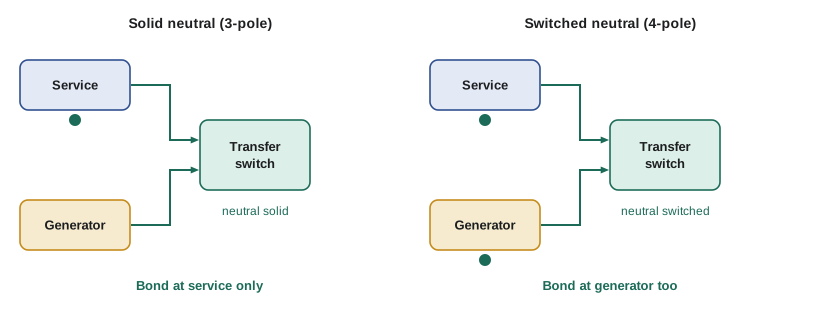
Transfer switches also differ in how they handle the neutral, and this decides how the generator is grounded. A transfer switch with a solid neutral switches only the ungrounded conductors; the generator's neutral is permanently connected to the building's neutral, so the generator is not a separately derived system and its neutral must not be bonded to its frame at the generator, because the bond is already made at the service. A transfer switch with a switched neutral opens the neutral too, so the generator is a separately derived system and its neutral is bonded to ground at the generator, with its own grounding conductor and electrode connection. Getting this wrong creates either a missing bond or a second bonding point, the same problem as the double-bonded transformer at the dental clinic. Portable generators often come with the neutral bonded to the frame, which suits a switched-neutral arrangement or use on their own receptacles, and may need the bond removed for a solid-neutral transfer switch, following the manufacturer's instructions.
Worked problem
Which way is the Hartley generator grounded?
The new standby generator at Hartley Farms feeds the farmhouse and the dryer motor control centre through an automatic transfer switch with a solid neutral. Where is the neutral bonded to ground?
Show solution
- A solid neutral means the generator's neutral is permanently tied to the service neutral.
- So the generator is not separately derived; the only neutral-to-ground bond is at the service.
- The generator's own factory bond, if fitted, must be removed as the manufacturer directs, and the generator frame is bonded through the equipment bonding conductor.
Answer: At the service only; the generator's frame is bonded but its neutral is not bonded at the generator.
Sizing the generator
A generator must be large enough for the load it will carry and for the inrush when motors start. The running load can be found from the demand calculations of Section 8 or, for an existing building, from metered demand, limited to the loads the owner wants on generator. Motor starting is usually the limit. When a large motor starts across the line, it draws its locked-rotor kVA, which can be five or six times its running kVA, and a generator has a much higher internal impedance than the utility's transformer, so its voltage dips sharply. If the dip is too deep, other loads drop out and the motor may not start. Generator manufacturers publish the voltage dip for a given starting kVA, and designers size the generator so that the largest motor starts with an acceptable dip, starting motors in sequence where possible.
Worked problem
Can the generator start the dryer fan? (illustrative values)
The Hartley standby generator is rated 100 kW at 600 V three-phase. The 30 hp dryer fan, started across the line, has a locked-rotor demand of about 200 kVA. Suppose the generator's data sheet shows a 30% voltage dip for 200 kVA of starting load and the farm wants no more than 15%. What are the options?
Show solution
- Across-the-line starting gives a dip twice the acceptable value.
- A soft starter or the fan's drive reduces the starting kVA, perhaps by half or more, bringing the dip within the limit.
- Starting the fan after the generator is carrying its other loads keeps the sequence predictable.
Answer: Start the fan through its drive or a soft starter; the generator alone cannot start it across the line within the dip limit.
The fan already runs on a drive since the expansion, so the generator sizing works. Priya notes that this is another reason drives are common on farms: they make generator backup practical without a much larger generator.
Conductors and protection from the generator
The conductors from the generator terminals to the first overcurrent device must have an ampacity related to the generator's rated output, as the rules set, because a generator can deliver its rated current continuously and somewhat more for short periods. The generator itself must be protected against overload, usually by a breaker mounted on the generator or by the generator's controller, sized from its rated current. On larger generators, the controller also protects against overspeed, low oil pressure, high coolant temperature and other engine faults. Look up the conductor multiplier in your Code; the example uses an illustrative value.
Worked problem
Generator output conductors (illustrative multiplier)
The 100 kW, 600 V three-phase generator runs at unity power factor for this example. Find its rated current, and the minimum conductor ampacity using an illustrative multiplier of 115%.
Show solution
- Rated current = 100 000 / (1.732 × 600) = 96.2 A.
- Minimum ampacity = 1.15 × 96.2 = 110.6 A (illustrative multiplier).
Answer: Rated current about 96 A; about 111 A of conductor ampacity with the illustrative multiplier.
Generators are usually rated in kW at 0.8 power factor, so the kVA rating is higher than the kW rating, and rated current is found from kVA. A 100 kW generator at 0.8 power factor is a 125 kVA machine with a rated current of about 120 A at 600 V. Exam questions sometimes give the kW and power factor and expect you to find the kVA first, the same trap as in the capacitor lesson.
Portable and power take-off generators
Portable generators connect to a building through a power inlet box mounted on the outside wall, a cord rated for the generator's output, and a transfer switch or interlocked generator breaker inside. The inlet must be of a type approved for the purpose, and the cord's plug and connector must match the generator's receptacle. The rules prohibit connecting a generator through a branch circuit receptacle, and they require the transfer means to be identified. For small loads, many people simply run extension cords from the generator's own receptacles to individual appliances, which avoids interconnection entirely but limits what can be powered.
Tractor power take-off generators are a farm staple. The tractor's PTO turns the generator at a set speed, typically 540 or 1000 r/min, through a gearbox, and the generator's output feeds the farm through a manual transfer switch at the main service or at the shop. The governor is the tractor's engine, so the voltage and frequency depend on the operator holding the right engine speed, and the generator's meter must be watched as loads change. The Hartleys' 45 kW PTO generator feeds the farmhouse and shop through a manual double-throw transfer switch at the yard pole; the new standby unit takes over the dryer and house, and the PTO unit stays as a backup for the shop and the cattle waterers.
A generator worksheet
import math

def rated_current(kw, pf, volts, phases=3):
    kva = kw / pf
    k = math.sqrt(3) if phases == 3 else 1
    return kva, kva * 1000 / (k * volts)

for kw, pf in [(100, 1.0), (100, 0.8), (45, 0.8)]:
    kva, amps = rated_current(kw, pf, 600)
print(f'{kw} kW at pf {pf}: {kva:.1f} kVA, {amps:.1f} A at 600 V, conductors >= {1.15 * amps:.1f} A (illustrative 115%)')100 kW at pf 1.0: 100.0 kVA, 96.2 A at 600 V, conductors >= 110.7 A (illustrative 115%) 100 kW at pf 0.8: 125.0 kVA, 120.3 A at 600 V, conductors >= 138.3 A (illustrative 115%) 45 kW at pf 0.8: 56.2 kVA, 54.1 A at 600 V, conductors >= 62.2 A (illustrative 115%)
Common mistakes
MistakeConnecting a generator through a branch-circuit receptacle.
InsteadUse an inlet and a transfer switch or approved interlock; never backfeed through a receptacle.
MistakeBonding the generator neutral at the generator with a solid-neutral transfer switch.
InsteadWith a solid neutral, bond only at the service; the generator is not separately derived.
MistakeSizing a generator from running load only.
InsteadCheck motor starting kVA and the allowable voltage dip.
MistakeFinding rated current from kW when the power factor is 0.8.
InsteadConvert to kVA first: kVA = kW / pf.
MistakeApplying life safety rules to an optional standby generator, or the reverse.
InsteadIdentify the generator's purpose first; it decides which rules apply.
Summary and key terms
- Generators are emergency, healthcare essential, optional standby or portable; the purpose decides the rules.
- A transfer switch or approved interlock must prevent the generator and the utility from being connected together, unless an approved interconnection is made.
- Solid-neutral transfer switches mean the generator is not separately derived; switched-neutral switches make it separately derived and bonded at the generator.
- Generator sizing depends on running load and motor starting kVA; drives and soft starters reduce starting demand.
- Output conductors and generator protection are sized from rated current; portable and PTO generators connect through inlets and transfer means.
- Backfeed
- Power flowing from a customer's generator onto the utility's lines.
- Transfer switch
- A device that connects a load to either the normal supply or an alternate supply, but not both.
- Solid neutral
- A transfer arrangement in which the neutral is not switched.
- Locked-rotor kVA
- The apparent power a motor draws at standstill when started across the line.
- Power take-off generator
- A generator driven by a tractor's power take-off shaft.
Practice problems
Work each problem on paper first, then reveal the answer to check.
80 kW at 0.8 pf: kVA?
Show answer
100 kVA.
With a solid-neutral transfer switch, where is the neutral bonded?
Show answer
At the service only.
What prevents backfeed with a portable generator?
Show answer
An inlet feeding a transfer switch or approved interlock.
Why does a drive help generator sizing?
Show answer
It reduces the motor's starting kVA, so the voltage dip is smaller.
Lesson quiz · 5 questions
Score 60% or more to complete this lesson.
Create a free account to save your progress, take quizzes and earn a certificate.