
MELC-105 · Lesson 6 of 12 · 22 min
Fire alarm and emergency systems
▶ Video coming soon A video version of this lesson is on the way.
Fire alarm and emergency systems are life safety systems: when they are needed, the building is already in trouble, and they have to work. That is why the Code treats them differently from ordinary branch circuits. Their supply must be reliable and protected from casual interruption, their wiring must survive long enough to do its job, and their installation is tied to the National Building Code, to fire codes and to ULC standards that the Code references. Master exams test the electrical side of this: how the circuits are supplied, protected and wired, how emergency lighting and exit signs are powered, and how fire pumps break the normal motor rules.
This lesson covers Section 32 (fire alarm systems, smoke and carbon monoxide alarms and fire pumps) and Section 46 (emergency systems, unit equipment and exit signs), and how they connect to the building code and the ULC installation and verification standards. The example is the Gaetz Avenue dental clinic, which needs a fire alarm connection to the building's system, emergency lighting and exit signs, and the Riverbend Condos building, which has a fire pump. Code text is not reproduced; check the rules in your own 2024 CE Code and in the building code adopted in your province.
Who decides what is required
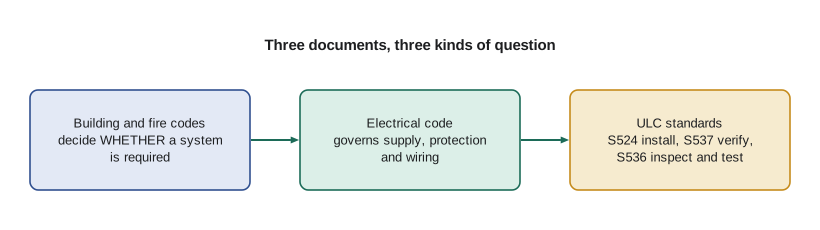
The electrical code does not decide whether a building needs a fire alarm system, emergency lighting or a fire pump. The building code and fire code do, based on occupancy, size and height. The electrical code then says how the electrical parts must be installed. Exams sometimes test this division: a question asking whether a small office needs emergency lighting is a building code question, and the right answer is usually that the building code determines it, while a question about how emergency lighting circuits are supplied and protected is an electrical code question with a specific rule behind it. Priya's lookup sheet has a line reminding her which document answers which kind of question.
The ULC standards matter too. CAN/ULC-S524 covers the installation of fire alarm systems, CAN/ULC-S537 covers their verification after installation, and CAN/ULC-S536 covers inspection and testing of existing systems. The building code requires fire alarm systems to be installed and verified to these standards, and the electrical code's Section 32 works alongside them. A fire alarm verification is done by a qualified technician who tests every device and reports to the owner; the electrical contractor does not sign it off alone.
Supplying a fire alarm system
A fire alarm control unit needs a reliable normal supply and a standby supply, usually batteries in the control unit or an emergency generator, sized to run the system for a stated time and then sound the alarm for a stated period. The normal supply generally comes from a dedicated branch circuit that serves nothing else, so that an overload or a fault on another load cannot take the fire alarm out. The breaker for that circuit must be protected from being switched off casually, which the rules achieve by requiring a locking device or other means, and by requiring the breaker and panel to be identified, commonly in red. Where the rules allow the fire alarm supply on the line side of the service disconnect or from a separate service, the conditions are detailed and exam-worthy.
At the dental clinic, the building's base fire alarm system already exists; the clinic adds devices that connect to it through the building's fire alarm contractor. Parkland Valley's job is to provide raceways, boxes and a supply for a sub-panel of the fire alarm system where the fire alarm contractor's drawings call for one. Priya checks that the supply comes from a dedicated circuit with a lockable, identified breaker, and that the fire alarm contractor has the verification scheduled before occupancy.
| Requirement (summarised) | Purpose | What Priya checks on site |
|---|---|---|
| Dedicated branch circuit | Nothing else can trip or overload it | Circuit directory and the panel schedule |
| Locking device on the breaker | Prevents casual switching off | A breaker lock or handle guard is installed |
| Identification in red | Makes the circuit recognizable | Panel and breaker marking |
| Standby power | Keeps the system alive during an outage | Batteries or generator, sized by the fire alarm designer |
| Wiring methods and circuit integrity | Circuits survive long enough during a fire | Cable types and routing on the drawings |
Fire alarm wiring
Fire alarm circuits include initiating circuits for detectors and pull stations, notification circuits for horns and strobes, and data or signalling circuits between control units and annunciators. Section 32 sets the conductor types and minimum sizes, wiring methods and separation from other systems. Fire alarm conductors must not share raceways, boxes or cables with other systems except where the rules allow. Circuits that must keep working during a fire in another part of the building, such as risers in high buildings, may need fire-rated cable or protection by construction, as the building code requires. Supervision means that the control unit monitors each circuit and reports trouble if a wire is cut or shorted; the wiring must be installed so that supervision works, which usually means no T-taps on circuits designed for end-of-line supervision.
Tyler asks why the fire alarm technician gets so upset about a missing end-of-line resistor. Denise explains that without it the control unit cannot tell an open circuit from a normal one, so a cut wire would go unnoticed until the alarm failed to sound. The electrician who pulls the wire is not responsible for the resistor, but is responsible for wiring the circuit in the pattern the drawings show.
Smoke and carbon monoxide alarms in dwellings
Smoke alarms and carbon monoxide alarms in dwellings are different from fire alarm systems: they are self-contained devices, required by the building code, and the electrical code covers how they are connected. Smoke alarms in new dwellings must be permanently connected to a branch circuit, interconnected so that one sounding sets off the others, and often have battery backup as the building code requires. The rules say which circuit they can be on and that there must be no disconnecting switch between the alarm and the overcurrent device, so they cannot be switched off with a light switch. A favourite exam question asks whether a smoke alarm can be on a lighting circuit, and the answer turns on the rule's conditions and any GFCI or AFCI protection that might interrupt it.
At the Aspen Ridge bungalow with its new secondary suite, the building code requires smoke alarms in both units, interconnected within each unit and, depending on the code's provisions for secondary suites, between units. Carbon monoxide alarms are required where there is a fuel-burning appliance or an attached garage. Priya plans the circuits so that the suite's alarms are fed from the suite's panel, interconnected as required, and not controlled by any switch.
Emergency systems and unit equipment
Section 46 covers emergency lighting and other emergency systems supplied from a source other than the normal supply. There are two broad approaches. Central systems use a battery bank or an emergency generator to feed emergency lighting circuits throughout the building through transfer equipment. Unit equipment uses self-contained battery packs, each with its own charger and lamps or remote heads, connected to the normal lighting circuit for the area it serves. Unit equipment is common in small commercial buildings like the dental clinic; central systems are common in larger buildings.
For unit equipment, the rules require it to be supplied from the same branch circuit as the normal lighting in the area, so that if that circuit fails, the unit comes on. Connection by a cord and plug is allowed only under conditions, and the receptacle must not be controlled by a switch. Emergency lighting circuits from a central system must be kept separate from other wiring and protected so that a fault elsewhere does not take them out. The building code sets how much light is needed on egress routes and for how long the emergency source must supply it.
Worked problem
Battery capacity for unit equipment (illustrative values)
A unit equipment pack at the dental clinic powers two remote heads of 9 W each and its own two 9 W heads from a 12 V battery. Suppose the building code requires 30 minutes of operation. What battery capacity in ampere-hours is needed, ignoring losses and ageing?
Show solution
- Total load: 4 × 9 = 36 W.
- Current at 12 V: 36 / 12 = 3 A.
- Capacity: 3 A × 0.5 h = 1.5 Ah before allowances for ageing and temperature.
Answer: At least 1.5 Ah; real designs add a margin for battery ageing and cold.
Voltage drop on remote heads matters too. A long run of small conductors from a 12 V pack to a remote head can lose enough voltage that the head is dim, and the building code's illumination requirement is not met. Manufacturers give maximum run lengths by wire size, and exams sometimes ask for a voltage drop calculation on a low-voltage DC circuit using the method from MELC-102.
Exit signs
Exit signs are required by the building code, which since the 2010 edition has called for the green running-figure pictogram rather than the old red EXIT lettering. The electrical code covers their supply: exit signs must be continuously lit, supplied from the emergency source when the normal supply fails, and connected so that they cannot be switched off with the area lighting. Most modern exit signs have an internal battery and are fed from an unswitched branch circuit; some are fed from a central emergency system. Photoluminescent signs, which glow without power after being charged by light, are permitted by the building code in some situations and need no electrical supply at all.
Fire pumps break the motor rules
A fire pump supplies water to sprinklers or standpipes during a fire, and the design priority reverses: protecting the motor matters less than keeping the pump running. A burned-out pump motor after a fire is an acceptable loss if the building was saved. So the rules for fire pumps in Section 32 differ from Section 28 in deliberate ways. The supply must be reliable and arranged so that it is not interrupted by the building's other loads, often a connection ahead of the service disconnect or a separate service, and the conductors and protective devices are sized so that the motor's locked-rotor current can flow indefinitely without opening the protection. Overload protection that would trip the motor is not used on the supply, and the fire pump controller is a listed unit designed for the purpose.
Fire pump conductors may need protection from fire, such as burial in concrete or fire-rated cable, so that they keep working during the fire. The conductors are also sized for voltage drop at starting, so that the motor can start and the controller does not drop out. An exam question that describes a fire pump with ordinary motor protection is testing whether you know these exceptions. At Riverbend Condos, the fire pump has its own service tap ahead of the main disconnect, with the conductors in a concrete-encased raceway and a listed fire pump controller; Priya sees it during a site visit for the EV charger job and notes it as an example for her study group.
Worked problem
Why ordinary motor protection is wrong for a fire pump
A fire pump motor has a full-load current of 65 A and a locked-rotor current of about 390 A. An ordinary motor circuit would be protected by a device that clears locked-rotor current within seconds. Why is that unacceptable here?
Show solution
- If the pump jams or stalls during a fire, ordinary protection would open and stop the pump.
- The fire pump rules require protection that carries locked-rotor current indefinitely, so the pump keeps trying to run.
Answer: Keeping water flowing to the sprinklers takes priority over protecting the motor.
A life safety checklist
# Emergency battery sizing check (values illustrative).
heads_w = [9, 9, 9, 9]           # lamp heads on one unit
battery_v = 12
minutes_required = 30            # set by the building code for this building
margin = 1.25                    # allowance for ageing and temperature (designer's choice)

load_w = sum(heads_w)
amps = load_w / battery_v
ah = amps * minutes_required / 60 * margin
print('load', load_w, 'W current', round(amps, 2), 'A capacity needed', round(ah, 2), 'Ah')load 36 W current 3.0 A capacity needed 1.88 Ah
Common mistakes
MistakePutting a fire alarm control unit on a shared receptacle circuit.
InsteadUse a dedicated branch circuit with a locked, identified breaker.
MistakeTreating smoke alarms like a fire alarm system.
InsteadDwelling smoke alarms are self-contained devices with their own connection rules.
MistakeFeeding unit equipment from a different circuit than the area lighting.
InsteadUnit equipment must come on when the area's normal lighting circuit fails.
MistakeApplying ordinary motor overload protection to a fire pump.
InsteadFire pump protection must carry locked-rotor current indefinitely.
MistakeAnswering a building code question from the electrical code.
InsteadThe building code decides what is required; the electrical code decides how it is installed.
Summary and key terms
- The building and fire codes decide what life safety systems are required; the electrical code governs supply, protection and wiring.
- Fire alarm systems need a dedicated, locked and identified supply, standby power, supervised circuits and verification to CAN/ULC-S537.
- Dwelling smoke and CO alarms are permanently connected, interconnected and not switch-controlled.
- Emergency lighting uses central systems or unit equipment fed from the area's normal lighting circuit; exit signs stay lit and switch to emergency power.
- Fire pumps reverse the motor rules: reliable supply, protection that carries locked-rotor current, and fire-protected conductors.
- Unit equipment
- A self-contained emergency lighting unit with its own battery, charger and lamps.
- Supervision
- Monitoring of fire alarm circuits so that a break or short is reported as trouble.
- Verification
- Testing of a newly installed fire alarm system to CAN/ULC-S537.
- Fire pump controller
- A listed controller designed to start and run a fire pump under fire conditions.
- Standby power
- A source, such as batteries or a generator, that supplies a system when the normal supply fails.
Practice problems
Work each problem on paper first, then reveal the answer to check.
Who decides whether a building needs emergency lighting?
Show answer
The building code.
Unit equipment with 30 W of heads at 6 V for 60 minutes: minimum Ah?
Show answer
30 / 6 × 1 = 5 Ah, plus margin.
Why are fire alarm breakers locked?
Show answer
To prevent casual switching off of a life safety system.
What sizes fire pump protection?
Show answer
It must carry the motor's locked-rotor current indefinitely.
Lesson quiz · 5 questions
Score 60% or more to complete this lesson.
Create a free account to save your progress, take quizzes and earn a certificate.