
MELC-105 · Lesson 1 of 12 · 27 min
Motor circuits under Section 28
▶ Video coming soon A video version of this lesson is on the way.
MELC-102 taught the arithmetic of a motor branch circuit: the 125% conductor rule, the feeder rule, the overload multipliers and the disconnect rating. This course goes back into Section 28 itself, because master and contractor exams test far more than the arithmetic. They ask where a disconnect has to be, what counts as a controller, when a motor needs its own branch circuit, which rules change for a motor on a drive, and what happens when several motors share one set of conductors. The questions are short, but each one turns on a specific rule, and the only way to answer quickly is to know how Section 28 is laid out.
This lesson walks through the structure of Section 28, the definitions that drive it, the general requirements for every motor installation, and the rules for conductors in the situations exams like: several motors, motors with other loads, wound-rotor and multi-speed motors, and motors fed by tap conductors. The running example is the grain-drying expansion at Hartley Farms, where Parkland Valley Electric is adding a second dryer, three augers and a new motor control centre. As in every MELC course, no Code text or tables are reproduced: rules are cited by number and explained in plain words, and every value that would come from a Code table is labelled illustrative. Check every rule in your own 2024 CE Code and your provincial amendments.
How Section 28 is organized
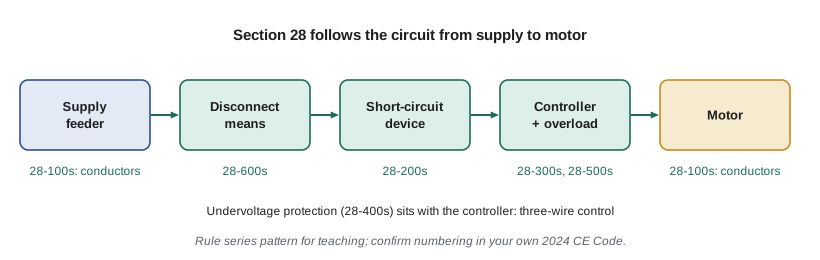
Section 28 is a supplementary section, so it amends and adds to the general sections rather than replacing them. Everything in Sections 0 to 16 still applies to a motor installation unless Section 28 says otherwise. The section is divided into subsections that follow the parts of a motor circuit from the supply to the motor: general requirements and conductors first, then overcurrent protection, then overload and overheating protection, then undervoltage protection, then disconnecting means, then controllers and control circuits, and finally special motors and equipment such as fire pumps and motors over 750 V. The rule numbers jump in hundreds between subsections, so 28-100 series rules are about conductors, 28-200 series about overcurrent protection, 28-300 series about overload protection, 28-400 series about undervoltage, 28-500 series about controllers and 28-600 series about disconnecting means. Check the exact grouping in your edition; the pattern is what makes the section easy to tab.
| Rule series (pattern) | Topic | Typical exam question |
|---|---|---|
| 28-000s and 28-100s | Scope, general requirements, conductors | Minimum conductor ampacity for one motor or several |
| 28-200s | Short-circuit and ground fault protection | Maximum fuse or breaker rating for a motor or feeder |
| 28-300s | Overload and overheating protection | Maximum overload setting for a given nameplate current |
| 28-400s | Undervoltage protection | When automatic restart after a power failure is allowed |
| 28-500s | Controllers and control circuits | What a controller must be able to do and how control circuits are protected |
| 28-600s | Disconnecting means | Location, rating and type of the motor disconnect |
| 28-700s and up | Special equipment: fire pumps, motors over 750 V, adjustable-speed drives | Rules that differ from the normal motor rules |
The definitions that drive the section
Denise's rule for the study group is to read the definitions inside every rule before reading the rule again, and Section 28 is where that habit pays off. Several words have meanings in the Code that differ from shop usage. A controller is any device that starts and stops the motor in normal operation, which includes a magnetic starter, a manual motor starter, a drive and, for small motors, a plain switch or even an attachment plug. A disconnecting means is the device that isolates the motor and controller from the supply for maintenance, and it is not necessarily the same device as the controller. Overload protection protects against running overcurrent, while overcurrent protection in the Code's sense of the 200 series protects against short circuits and ground faults. Full-load current, when the rules say it, means the value from the Code's tables unless the rule specifically says nameplate.
Some definitions are in Section 0 and some are at the start of Section 28. The duty classifications matter too: continuous duty, short-time duty, intermittent duty, periodic duty and varying duty. Most motors on exams are continuous duty, but a question about a hoist, a crane, a dock leveller or a valve operator is testing whether you notice that the conductor multiplier changes with the duty. The Code gives a table of multipliers for non-continuous duty; look it up and note it on your lookup sheet. Marcus, who spent years on oil sands shutdowns, laughs that he has wired hundreds of motors and never once thought about duty cycle until the study group made him.
General requirements for every motor
Before any calculation, Section 28 sets out general requirements that apply to every motor installation. Motors must be installed so that they get adequate ventilation and so that maintenance is possible, which in practice means working space in front of controllers and access to the motor itself. Motors in locations where combustible material, dust or flyings could collect need the right enclosure. Exposed live parts of motors and controllers must be guarded, usually by the enclosure itself. The motor frame must be bonded to ground under Section 10, which MELC-104 covers. Terminal housings must be large enough for the conductors and connections, and the Code gives minimum sizes; on an exam, that is a lookup.
A requirement that surprises residential electricians is that each motor generally needs to be supplied by its own branch circuit unless the rules for several motors on one circuit are met. The Code allows several small motors on one branch circuit under specific conditions, for example where each motor is small and has its own overload protection, or where the combination is a factory-assembled unit with its own protection. These conditions are exam material. Write the rule number on your lookup sheet with the conditions summarised in your own words.
Worked problem
Can the three small augers share one branch circuit?
At Hartley Farms, three 1 hp, 230 V single-phase sweep augers in the new bin are fed from one 20 A branch circuit in the original design. Priya needs to check whether that is allowed.
Show solution
- Find the rule allowing several motors on one branch circuit and read its conditions.
- Check each condition against the design: motor size limits, whether each motor has its own overload protection, and whether the branch circuit protection is suitable for the smallest conductor and overload device.
- If any condition fails, each auger needs its own branch circuit or the protection needs to change.
Answer: It depends on the conditions in the rule; Priya documents each one and the auger starters are specified with individual overload relays so the shared circuit complies.
Conductors for one motor and for several
MELC-102 covered the main conductor rules: at least 125% of the table full-load current for a single continuous-duty motor, and 125% of the largest plus 100% of the others for several motors. Section 28 adds the situations that make exam questions interesting. Where a feeder supplies motors and other loads, the motor portion is calculated with the motor rule and the other loads are added according to their own rules, such as the continuous-load rules of Section 8. Where the motors cannot all run at once because of interlocks, the rules allow the feeder to be sized for the largest combination that can run together. Where a motor's duty is short-time, intermittent or periodic, the conductor multiplier comes from the duty-cycle table instead of 125%.
Worked problem
Feeder to the new motor control centre (illustrative values)
The new motor control centre at Hartley Farms supplies a 30 hp dryer fan, two 10 hp augers and a 5 hp bucket elevator at 600 V three-phase, plus a 15 kVA lighting transformer. Suppose the motor table gives illustrative full-load currents of 32 A, 11 A, 11 A and 6.1 A. The transformer's rated primary current is 14.4 A, treated as a continuous load at 125% for this example.
Show solution
- Largest motor at 125%: 1.25 × 32 = 40 A.
- Other motors at 100%: 11 + 11 + 6.1 = 28.1 A.
- Transformer at 125% (as assumed here): 1.25 × 14.4 = 18 A.
- Feeder ampacity ≥ 40 + 28.1 + 18 = 86.1 A.
Answer: At least 86.1 A with these illustrative values; Priya checks how her Code treats the transformer load before finalizing.
Wound-rotor, multi-speed and part-winding motors
Exams sometimes include a motor that is not a standard squirrel-cage machine. A wound-rotor motor has secondary conductors between the rotor and its resistor bank, and the Code sets their minimum ampacity as a share of the secondary full-load current, with different multipliers depending on whether the resistors are continuous duty or not. A multi-speed motor has a different full-load current at each speed, and the rules say which speed's current to use for conductors and which for overload protection: generally the highest full-load current for conductors and protection appropriate to each winding. A part-winding motor starts on half its windings to reduce starting current, and the rules for its protection reflect that it has two sets of windings.
None of these appear often in the field for a residential and agricultural contractor like Parkland Valley, which is exactly why candidates miss them on exams. Priya adds a row for each to her lookup sheet: motor type, which current, which multiplier, rule number. Tyler asks whether anyone still installs wound-rotor motors. Marcus says the old crushers at one plant he worked at had them, and the resistor banks glowed on cold mornings.
Tap conductors from a motor feeder
Motor control centres and long feeders often have smaller tap conductors running from the feeder to an individual motor's controller. The Code allows these taps without overcurrent protection at the feeder end under strict length and ampacity conditions, similar in spirit to the feeder tap rules in Section 14. A short tap inside the same enclosure may be allowed at a smaller ampacity than a longer tap run in conduit, and the conditions get stricter as the tap gets longer. The exam pattern is to give you a feeder size, a tap length and a tap conductor and ask whether it complies. Read the conditions carefully: the ampacity of the tap compared with the feeder's overcurrent device, the length limit, and where the tap must end.
Worked problem
A tap to the bucket elevator (conditions only)
A 6 m tap in rigid conduit runs from the motor feeder to the bucket elevator's starter. The tap ends at a starter with a fused disconnect sized for the elevator. What does Priya check?
Show solution
- The tap length against the rule's limits.
- The tap conductor's ampacity compared with the feeder overcurrent device rating, as the rule requires for that length.
- That the tap ends at a single protective device sized for the motor branch circuit.
- That the tap is protected from physical damage.
Answer: If every condition in the rule is met, the tap is allowed without protection at the feeder end.
Motors on adjustable-speed drives
A growing share of motors at farms and in buildings are supplied through variable-frequency drives. For the circuit feeding the drive, the conductors and short-circuit protection are generally based on the drive's rated input current, not the motor table current, because the drive is the load the branch circuit sees. Between the drive and the motor, the conductors are sized from the motor current, with attention to the drive's output, and the drive's electronic overload often serves as the motor's overload protection if it is listed for that purpose. Bypass contactors, which let the motor run across the line if the drive fails, bring the normal motor rules back for that path.
Drives also introduce issues that Section 28 does not fully cover but that inspectors and exams raise: harmonic currents on the supply side, which can overheat neutrals and transformers; reflected-wave voltage spikes at the motor terminals on long cable runs, which can damage motor insulation; and bearing currents. The installation instructions of the drive and motor manufacturers matter here, and Rule 2-024 requires approved equipment to be installed according to its markings and instructions, which MELC-101 covered.
Worked problem
Sizing the drive supply (illustrative values)
The 30 hp dryer fan is moved onto a drive whose nameplate input current is 36 A, while the motor's illustrative table full-load current is 32 A. Which current sets the supply conductors, and what is the minimum ampacity?
Show solution
- The supply conductors feed the drive, so use the drive's rated input current.
- Minimum ampacity: 1.25 × 36 = 45 A (assuming the rule applies 125% to the drive input current; confirm in your Code).
Answer: About 45 A, based on the drive input current rather than the motor table current.
A worked review
# Feeder for motors plus other loads (all values illustrative).
motors = {'dryer fan': 32, 'auger A': 11, 'auger B': 11, 'elevator': 6.1}
other_continuous = {'lighting transformer': 14.4}

largest = max(motors.values())
others = sum(motors.values()) - largest
motor_part = 1.25 * largest + others
other_part = sum(1.25 * a for a in other_continuous.values())
print('largest motor:', largest, 'A')
print('motor portion:', round(motor_part, 2), 'A')
print('other loads:', round(other_part, 2), 'A')
print('feeder ampacity at least', round(motor_part + other_part, 2), 'A')largest motor: 32 A motor portion: 68.1 A other loads: 18.0 A feeder ampacity at least 86.1 A
The code mirrors Priya's worksheet: identify the largest motor, apply 125% to it alone, add the others at 100%, then add other loads by their own rules. Change the values and rerun it to practise.
Common mistakes
MistakeTreating the controller and the disconnecting means as the same thing.
InsteadThey are separate functions; one device can serve both only where the rules allow.
MistakeApplying 125% to a short-time or intermittent duty motor.
InsteadUse the duty-cycle multipliers for non-continuous duty.
MistakePutting several motors on one branch circuit without checking the conditions.
InsteadSeveral motors may share a branch circuit only under the specific conditions of the rule.
MistakeSizing drive supply conductors from the motor table current.
InsteadUse the drive's rated input current for the circuit feeding the drive.
MistakeForgetting that the general sections still apply.
InsteadSection 28 amends Sections 0 to 16; everything else still applies.
Summary and key terms
- Section 28 follows the motor circuit: conductors, short-circuit protection, overload protection, undervoltage protection, controllers and disconnecting means.
- Read the definitions: controller, disconnecting means, overload and overcurrent protection, full-load current and duty classifications.
- Each motor normally needs its own branch circuit unless the conditions for several motors on one circuit are met.
- Feeders: 125% of the largest motor plus 100% of the others, plus other loads by their own rules; interlocked motors and duty cycles change the result.
- Wound-rotor, multi-speed, part-winding motors, motor taps and drives all have specific rules worth a line on your lookup sheet.
- Controller
- A device that starts and stops a motor in normal operation.
- Disconnecting means
- A device that isolates the motor and controller from the supply.
- Duty cycle
- The pattern of operation of a motor: continuous, short-time, intermittent, periodic or varying.
- Motor control centre
- An assembly of motor starters, protective devices and controls in one enclosure.
- Adjustable-speed drive
- Equipment that controls motor speed by varying the supplied frequency and voltage.
Practice problems
Work each problem on paper first, then reveal the answer to check.
Feeder supplies motors with table currents of 40, 20 and 15 A. Minimum ampacity?
Show answer
1.25 × 40 + 20 + 15 = 85 A.
Which current sizes the conductors feeding a drive?
Show answer
The drive's rated input current.
A motor's duty is intermittent. Do you use 125%?
Show answer
No; use the duty-cycle table's multiplier for that duty.
Name the rule series for overload protection.
Show answer
The 28-300 series (check your edition).
Lesson quiz · 5 questions
Score 60% or more to complete this lesson.
Create a free account to save your progress, take quizzes and earn a certificate.